Falling Towards Heaven: Trust and 2013’s ‘Gravity’ (Psalm 62)

gravity posterSpace.  It spreads across the night sky like silken drapery, but scientists and astronomers tell us that it stretches out to infinity.  There, in the cold and the dark all our “wheres” and our “whys” vanish in a silence that yawns before us like an endlessly open grave.

In 2013 the science fiction thriller Gravity captured a nation’s attention—garnering seven academy awards.   The film centers on Ryan—an astronaut played by Sandra Bullock.  A cataclysmic accident leaves her stranded above the earth with little to no hope of rescue.

But when I watched the movie for the first time (no spoilers below; I promise), I was surprised to find that the film’s true conflict lay within.  You see, Ryan had been adrift for some time.  After the tragic death of her daughter, Ryan disconnected from life, preferring instead to stay in the car and drive for hours with no particular destination or purpose.

Through Ryan’s eyes, we see that space forms the perfect backdrop from man’s fragile condition.  From the moment we are born, we are set adrift—untethered from the cord that once offered both security and sustenance.  We grow older only to be repeatedly taught—by the greatest prophets of our age—that there is no up, no real “down.”  In a postmodern world, such absolutes are merely the by-products of our perception.  And so like Ryan, we are cut free.  Cut free to inhabit a world haunted by both the memory and uncertainty that lies on either side of the horizon.

gravity lullabyIn the film, Ryan makes contact with earth for the briefest of moments—but she manages only to contact a fisherman who speaks only Russian.  As the hopelessness of her plight settles on her shoulder like a burial shroud, she makes a moving confession:

“I’m gonna die…I know, we’re all gonna die. Everybody knows that. But I’m going to die today. Funny that… you know, to know. But the thing is, is that I’m still scared. Really scared. Nobody will mourn for me, no one will pray for my soul. Will you mourn for me? Will you say a prayer for me? Or is it too late… ah, I mean I’d say one for myself but I’ve never prayed in my life. Nobody ever taught me how… nobody ever taught me how…”

As her confession ends, the camera narrows its focus to a single tear that—in the absence of gravity—floats upward.

All tears fall towards heaven.  But, I suppose you already knew that.  If it’s true that “there are no atheists in foxholes,” then it stands to reason that the extremes of life—pain, fear, panic—finally lift our eyes above the horizon of self towards the sky.

Movies like Gravity grab our attention through their blockbuster effects; they hold our attention through their ability to accurately reflect the human heart.  Good art does this.  And in the book of psalms, we find art that predates Christ by nearly a millennium—yet speaks as powerfully to the human condition as ever.

MY SOUL WAITS IN SILENCE

In Psalm 62, David writes another “trust psalm.”  As with the other psalms of this type, we don’t know precisely what David was experiencing—though some commentaries suggest he wrote this psalm during a time of political upheaval started by a political/military rival named Absalom.

But like many other psalms of trust, this song helps us understand what it’s like to “wait in silence.”  Where is God?  Why continue to pray when we feel so terrifyingly alone?

David writes:

1  For God alone my soul waits in silence; from him comes my salvation.

He alone is my rock and my salvation, my fortress; I shall not be greatly shaken.

How long will all of you attack a man to batter him, like a leaning wall, a tottering fence?

They only plan to thrust him down from his high position. They take pleasure in falsehood. They bless with their mouths, but inwardly they curse. Selah

David never allowed his circumstances to shape his view of God’s character.  Verses 3-4 reveal that David understood the full gravity of his situation—but verses 1-2 reveal that David understood that God was greater still.

David continues this in the next verses:

For God alone, O my soul, wait in silence, for my hope is from him.

He only is my rock and my salvation, my fortress; I shall not be shaken.

On God rests my salvation and my glory; my mighty rock, my refuge is God.

Trust in him at all times, O people; pour out your heart before him; God is a refuge for us. Selah

Notice that verses 5-6 are essentially a restatement of verses 1-2.  God’s character remains the basis for trust in God.  In verse 8, David’s song takes the form of an explicit command: trust in Him at all times.

Finally, David turns his focus to the contrast between man and God:

Those of low estate are but a breath; those of high estate are a delusion; in the balances they go up; they are together lighter than a breath.

10  Put no trust in extortion; set no vain hopes on robbery; if riches increase, set not your heart on them.

11 Once God has spoken; twice have I heard this: that power belongs to God, 12  and that to you, O Lord, belongs steadfast love. For you will render to a man according to his work.

The final verses of the song sound ominous: you get what’s coming to you.  God is a God of justice—David could count on this in dealing with his own enemies.  But the gospel says that God renders to Christ according to our work—so that we can receive according to Christ’s righteousness.  That changes everything.  That tells us our battles are already won.

FEELING THE FULL GRAVITY

But what about those of us who—like the astronaut Ryan—have never been taught how to pray?  And I don’t mean that we haven’t been shown, haven’t had prayer modeled for us.  I mean we will face circumstances that defy our understanding.  If a loved one is diagnosed with a debilitating and fatal illness, what should we really pray?  Do we pray for healing?  Do we pray for peace?  Do we pray for a swift and merciful end?  Once again, all tears fall toward heaven as we feel the full gravity of our ordeal.  But like David, we can trust in the power of God to work out all things for His glory.  In Romans 8, Paul tells his readers that “the Spirit helps us in our weakness. We do not know what we ought to pray for, but the Spirit himself intercedes for us through wordless groans” (Romans 8:26).  Are you facing a circumstance for which you don’t know how to pray?  Don’t worry; God does.  And as our tears fall toward heaven, so does God’s mercy fall back on us.


Unanswered Prayer and the Character of God (Psalm 27)

In yesterday’s post, we highlighted the way consumerism and greed only betray our lack of confidence in God.  Therefore, my prayers often remain unanswered because the things I want aren’t always the things that God wants.  “But,” you might protest.  “Surely not all of our unanswered prayers are rooted in greed.”  And that’s quite true.  What about when we pray for someone’s physical healing?  What about when we pray for our children’s health and success?  What about when we pray that a friend or neighbor would turn to God?  Surely we wouldn’t label such prayers as “greedy,” would we?  And wait—wasn’t it God who said that “it’s not good for man to be alone?”  So as the years tick by, is it really so selfish to pray for a spouse?

So yes, greed can often betray the true source of our comfort and hope.  But unanswered prayers might also prompt us to pause and reflect on the character of God.  Why?  Because if I have a distorted view of God, then it’s no wonder that my prayer life rings hollow and fruitless.

In one of his sermons on 1 John, Dr. Martin Lloyd Jones once observed that in times of crisis, prayer might not be our wisest course—at least not immediately.  Instead, it may be time to examine our views of God:

“…in a situation of crisis the New Testament does not immediately say, ‘Let us pray.’  It always says first, ‘Let us think, let us understand the truth, let us take a firm hold of the doctrine.’…Have we not all known something of this in our personal experience?  We have often been in difficulty and we have prayed to God to deliver us, but in the meantime we have not put something right in our lives as we should have done.  Instead of facing the trouble, and doing what we knew we should be doing, we have prayed.  I suggest that at a point like that, our duty is not to pray but to face the truth, to face the doctrine and apply it.  Then we are entitled to pray, and not until then.”  (D. Martin Lloyd Jones, Life in Christ: Studies in First John, p. 16)

I believe it was Voltaire who once said that “God made man in His own image; then man returned the favor.”  A generation or so ago, we lived in what we called the “modern” period.  Our greatest question was: “Should I believe in God or not?”  Now, we live in what’s being called the “postmodern” period.  Our greatest question is: “What kind of God should I believe in?”  Billy Corgan, the mind and voice of the band Smashing Pumpkins, finds liberation in the divorce of organized religion and personal spirituality.  “I can now have a punk rock relationship with God,” he tells one recent interviewer.  “And that’s been great.”

In short, we serve the God that best serves us.  The gospel says that truth is not contingent on our perceptions.  To know God—to really be connected to the Lord of the universe—we must stretch our minds beyond the borders of our own expectations.  Trust in God demands we see who He really is.  And when we do, our prayer life changes forever.

FAR-SIGHTEDNESS

In Psalm 27, David offers a beautiful song that describes his relationship with God.  Verse 1 serves as a kind of summary:

 1         The Lord is my light and my salvation; whom shall I fear? The Lord is the stronghold of my life; of whom shall I be afraid?

God is the source of both light and salvation.  David can be secure in knowing who God is.  This influences the way he responds to his surrounding circumstances—some of which are quite hostile:

When evildoers assail me to eat up my flesh, my adversaries and foes, it is they who stumble and fall.

Though an army encamp against me, my heart shall not fear; though war arise against me, yet I will be confident.

But notice that David doesn’t pray for deliverance.  David’s greatest desire is not a solution to his problems, but a greater vision of God:

One thing have I asked of the Lord, that will I seek after: that I may dwell in the house of the Lord all the days of my life, to gaze upon the beauty of the Lord and to inquire in his temple.

For he will hide me in his shelter in the day of trouble; he will conceal me under the cover of his tent; he will lift me high upon a rock.

And now my head shall be lifted up above my enemies all around me, and I will offer in his tent sacrifices with shouts of joy; I will sing and make melody to the Lord.

It is truly the far-sighted who see better things.  The greater our vision of God, the more our problems diminish.

BREAD AND SNAKES

David then turns his focus to a specific request.  He prays now for deliverance, but again notice that his greater joy, his greater aim, is for a larger picture of God:

Hear, O Lord, when I cry aloud; be gracious to me and answer me!

You have said,  “Seek my face.” My heart says to you, “Your face, Lord, do I seek.”

Hide not your face from me. Turn not your servant away in anger, O you who have been my help. Cast me not off; forsake me not, O God of my salvation!

10  For my father and my mother have forsaken me, but the Lord will take me in.

11 Teach me your way, O Lord, and lead me on a level path because of my enemies.

12 Give me not up to the will of my adversaries; for false witnesses have risen against me, and they breathe out violence.

13  I believe that I shall look upon the goodness of the Lord in the land of the living!

14 Wait for the Lord;  be strong, and let your heart take courage; wait for the Lord!

In the New Testament, Jesus speaks of God as a loving Father:

“Ask,  and it will be given to you; seek, and you will find; knock, and it will be opened to you. For everyone who asks receives, and the one who seeks finds, and to the one who knocks it will be opened. Or which one of you, if his son asks him for bread, will give him a stone?10 Or if he asks for a fish, will give him a serpent? 11 If you then, who are evil, know how to give good gifts to your children, how much more willyour Father who is in heaven give good things to those who ask him! (Matthew 7:7-11)

There have often been things in my life—good things—that I’ve gone to God with time and again.  Yet instead of receiving them, I find myself with an armful of “stones” and “snakes.”  What might this tell me about God’s character?  Is this some form of punishment?  Not necessarily.  It just means that those stones and snakes aren’t things I’m receiving from God.  And ultimately, Jesus’ words are more about the character of a loving Father than the specific things I receive.

The gospel tells me that God is enough—because the gospel promises that in Christ I am brought near to a loving Father.  Is God enough for you?

Is God enough when you endure years of singleness?

Is God enough when your loved one doesn’t experience healing?

Is God enough when your children turn their backs on God, or the family?

Is God enough when your marriage begins to crumble?

A scholar named Marcus J. Borg once wrote of a chaplain in a highly academic seminary—one in which students’ faith was being routinely tested.  One day a young man came into the chaplain’s office to confess: “I don’t believe in God anymore.”  “Tell me about this God you don’t believe in,” the chaplain replied.  “Because maybe I don’t believe in him either.”

If God is not enough for you, then I doubt he’s enough for me either.  I don’t mean to trivialize our problems or our requests—only to point us to the fact that our God is beyond them all.  If Christianity is false, then my only hope is to maximize my happiness while minimizing my suffering.  But if Christianity is true, then greatest joy can be found even in the worst of circumstances.

Greed and Unanswered Prayer (Psalm 16)

shop“The best things in life are free, but you can give them to the birds and the bees.   I want money…that’s what I want.”  The song “Money” finds its origins with Barrett Strong, but you and I are probably most familiar with the version performed by the Beatles.

Greed: when having enough is never enough.  We live in a world of endless consumer choice.  And with so many choices before us, we feel exhausted with having to “keep up.”  The result is that we’ve learned to live with relatively little margin—both in terms of finance as well as time.   But spiritually speaking, greed doesn’t simply reveal our lust for more; it also reveals a lack of contentment in what we have.  The poet Thoreau once wrote that “most men live lives of quiet desperation,” but the bustling of the average shopping mall, or the array of consumer products available online reveal that our desperation is anything but quiet.  And what we won’t hear above the noise, is trust.  In fact, according to social analyst Juliet B. Schor, most money is spent in trying to keep up with a fast-paced world.

“[W]hat stands out most about much of the recent spate of spending is its defensive character. Parents worry that their children need computers and degrees from good colleges to avoid being left behind in the global economy. Children, concerned about being left out in the here and now, demand shoes, clothes, and video games….Increasingly overworked, adults need stress-busting weekends, microwaves, restaurants meals, and takeout to keep up with their daily lives. But the cost of each of these conveniences adds up. (Juliet B. Schor, The Overspent American)

Consumerism becomes the means by which we weather the storms of modern life.  But the gospel says that such things will never truly satisfy you.  Jesus warns His followers not to find their treasure on earth, “where moth and rust destroy” (Matthew 6:19).  Instead we should find our contentment and satisfaction in God.

This is what David essentially says in the sixteenth Psalm.

THINGS FALL APART

Some translations may label this psalm as a “mikhtam” of David.  Like selah, the word mikhtam is a musical term whose precise meaning has been lost to the pages of history.  Like the other “trust psalms,” David indicates some sort of suffering, but he never goes into detail.  Instead, the character of God becomes the focus of the psalm, and this forms the basis for David’s trust:

Preserve me, O God, for in you I take refuge.

I say to the Lord, “You are my Lord; I have no good apart from you.”

As for the saints in the land, they are the excellent ones, in whom is all my delight.

David says that he has “no good apart from [God].”  If God is the author and creator of every earthly joy, then surely we can’t find joy and satisfaction outside His will.  Yet there are those who attempt to do exactly that.  If I look to money, wealth, and things for satisfaction, then those things become the true “gods” of my heart.  Listen to what David sings:

The sorrows of those who run after another god shall multiply; their drink offerings of blood I will not pour out or take their names on my lips.

Sorrows “multiply” when we seek comfort in things.  There’s actually a practical reason: things fall apart.  When the iPhone was first released, people waited in lines that stretched around the block.  Today I have an iPhone 3—and it’s so old that many apps no longer work.  Things break, they go obsolete, there’s always something more.

PLEASANT PLACES

Of course, this doesn’t quite address the question of unanswered prayer.  Can we still trust in a God who says “no?”  Maybe the Rolling Stones had a point: “You can’t always get what you want.”

But David’s focus remained on God:

The Lord is my chosen portion and my cup; you hold my lot.

The lines have fallen for me in pleasant places; indeed, I have a beautiful inheritance.

A friend of mine says verse 6 is one of his all-time favorites.  “The lines” refer to property lines.  In an agrarian society, the amount of your wealth was equal to the size of your property.  What David is saying is his property lines had “fallen…in pleasant places”—he’s happy with what he’s got.

Is that sour grapes?  If I pray for something—and don’t receive it—isn’t it a cop-out to try and convince myself that I’m better off without a new car, or a spouse, etc.?  Maybe.  But think about it for a second.  Think of all the things you’ve ever prayed for.  Think of all the things you prayed for and never got.  Are there things on that list that—though you wanted them badly at the time—you can now look back and realize you were better off without it?  What percentage of things are on that list that you can honestly say you’d be better off if God said “yes.”  It doesn’t have to be 0%–some requests bear repeating.  But I doubt that the number is all that high.  What might this tell us?  It tells us that for us as well, God’s boundaries have fallen in pleasant places.

ETERNAL VALUE

Finally, David looks to things of eternal value.

I bless the Lord who gives me counsel; in the night also my heart instructs me.

 8 I have set the Lord always before me; because he is at my right hand, I shall not be shaken.

Therefore my heart is glad, and my whole being rejoices; my flesh also dwells secure.

10  For you will not abandon my soul to Sheol, or let your holy one see corruption.

11  You make known to me the path of life; in your presence there is fullness of joy;at your right hand are pleasures forevermore.

If any of the wording sounds familiar, it’s because Peter and Paul would later apply verses 8-11 (esp. 10a) to the resurrection of Jesus (cf. Acts 2:25-28; 13:35-37).   Jesus’ followers can have the same confidence that we, too, will experience the resurrection of our bodies when Christ returns to restore creation.

If that’s true, it changes everything about my present.  If even the greatest enemy—death—has been defeated through Christ’s resurrection, what have I left to fear?  And if I can count on my own resurrection, what else do I really need in life to feel “complete?”  The gospel makes no promises of temporary happiness; it makes magnificent promises of lasting joy.


“The Waiting is the Hardest Part” (Psalm 4)

bufferingTom Petty had a point: “The waiting is the hardest part.”  When he recorded that song in 1981, no one could have imagined a future where waiting would be virtually eliminated.

When I was growing up, there were certain things you had to “send away” for.  And that meant filling out a small card (with a pen, no less!), attaching a stamp, putting it in the mail, and then waiting 6-8 weeks for delivery.  Fast forward to today.  I literally have a device in my pocket that lets me buy literally anything I want over the internet, and have it shipped right to my door within a span of two days—and Amazon is tinkering with robotic delivery “drones” that fly your package right to your door in 30 minutes or less.  In a culture of “apps,” we have instant everything.  Forget video rental stores; Amazon and Netflix let me stream movies right into the palm of my hand.  Communication?  I can text anyone on my contact list anytime I want.  Or tag them in a status on social media.

In his book Present Shock, NPR’s Douglas Rushkoff argues that we live in a society consumed with now:

“…we tend to exist in a distracted present, where forces on the periphery are magnified and those immediately before us are ignored…As a result, our culture becomes an entropic, static hum of everybody trying to capture the slipping moment.  Narrativity and goals are surrendered to a skewed notion of the real and immediate; the Tweet; the status update.  What we are doing at any given moment becomes all-important—which is behavioristically doomed.  For this desperate approach to time is at once flawed and narcissistic.  Which ‘now’ is important: the now I just lived or the now I’m in right now?”  (Douglas Rushkoff, Present Shock, p. 4, 6)

According to a 2012 article on Fox News, the act of communicating via texting and social media releases a brain chemical known as oxytocin—the same chemical released during such activities as sex.   In other words, from a strictly biological standpoint, we’ve intertwined our demand for now with close, intimate bonding.   It’s no wonder, then, that my impatience makes it hard for me to “be still” and “know God” (cf. Psalm 46:10).

This is why “trust” psalms become an essential part of our worship.  They remind us that the convenience of connectivity can never eclipse the satisfaction of intimacy.  In the Bible, trust psalms are a special category of “lament.”  None of these psalms tell us why the writer was feeling so stressed—we find only an unwavering devotion to God—even though it often finds expression in raw, human emotion.

In his book Out of Control, Pastor Ben Young suggests three healthy practices that help us repent of trust in self and cultivate a trust in God.  We can actually see how these three movements parallel David’s thoughts in the fourth Psalm.

MOVE AWAY FROM TECHNOLOGY

Frustration has often been defined as the distance between expectation and reality.  So if God does not immediately answer my prayers, then as the span of time increases, my prayers become increasingly frustrated and desperate.  Listen to what David writes in Psalm 4:

1 Answer me when I call, O God of my righteousness!  You have given me relief when I was in distress. Be gracious to me and hear my prayer!

O men, how long shall my honor be turned into shame? How long will you love vain words and seek after lies? Selah

In his commentary on Psalms, the ancient writer Chrysostom makes the point that God listens to me while I pray, not after I pray.  By that he meant that God is intimately involved in our lives at every given moment.  If that’s true, then why doesn’t God answer me right this second?  The Bible doesn’t really give us an answer for this—but think about it: would you really be satisfied if you knew the reason why?  All we really can draw from the pages and stories of scripture is that God operates on a timing all His own—and that demands patience and trust.

In an instant-everything world, is there not value in cultivating trust in something outside of our internet connection?  Trusting in God means having confidence that He will do what’s best—even if that means a delay in His answer, or an answer that conflicts with my expectations.

Therefore, moving away from technology helps “reset” my expectations.  Learning to set aside time to not check my email, to not scroll through social media, to not be instantly available to everyone I know—these practices help me be more fully present to the people in my life, rather than constantly being “available.”

MOVE AWAY FROM EXPECTATION

Second, David looks to God’s perfect plan of salvation.  He has confidence in his relationship to God—made possible only because of God’s loving choice:

But know that the Lord has set apart the godly for himself; the Lord hears when I call to him.

Be angry, and do not sin; ponder in your own hearts on your beds, and be silent.  Selah

Be angry?  Of course.  David knows that unmet expectation will inevitably give birth to frustration.  Anger is a part of the human condition.  But David cautions against sinful complaining.  Why?  Because my anger often reveals my idols.  If I can only feel comfortable when my life is “under control,” then I don’t trust in God; I trust in myself.  And when that control is threatened—sometimes by something as simple as being cut off in traffic!—I become angry.  I lash out.  I complain.   And when I do, my idol is revealed.  But if I trust in God, I may still become angry—but I can use that anger to remind me to repent of my idol of control and look to God as my source of hope.

This also means that we change our expectations.  In our instant-everything world, God becomes a cosmic vending machine.  He either spits out exactly what I want—or He takes my money and leaves me pounding on His chest without getting something in return.  But if I learn to sing like David, God ceases to be merely a dispenser of goods—God is my greatest good.  My trust, my confidence in God is no longer based on His blessings, but the very “light of his face” becomes the center of my world.  If my expectation is blessing, then my relationship with God becomes conditional on Him serving me.  But if my expectation is more of Him, He never disappoints.

MOVE INTO COMMUNITY

Finally, David looks to God’s goodness as the basis for his trust.

Offer right sacrifices, and put your trust in the Lord.

There are many who say, “Who will show us some good? Lift up the light of your face upon us, O Lord!”

You have put more joy in my heart than they have when their grain and wine abound.

In peace I will both lie down and sleep; for you alone, O Lord, make me dwell in safety.

The language of “right sacrifices” instantly brings to mind images of Israel’s worship.  Today, we worship in a new community called the church.  It’s easy, unfortunately, to allow church to be simply one other thing in our hectic schedule.  But if we move into community—if we invest in the people around us, then we cultivate a greater sense of trust in God.  How?  Because in community we most fully experience the joy that God promised His people.  In community we turn our focus from the distractions of the merely urgent to the joy of the truly eternal.

In his excellent book Doubt, Os Guiness writes that faith was meant to occupy the seasons of waiting.  He writes:

“Faith’s calling is to live in between times.  Faith is in transit.  It lives in an interim period.  Behind faith is the great ‘no longer.’  Ahead of it lies the great ‘not yet.’  God has spoken and God will act.  Christ has come once and Christ will come again.  We have heard the promises and we will witness the event.  However long the waiting takes, it is only the gap between the thunder and the lightning.”  (Os Guiness, Doubt, (p. 224)

Thunder and lightning.  Our summer sky crackles with reminders of God’s faithfulness, and the promise that He won’t leave His waiting children unfulfilled.

“Will God keep forgiving me?” (Psalm 139)

FacebookImagine your friends and neighbors could know your thoughts.  And I mean all of them—not just the ones you carefully edit for Twitter and Facebook.  There’s a good chance you wouldn’t want the world to know exactly what you’re thinking—yet when we stand before the God of the universe, this is exactly what happens.

In Psalm 139, we find a beautiful song about what life looks like when you stay connected with the very One who created you.  Mind you, David’s perspective was groundbreaking.  As John Goldingay observes in his commentary on Psalms, “other Middle Easter peoples [believed that] different [gods] controlled different regions or parts of the cosmos.  Israel knew that [God] controlled them all.”  And so it was unusual to find someone in David’s day who claimed to have fellowship with their own Creator:

1 O Lord, you have searched me and known me!

You know when I sit down and when I rise up; you discern my thoughts from afar.

You search out my path and my lying down and are acquainted with all my ways.

Even before a word is on my tongue, behold, O Lord you know it altogether.

You hem me in, behind and before, and lay your hand upon me.

Such knowledge is too wonderful for me; it is high; I cannot attain it.

Where shall I go from your Spirit? Or where shall I flee from your presence?

If I ascend to heaven, you are there! If I make my bed in Sheol, you are there!

If I take the wings of the morning and dwell in the uttermost parts of the sea,

10  even there your hand shall lead me, and your right hand shall hold me.

11  If I say,  “Surely the darkness shall cover me, and the light about me be night,”

12 even the darkness is not dark to you; the night is bright as the day, for darkness is as light with you.

13  For you formed my inward parts; you knitted me together in my mother’s womb.

14  I praise you, for I am fearfully and wonderfully made. Wonderful are your works; my soul knows it very well.

15 My frame was not hidden from you, when I was being made in secret, intricately woven in the depths of the earth.

16  Your eyes saw my unformed substance; in your book were written, every one of them, the days that were formed for me, when as yet there was none of them.

17  How precious to me are your thoughts, O God! How vast is the sum of them!

18 If I would count them, they are more than the sand. I awake, and I am still with you.

(Psalm 139:1-18)

Nothing is hidden from God.  Does that thrill us—or horrify us?  Maybe a little of both.  It’s wonderful to be so perfectly known, yet terrifying to think that our worst flaws might be exposed.

Christianity teaches that through God’s grace, Christ’s followers are enabled to “repent” from their sin.  To “repent” means to change our attitudes toward things that oppose God’s goodness.  And, over time, this repentance leads to a change in our behavior as well.  But wait—what about those times when we repent of something, only to turn around and repeat the same mistake?   Is this true repentance?  Will God forgive my repeat offense?

Each of us has probably asked this question at one time or another.  In yesterday’s post, we discussed God’s transformative work of sanctification.  To answer this question, it may be helpful to distinguish between what’s called positional and progressive sanctification:

Positional sanctification Progressive sanctification
Forgiveness for sin Freedom from sin
All at once Over time
“I am a child of God” “I am learning to obey my Father”

Positional sanctification means that I am forgiven from sin.  Therefore my new “position” before God is as an adopted son.   Progressive sanctification means I pursue freedom from sin.  Positional sanctification happens all at once—it’s sort of a by-product of justification.  But progressive sanctification takes a lifetime.  We only multiply our guilt—or heap it on others—when we confuse these two truths.  If I expect my progress to happen overnight, then I will inevitably feel ashamed at my repeated failures.

The gospel therefore says yes: we experience God’s forgiveness not because of the purity of our faith, but the object of our faith—Jesus.  So we can always count on God’s forgiveness for our sin.  But the question we might wish to consider is a bit different: “What stands in the way of my progress before God?”

David’s song actually concludes with words we might find helpful:

19  Oh that you would slay the wicked, O God! O men of blood, depart from me!

20  They speak against you with malicious intent; your enemies take your name in vain.

21 Do I not hate those who hate you, O Lord? And do I not loathe those who rise up against you?

22  I hate them with complete hatred; I count them my enemies.

23  Search me, O God, and know my heart! Try me and know my thoughts!

24  And see if there be any grievous way in me, and lead me in the way everlasting!

David’s words are harsh, uncompromising.  But they remind us that to be a follower of Jesus means separation from the things that oppose His character.  If I find myself unsuccessful in my progress with God, it could be that I am continuing to surround myself with things that pull me away from God and toward self.  What might this mean?  A few years ago a friend of mine was seeking out accountability.  Apparently he’d gotten a new cable TV package, and the particular deal included some equivalent of the Playboy channel.   When my friends and I asked why he didn’t simply cancel the package, he responded: “But this was the only one that included ESPN!”  It’s laughable, really, but the inconvenience and sacrifice of losing sports coverage means nothing compared to the terrible cost of pornography addiction.

AMONG THE TREES

Still, it’s discouraging when we don’t seem to be making progress in our spiritual lives.  If you struggle to overcome pornography, then there are actual biological reasons why the sin is so alluring.  And chances are, you will stumble and fall multiple times before you experience freedom.

In Mark’s gospel, Jesus heals a blind man—but listen to what happens when the blind man opens his eyes:

He looked up and said, “I see people; they look like trees walking around.” Once more Jesus put his hands on the man’s eyes. Then his eyes were opened, his sight was restored, and he saw everything clearly. (Mark 8:24-25)


Sometimes healing comes all at once; sometimes it takes stages.  Writing of his own struggle with pornography, Christian musician Kirk Franklin tells his readers that “Jesus won’t leave you among the trees.”  We can count on God to heal us—even though the end remains in the distance.

DISPLEASING HEART

Finally, what of us who continue to struggle with inward guilt?  To be “known” by God only encourages me to be all the more distant from Him and His word.  If I pray, aren’t I just being a hypocrite?  Isn’t it easier to stay away and avoid the subject, as if God is an unwanted relative?

But you see, it’s actually just the opposite.  If God knows my every detail—including my every flaw—then He knows my weaknesses better than I ever could.  You think God doesn’t know the kinds of thoughts you entertain?  You think God doesn’t know what kind of person you really are?  That’s good news, because then who better to shape us into the person we might become.  Saint Theresa of Lysieux once wrote that “If you are willing to serenely bear the trial of being displeasing to yourself, then you will be for Jesus a pleasant place of shelter.”  The gospel tells us we’re worse than we thought.  But the gospel also tells us we’re more loved than we could know.  And through God’s grace, we can allow His presence slowly move us from shame to joy.


“I can’t forgive myself” (Psalm 85)

Disqualified.  Few impacts sting like a fall from grace, and fewer still are the men who rise from them.  So it’s no wonder that we spend so much time under guilt’s haunting shadow.  As we observed earlier this week, popular psychology has divorced the subjects of guilt and shame.  If there are no moral absolutes, then what’s to feel guilty over?  I’m left only to deal with my shame.  There’s just one problem: it’ll never work.  Shame comes back to us, in pangs and waves of memory.  Reflecting on his experience before meeting Jesus, Christian author Lee Strobel writes:

“I know what it’s like to live a life of moral relativism, where every day I make fresh ethical choices based on self-interest and expediency….Yet [many] are beginning to conclude that moral anarchy isn’t all that Hugh Hefner once painted it to be….Often, there’s a free-floating sense of guilt, and inevitably there’s harm caused to oneself and others.”  (Lee Strobel, Inside the Mind of Unchurched Harry and Marry, p. 47-49)

But what about those who follow Jesus?  I often hear—from myself as much as others—that it’s hard to feel forgiven.   “I know God forgives me,” you might even be thinking.  “But I can’t forgive myself.”

You’re not alone.  None of ever truly are.  Paul—the man responsible for much of our New Testament—was simultaneously the most religious man who ever lived, yet also the most sinful.  In his letter to the Romans Paul writes:

“…I do not understand my own actions. For I do not do what I want, but I do the very thing I hate…I have the desire to do what is right, but not the ability to carry it out….I do not do the good I want, but the evil I do not want is what I keep on doing….Wretched man that I am! Who will deliver me from this body of death?” (Romans 7:18-25)

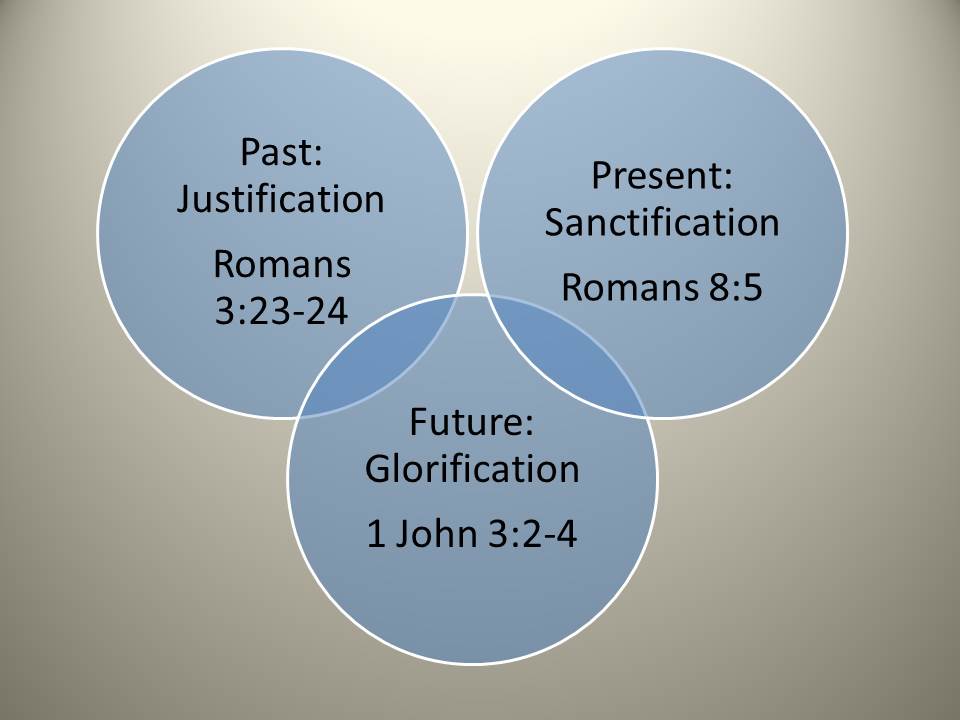
SalvationThe Christian life is indeed a journey, and our desired destination doesn’t always match the label reading “You are here.”  This is why we must understand that the Bible never defines salvation as a one-time event.  The language of “getting saved” is wholly absent from the pages of the New Testament.  Granted, I’m not suggesting that it’s less than that—such language has often been helpful when speaking to first-time believers.  But I am suggesting it’s more than that—and I believe scripture tells such a story.  Scripture tells us that salvation has both a past, present, and future component—all of which are helpful in dealing with lingering feelings of guilt.

We can actually see this in the eighty-fifth psalm.  Perhaps it’s fitting that this psalm has no specified author—it might just as well have been written by any one of us.  And ultimately, these words point us toward the salvation found in Jesus—graciously applied to all generations who seek Him.

JUSTIFICATION: “Restored, forgiven, covered”

First, salvation has a past component.

1 Lord, you were favorable to your land; you restored the fortunes of Jacob.

2 You forgave the iniquity of your people; you covered all their sin. Selah

3  You withdrew all your wrath; you turned from your hot anger.

The psalmist tells us that God was “favorable” to His people.  Look at the verbs he uses to unpack this: “restored, forgave, covered.”  There is great confidence in a God who covers over sin.

Christian theology calls this “justification,” a courtroom term that means being “declared righteous” before a judge.  The basis for this?  When Jesus died on the cross, He paid the just penalty for your sins—and my sins.  Elsewhere in Romans, Paul writes that “all have sinned and fall short of the glory of God, and are justified by his grace as a gift, through the redemption that is in Christ Jesus” (Romans 3:23-24).  And in exchange, we received His righteous reputation.  So when a holy and just God looks down at us, He no longer sees our sin, but Christ’s righteousness.

SANCTIFICATION: “Restore us again”

Second, salvation has a present component.  Listen to what the psalmist asks of God in the next collection of verses:

4  Restore us again, O God of our salvation, and put away your indignation toward us!

5  Will you be angry with us forever? Will you prolong your anger to all generations?

6  Will you not revive us again, that your people may rejoice in you?

7  Show us your steadfast love, O Lord, and grant us your salvation.

The psalmist asks that God “restore us again.”  Why?  Justification is a past event, yet as we move forward in the present we’ll experience the very sort of life Paul described above—doing what we hate, avoiding what we love.  Christian theology teaches that over time, through the Spirit’s leading, we become more like Jesus.  This is called “sanctification.”  The gospel says that I am accepted not by good works, but by Christ’s sacrifice.  If I am saved by grace, then surely I am also sanctified by grace.  How?  It’s simple: Christianity teaches that we are not loved because we are beautiful; we are beautiful because we are loved.  Because I already have God’s acceptance in Christ, I am set free to follow after Him in a lifelong pursuit of His goodness.  Will I succeed?  No—at least never entirely.  But like a young child chasing his earthly daddy, so too can we find joy in striving to be like our heavenly Father.

In Romans, Paul writes that “those who live according to the flesh set their minds on the things of the flesh, but those who live according to the Spirit set their minds on the things of the Spirit” (Romans 8:5).  The Christian life is about learning to walk in step with this Spirit.

GLORIFICATION: “righteousness and peace kiss each other”

Finally, there is a greater future for all of God’s people.  I love how the psalmist phrases it—that in God’s presence “righteousness and peace kiss each other.”  Israel looked forward to a time when God’s people would experience on earth the very blessings of heaven:

8  Let me hear what God the Lord will speak, for he will speak peace to his people, to his saints; but let them not turn back to folly.

9  Surely his salvation is near to those who fear him, that glory may dwell in our land.

10  Steadfast love and faithfulness meet; righteousness and peace kiss each other.

11  Faithfulness springs up from the ground, and righteousness looks down from the sky.

12  Yes,  the Lord will give what is good, and our land will yield its increase.

13  Righteousness will go before him and make his footsteps a way.


We see a glimpse of this in John’s gospel.  When calling His first disciples, Jesus says that “I tell all of you the solemn truth– you will see heaven opened and the angels of God ascending and descending on the Son of Man.” (John 1:51)  In his commentary on John, N.T. Wright says that it’s as if Jesus is saying, “follow me and you’ll see what it’s like when heaven and earth are open to each other.”  Heaven and earth intersect in the person of Jesus.  But heaven and earth will not become one until Christ’s future return:

Beloved, we are God’s children now, and what we will be has not yet appeared; but we know that when he appears we shall be like him, because we shall see him as he is. And everyone who thus hopes in him purifies himself as he is pure. (1 John 3:2-4)

What does this mean?  It means the struggle I experience today won’t be the struggle I experience for eternity.  Christian history is full of stories of men and women who struggled against sin in this life because they were confident that in the next life they would be “glorified”—free from all earthly suffering.  This is why eternity is so important; if this life is all we have, then the suggestion that we suppress our natural desires must seem unnatural—even cruel.  But if Christianity is true, then our present struggles will one day melt away in the presence of Jesus.

WHO’S REALLY MY SAVIOR?

Still, the guilt persists.  “I can’t forgive myself.”  But stop and examine the question.  Do we really need our own forgiveness?  When we struggle to forgive ourselves, it reveals that our truest savior is not God, but our own moral record.  Let it go.  Only when we begin to live in the light of the gospel and in step with the Spirit will we experience true and lasting freedom.  The reason the psalms become a vital part of our worship is because these things don’t happen to us over the course of a single Sunday, but a lifetime of Sundays.  But through God’s grace, this joyous song carries on into eternity.

What the church can learn from Kurt Cobain (Psalm 38)

Bono—the lead singer for the rock band U2—colorfully called David “the first blues musician.”  Music—or, more specifically, the lyrics it contains—reveals the depths and contours of the human soul like no other.  A famous philosopher once wrote that while “music is the furthest distance between two points, it is the closest distance to infinity.”

Kurt CobainI grew up in the era of grunge rock, of torn jeans, flannel shirts, and music that didn’t challenge convention as much as run it over with a truck.  In 1991, the rock band Nirvana stunned the music world with their sophomore album Nevermind.  The music was harsh, the production raw—but Kurt Cobain’s voice would shape my generation like few others would.  In many ways, Cobain’s lyrical legacy was unmatched.  While rock music of the 60s and 70s encapsulated a spirit of rebellion, rock music of the 90s turned its focus on personal feelings—both good and bad.  One analyst observed that hard rock was traditionally thought to be

“a very sort of macho genre. … But after Nevermind hit, suddenly it was cool to be in a hard rock band and to sing about your feelings—and to sing about your feelings in a complex way. Hard rock became inward-looking. You can see that influence in the nu metal bands like Korn or Slipknot. All of a sudden it was acceptable to be in a metal band and to sing about your neighbor molesting you or something. Hard rock really became cathartic as opposed to escapist.”(quoted by Tony Sclafani, “Why Nirvana’s ‘Nevermind’ Spoke to a Generation,” Today.com, September 22, 2011)

As you well know, Cobain’s inner demons were all too real.  A few years after Nevermind’s breakthrough success, he took his own life.  But his legacy would carry on into the present day.

What does this have to do with Christian worship?  Simply this: we live in a world whose inner demons have come unmasked.  You want to understand sin?  Understand inner anguish?  You have only to look as far as the radio dial, or the top 40 playlist.

So when we read the book of psalms we see something similar at work.  David is lamenting his sin, using the colorful language of poetry and song.  Watch what happens when we take one of his songs and place it side-by-side with a song by the band “Pop Evil:”

David: Psalm 38 Pop Evil: “Monster You Made”
1  O Lord, rebuke me not in your anger, nor discipline me in your wrath! 2  For your narrows have sunk into me, and your hand has come down on me. 3  There is no soundness in my flesh because of your indignation; there is no health in my bones because of my sin. 4  For my iniquities have gone over my head; like a heavy burden, they are too heavy for me.5  My wounds stink and fester because of my foolishness, 6  I am utterly bowed down and prostrate; all the day I go about mourning. 7  For my sides are filled with burning, and there is no soundness in my flesh. 8  I am feeble and crushed; I groan because of the tumult of my heart.


9  O Lord, all my longing is before you; my sighing is not hidden from you. 10  My heart throbs; my strength fails me, and the light of my eyes—it also has gone from me. 11  My friends and companions stand aloof from my plague, and my nearest kin stand far off.


12  Those who seek my life lay their snares; those who seek my hurt speak of ruin and meditate treachery all day long. 13  But I am like a deaf man; I do not hear, like a mute man who does not open his mouth. 14  I have become like a man who does not hear, and in whose mouth are no rebukes.


15  But for you, O Lord, do I wait; it is you, O Lord my God, who will answer. 16  For I said, “Only let them not rejoice over me, who boast against me when my foot slips!”


17  For I am ready to fall, and my pain is ever before me. 18  I confess my iniquity; I am sorry for my sin. 19  But my foes are vigorous, they are mighty, and many are those who hate me wrongfully. 20  Those who render me evil for good accuse me because I follow after good. 21  Do not forsake me, O Lord! O my God, be not far from me! 22  Make haste to help me, O Lord, my salvation!


Take a good look at me now
Do you still recognize me
Am I so different inside
This world is trying to change me
And I admit I don’t want to change with it
And I admit I can’t go on like this anymoreErase this monster I’ve become
Forgive me for all the damage done
It’s not over
Say it’s not over
I’m begging for mercy
I’m only the monster you made meI’m better alone now
See I’m torn from my mistakes
And I stop believing that I could ever make things change
How much can I take
When I know that it hurts you
How long can I wait
When I can’t go on like this anymore

Erase this monster I’ve become
Forgive me for all the damage done
It’s not over
Say it’s not over
I’m begging for mercy
I’m only the monster you made me

Because who I am
Isn’t who I used to be
And I’m not invincible
I’m not indestructible
I’m only human
Can’t you see
The beauty in me

Far away through the pain
I hear the angels calling
Far away through the pain
I see my demons falling


Far away through the pain
I hear the angels calling
Far away through the pain
I see my demons falling

Erase this
Erase this
Erase this monster you made me

True, the rock song lacks any specific object of hope—only a pleading for someone to “erase this monster.”  Yet ironically, in a world devoid of moral absolutes, the rock stars cry out against their own sinful consciences.

Yet sadly, as worship leader Michael Gungor observes, even though nearly 70% of the psalms are laments, less than 1% of the songs on the popular Christian worship database fit this pattern.  In other words, if you want to hear a song like David’s, you’re more likely to do so on the hard rock station than the worship station.  Worship leader Mike Cosper observes this discrepancy in his recent book, Rhythms of Grace:

“We are children of a much more sanitized era, you and I.  …The sentiment of most contemporary Christian worship is high on emotional language, heavy on the Spirit (and its accompanying imagery of flames, wind, and doves), but usually thin on (if not bereft of) the topic of bleeding birds and beasts.  We talk about the cross as a shorthand for the bloody sacrifice of Jesus, but even that is removed from the hands-on messiness of Israel’s worship.”  (Mike Cosper, Rhythms of Grace, p. 49)

I once knew of a worship leader who was fired from his job because he didn’t smile enough.  In today’s “sanitized era,” we’ve come to exchange sackcloth and ash for Colgate and hair gel.

But why would we find value in singing songs like David’s?  Who wants to come to church to sing about feeling “feeble and crushed?”  Well, more than you might think—at least if Kurt Cobain’s legacy is any indication.  We live in a hurting world.  I’m not trying to ennoble these rock stars, let alone affirm their hopelessness.  I’m suggesting that they express a sense of loneliness and hurt that can only be met through Jesus.  So I ask again, what value is there in the language of lament?  Because in the honesty of confession we find the certainty of consolation.  Musicians like Cobain did not find this consolation—but the psalms point us toward a God whose desire is to draw us nearer to Himself.  The church can—and I would suggest should—learn from this.  If we do not teach one another how to mourn—and mourn well—then who will?  The gospel promises hope to the fallen, grace to the barren, life to the lifeless.  But all of these demand an honest, unvarnished look at ourselves—for only then can we fully appreciate the contrasting beauty of the Savior.

“The Beating of that Hideous Heart” (Psalm 32)

heartEdgar Allen Poe’s “The Telltale Heart” is a classic story of paranoia, guilt, and a murder most foul.  The story is told from the narrator’s point of view, who defends his sanity all the while obsessing over the details of a murder.  Though the narrator claims to love the old man, he cannot tolerate the man’s “vulture eye” another day—and so he commits murder to rid himself of this menace.  He stashes the evidence beneath the floorboards, where he believes the matter has been put to rest.  So confident is he that when the police arrive to investigate, the narrator offers them chairs directly above the floorboards that conceal the old man’s body.

And that’s when he hears it.  The sound faint at first—like “a watch enveloped in cotton.”  But the sound persists, louder in his ears—surely the police hear it to? he wonders.   Finally he cries out:  “Villains! I admit the deed!—tear up the planks! here, here!—It is the beating of his hideous heart!”

MORAL EMOTIONS

Guilt belongs to a set of what psychologists call “moral emotions.”  Though Poe’s unnamed narrator is mad, we readily identify with his inner conflict and psychic pain.  Why?  Well, there’s no real consensus as to what purpose guilt serves—if any.  Sigmund Freud, the famous psychologist, believed that all human beings are trapped between a sense of love and loathing.  The human endeavor, then, is to learn to manage and mask this guilt—or, in some cases, to eliminate guilt entirely.  Though the specifics of Freud’s ideas haven’t stood the test of time, it’s hard to ignore his legacy.  There’s just one problem: we can never escape our guilt.  Guilt is far too universal.

In the latter half of the twentieth century, a psychologist named Richard Schweder suggested that humans experience “moral emotions” when we violate our standards of ethics.  If I violate the “ethics of community”—say, by cursing in a wedding toast—I feel a sense of embarrassment.  If I fail to achieve my personal goals—perhaps I miss a job promotion, or fail a test—then I feel disappointment at violating my own “ethic of autonomy.”  But if I feel a sense of guilt over some secret act, a sense of shame over my own thoughts and behavior, then I have violated what Schweder called the “ethics of divinity.”  Modern psychology only affirms what God’s word already tells us: that the “human heart is deceitful  above all things and desperately sick” (Jeremiah 17:9).

If you don’t have a church background, I can understand how you might feel a bit defensive.  Freud actually had a point when he observed that religion is the cause of our guilt as much as it is a solution.  “What I do in my bedroom is my business,” some might insist.  “What does it matter as long as I’m not hurting anyone?”  But if that’s true, if you really believe that, why is guilt so persistent and so pervasive?  It can’t be the negative effects of religion, or some lingering “Catholic guilt”—otherwise guilt would be a uniquely Western phenomenon.  No; guilt is a human phenomenon, and God’s Word tells us it is the symptom of a far greater disease.

It is the beating of our hideous heart.

DAVID’S REPENTANCE

This is why the so-called “penitential psalms” carry so much weight.  For centuries, confession of sin was considered a vital part of the worship experience.   Why?  Because repentance means more than reflecting on my guilt—it means turning toward the Source of my forgiveness.  So in Psalm 32 we read David speaking of what it means to be “blessed”—to be truly and joyously fulfilled:

1 Blessed is the one whose transgression is forgiven, whose sin is covered.

2  Blessed is the man against whom the Lordcounts no iniquity, and in whose spirit there is no deceit.

3  For when I kept silent, my bones wasted away through my groaning all day long.

4  For day and night your hand was heavy upon me; my strength was dried up as by the heat of summer.

Selah

Notice the Psalm is punctuated by the undefinable musical term Selah.  Each “stanza” of David’s blues song describes what repentance looks like.  David experiences guilt as a sense of inner anguish—he says that his “bones wasted away.”  But notice as well that in verse 4, David identifies God as the source of his guilt.  Why is this important?  Because it means that guilt doesn’t merely come from violating our own conscience or the shifting standards of our culture.  It comes from the very character of God.  Conform your life to God’s character, and you will experience blessing.  Violate God’s character, and you will experience guilt.

5  I acknowledged my sin to you, and I did not cover my iniquity; I said, “I will confess my transgressions to the Lord,” and you forgave the iniquity of my sin.

Selah

David’s solution is confession.  Contemporary psychology has emphasized a division between guilt and shame.  Guilt says: “I did a bad thing.”  Shame says: “I am a bad thing.”  Seeking to bolster self-esteem, psychology sought to focus on removing shame.  But this proved to be toxic.  Why?  Because if I am motivated by guilt, I can change my behavior.  If I am motivated by shame, instead of changing my behavior I seek to improve my mood.  Rather than look to God for forgiveness, I turn my focus to lesser comforts—career, relationships, pornography—to improve my self-worth.  The tragedy is that this only deepens the spiral.  Our modern remedies only further the illness.  We need God’s true forgiveness.

6  Therefore let everyone who is godly offer prayer to you at a time when you may be found; surely in the rush of great waters, they shall not reach him.

7  You are a hiding place for me; you preserve me from trouble; you surround me with shouts of deliverance.

Selah

Guilt can only be taken care of by God.  David, of course, didn’t have the benefit of our knowledge.  David’s righteousness was given on credit—but the bill would come due at Calvary.  When Jesus died on the cross, the forgiveness and blessing wasn’t just applied to the church that would come after Him—it was also granted to all God’s people who came before.

God therefore becomes the truest and best hiding place for those experiencing deep and profound guilt.  Our hearts are truly dirty, deceptive, hideous.  But the gospel promises that in time, we shall be granted a new heart, a clean heart—one that replaces the one we have now (Ezekiel 36:26).

What does life look like in the meantime?  It means living on mission, and sharing this same message of forgiveness:

8  I will instruct you and teach you in the way you should go; I will counsel you with my eye upon you.

9  Be not like a horse or a mule, without understanding, which must be curbed with bit and bridle,or it will not stay near you.

10  Many are the sorrows of the wicked, but steadfast love surrounds the one who trusts in the Lord.

11  Be glad in the Lord, and rejoice, O righteous, and shout for joy, all you upright in heart!

(Psalm 32:1-11)

Our lives are meant to gradually yet faithfully reflect the character of God.  When they do, we experience unspeakable joy.  When they don’t, we experience unspeakable grief.  God’s judgment weighs heavily on our minds—but justly so.  The good news of the gospel is that this judgment fell on Jesus, so that Jesus’ perfect record could be given to me.

In 2011, an elderly couple died an hour apart from each other.  The husband passed first—but family and medical staff were baffled that his heart monitor still registered a pulse.  It was because his wife lay beside him.  The rhythm of her heart was enough to be felt through her husband, as though love itself radiates like pure energy.  The same is true for you and for me.  My heart isn’t just hideous; it’s dead.  But when I stay close to Christ, the heartbeat of God flows through me, trading my guilt for his acceptance, death for life, and tears for joy.

Confession is good for the soul (Psalm 6)

Phone Booth starring Colin Farrell.

Tensions were high.  Sweat ran cold across the stern faces focused on the figure in the phone booth.  His name was Stu Shepherd—the character played by Collin Farrell in the 2002 film Phone Booth.

 As the target of a sophisticated terrorist plot, Shepherd is held hostage in a New York City phone booth—his unseen captor controlling him through the telephone.  Framed for the terrorist’s crimes, the booth is surrounded by police, reporters—and eventually Stu’s wife.  His unseen captor assures him that the only way out of his nightmare is to confess—to his wife, to the world—his affair, his selfishness, and his various indiscretions.  At the climax of the film, Stu Shepherd makes his confession:

“I have never done anything for anybody who couldn’t do something for me. I string along an eager kid with promises I’ll pay him money. I only keep him around because he looks up to me.…I lie in person and on the phone. I lie to my friends.…I am just a part of a big cycle of lies…I wear all this [fancy Italian clothing]because underneath I still feel like the Bronx. I think I need these clothes and this watch. My two-thousand-dollar watch is a fake and so am I. I’ve neglected the things I should have valued most.… I mean, I work so hard on this image, on Stu Shepherd…I have just been dressing up as something I’m not for so long, I’m so afraid no one will like what’s underneath.”

They say that confession is good for the soul.  If you were to write your own “Stu Shepherd” speech, what would you say?  Are there things that weigh on your conscience?  Perhaps like Stu, you live with the persistent fear that “no one will like what’s underneath.”  In one of his diaries, author Franz Kafka wrote: “The state in which we find ourselves today is sinful, quite independent of guilt.” Do you hear what he’s saying?   If you’re living in today’s world, you may be thinking: “No one has the right to judge me.  No one has the right to label what I do as a ‘sin.’”  Like Stu Shepherd, most of us spend our lives trying to either hide our “bad” qualities or emphasize our “good” qualities in order to manage the judgments of others.  Yet deep down, we live with a secret fear that if our souls were truly exposed, we would be judged, condemned, and rejected.

DAVID’S STU SHEPHERD SPEECH (PSALM 6)

O Lord, rebuke me not in your anger,nor discipline me in your wrath.
Be gracious to me, O Lord, for I am languishing; heal me, O Lord, for my bones are troubled.
My soul also is greatly troubled.    But you, O Lord—how long?

Turn, O Lord, deliver my life; save me for the sake of your steadfast love.
For in death there is no remembrance of you; in Sheol who will give you praise?

I am weary with my moaning; every night I flood my bed with tears; I drench my couch with my weeping.
My eye wastes away because of grief; it grows weak because of all my foes.

Depart from me, all you workers of evil, for the Lord has heard the sound of my weeping.
The Lord has heard my plea; the Lord accepts my prayer.
10 All my enemies shall be ashamed and greatly troubled; they shall turn back and be put to shame in a moment.

In his commentary on the Psalms, Derek Kidner writes that this “psalm gives words to those who scarcely have the heart to pray, and brings them within sight of victory.”  How?  David writes that “the Lord has heard the sound of my weeping” (v. 8).  David’s trust could lie in the character of God.  And so can ours.

See, we have to view the words of David in light of the work of Christ.  What David knew in part, we can experience in whole.  When Christ came, He finished the work of redemption that God had set in place since the day our ancestors were kicked out of paradise.  When we read Psalm 6, we can know that God delivers our lives because He offers His own.

BECOMING SIN

In his letter to the church in Corinth, Paul says that on the cross, Jesus “became sin…so that we might become His righteousness” (2 Corinthians 5:21).  We experience deliverance only because Christ endured condemnation.   And in so doing, we trade reputations.  Now it’s Christ who owns my “Stu Shepherd speech.”  It’s Christ who stands guilty for what I’ve done.  And me?  I now stand before God a free man, delivered from God’s just anger over my guilt.

That’s why Christianity is of such enormous and vital importance.  If Christianity isn’t true, then I have no hope for what to do with my guilt.  If Jesus Christ is just a man, then He can condemn my sin, but never purge me of it.  Religion alone can only magnify my guilt; only the cross can set me free from it.

Are you hurting?  Struggling?  Guilty?  Let David’s words become your own.  And only because of the finished work of Christ can you claim such words as your deliverance.

Counting the Days of our Lives (Psalm 90)

Counting the Days of our Lives (Psalm 90)

I believe my favorite of all Psalms on God’s Playlist is the 90th.  It is very unusual, as it is the only one written by Moses.  The subject and content seem to indicate it was from a period of his life when the children of Israel were wandering in the wilderness… spending 40 years with no purpose other than to see everyone over age 20 die off due to their unbelief.  Certainly this would mark a time when Moses had a special perspective on life and death.

PS 90:1 Lord, you have been our dwelling place throughout all generations.

PS 90:2 Before the mountains were born or you brought forth the earth and the world, from everlasting to everlasting you are God.

PS 90:3 You turn men back to dust, saying, “Return to dust, O sons of men.”

PS 90:4 For a thousand years in your sight are like a day that has just gone by, or like a watch in the night.

PS 90:5 You sweep men away in the sleep of death; they are like the new grass of the morning–

PS 90:6 though in the morning it springs up new, by evening it is dry and withered.

PS 90:7 We are consumed by your anger and terrified by your indignation.

PS 90:8 You have set our iniquities before you, our secret sins in the light of your presence.

PS 90:9 All our days pass away under your wrath; we finish our years with a moan.

PS 90:10 The length of our days is seventy years–or eighty, if we have the strength; yet their span is but trouble and sorrow, for they quickly pass, and we fly away.

PS 90:11 Who knows the power of your anger?  For your wrath is as great as the fear that is due you.

PS 90:12 Teach us to number our days aright, that we may gain a heart of wisdom.

What I find compelling about this Psalm is the way it speaks of the brevity of life and also puts numbers to the span of life.  He says that the average lifespan is 70 years, or 80 if you have extra strength… but even that is a mixed blessing.  We are as permanent as the grass that springs up with life, but withers quickly under the exposure of the sun’s heat.

Another interesting component of this Psalm is the way it makes its own application in verse 12 (I wish all Scriptures did that!).  Moses says we should number our days.  Since the average number of years in life is 70-80, we are able to figure out where we are in the big picture – presuming the gift of good health, etc.  If we are age 35-40, we are about half done already!

The goal is a heart of wisdom.  The Hebrew word here is one that speaks of a skill in living.  Skill in living, translated to our dispensation of the church, could rightly be said to define a fully devoted follower of Christ.  Wisdom in living for us involves being aware that life is short, and life is fleeting.  The days are forever passing that we may redeem in wisdom to live for the Lord.

It is easy in life to think (beginning as a Christian teenager) that there is time in college to get serious about living for God.  And then, in college, to think, “I’ll live for God when I get into my career.”  Before long, it gets postponed to “when I have a family.”  Next, it is “when the kids are growing up”… and then, “after I retire I’ll have the time.”  Then finally, in what has seemed like a mere passing of a couple of years, we are looking at soon passing into eternity.

My parents had an oft-quoted Christian saying posted on the wall of our dining room during my childhood years… “One life twill soon be past, only what’s done for Christ will last.”

It is good and healthy for us to daily consider how we are using the days of our lives.  It is wise to consider the priorities we establish.  We all have the same amount of time each day and each week.  We need to live in a conscious awareness of these parameters and make time to work for eternal benefit in service to God.

Col. 4:5 Be wise in the way you act toward outsiders; make the most of every opportunity. 6 Let your conversation be always full of grace, seasoned with salt, so that you may know how to answer everyone.