
Many Malcontents and One Miscreant (1 Samuel 22)

Since today’s application of the passage is rather obvious, I’ll begin with the end and work back to the beginning.

If you find yourself estranged and out of touch with the government and it seems like God isn’t working fast enough in your life, here is what you do. You drop everything and head for the hills and live in a cave. You gather together every other dissident with a gripe, form a vigilante army, and live like doomsday preppers.

Seriously, these were difficult times in Israel. The king was completely unglued and a psychological “Exhibit A” who was haunted by an evil spirit. Certainly David was not the only one negatively impacted by the social unrest and disorder to naturally descend from such leadership disarray.

Fearing the possible reprisals of Saul, David moves his family to the area of Moab – perhaps to be with distant relatives related to his great grandmother Ruth?

David at Adullam and Mizpah

22:1 David left Gath and escaped to the cave of Adullam. When his brothers and his father’s household heard about it, they went down to him there. 2 All those who were in distress or in debt or discontented gathered around him, and he became their commander. About four hundred men were with him.

3 From there David went to Mizpah in Moab and said to the king of Moab, “Would you let my father and mother come and stay with you until I learn what God will do for me?” 4 So he left them with the king of Moab, and they stayed with him as long as David was in the stronghold.

5 But the prophet Gad said to David, “Do not stay in the stronghold. Go into the land of Judah.” So David left and went to the forest of Hereth.

Saul Kills the Priests of Nob

Saul was of the family of Kish of the tribe of Benjamin – an oft rather rugged and impulsive clam within the nation. These were his advisors that he gathered around him, expressing his irritation and paranoia that none of them were letting him know what was going on with this “David, son of Jesse” character running around the countryside.

6 Now Saul heard that David and his men had been discovered. And Saul was seated, spear in hand, under the tamarisk tree on the hill at Gibeah, with all his officials standing at his side. 7 He said to them, “Listen, men of Benjamin! Will the son of Jesse give all of you fields and vineyards? Will he make all of you commanders of thousands and commanders of hundreds? 8 Is that why you have all conspired against me? No one tells me when my son makes a covenant with the son of Jesse. None of you is concerned about me or tells me that my son has incited my servant to lie in wait for me, as he does today.”

Demonstrating that political patronage is as old as, well, the hills of Jerusalem, one person takes the bait, a man named Doeg – an Edomite (descendent of Esau). He relates to Saul the story of seeing David being cared for by a priest at Nob (see Tuesday’s devotional) and where David picked up the sword of Goliath. This infuriates Saul who calls these priests, and Ahimelek in particular, to appear and give an account.

9 But Doeg the Edomite, who was standing with Saul’s officials, said, “I saw the son of Jesse come to Ahimelek son of Ahitub at Nob. 10 Ahimelek inquired of the Lord for him; he also gave him provisions and the sword of Goliath the Philistine.”

11 Then the king sent for the priest Ahimelek son of Ahitub and all the men of his family, who were the priests at Nob, and they all came to the king. 12 Saul said, “Listen now, son of Ahitub.”

“Yes, my lord,” he answered.

13 Saul said to him, “Why have you conspired against me, you and the son of Jesse, giving him bread and a sword and inquiring of God for him, so that he has rebelled against me and lies in wait for me, as he does today?”

14 Ahimelek answered the king, “Who of all your servants is as loyal as David, the king’s son-in-law, captain of your bodyguard and highly respected in your household? 15 Was that day the first time I inquired of God for him? Of course not! Let not the king accuse your servant or any of his father’s family, for your servant knows nothing at all about this whole affair.”

As a wonderful example of living for God in face of civil power (something more imaginable for religious leaders here lately than in former times – I might add with no extra charge), Ahimelek speaks the truth of the situation. Doeg is the only one willing to take on the task of carrying out Saul’s edict to execute these servants of God and their families.

16 But the king said, “You will surely die, Ahimelek, you and your whole family.”

17 Then the king ordered the guards at his side: “Turn and kill the priests of the Lord, because they too have sided with David. They knew he was fleeing, yet they did not tell me.”

But the king’s officials were unwilling to raise a hand to strike the priests of the Lord.

18 The king then ordered Doeg, “You turn and strike down the priests.” So Doeg the Edomite turned and struck them down. That day he killed eighty-five men who wore the linen ephod. 19 He also put to the sword Nob, the town of the priests, with its men and women, its children and infants, and its cattle, donkeys and sheep.

20 But one son of Ahimelek son of Ahitub, named Abiathar, escaped and fled to join David. 21 He told David that Saul had killed the priests of the Lord. 22 Then David said to Abiathar, “That day, when Doeg the Edomite was there, I knew he would be sure to tell Saul. I am responsible for the death of your whole family. 23 Stay with me; don’t be afraid. The man who wants to kill you is trying to kill me too. You will be safe with me.”

This Doeg character is a despicable creature – a miscreant even. Now there is a word you don’t hear much. It is infrequently used of someone who is the worst category of persons imaginable. I can tell you that any Civil War buff can relate that they know that word to have been used famously by Robert E. Lee to describe a particular Union General named John Pope – due to that general’s belief that the civilian population in Virginia should feel the effects of war and their secessionist philosophy and decisions. It was unusually harsh language for the verbally circumspect Lee.

Doeg is a true miscreant … killing priests, families, townsmen and children, and even their herds. The entire situation grieved David terribly. Could it get much worse?

What can we take away from this passage? Though it may seem like stretching things a bit, it is true that many of those who were coming to David would eventually be a big part of his life and story later when he became king. And the one priest who escaped – Abiathar – would also serve long as the high priest.

So even in times when it seems that everything is upside-down and God seems distant and disinterested, God is always at work – often in circumstances and ways that cannot be seen or measured. And God is very good with records and is the avenger of injustice in the long-run.

Our need is to obey and serve God today with what is right and what can be done now – even if it seems small and insignificant. Do what is right and true with what can be seen and accomplished this day, and trust God with the rest and for his timing to complete what is good and just.
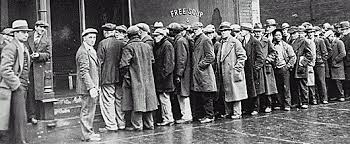
A Dark Decade of Troubles (Psalm 56)

Being adopted by my grandparents, I grew up with a different generation of parents than did the rest of my friends. They were survivors of the Great Depression, and it impacted the rest of their lives and their thinking on many topics.

My parents were married on September 7th of 1929. This was four days after the highest point achieved ever by the Dow Jones Average. Black Tuesday hit on October 29th, seven weeks into their marriage.  depression soup line

My father lost most of his savings in the bank. He did maintain a job throughout The Depression, but he never trusted any sort of speculative investment ever after. He was a classic “cash and carry” guy. The stories of what they went through in the first decade of their marriage to make a living and support also my mother’s parents and three infants were absolutely amazing … and at times, heartbreaking.

But in it all, my father always gave God a minimum of 10%, and at the end of his life he testified to the church I was pastoring (and that he was attending in our home town) that God had taught him through this dark period how his needs would always be faithfully met in some way.

As we have entered into our readings on the life of David upon a period of time where the future king spent likely a decade running from Saul, David was learning valuable lessons that would serve him well in the role he would play as Israel’s king. Make no mistake about it, these were tough times. There were experiences where he could not see how he could possibly survive. Fear and looming demise were his constant companions, but so also was God’s faithfulness.

David would take his pen to write songs that spoke of these times and the lessons he was learning and declaring for others to hear. Psalms that have a direct foundation in this horrific period of David’s life are 18, 34, 52, 54, 56, and 57.

Here today we read just one of these, the historical situation of which we read about just yesterday…

Psalm 56

For the director of music. To the tune of “A Dove on Distant Oaks.” Of David. A miktam. When the Philistines had seized him in Gath.

1 Be merciful to me, my God, for my enemies are in hot pursuit; all day long they press their attack.
2 My adversaries pursue me all day long; in their pride many are attacking me.

3 When I am afraid, I put my trust in you.

4 In God, whose word I praise—in God I trust and am not afraid. What can mere mortals do to me?

5 All day long they twist my words; all their schemes are for my ruin.
6 They conspire, they lurk, they watch my steps, hoping to take my life.
7 Because of their wickedness do not let them escape; in your anger, God, bring the nations down.

8 Record my misery; list my tears on your scroll—are they not in your record?
9 Then my enemies will turn back when I call for help. By this I will know that God is for me.

10,11 In God, whose word I praise, in the Lord, whose word I praise—in God I trust and am not afraid. What can man do to me?

12 I am under vows to you, my God; I will present my thank offerings to you.
13 For you have delivered me from death and my feet from stumbling, that I may walk before God in the light of life.

We may never have a situation where people are actually out to seek our lives. But we will all face difficult times where people who are not motivated by God or yielded to him will seek to portray us in a difficult and negative way that could have dire consequences upon the details of our lives. We will have dark times; there is no escaping that reality.

But in those times, like David, we have God to cry out to for justice and endurance in the midst of our sufferings. We can ultimately rest in knowing that there is no harm that can come to us that is outside God’s control.

Fugitive Lessons (1 Samuel 21:1-15)

It is now over 20 years ago that Harrison Ford and Tommy Lee Jones starred in the 1993 film “The Fugitive” – based upon a 1960s television series of the same name. Harrison Ford plays the role of a wrongfully-convicted killer of his wife, and he escapes from custody and sets out to prove his innocence, all the while being pursued by U.S. Marshals.

The story of David on the run from Saul is not really a categorically different sort of action-packed adventure.

As we saw yesterday, David’s life is not safe in the presence of King Saul. He bids farewell to his friend Jonathan and sets out for what will be likely about a decade of his life on the run from the government as a fugitive. Today’s chapter is the first of several that talk about some of his adventures. And a number of Psalms are written by David during this time of his life as well, and we’ll look at one of them tomorrow.

In 1 Samuel 21 we see two fugitive stories. The first is about David going to a place where the Ark was and where there were the priests of Nob. David finds help here – he finds food at a time when he was near starving, being allowed to each the de-consecrated bread that was actually only to be eaten by the priests.

David at Nob

21:1 David went to Nob, to Ahimelek the priest. Ahimelek trembled when he met him, and asked, “Why are you alone? Why is no one with you?”

2 David answered Ahimelek the priest, “The king sent me on a mission and said to me, ‘No one is to know anything about the mission I am sending you on.’ As for my men, I have told them to meet me at a certain place. 3 Now then, what do you have on hand? Give me five loaves of bread, or whatever you can find.”

4 But the priest answered David, “I don’t have any ordinary bread on hand; however, there is some consecrated bread here—provided the men have kept themselves from women.”

5 David replied, “Indeed women have been kept from us, as usual whenever I set out. The men’s bodies are holy even on missions that are not holy. How much more so today!”6 So the priest gave him the consecrated bread, since there was no bread there except the bread of the Presence that had been removed from before the Lord and replaced by hot bread on the day it was taken away.

7 Now one of Saul’s servants was there that day, detained before the Lord; he was Doeg the Edomite, Saul’s chief shepherd.

Remember this name – Doeg – as he is essentially a spy for Saul, and he will return in the story of the next chapter. This is not a good guy.

8 David asked Ahimelek, “Don’t you have a spear or a sword here? I haven’t brought my sword or any other weapon, because the king’s mission was urgent.”

9 The priest replied, “The sword of Goliath the Philistine, whom you killed in the Valley of Elah, is here; it is wrapped in a cloth behind the ephod. If you want it, take it; there is no sword here but that one.”

David said, “There is none like it; give it to me.”

The principle is that life itself is more holy than bread. Jesus referenced this very passage, as it reads in Matthew 12:1-8 …

12:1 At that time Jesus went through the grain fields on the Sabbath. His disciples were hungry and began to pick some heads of grain and eat them. 2 When the Pharisees saw this, they said to him, “Look! Your disciples are doing what is unlawful on the Sabbath.”

3 He answered, “Haven’t you read what David did when he and his companions were hungry? 4 He entered the house of God, and he and his companions ate the consecrated bread—which was not lawful for them to do, but only for the priests. 5 Or haven’t you read in the Law that the priests on Sabbath duty in the temple desecrate the Sabbath and yet are innocent? 6 I tell you that something greater than the temple is here. 7 If you had known what these words mean, ‘I desire mercy, not sacrifice,’ you would not have condemned the innocent. 8 For the Son of Man is Lord of the Sabbath.”

David at Gath

10 That day David fled from Saul and went to Achish king of Gath. 11 But the servants of Achish said to him, “Isn’t this David, the king of the land? Isn’t he the one they sing about in their dances: “‘Saul has slain his thousands, and David his tens of thousands’?”

12 David took these words to heart and was very much afraid of Achish king of Gath. 13 So he pretended to be insane in their presence; and while he was in their hands he acted like a madman, making marks on the doors of the gate and letting saliva run down his beard.

14 Achish said to his servants, “Look at the man! He is insane! Why bring him to me?15 Am I so short of madmen that you have to bring this fellow here to carry on like this in front of me? Must this man come into my house?”

Desperate times call for desperate measures, and David goes to a place where Saul will not pursue him – into enemy territory of the Philistines. There he feigns being a madman. It was not a practice in ancient times to kill the insane, as superstitions were that this would offend the gods in some way and bring trouble upon oneself for doing so.

A tough faith comes out of tough times

So, have you been going through a rough stretch of life? Does it seem like God is far away? You know what is right, you are seeking to live rightly, but you don’t seem to be finding the rewards for it?

Look at David here … is your life that bad right now?

More questions … looking back over your life if you’ve known the Lord for a longer period of time … when did you grow the most in your faith? When things were going swimmingly well? Or when times were difficult and you had to throw yourself upon the Lord?

The well-known women’s Bible teacher and former missionary Elizabeth Elliott had some years ago a program on Christian radio called “Gateway to Joy.”  I remember hearing her say one time that she was asked by another woman, “How can I become such a great woman of faith as you are?”

Sensing that the questioner was seeking some sort of immediate “fix” or “magical spiritual pill,” Elizabeth said something to this effect, “Well, you can have your husband killed by a hostile Indian tribe in Ecuador and then live among those savages, raise a child as a widow, marry a second time and become a widow a second time, and deal with dozens of others challenges of life, and then maybe you too can have a great faith.”

David was anointed as a boy to become the king of the nation. You would think that God would take better care of him. But God was with him in everything, teaching and preparing him – even through years of trauma – to be dependent upon the Lord for all things.

This theme of suffering and carrying the cross before wearing the crown – our subtitle of the series – is a timeless truth that resounds to our day and our lives as well. God is so much more interested in our heart relationship of dependence upon him than he is that we have success and comfort.

Look to him today, right now, this moment, for whatever challenge you have … whatever fugitive feeling you possess about life in this unjust world.

The Treasure of Loyalty (1 Samuel 20:1-42)

If you have had lifelong or long-term friends who have been faithful and loyal to you through all of the ups and downs of your life, you possess a great and rare treasure.

Through the wonder of the computer age and social media, I have the opportunity to have occasional contacts with friends from childhood and high school. There are an additional few from college and grad school. A great disappointment is the loss of contact with the vast majority of friends from my previous ministry.

In all of these stages of life, while I remain thankful and in possession of warm memories of people along those pathways, I am sad that so few have remained very close at all.

But there is one friend from New Jersey that is still unique. We ran about 10,000 miles together when marathon training in our younger years. Our parents were friends and our families always went to the same two churches – one of which he has become the pastor of in these latter years of life. There is nothing we can’t talk about and have not discussed.

Today we look at the famous passage of the loyal friendship of David and Jonathan – a relationship that was based upon a covenant of love. It is an imperfect picture of the perfect covenant of relationship that we have with the true king – one that was bought by the blood of Christ.

To review the background leading to this passage, recall that after David killed Goliath, he was put in charge of a segment of the army in Israel, and he had great success in all that he did – because God was with him and blessed his efforts. He was loved by the army and the people, who sang a song about him—that Saul killed his thousands, but David his ten thousands.

All of this created both a jealousy and a fear in Saul, who was haunted by an evil spirit that had come after the Holy Spirit had departed. He twice threw spears at David to try to kill him.

Saul devised plots to put David in battle situations that were very difficult and where he may well have been killed by the Philistines. But God was with David.

Through a whole variety of circumstances, it had become very clear that David could simply no longer safely be in Saul’s presence, as the king had become unhinged in every way.

20:1  Then David fled from Naioth at Ramah and went to Jonathan and asked, “What have I done? What is my crime? How have I wronged your father, that he is trying to kill me?”

2 “Never!” Jonathan replied. “You are not going to die! Look, my father doesn’t do anything, great or small, without letting me know. Why would he hide this from me? It isn’t so!”

3 But David took an oath and said, “Your father knows very well that I have found favor in your eyes, and he has said to himself, ‘Jonathan must not know this or he will be grieved.’ Yet as surely as the Lord lives and as you live, there is only a step between me and death.”

4 Jonathan said to David, “Whatever you want me to do, I’ll do for you.”

5 So David said, “Look, tomorrow is the New Moon feast, and I am supposed to dine with the king; but let me go and hide in the field until the evening of the day after tomorrow. 6 If your father misses me at all, tell him, ‘David earnestly asked my permission to hurry to Bethlehem, his hometown, because an annual sacrifice is being made there for his whole clan.’ 7 If he says, ‘Very well,’ then your servant is safe. But if he loses his temper, you can be sure that he is determined to harm me. 8 As for you, show kindness to your servant, for you have brought him into a covenant with you before the Lord. If I am guilty, then kill me yourself! Why hand me over to your father?”

9 “Never!” Jonathan said. “If I had the least inkling that my father was determined to harm you, wouldn’t I tell you?”

10 David asked, “Who will tell me if your father answers you harshly?”

11 “Come,” Jonathan said, “let’s go out into the field.” So they went there together.

12 Then Jonathan said to David, “I swear by the Lord, the God of Israel, that I will surely sound out my father by this time the day after tomorrow! If he is favorably disposed toward you, will I not send you word and let you know? 13 But if my father intends to harm you, may the Lord deal with Jonathan, be it ever so severely, if I do not let you know and send you away in peace. May the Lord be with you as he has been with my father. 14 But show me unfailing kindness like the Lord’s kindness as long as I live, so that I may not be killed, 15 and do not ever cut off your kindness from my family—not even when the Lord has cut off every one of David’s enemies from the face of the earth.”   

16 So Jonathan made a covenant with the house of David, saying, “May the Lord call David’s enemies to account.” 17 And Jonathan had David reaffirm his oath out of love for him, because he loved him as he loved himself.

18 Then Jonathan said to David, “Tomorrow is the New Moon feast. You will be missed, because your seat will be empty. 19 The day after tomorrow, toward evening, go to the place where you hid when this trouble began, and wait by the stone Ezel. 20 I will shoot three arrows to the side of it, as though I were shooting at a target. 21 Then I will send a boy and say, ‘Go, find the arrows.’ If I say to him, ‘Look, the arrows are on this side of you; bring them here,’ then come, because, as surely as the Lord lives, you are safe; there is no danger. 22 But if I say to the boy, ‘Look, the arrows are beyond you,’ then you must go, because the Lord has sent you away. 23 And about the matter you and I discussed—remember, the Lord is witness between you and me forever.”

24 So David hid in the field, and when the New Moon feast came, the king sat down to eat. 25 He sat in his customary place by the wall, opposite Jonathan, and Abner sat next to Saul, but David’s place was empty. 26 Saul said nothing that day, for he thought, “Something must have happened to David to make him ceremonially unclean—surely he is unclean.” 27 But the next day, the second day of the month, David’s place was empty again. Then Saul said to his son Jonathan, “Why hasn’t the son of Jesse come to the meal, either yesterday or today?”

28 Jonathan answered, “David earnestly asked me for permission to go to Bethlehem. 29 He said, ‘Let me go, because our family is observing a sacrifice in the town and my brother has ordered me to be there. If I have found favor in your eyes, let me get away to see my brothers.’ That is why he has not come to the king’s table.”

30 Saul’s anger flared up at Jonathan and he said to him, “You son of a perverse and rebellious woman! Don’t I know that you have sided with the son of Jesse to your own shame and to the shame of the mother who bore you? 31 As long as the son of Jesse lives on this earth, neither you nor your kingdom will be established. Now send someone to bring him to me, for he must die!”

32 “Why should he be put to death? What has he done?” Jonathan asked his father. 33 But Saul hurled his spear at him to kill him. Then Jonathan knew that his father intended to kill David.

34 Jonathan got up from the table in fierce anger; on that second day of the feast he did not eat, because he was grieved at his father’s shameful treatment of David.

35 In the morning Jonathan went out to the field for his meeting with David. He had a small boy with him, 36 and he said to the boy, “Run and find the arrows I shoot.” As the boy ran, he shot an arrow beyond him. 37 When the boy came to the place where Jonathan’s arrow had fallen, Jonathan called out after him, “Isn’t the arrow beyond you?” 38 Then he shouted, “Hurry! Go quickly! Don’t stop!” The boy picked up the arrow and returned to his master. 39 (The boy knew nothing about all this; only Jonathan and David knew.) 40 Then Jonathan gave his weapons to the boy and said, “Go, carry them back to town.”

41 After the boy had gone, David got up from the south side of the stone and bowed down before Jonathan three times, with his face to the ground. Then they kissed each other and wept together—but David wept the most.

42 Jonathan said to David, “Go in peace, for we have sworn friendship with each other in the name of the Lord, saying, ‘The Lord is witness between you and me, and between your descendants and my descendants forever.’” Then David left, and Jonathan went back to the town.

David’s fear about Saul seeking his life proved to be of real substance. And Jonathan’s fears were not without merit as well. Saul’s son knew and understood that David was to become the next king. He knew that in ancient times (as is seen even today is certain military coups around the world) the royal family being deposed was often fully exterminated. This made it impossible for uprisings and rival claimants to the throne in opposition to the new regime.

Jesus is to be crowned the true and better King ultimately. The fleshly nature of Adam within us, and the connection we have to Satan through this evil world of which he is the prince, tells us to make ourselves the king – to see self as our own sovereign ruler of our lives.

Rather, we need to trust in Christ as the King. There has been a covenant of loyal love established – that God will be faithful through his hesed (covenant love) to his people because of the sacrifice of his Son Jesus.

Because of Jesus, the descendants of Adam are not wiped out when Jesus takes the throne, but instead are brought near—very much like the covenant established between David and Jonathan.

So we have a choice – to act like Saul – essentially in self-centered interest like our original father Adam and refuse to trust in God; or we can be like Jonathan in knowing who the king is going to be, and walk in trust and loyal and faithful relationship with Jesus – our brother and friend – who loves us so much as to give his life for us to cover our transgressions.

Shame or Glory (1 Samuel 19)

The greatest of human tragedies is not to live for self, but the tragedy of unrepentance.  Every human being is born selfish, hostile toward God.  It is only through God’s grace that we are brought near through the blood of Jesus.

The story of 1 Samuel records two equal and opposite reactions to King David.  We find the sacrificial loyalty of Jonathan, but we also find the deep-seated hatred of King Saul.   The contrasting reactions were meant to give readers pause: How do you react to God’s chosen King?  For the original readers of these stories, this meant how they reacted to the line of kings who came from David onward.  For those living in the age of the Church, this means how we react to the true King: Jesus, who also comes from the line of David.

DAVID’S ESCAPE

In 1 Samuel 19, we find the story reaching critical mass.  Saul’s earlier indirect attempts to assassinate David had proved unsuccessful, so now the gloves come off.  Fortunately, Jonathan remains committed to his friend David, and pleads his case before his father:

And Saul spoke to Jonathan his son and to all his servants, that they should kill David. But Jonathan, Saul’s son, delighted much in David. 2 And Jonathan told David, “Saul my father seeks to kill you. Therefore be on your guard in the morning. Stay in a secret place and hide yourself. 3 And I will go out and stand beside my father in the field where you are, and I will speak to my father about you. And if I learn anything I will tell you.” 4 And Jonathan spoke well of David to Saul his father and said to him, “Let not the king sin against his servant David, because he has not sinned against you, and because his deeds have brought good to you. 5 For he took his life in his hand and he struck down the Philistine, and the Lord worked a great salvation for all Israel. You saw it, and rejoiced. Why then will you sin against innocent blood by killing David without cause?”6 And Saul listened to the voice of Jonathan. Saul swore, “As the Lord lives, he shall not be put to death.” 7 And Jonathan called David, and Jonathan reported to him all these things. And Jonathan brought David to Saul, and he was in his presence as before.

Unfortunately, this peace wasn’t meant to last.  In fact, we might even wonder if Saul is just “playing nice,” biding his time until the next opportunity.  A short while later, an evil spirit once again settles on Saul—the third time this is recorded (cf. 16:14; 18:10).  David had evaded Saul’s attacks before, now he would have to escape them entirely:

8 And there was war again. And David went out and fought with the Philistines and struck them with a great blow, so that they fled before him. 9 Then a harmful spirit from the Lord came upon Saul, as he sat in his house with his spear in his hand. And David was playing the lyre. 10 And Saul sought to pin David to the wall with the spear, but he eluded Saul, so that he struck the spear into the wall. And David fled and escaped that night.


11 Saul sent messengers to David’s house to watch him, that he might kill him in the morning. But Michal, David’s wife, told him, “If you do not escape with your life tonight, tomorrow you will be killed.” 12 So Michal let David down through the window, and he fled away and escaped. 13 Michal took an image and laid it on the bed and put a pillow of goats’ hair at its head and covered it with the clothes. 14 And when Saul sent messengers to take David, she said, “He is sick.” 15 Then Saul sent the messengers to see David, saying, “Bring him up to me in the bed, that I may kill him.” 16 And when the messengers came in, behold, the image was in the bed, with the pillow of goats’ hair at its head.17 Saul said to Michal, “Why have you deceived me thus and let my enemy go, so that he has escaped?” And Michal answered Saul, “He said to me, ‘Let me go. Why should I kill you?’”

Like Jonathan, Michal’s devoted love protects David from harm.  She creates a ruse to fool Saul’s messengers—using a household idol to create the illusion of David in bed, sick.

But we might ask a critical question: why would David’s house contain an idol?  In the ancient world, sometimes these household idols were specific statues that you’d inherit—passed down like some bizarre family heirloom.  But it’s hard to imagine that Michal—or anyone in this premodern society—could completely separate family tradition from pagan worship.  The text doesn’t specify just who owned this idol, nor does it give us reason to throw rocks at David for permitting such an object in his home.   Yet it reminds us that he inhabited a world full of misplaced faith—trusting in lesser gods for security or wealth.

SAUL’S RUIN

Now that David had escaped, the text describes the further descent of Saul:

18 Now David fled and escaped, and he came to Samuel at Ramah and told him all that Saul had done to him. And he and Samuel went and lived at Naioth. 19 And it was told Saul, “Behold, David is at Naioth in Ramah.” 20 Then Saul sent messengers to take David, and when they saw the company of the prophets prophesying, and Samuel standing as head over them, the Spirit of God came upon the messengers of Saul, and they also prophesied. 21 When it was told Saul, he sent other messengers, and they also prophesied. And Saul sent messengers again the third time, and they also prophesied.22 Then he himself went to Ramah and came to the great well that is in Secu. And he asked, “Where are Samuel and David?” And one said, “Behold, they are at Naioth in Ramah.” 23 And he went there to Naioth in Ramah. And the Spirit of God came upon him also, and as he went he prophesied until he came to Naioth in Ramah. 24 And he too stripped off his clothes, and he too prophesied before Samuel and lay naked all that day and all that night. Thus it is said, “Is Saul also among the prophets?”

Do you remember hearing that last line before?  Is Saul among the prophets? was a question posed earlier (1 Samuel 10:12) when Saul was first anointed.  It’s as if the writer is trying to get us to think back to the day that Saul’s kingship began—and just how far he’d fallen.

And so we now see the radical difference between Jonathan and Saul.  Jonathan gave his clothes to David as an act of self-sacrifice (1 Samuel 18:1-5).  Saul stripped his clothes as an act of self-destruction.  What did he “prophesy?”  It makes little difference.  At this point he was far from God, a man who’d gone from splendor to shame through a series of poor choices.  And those are the final consequences of every person’s reaction to God’s chosen king: you either bare your soul in love, or be stripped bare in shame.  This is why Jesus would later warn the religious leaders that “What you have said in the dark will be heard in the daylight, and what you have whispered in the ear in the inner rooms will be proclaimed from the roofs” (Luke 12:3).  And that’s horrifying—until we consider that our only other recourse is to lay ourselves bare before the great physician and unmask our secrets and our shame.  We will be clothed in Christ’s mercy, or covered in the shame and scandal of a life lived for self.

SPIRITUAL ENDURANCE

What about us?  What about the “long haul?”  Is it possible to start out like Jonathan—full of love for God and for Jesus—and only end up like Saul?  Experience tells us the answer is a haunting “yes.”  We can easily name those who have been “on fire” for God, only later to walk away from faith.  Still more painfully, we can name those who walked to their graves without having publicly turned back toward God.

There are many Godly, intelligent Christians who love Jesus deeply and believe that you can lose your salvation.  I am not one of them.  I believe that “he who began a good work in you will carry it on to completion until the day of Christ Jesus” (Philippians 1:6).  I believe that “those he predestined, he also called; those he called, he also justified; those he justified, he also glorified” (Romans 8:30).  I also believe there are two critical elements in this passage that we need to think deeply about:

  • The presence of the Spirit. In Saul’s day, the Holy Spirit came upon select individuals for the purpose of leadership.  In the age of the Church, the Holy Spirit comes upon all believers to empower them the live on mission (Acts 1:8).  So while Saul saw the Spirit leave, Christians do not share this same fear.  And as he departed, Jesus promised that “I will be with you until the very end of the age” (Matthew 28:20).
  • The object of faith. Michal’s home contained idols.  And—again—while we needn’t throw rocks, we recognize that David inhabited a world of imperfect trust and divided beliefs.  Often, I hear people say: “I just don’t know that much about the Bible,” or “I just wish I could pray more.”  But God so regularly rescues idolatrous people that we have no choice but to conclude that I am acceptable to God not because of the quantity of my faith, but the object of my faith.  If God saves me at all, it says more about his goodness than my own.

But surely we can’t afford to be lazy?  Surely not.  The writer of Hebrews challenges his readers to “run the race set before you” (Hebrews 12:1).  Good works are never the basis of faith—but they are the expression of faith.  Every follower of Jesus is challenged to daily take up the cross and follow Jesus in a hostile world, that one day we might not be stripped in shame but clothed in glory.


How to Land a Wife in 200 Easy Steps (or: “Still a Better Love Story than Twilight”–1 Samuel 18:12-30)

Few things possess more horsepower than romance.   Bob Dylan’s 2001 song “Bye and Bye” speaks of a man obsessed: “The future for me is already a thing of the past.  You were my first love and you will be my last.”  Desire is deeply ingrained in the heart of ever man and woman.  While marriage can never be elevated to the status of an idol (after all, singleness can be a Godly gift, whether for a season or a lifetime), marriage remains God’s ideal design for mankind.

So it’s little wonder that Saul would capitalize on this fundamental fact of human nature to eliminate his up-and-coming rival, David.   Having failed to kill David with his spear, Saul hatches two plots to have David killed indirectly.

PLOT #1

Saul’s first plot boils to the front of his mind after the people of Israel continue to express their allegiance to David and his military might.

 Saul was afraid of David because the Lord was with him but had departed from Saul. 13 So Saul removed him from his presence and made him a commander of a thousand.  And he went out and came in before the people. 14 And David had success in all his undertakings, for the Lord was with him. 15 And when Saul saw that he had great success, he stood in fearful awe of him. 16 But all Israel and Judah loved David, for he went out and came in before them.

Then Saul said to David, “Here is my elder daughter Merab.  I will give her to you for a wife. Only be valiant for me and fight the Lord’s battles.” For Saul thought, “Let not my hand be against him, but let the hand of the Philistines be against him.” 18 And David said to Saul, “Who am I, and who are my relatives, my father’s clan in Israel, that I should be son-in-law to the king?” 19 But at the time when Merab, Saul’s daughter, should have been given to David, she was given to Adriel the Meholathite for a wife.

Saul is cold, calculating.  Do you understand his scheme?  In verse 17, he essentially says to himself, Let’s let the bad guys do my dirty work for me.  By sending David into deeper conflict, the Philistine adversaries would take him out.  The bad guys would get the blame, and Saul would keep his hands clean.

The problem?  David seems to think himself unworthy to be the king’s son-in-law.  Sadly, in the ancient world women were viewed as commodities to be bought or won.  David lacked a sufficient “bridal price” to pay for the privilege of marrying Merab.  Though this marriage would advance his career, he declines—which is why Merab is given to another man.

PLOT #2

Not to be outdone, Saul hatches another, similar plan.

20 Now Saul’s daughter Michal loved David. And they told Saul, and the thing pleased him. 21 Saul thought, “Let me give her to him, that she may be a snare for him and that the hand of the Philistines may be against him.” Therefore Saul said to David a second time, “You shall now be my son-in-law.” 22 And Saul commanded his servants, “Speak to David in private and say, ‘Behold, the king has delight in you, and all his servants love you. Now then become the king’s son-in-law.’” 23 And Saul’s servants spoke those words in the ears of David. And David said, “Does it seem to you a little thing to become the king’s son-in-law, since I am a poor man and have no reputation?” 24 And the servants of Saul told him, “Thus and so did David speak.” 25 Then Saul said, “Thus shall you say to David, ‘The king desires no bride-price except a hundred foreskins of the Philistines, that he may be avenged of the king’s enemies.’”  Now Saul thought to make David fall by the hand of the Philistines.

Saul’s plan was simple: if David couldn’t afford a “bridal price,” then Saul would engineer a situation wherein David could collect this price.  But…most people don’t include, you know, body parts on their wedding registry.  Why this bizarre request?  Well, practically, since circumcision represented Israel’s inclusion in God’s promises dating back to Abraham, then the foreskins would prove that he truly slaughtered 100 of God’s enemies.  In Mitchell Dahood’s commentary on Psalms, he notes that in Psalm 118 David writes: “All nations surround me; in the name of the LORD I cut them off” (Ps 118:10-12).  The “cut them off” in this passage literally means “circumcise”—the act here is more than merely killing their enemies, but separating them from the community of God.  For Saul, this steep price would ensure that David wouldn’t come back alive.

 26 And when his servants told David these words, it pleased David well to be the king’s son-in-law.  Before the time had expired, 27 David arose and went, along with his men, and killed two hundred of the Philistines.  And David brought their foreskins, which were given in full number to the king, that he might become the king’s son-in-law. And Saul gave him his daughter Michal for a wife. 28 But when Saul saw and knew that the Lord was with David, and that Michal, Saul’s daughter, loved him, 29 Saul was even more afraid of David. So Saul was David’s enemy continually.

30 Then the commanders of the Philistines came out to battle, and as often as they came out David had more success than all the servants of Saul, so that his name was highly esteemed.

Earlier David had been said to “kill his tens of thousands.”  Now, he doubly satisfies Saul’s requirements, returning with 200 foreskins.  What Saul had intended as an evil scheme only deepened the nation’s love for David.  Even Saul’s daughter Michal joins her brother Jonathan in her loyal love for David.  Saul’s plans did not succeed, but only result in David being further exalted.

THE TRUE AND BETTER BRIDEGROOM

By now you’ve noticed that we’re making an effort to read the Old Testament twice: the first time to understand the original historical and cultural meanings, and the second time to understand how the whole Bible is a story about Jesus.  What do we make of such bizarre stories as this?

First, we recognize that like David, Jesus entered into a world whose reactions toward him were mixed.  Though many praised his miraculous works, the religious leaders felt threatened by his growing popularity.  And so, like Saul, they schemed to have him killed.  And like David, this scheme only backfired.  The hour of Christ’s greatest humiliation would only be his greatest hour of glory—through Christ’s death and resurrection, he would “draw all men to himself” (John 12:32).

And the Bible is also a story about marriage.  Jesus, the true and better David, would pay a unique bridal price to rescue his bride, the Church.  Paul picks up on this theme in his letter to the Church at Ephesus:

“Christ loved the church and gave himself up for her, 26 that he might sanctify her, having cleansed her by the washing of water with the word, 27 so that he might present the church to himself in splendor, without spot or wrinkle or any such thing, that she might be holy and without blemish.” (Ephesians 5:25-27)

David would produce his required “bridal price” while preserving his life.  Jesus would pay the “bridal price” for the Church by relinquishing his life.

What does that mean for you and I?  This means that though we are deeply flawed, Jesus was willing to go to great lengths to rescue us (cf. Romans 5:8).  Therefore, I don’t need to derive worth from idolatrous pursuits.  I view my career not as a source of identity, but as an opportunity to express my faith.  I abstain from self-indulgence or even pornography—not only because I recognize these things as “bad” but because I understand that Christ is infinitely greater.  If I am married, I no longer derive worth from my spouse, but ascribe worth to my spouse.

Christ loves you.  He died for you.  What else is greater than that?  Who can you share this love with today?


The Aftermath of Success (1 Samuel 17:55-58; 18:1-11)

Someone will always be better than you.  So long as you derive your worth from your abilities, your performance, your good looks, you will always live in fear of being shown up by someone more capable, someone more successful, someone more good looking.

In 2013, an article in Slate magazine published an article titled: “Is Facebook Making Us Sad?” According to new social research, social media only increases our natural tendency to compare ourselves to others:

“The human habit of overestimating other people’s happiness is nothing new, of course. … By showcasing the most witty, joyful, bullet-pointed versions of people’s lives, and inviting constant comparisons in which we tend to see ourselves as the losers, Facebook appears to exploit an Achilles’ heel of human nature. …Facebook is, after all, characterized by the very public curation of one’s assets in the form of friends, photos, biographical data, accomplishments, pithy observations, even the books we say we like. Look, we have baked beautiful cookies. We are playing with a new puppy. We are smiling in pictures (or, if we are moody, we are artfully moody.) Blandness will not do, and with some exceptions, sad stuff doesn’t make the cut, either. The site’s very design—the  presence of a “Like” button, without a corresponding “Hate” button—reinforces a kind of upbeat spin doctoring.”

How you respond to your neighbors’ happiness reveals the true god of your heart.

In short, we want to be just like our neighbors—but just a little bit better.  When we fail to “measure up” to these standards, we feel let down, disappointed—maybe even angry.

The slaying of Goliath marked a turning point in the life of David.  From this day forward he wouldn’t be merely a shepherd boy—this unlucky eighth son of a Bethlehem farmer.  No; this was a force to be reckoned with.

While David was on the battlefield, Saul was pondering who exactly this young man was:

55As soon as Saul saw David go out against the Philistine, he said to Abner, the commander of the army, “Abner, whose son is this youth?” And Abner said, “As your soul lives, O king, I do not know.” 56And the king said, “Inquire whose son the boy is.” 57And as soon as David returned from the striking down of the Philistine, Abner took him, and brought him before Saul with the head of the Philistine in his hand. 58And Saul said to him, “Whose son are you, young man?” And David answered, “I am the son of your servant Jesse the Bethlehemite.”

These questions are bizarre.  After all, Saul had met David before—he’d been the court musician.  Some think Saul is trying to gain a better understanding of his family history—but he’d met Jesse as well.  In his Handbook to the Historical Books, Victor Hamilton suggests that maybe Saul is asking a selfish question.

“Might it be that Saul, well aware of David’s prowess and hence usefulness to Saul in the future, is asking David to renounce Jesse as his father and proclaim himself Saul’s son?  After all, had not Samuel earlier predicted that Israel’s kings ‘will take your sons and appoint them to his chariots’ (8:11)?  That seems to be literally fulfilled in 8:2, where we read that ‘Saul took him that day and would not let him return to his father’s house.’”  (Victor Hamilton, Handbook to the Historical Books, p. 261)

David’s life would never be the same, but now we’d see the ways that the royal family—both Saul and his son Jonathan—would react to this rising superstar.  And the story reveals the ways our own hearts might respond to God’s anointed King Jesus.

DAVID AND JONATHAN

Jonathan was Saul’s son, and in every “natural” sense the heir to the throne.  There was just one problem: God had declared that the throne would pass to David.  The story of David and Jonathan picks up immediately after the falling of Goliath.

As soon as he had finished speaking to Saul, the soul of Jonathan was knit to the soul of David, and Jonathan loved him as his own soul. 2 And Saul took him that day and would not let him return to his father’s house. 3 Then Jonathan made a covenant with David, because he loved him as his own soul. 4 And Jonathan stripped himself of the robe that was on him and gave it to David, and his armor, and even his sword and his bow and his belt. 5 And David went out and was successful wherever Saul sent him, so that Saul set him over the men of war. And this was good in the sight of all the people and also in the sight of Saul’s servants.

The story of David and Jonathan is one of the best-loved stories of friendship in all of scripture.  Jonathan’s love for David ran deep—and strong.  Yet for clarity’s sake, we should note that this love did not go beyond friendship (as some have historically suggested)—nowhere else do we hear the Hebrew word ahab being used to refer to romantic love.  No; this was brotherly affection—yet it’s impossible to be unmoved by the sacrificial nature of it. Jonathan strips himself of his own robe and armor, giving it to David.  The gesture is deeply symbolic: Jonathan is essentially abdicating his right to the throne.  By handing over these items, he essentially tells David: Here; these are yours.  And the throne goes with it.

DAVID AND SAUL

Saul’s response to David is less generous.  He’d essentially used David as a pawn in his army—ironically not that different from the way the Philistines had used Goliath.  But when David is successful, Saul is incensed.

6 As they were coming home, when David returned from striking down the Philistine, the women came out of all the cities of Israel, singing and dancing, to meet King Saul, with tambourines, with songs of joy, and with musical instruments.1 7 And the women sang to one another as they celebrated,

“Saul has struck down his thousands,

and David his ten thousands.”

8 And Saul was very angry, and this saying displeased him. He said, “They have ascribed to David ten thousands, and to me they have ascribed thousands, and what more can he have but the kingdom?”9 And Saul eyed David from that day on.

10 The next day a harmful spirit from God rushed upon Saul, and he raved within his house while David was playing the lyre, as he did day by day.  Saul had his spear in his hand. 11 And Saul hurled the spear, for he thought, “I will pin David to the wall.” But David evaded him twice.

The people sang the praises of David.  “Saul has struck down his thousands, and David his ten thousands.”  Even our English translations capture the meaning of the original Hebrew: David had risen to a position of obvious superiority—and obvious popularity.  Earlier, Saul had seen David as an opportunity, a chance to further his empire.  Now, he saw only a threat to his position.

THE TRUE AND BETTER KING

Do you see the contrast in responses to David?  Jonathan and Saul form mirror images to the way God’s people might respond to God’s chosen King.  Saul responded in jealousy and anger.  Jonathan responded in sacrificial love.

The truth is, most of us would prefer to be the king of our own worlds.  We become angry at anything that threatens our own sovereignty—which is partly why we feel threatened when we compare our happiness to that of others.  Christianity demands that we align our hearts with that of God’s, and that means we have to abdicate our thrones to the true King, Jesus.

Therefore, we will respond to Jesus as either a “Jonathan” or a “Saul.”  If I am accustomed to living life my way, then like Saul I will become enraged at the demands Christ places on me to follow him, to love my neighbor, to forgive others, etc.  But if I recognize the supreme value and authority Christ possesses, then like Jonathan I strip myself of my delusions of grandeur.  I lay my soul bare before him.  I express only gratitude and devotion.

Most of us will have days when we waver between these two reactions.  But over time we will become more accustomed to devoting ourselves to God’s true King, Jesus.  You may crown him as Lord, or condemn his intrusion.  But in either case, he cannot be ignored.  How will you respond?

Your Goliath is too Small (1 Samuel 17:32-54)

The stage had been set.  David—at this point only a 17 year old shepherd boy—had vowed to face the mighty warrior Goliath.

David said to Saul, “Let no man’s heart fail because of him. Your servant will go and fight with this Philistine.” 33And Saul said to David, “You are not able to go against this Philistine to fight with him, for you are but a youth, and he has been a man of war from his youth.” 34But David said to Saul, “Your servant used to keep sheep for his father. And when there came a lion, or a bear, and took a lamb from the flock, 35 I went after him and struck him and delivered it out of his mouth. And if he arose against me, I caught him by his beard and struck him and killed him. 36Your servant has struck down both lions and bears, and this uncircumcised Philistine shall be like one of them, for he has defied the armies of the living God.” 37And David said, “The LORD who delivered me from the paw of the lion and from the paw of the bear will deliver me from the hand of this Philistine.” And Saul said to David, “Go, and the LORD be with you!” 38Then Saul clothed David with his armor. He put a helmet of bronze on his head and clothed him with a coat of mail, 39and David strapped his sword over his armor. And he tried in vain to go, for he had not tested them. Then David said to Saul, “I cannot go with these, for I have not tested them.” So David put them off. 40Then he took his staff in his hand and chose five smooth stones from the brook and put them in his shepherd’s pouch. His sling was in his hand, and he approached the Philistine.

All along, God had been preparing David for this encounter—though in not quite the same way as boot camp.  As a shepherd, he’d spent time in the wilderness, perfecting his skill at keeping animals at bay.  This included some experience using a slingshot.

Do you remember the old movie Karate Kid?  The film featured Ralph Macchio, playing a young man determined to learn karate to beat the Cobra Kai.  He goes to Mr. Miyagi for training.  What does the old man have him do?  Wax the car.  “Wax on; wax off.”  Paint the fence.  Sand the floor.  Finally the kid snaps and confronts his mentor.  It’s then that Mr. Miyagi shows him the real import of “wax on; wax off.”  The repetitive motions he’d been making during all this manual labor?  They became the basis for defensive karate moves.  Waxing the car hadn’t been some arbitrary stunt; it had been a vital part of a warrior’s preparation.

David was no different.  God had used his past to prepare him for his future.  So much so that David declines the armor from Saul—weighty and a few sizes too big.  He faces Goliath instead with a bag full of rocks and a heart full of faith.

41And the Philistine moved forward and came near to David, with his shield-bearer in front of him. 42And when the Philistine looked and saw David, he disdained him, for he was but a youth, ruddy and handsome in appearance. 43And the Philistine said to David, “Am I a dog, that you come to me with sticks?” And the Philistine cursed David by his gods. 44The Philistine said to David, “Come to me, and I will give your flesh to the birds of the air and to the beasts of the field.” 45Then David said to the Philistine, “You come to me with a sword and with a spear and with a javelin, but I come to you in the name of the LORD of hosts, the God of the armies of Israel, whom you have defied. 46This day the LORD will deliver you into my hand, and I will strike you down and cut off your head. And I will give the dead bodies of the host of the Philistines this day to the birds of the air and to the wild beasts of the earth, that all the earth may know that there is a God in Israel, 47and that all this assembly may know that the LORD saves not with sword and spear. For the battle is the LORD’s, and he will give you into our hand.”

48When the Philistine arose and came and drew near to meet David, David ran quickly toward the battle line to meet the Philistine. 49And David put his hand in his bag and took out a stone and slung it and struck the Philistine on his forehead. The stone sank into his forehead, and he fell on his face to the ground.

50So David prevailed over the Philistine with a sling and with a stone, and struck the Philistine and killed him. There was no sword in the hand of David. 51Then David ran and stood over the Philistine and took his sword and drew it out of its sheath and killed him and cut off his head with it. When the Philistines saw that their champion was dead, they fled. 52And the men of Israel and Judah rose with a shout and pursued the Philistines as far as Gath and the gates of Ekron, so that the wounded Philistines fell on the way from Shaaraim as far as Gath and Ekron. 53And the people of Israel came back from chasing the Philistines, and they plundered their camp. 54And David took the head of the Philistine and brought it to Jerusalem, but he put his armor in his tent.

David slew the giant not with sling, sword, and stone, but with confidence in what God could accomplish through him.

Here’s the danger: all my life I’ve heard this taught as an example of how you and I can “face our giants.”  That if we have the “five smooth stones” of faith then we can conquer our fears, conquer our temptations, emerge from our struggles victoriously.  So whether our “giants” are addictive behaviors, sexual temptation, prolonged suffering, childlessness, singleness, we have only to “stand and fight.”  Pray more, read the Bible more—you know, be a “better Christian.”  That actually preaches really well.  But there’s just one problem: you’re not David.  You can stand and face your struggles all you want, you can throw as many rocks as you’d like.  But you’ll miss every time.  Why?  First of all, David occupied a position you and I do not.  He was God’s chosen leader over Israel.  Perhaps you and I aren’t empowered to fulfill this same destiny.

But there’s another key issue.  Your Goliath is too small.  So long as we see our problem as merely an issue of circumstance—of singleness, of suffering—we miss the real Goliath that roams the horizon.

If we search the pages of scripture, we find a powerful theme of conflict that runs through the great narrative.  Peter, for example, tells his readers to “Be sober-minded; be watchful. Your adversary the devil prowls around like a roaring lion, seeking someone to devour” (1 Peter 5:8).  Years earlier, Isaiah had predicted that God’s true servant would “swallow up death forever; and the Lord GOD will wipe away tears from all faces, and the reproach of his people he will take away from all the earth” (Isaiah 25:8).  There is a greater Goliath.  He bears the names of sin, Satan, and death.  None of us can face these adversaries on our own.  We need a true and better champion.  We need Jesus.

Paul tells us that on the cross Jesus “disarmed the rulers and authorities and put them to open shame, by triumphing over them in him” (Colossians 2:15).  So prominent was this theme in early Christendom it got its own Latin name: Christus victor—literally “Christ the victor.”

Therefore Jesus is the true and better David, who slays the greater Goliath of sin, suffering, and death.  And his victory has been imputed to our account—that is, by following Jesus we, too experience victory over sin and death.  But if that’s true, why do we still hurt?  If you’ll pardon the allegory, it’s because while the giant has been struck dead, we still wait for him to fall.  And so as we follow Jesus, Goliath’s shadow falls on our shoulders—but his spear can never touch us.  Goliath looms on the horizon—but his sword can never cut our flesh.  The gospel assures us there will be a day when even death itself will be “swallowed in victory” (1 Corinthians 15:54).  And until that day we wait for the giant to topple, we wait for God’s Kingdom to triumph.

Fall Goliath, Fall.

Facing the Giants (1 Samuel 17:1-31)

Every heart is a battlefield, and every lifetime a war.  The story of David and Goliath has become so familiar as to provoke disinterest, but in truth the story tells us everything about the way we handle life’s inevitable conflicts.  If we peel back the layers of our own modern “twists” on this ancient story, we find a fascinating story that initially smells of fear yet in the end screams of victory.

1Now the Philistines gathered their armies for battle. And they were gathered at Socoh, which belongs to Judah, and encamped between Socoh and Azekah, in Ephes-dammim. 2And Saul and the men of Israel were gathered, and encamped in the Valley of Elah, and drew up in line of battle against the Philistines. 3And the Philistines stood on the mountain on the one side, and Israel stood on the mountain on the other side, with a valley between them. 4And there came out from the camp of the Philistines a champion named Goliath of Gath, whose height was six cubits and a span. 5He had a helmet of bronze on his head, and he was armed with a coat of mail, and the weight of the coat was five thousand shekels of bronze. 6And he had bronze armor on his legs, and a javelin of bronze slung between his shoulders. 7The shaft of his spear was like a weaver’s beam, and his spear’s head weighed six hundred shekels of iron. And his shield-bearer went before him. 8He stood and shouted to the ranks of Israel, “Why have you come out to draw up for battle? Am I not a Philistine, and are you not servants of Saul? Choose a man for yourselves, and let him come down to me. 9If he is able to fight with me and kill me, then we will be your servants. But if I prevail against him and kill him, then you shall be our servants and serve us.” 10And the Philistine said, “I defy the ranks of Israel this day. Give me a man, that we may fight together.” 11When Saul and all Israel heard these words of the Philistine, they were dismayed and greatly afraid.

What’s going on here?  The ancient world observed a practice known as ish habbenaym—literally “the man between two.”  A battle would begin with a one-on-one battle between two chosen “champions.”  Why?  Because the ancient world saw their victory as not merely their own, but the blessing (or judgment!) of their respective God/gods.  The winner of this initial “grudge match” would have an enormous impact on troop morale—which helps us understand why armies would actually turn and flee if their champion was defeated.

Goliath was one such champion.  Later Hebrew manuscripts tell us that he was “four cubits and a span,” making him over 6 feet tall.  But earlier Hebrew manuscripts tell us that he was “six cubits and a span,” making him somewhere between nine feet and nine foot nine.  His armor alone weighed roughly 150 lbs—the head of his spear weighed an additional 15.  And notice the blend of bronze and iron weaponry.  Historians have been quick to note that Goliath’s armament was a blend of a variety of different cultures, which only serves to highlight Goliath’s backstory.  His impressive height, his array of weaponry—this was a hired gun.  He had probably traveled extensively, sort of a mercenary hired out to win battles.  He’d killed before—probably many times.  And judging by his raucous speech, he truly had come to believe himself untouchable.

The irony?  There truly was one man in Israel “head and shoulders” above the rest.  Saul.  Of all the people in Israel, this would have been the man you’d expect to face the giant.   But no.  The text is clear: Saul was no different than the rest of the men: weak in the knees, weak in the heart, weak in the soul.

The truth is, most of us will never face physical combat.  But we each have a giant that looms over us on the horizon.  For some, it’s a Goliath of temptation.  For others, it’s a Goliath of trials and suffering.  For all, it’s a Goliath that presses us toward the question: Is God in this? 

While Saul was the most likely candidate for a warrior, the true warrior would come through David.   Now mind you, roughly five years had passed since David’s anointing.  He was now a 17 year old boy—yet despite his anointing he remained a shepherd until his time of succession.  When he arrives at the battlefield, he comes not as a soldier, but as a delivery boy.

 12Now David was the son of an Ephrathite of Bethlehem in Judah, named Jesse, who had eight sons. In the days of Saul the man was already old and advanced in years. 13The three oldest sons of Jesse had followed Saul to the battle. And the names of his three sons who went to the battle were Eliab the firstborn, and next to him Abinadab, and the third Shammah. 14David was the youngest. The three eldest followed Saul, 15but David went back and forth from Saul to feed his father’s sheep at Bethlehem. 16For forty days the Philistine came forward and took his stand, morning and evening.

 17And Jesse said to David his son, “Take for your brothers an ephah of this parched grain, and these ten loaves, and carry them quickly to the camp to your brothers. 18Also take these ten cheeses to the commander of their thousand. See if your brothers are well, and bring some token from them.” 19Now Saul and they and all the men of Israel were in the valley of Elah, fighting with the Philistines.

 20And David rose early in the morning and left the sheep with a keeper and took the provisions and went, as Jesse had commanded him. And he came to the encampment as the host was going out to the battle line, shouting the war cry. 21And Israel and the Philistines drew up for battle, army against army. 22And David left the things in charge of the keeper of the baggage and ran to the ranks and went and greeted his brothers. 23As he talked with them, behold, the champion, the Philistine of Gath, Goliath by name, came up out of the ranks of the Philistines and spoke the same words as before. And David heard him.

 24All the men of Israel, when they saw the man, fled from him and were much afraid. 25And the men of Israel said, “Have you seen this man who has come up? Surely he has come up to defy Israel. And the king will enrich the man who kills him with great riches and will give him his daughter and make his father’s house free in Israel.”

 26And David said to the men who stood by him, “What shall be done for the man who kills this Philistine and takes away the reproach from Israel? For who is this uncircumcised Philistine, that he should defy the armies of the living God?” 27And the people answered him in the same way, “So shall it be done to the man who kills him.”

 28Now Eliab his eldest brother heard when he spoke to the men. And Eliab’s anger was kindled against David, and he said, “Why have you come down? And with whom have you left those few sheep in the wilderness? I know your presumption and the evil of your heart, for you have come down to see the battle.” 29And David said, “What have I done now? Was it not but a word?” 30And he turned away from him toward another, and spoke in the same way, and the people answered him again as before.

 31When the words that David spoke were heard, they repeated them before Saul, and he sent for him.

Once again we see a contrast.  Two men.  Two kings.  Saul hid in fear.  David stood in faith.  The truth is most of us are more like Saul than David.  When trouble looms ahead, I’d much rather hide—sink myself into career, into entertainment, into hobbies, even sin.  Men especially can flee from their responsibilities as men.  How?  Video games—whose players extend well beyond teenagers these days—give me a false sense of accomplishment.  Pornography grants me a false sense of intimacy.  Why focus on being productive when I have Call of Duty?  Why focus on marriage when I have an internet connection and no one’s watching?

It takes a man like David to step up in faith and say that I’m willing to do the unthinkable, and with God accomplish the impossible.  And if our faith is placed in God alone, then we are reminded that it is not the purity of our faith that saves us—it is the object of our faith.  Your impossible circumstances may only be a matter of perception.  Are you focusing on the problem, or are you focusing on the Solution?

We need to give a “to be continued” today.  Tomorrow we’ll come back and finish this story of David and Goliath, to answer how Jesus is the true and better David.

A Musician a Day Drives the Devil Away (1 Samuel 16:14-23)

As most of you who know me are aware, I was a double major in college that included a degree in music. The music department was looked upon by the rest of the school as being a bit … well … more than a bit weird – inhabited by an odd mix of artsy people. And frankly, it was true; it was a pretty weird bunch. We were called “Twinks.”  I was one of only two or three normal people there … I think – at least that’s how I remember it! As an athlete, I was my college’s version of Justin Tucker – the Baltimore Raven’s player who was an opera singing music major at the University of Texas.

But where would the world be without musicians? Who doesn’t listen to music for soothing enjoyment?  (Actually, to be truthful, I don’t … just another area where I’m weird.)  When things in life get tough, what do people do? They call for a musician on their iPod or phone playlist.

The French poet Alphonse de Lamartine said that “music is the literature of the heart; it commences where speech ends.”

“Music is the medicine of the mind,” said Civil War General and Congressman John A. Logan.

And it was a medicine for the mind that King Saul needed …

David in Saul’s Service

14 Now the Spirit of the Lord had departed from Saul, and an evil spirit from the Lord tormented him.

Say what? God sends evil spirits?

The way we should read this is that God allowed an evil spirit in the absence of the withdrawal of the Holy Spirit. The indwelling Spirt of the Lord was not a universal experience of God’s people until the Day of Pentecost – which is what is so great about knowing Christ and being a part of his body, the church. We possess what was only given by God in the Old Testament to certain people at certain times.

15 Saul’s attendants said to him, “See, an evil spirit from God is tormenting you. 16 Let our lord command his servants here to search for someone who can play the lyre. He will play when the evil spirit from God comes on you, and you will feel better.”

17 So Saul said to his attendants, “Find someone who plays well and bring him to me.”

The secret service agents around King Saul knew that something had to be done to calm him down at these times of torment. And yes, maybe music would be the soothing answer. So they went on a search for the best Twink they could find, and look who it turned out to be …

18 One of the servants answered, “I have seen a son of Jesse of Bethlehem who knows how to play the lyre. He is a brave man and a warrior. He speaks well and is a fine-looking man. And the Lord is with him.”

19 Then Saul sent messengers to Jesse and said, “Send me your son David, who is with the sheep.” 20 So Jesse took a donkey loaded with bread, a skin of wine and a young goat and sent them with his son David to Saul.

21 David came to Saul and entered his service. Saul liked him very much, and David became one of his armor-bearers. 22 Then Saul sent word to Jesse, saying, “Allow David to remain in my service, for I am pleased with him.”

23 Whenever the spirit from God came on Saul, David would take up his lyre and play. Then relief would come to Saul; he would feel better, and the evil spirit would leave him.

That’s quite a coincidence isn’t it? Actually, no, it is not. Rather, it was the sovereign hand of God at work. God was giving young David the experience and exposure to the royal house – putting him behind the curtains and into the context of the sphere of the king, for better and worse.

On the day that I write this, I spent several hours with a young man who sought out my counsel to discuss knowing the “calling of God.”  I think some pastors and others I know have had a dramatic moment-in-time experience of hearing God’s call to do a particular work.

But I think most people discover God’s call in their life in the cumulative experiences of life where God sovereignly opens and closes doors. And the pattern and pathways that He orchestrates can only be fully seen after it is all done.

Those paths are not always straight and not always pleasant. But God is at work at all times and in all things, composing within us a life symphony that is a crescendo of glory to his praise if we will yield to the Devine Composer’s notations and rhythms for our lives.