
Incarnation and Kenosis (Philippians 2:1-11)

We preachers like to think that from time to time we come up with a word picture about a biblical concept that so perfectly nails it, we call such a thing a “killer illustration.”  When you’ve got one of these, Saturday night cannot turn over fast enough until Sunday when you can deliver it!

Hey, while I’m letting you behind the curtain of “pastor world” here by that confession above, let me tell you something else that goes on inside us church shepherds. There are times when in a church family you have two people who are really good folks – good workers, dependable, etc.  But they don’t get along well with each other. They just see differently about the way certain things should be done. And along the way you see a few other people gravitating behind each of these folks. In a way, you hate to say anything, because as a pastor you really appreciate the good side of the two leaders; so you end up enduring the negatives to not upset the positives. But invariably a day comes when you’ve got to say something to try to get the situation toward a better place. That is difficult. It can backfire “bigly.”e92l8pwchd4-ben-white

It seems that Paul had such a situation going on in Philippi. He was hearing about it from a distance. There is a hint of the problem in 2:14 where he writes, “Do everything without grumbling or arguing…”  And then finally it all comes spewing out in the final chapter (4:2,3) where he says, I plead with Euodia and I plead with Syntyche to be of the same mind in the Lord. Yes, and I ask you, my true companion, help these women since they have contended at my side in the cause of the gospel, along with Clement and the rest of my co-workers, whose names are in the book of life.”

Boom!  Nothing like getting your names written in the Scriptures because you were having a junior high girl fight! I’d like to know how it turned out. But it might have worked out well, and that is because prior to confronting them in the text, Paul had the greatest “killer illustration” of them all…

2:1 — Therefore if you have any encouragement from being united with Christ, if any comfort from his love, if any common sharing in the Spirit, if any tenderness and compassion, 2 then make my joy complete by being like-minded, having the same love, being one in spirit and of one mind. 3 Do nothing out of selfish ambition or vain conceit. Rather, in humility value others above yourselves, 4 not looking to your own interests but each of you to the interests of the others.

5 In your relationships with one another, have the same mindset as Christ Jesus:

So there is the set-up … or what we call in Bible study the “context.”  Paul is saying that if you’ve got anything good going on at all in your life in relation to the Spirit working within, then be of one mind, one spirit, loving, forgetting ambition or personal interest, and in humility placing a greater value upon the values of others than upon yourself. Nice words, but what does such a thing look like?  Paul says to model the mindset of Jesus Christ …

6 Who, being in very nature God, did not consider equality with God something to be used to his own advantage; 7 rather, he made himself nothing by taking the very nature of a servant, being made in human likeness. 8 And being found in appearance as a man, he humbled himself by becoming obedient to death—even death on a cross!

The humiliation of Christ in his incarnation was so much bigger than any preferring of others that ought to be going on in Philippi … or Phillipsburg … or even Hagerstown!  There is simply no greater voluntary condescension than the attitude and action of Jesus. Check out the downward path >> Though totally God, he didn’t tenaciously hang onto that exalted position >> he became like a servant and took on human flesh >> he allowed himself to be so fully human as to even experience death >> but it was not just an easy natural death, but the worst imaginable – that of a cross.

This passage is called “kenosis” (from the verb ‘kenao’ in the passage) because it speaks of how Jesus emptied himself of the full use of his divine attributes in coming to earth.  This meant that he no longer exercised his omnipotence or other divine powers—except through the power of the Spirit, like when it says that Jesus was “led by” or “full of” the Holy Spirit. So, Jesus was fully God, but while living on earth he voluntarily limited himself to that which the Spirit could do through him.

Christ is an example of how to live and walk by the Spirit. And this “illustration” passage also teaches the great truth of the true humanity of Jesus Christ. He was not some sort of phantom spirit of a higher order than mankind. He was fully human, yet without sin.

9 Therefore God exalted him to the highest place and gave him the name that is above every name, 10 that at the name of Jesus every knee should bow, in heaven and on earth and under the earth, 11 and every tongue acknowledge that Jesus Christ is Lord, to the glory of God the Father.

I’ll pause for a moment while you try to think of a more beautiful passage in the Scripture than is this one … … … OK, yes, didn’t think you could come up with anything.

Did Jesus Always Exist?

Many of you who see me around church or wherever seem to have the same delusion. You keep telling me that I’m limping! There are even times when I’m walking along, and with that inner voice of conversation we have with ourselves inside our head, I say to myself, “Wow, you’re really walking well today … no pain or anything!”  Only to have the next person I see say to me, “So what are you limping about?”  More delusion.

Well I recently met a doctor who says he can fix this and remove this delusion from the minds of other people. It involves some nastiness of cutting this and that. It’s just too gruesome to talk about in a devotional blog. But before I allow this fellow to attempt this (or to even see him long enough to talk about it), I had to know a lot about who he is, where he’s been, what he’s done, and what are his exact credentials to do what he says he can do.

If Jesus is to be what we want him to be and believe him to be as our savior from sin, we should want to know and understand his background and credentials. How long has he been around as a part of the Godhead? Is he an eternal part of God? How long did he exist before being born in Bethlehem? Did God create Jesus the day before the incarnation, outfit him for a perfect human experience and say to him, “You look good Son; you’re going to do a great job!”

All of this discussion is a part of the larger topic of understanding exactly who Jesus is—what we’ll be talking about all of this week. And answering the question as to the eternal preexistence of Jesus is more than the academic stuff of theological debate. Everything rides on it. Because if you don’t have Jesus as an eternal, self-existent part of the Godhead, you have a created being—insufficient to be the payment for sin.

Biblical heresies old and new (as in various cult groups) fall short on this, somehow seeing Jesus as less than the eternal God who always existed. Early on, in Colossians for example, we see Paul battling an emergent form of Gnosticism—a group who saw Jesus as some sort of intermediate spiritual being between God and man. In church history, the eternal preexistence of Christ was affirmed at the Council of Nicaea in A.D. 325 to combat the error of Arianism. Arius believed that Jesus was the first and foremost of created spirits, but not eternal.

Ultimately we affirm the eternality of Jesus Christ as the Divine Son, not because our theology demands it in order to have a qualified savior, but because the Scriptures teach it quite affirmatively. Here are the primary passages to which we would point …

  • The prophet Micah (5:2) in writing of the prophecy of Christ’s birth in Bethlehem says that Jesus will be one who will be ruler over Israel, whose origins are from of old, from ancient times.
  • Likewise Isaiah (9:6), in foretelling the incarnation, wrote that the child to be born was the Wonderful Counselor, Mighty God, Everlasting Father, Prince of Peace.
  • John (1:1-3) begins his gospel by referencing Jesus as the Logos—the Word—saying that In the beginning was the Word, and the Word was with God, and the Word was God. He was with God in the beginning. Through him all things were made; without him nothing was made that has been made.yw2ucaj6oau-martin-sattler
  • The Apostle Paul wrote of the supremacy of Christ to the Colossians (1:16,17), affirming of Jesus: For in him all things were created: things in heaven and on earth, visible and invisible, whether thrones or powers or rulers or authorities; all things have been created through him and for him. He is before all things, and in him all things hold together.  
  • And in John’s Revelation of Jesus Christ (1:11) he reported, “I am the Alpha and the Omega,” says the Lord God, “who is, and who was, and who is to come, the Almighty.”

To deny the eternality of Christ, you would have to deny the authority of Scripture. So Jesus is not a last-minute creation by God to fix everything that went wrong, rather he is the Creator God and the expression of God’s love and grace to redeem a lost creation in the only way it could be saved. This is who loves you and has died for you.

Real Men Don’t Show Their Legs (Luke 15)

A Father’s heart never stops searching; a Father’s heart abandons anything but hope.

When Jesus tells the story of the so-called “prodigal son,” He does so because He wants us to understand—beyond the shadow of a doubt—that this is what God the Father is like, this is what it is like to be restored to Him.

“YOU’RE DEAD TO ME”

Jesus’ parable begins familiarly enough:

11 And he said, “There was a man who had two sons. 12 And the younger of them said to his father, ‘Father, give me the share of property that is coming to me.’ (Luke 15:11-12a)

Make no mistake, this was unheard of. People didn’t typically take their inheritance from a living relative—they only received it once they’d passed. The son’s request came with all the subtlety of a slap in the face, as though he’d told his father: “You’re worth more to be dead than alive.”

Nonetheless, the father complied, and the son’s raucous journey began:

And he divided his property between them. 13 Not many days later, the younger son gathered all he had and took a journey into a far country, and there he squandered his property in reckless living. (Luke 15:12b-13)

The point, of course, is that all of us have been there. All of us have rebelled against the authority of our God because we wanted a taste of the high life, a taste of life without constraint, or rules, or anything to hold us back from that taste of the forbidden. A Father’s love, after all, seems such a small price for such incredible freedom…

A FATHER’S HEART

Sadly, what goes up must come down, and for this wayward son, it’s not long before he realizes that to be one’s own master is to equally be one’s own slave:

14 And when he had spent everything, a severe famine arose in that country, and he began to be in need. 15 So he went and hired himself out to one of the citizens of that country, who sent him into his fields to feed pigs. 16 And he was longing to be fed with the pods that the pigs ate, and no one gave him anything.

17 “But when he came to himself, he said, ‘How many of my father’s hired servants have more than enough bread, but I perish here with hunger! 18 I will arise and go to my father, and I will say to him, “Father, I have sinned against heaven and before you. 19 I am no longer worthy to be called your son. Treat me as one of your hired servants.”’ 20 And he arose and came to his father. (Luke 15:14-20a)

The son’s journey had begun by taking his father’s money to go find himself. His journey home begins when “he came to himself.” He came to his senses, that is, and he devises a plan to return—in disgrace, but with a roof over his head.

The son imagines his father as unwilling to treat him as anything but a servant, but we’re told that the father’s heart had never stopped looking, waiting, hoping. We can imagine the father looking out the window, scanning the distance for some clue regarding his son’s return. That’s why, I think, we’re told that the son doesn’t make it all the way home before the reunion with his father:

 But while he was still a long way off, his father saw him and felt compassion, and ran and embraced him and kissed him. 21 And the son said to him, ‘Father, I have sinned against heaven and before you. I am no longer worthy to be called your son.’22 But the father said to his servants, ‘Bring quickly the best robe, and put it on him, and put a ring on his hand, and shoes on his feet. 23 And bring the fattened calf and kill it, and let us eat and celebrate. 24 For this my son was dead, and is alive again; he was lost, and is found.’ And they began to celebrate. (Luke 15:20b-24)

The father runs to him, embraces him, restores him, honors him. Given our distance from the culture, I suspect it’s easy to overlook the shocking nature of this scene. Grown men didn’t run, you see. To do so would risk showing one’s legs, and in that culture real men don’t show their legs. To run, to embrace the wayward son, to adorn him with “the best robe,” to celebrate his return—these aren’t the acts of a “dignified” man; these are the acts of a father with trembling hands and tear-lined cheeks.

The gospel is fundamentally a family affair. Because of what Christ has done for us, we are welcomed into God’s family.  Paul tells us that all of us are “adopted as sons,” and can call God not our master, but our Father:

3 In the same way we also, when we were children, were enslaved to the elementary principles of the world. 4 But when the fullness of time had come, God sent forth his Son, born of woman, born under the law, 5 to redeem those who were under the law, so that we might receive adoption as sons. 6 And because you are sons, God has sent the Spirit of his Son into our hearts, crying, “Abba! Father!” 7 So you are no longer a slave, but a son, and if a son, then an heir through God. (Galatians 4:3-7)

There’s something radically, shockingly undignified about this, because it places blessing on those who deserve none, and stirs up love and forgiveness because of the Father’s goodness—and never our own.

SAVED FROM RIGHTEOUSNESS

Still, such a spectacle chafes against what we have long held as true: that good things come only to good people. In Jesus’ story, there are two brothers; that’s partly His point. And while the father is throwing a party for the returning son, the older brother is seething with resentment:

 25 “Now his older son was in the field, and as he came and drew near to the house, he heard music and dancing. 26 And he called one of the servants and asked what these things meant. 27 And he said to him, ‘Your brother has come, and your father has killed the fattened calf, because he has received him back safe and sound.’ 28 But he was angry and refused to go in. His father came out and entreated him, 29 but he answered his father, ‘Look, these many years I have served you, and I never disobeyed your command, yet you never gave me a young goat, that I might celebrate with my friends. 30 But when this son of yours came, who has devoured your property with prostitutes, you killed the fattened calf for him!’ 31 And he said to him, ‘Son, you are always with me, and all that is mine is yours. 32 It was fitting to celebrate and be glad, for this your brother was dead, and is alive; he was lost, and is found.’” (Luke 15:25-32)

The story ends abruptly here, as though Jesus is challenging us to consider who we most resemble in the story. For some of us are much like the older brother. We feel we are deserving of the Father’s love through lives of obedience. We squint our eyes at those we regard as less deserving of God’s love—the “hard cases” that we think are too far-gone for God’s mercy, the folks too “undignified” to find a place at the Father’s table.

But the most undignified thing of all is that the gospel is for the broken as well as the put together. The gospel calls us away from our self-indulgence but also our self-righteousness. The gospel promises that all are adopted into God’s family—the left-outs, the cast-aside, but also the church kids, the choir boys, and the morally “pure.”

Because it’s always, always been about the Father’s goodness—never our own. Don’t you see what electrifying good news this is? It means rather than labor in our perceived righteousness, we rest in the Father’s love. The party is about to begin; the bill has already been paid for.

Won’t you join us at the Father’s table?


Fatherly Discipline

One of the natural consequences of having a Father is that we are under His authority. Violate that authority, and you bear the brunt of a Father’s discipline. The fact that the Father bears the lion’s share of this burden is evident from every time a mother tells her child: “Just wait until your Father gets home.”

There are two ways that earthly fathers distort this. The first and obvious way is for discipline to give way to abuse—whether it be physical, verbal, or emotional. The second way is less obvious, but it occurs when fathers fail to properly train their children in Godliness. The result of the first style is often a wild child, a “party girl” or guy who’s always trying to get back at daddy. The result of the second isn’t much different; it’s an unruly young adult whose lack of focus or direction leaves them listlessly searching for who they are.

When we consider God, we are confronted by a God who holds His creation to His infinitely righteous standards. This has profound implications for those inside and outside the Church.

THE FATHER’S JUDGMENT

When Paul was in Athens, he begins his speech by highlighting the fact that God is the creator of the universe, and we are his “offspring.” He then derives a conclusion—namely, that our tendency to fashion gold and silver idols is insufficient for real relationship, and apart from repentance mankind faces the danger of God’s righteous judgment:

29 Being then God’s offspring, we ought not to think that the divine being is like gold or silver or stone, an image formed by the art and imagination of man. 30 The times of ignorance God overlooked, but now he commands all people everywhere to repent, 31 because he has fixed a day on which he will judge the world in righteousness by a man whom he has appointed; and of this he has given assurance to all by raising him from the dead.” (Acts 17:29-31)

God’s Holy character—revealed in Himself as well as His Son—becomes the yardstick by which He measures all humanity. Peter echoes this same point when he tells his readers: “if you call on him as Father who judges impartially according to each one’s deeds, conduct yourselves with fear throughout the time of your exile (1 Peter 1:17).”

Peter, of course, emphasizes God’s judgment as a reason to conduct oneself with righteousness even when surrounded by a non-Christian culture. But for those outside the Church, this judgment is all the more severe, because it naturally involves just punishment.

And that’s a good thing. Why? Because a Father who loves but fails to set wrongs to right is really not much of a Father at all. I know that the idea of judgment sounds…well, terrifying, but even if it weren’t true, we should want it to be true. Because deep inside we should long for a God who establishes justice by putting wrongs to right and establishing His goodness across the whole world. And we can be equally thankful that we can experience freedom from the Father’s wrath through the atoning work of the Son.

THE FATHER’S DISCIPLINE

So what about those of us inside the Church? The writer of the book of Hebrews dedicates an extended passage to the Father’s discipline:

4 In your struggle against sin you have not yet resisted to the point of shedding your blood. 5 And have you forgotten the exhortation that addresses you as sons?

“My son, do not regard lightly the discipline of the Lord,
nor be weary when reproved by him.
6 For the Lord disciplines the one he loves,
and chastises every son whom he receives.”

7 It is for discipline that you have to endure. God is treating you as sons. For what son is there whom his father does not discipline? 8 If you are left without discipline, in which all have participated, then you are illegitimate children and not sons. 9 Besides this, we have had earthly fathers who disciplined us and we respected them. Shall we not much more be subject to the Father of spirits and live? 10 For they disciplined us for a short time as it seemed best to them, but he disciplines us for our good, that we may share his holiness. 11 For the moment all discipline seems painful rather than pleasant, but later it yields the peaceful fruit of righteousness to those who have been trained by it. (Hebrews 12:4-11)

It’s difficult, of course, to draw a one-to-one correspondence between our immediate circumstances and the Lord’s discipline. That is, I can’t always know whether a bad experience is something the Lord is specifically using to discipline me—but that’s all the more reason to press into God’s character in all circumstances. Not every experience we have may be pleasant, but all may be enriching.

This is where the gospel makes all the more difference. The gospel promises that Jesus bore the Father’s wrath that I might only experience the wounds of the Lord’s discipline. Our loving Father doesn’t walk us around harm, but sometimes through it, so that we might better understand His love and His grace. This is a far cry from either the abusive or absentee fathers of today’s world.

And ultimately, we can trust that the righteousness God sees in us comes not from our works, but through the finished work of the Son.  Because of this, we trust in God’s goodness, even amidst the storms.


Our Father, Our Creator

One of the primary roles of every father is to provide life. Not just in biological terms, mind you, but to provide the means for understanding life in all its sheer vastness and brute complexity. In nearly every human culture, it is the role of the father to provide instruction and direction for his family, to hold them to common purpose, and to be their source of common strength.

So if God describes Himself as “Father,” then it stands to reason that He would have very much this same role.

CREATOR OF ALL

There was a point in Paul’s career when he found himself standing in the city of Athens. The city had reached its heyday long before Paul’s arrival; nevertheless it maintained a reputation for both public spirituality and the intellectually elite.

22 So Paul, standing in the midst of the Areopagus, said: “Men of Athens, I perceive that in every way you are very religious. 23 For as I passed along and observed the objects of your worship, I found also an altar with this inscription: ‘To the unknown god.’ What therefore you worship as unknown, this I proclaim to you. 24 The God who made the world and everything in it, being Lord of heaven and earth, does not live in temples made by man, 25 nor is he served by human hands, as though he needed anything, since he himself gives to all mankind life and breath and everything. (Acts 17:22-25)

Paul stands before a council of learned men and proclaims several fundamental truths about God. Now granted, the text here does not specify that Paul refers to God the Father, but if we step back and look at the scope of Scripture we see that Paul’s description fits the character of the Father primarily.

Paul describes God primarily as creator. Every member of the Trinity is involved in creation in some way, but we tend to associate the Father with creation more closely than anyone else. Members of the ancient church went as far as labeling the Father as the fons divitatis, the fountain from whom all things proceed—which helps understand why the Father is given pride of place even among the Trinity.

To the church in Corinth, Paul writes:

yet for us there is one God, the Father, from whom are all things and for whom we exist, and one Lord, Jesus Christ, through whom are all things and through whom we exist. (1 Corinthians 8:6)

So the Father’s role is first and foremost seen in creation.

CREATOR OF ISRAEL

This creative work is more than the creation of people in general; it also applies to the formation of Israel in particular:

Do you thus repay the Lord,
you foolish and senseless people?
Is not he your father, who created you,
who made you and established you? (Deuteronomy 32:6)

Here the “you” refers specifically to the Israelites. God was the “Father” of the nation; He created this people through Abraham and others to be a people after Himself. Similar language appears in the book of Isaiah:

But now, O Lord, you are our Father;
we are the clay, and you are our potter;
we are all the work of your hand. (Isaiah 64:8)

For Israel, recognizing God as creator demanded a yieldedness to His will and character.

SUSTAINER OF LIFE

Paul, before the council in Athens, makes similar claims about all people. Because God is the source of life, He is likewise the sustainer of life:

26 And he made from one man every nation of mankind to live on all the face of the earth, having determined allotted periods and the boundaries of their dwelling place, 27 that they should seek God, and perhaps feel their way toward him and find him. Yet he is actually not far from each one of us, 28 for

“‘In him we live and move and have our being’;

as even some of your own poets have said,

“‘For we are indeed his offspring.’ (Acts 17:26-28)

Paul knows his audience. He basically quotes from their Top-40 stations and applies the poetry and lyrics of their culture to the gospel.

Paul is emphasizing that only through God can mankind find his or her destiny. And in so doing, he affirms that people are indeed hungry for the knowledge of God.

See, when we think about life, we often get the order backwards. Science tells us that we begin with created matter, and through complex processes eventually life arises. But the gospel tells us this is altogether backward. Because “the Father has life in Himself” (John 5:26), all of creation proceeds from Him.

Too often we go searching for life through all the wrong things. Smart phones, social media, career, what have you. And the more our identities get spread out across electronic networks, the more our souls feel stretched thin.

But if God is the source of life, if my meaning and purpose are found in Him, then I needn’t go looking for meaning and purpose elsewhere. To acknowledge God as Father means we can rest from the exhaustive business of being our own masters, the captains of our own misguided souls. Instead we can trust our Father, who leads us and shepherds us through His good, pleasing, and perfect will.

Is God really a man?

Fathers don’t exactly have the best reputation these days. The days of “Father Knows Best” have given way to a world of Homer Simpsons—and that’s if we see families on TV at all. Men are often portrayed as bumbling accessories, necessary for the relationship but redeemable only through a woman’s gentle insistence.

I don’t mean to say that there’s some sort of “war on men” out there. After all, men are still seen as being in a position of greater power, socially speaking. But the lines between masculinity and femininity have blurred—so much so that both men and women are expected to occupy both ends of the gender spectrum. That’s why you might see a young man with a flannel shirt, a big ferocious beard—but he’s wearing skinny jeans and eating a kale salad.

So in some ways, I suspect that being distinctively “masculine” carries some cultural baggage. For some, labeling God as “Father” might seem culturally repressive, maybe even a little sexist. Some modern denominations have even taken to praying to “Mother-Father” God as a way to be more gender-inclusive.

What does the Bible say? Is God really a man?

DOES GOD HAVE A BODY?

Several clues help us. First, we acknowledge that the Bible never really confirms that God the Father has a body at all—let alone a “male” body. Again, let’s be clear: God the Son became a man when He arrived on earth as Jesus, and He remains a man in His resurrected body today. But God the Father? Jesus hints that the Father has no body, He is only “Spirit:”

24 God is spirit, and those who worship him must worship in spirit and truth.” (John 4:24)

This helps explain why John opens His gospel by saying that “no one has ever seen God” (John 1:18), meaning that Jesus is the first and only direct encounter we can ever have with God.

But wait. If you’ve grown up in Church you can probably remember lots of examples of people in the Old Testament seeing God in one form or another. Moses catches a glimpse of God’s back as He passed by the mouth of the cave (Exodus 33:18-34:9). Isaiah saw the throne of God, whose robe filled the temple (Isaiah 6:1). Didn’t these men see God?

Some would actually say that in these examples, these men were actually seeing Jesus before Jesus officially came to earth. Personally, I’m not that confident. I think we should see these examples as ways that God chose to reveal Himself to these people for a specific purpose. I mean, God also appeared in a burning bush, a pillar of fire, a smoking fire pot and a flaming torch—but I don’t know anybody who wants to argue that God is any of those things.

The Old Testament may even affirm that God has no form:

You saw no form of any kind the day the LORD spoke to you at Horeb out of the fire. Therefore watch yourselves very carefully (Deuteronomy 4:15)

Elsewhere we’re told that “God is not human that He should lie” (Numbers 23:19), and if we look at the whole scope of the Bible, I think we find a God who is so utterly different from us that God the Father does not share a physical form.

GOD’S FEMININE SIDE

The second clue comes from the fact that occasionally, the Bible uses feminine imagery to describe God. This is actually consistent with the idea that both men and women are created in God’s image (Genesis 1:26); this seems to indicate that God has feminine characteristics. For example, we read:

As one whom his mother comforts,
so I will comfort you;
you shall be comforted in Jerusalem. (Isaiah 63:13)

And in the New Testament we hear similarly “motherly” language:


34 O Jerusalem, Jerusalem, the city that kills the prophets and stones those who are sent to it! How often would I have gathered your children together as a hen gathers her brood under her wings, and you were not willing! (Luke 13:34)

Later in Luke Jesus likens God to a housemaid searching for a lost coin. Feminine imagery is rarely applied to God, but it is there, it is part of God’s word, and it is therefore good and beautiful and true.

REVEALED AS FATHER

Still, there’s a distinction to be made between being described as “motherly” and being described as a mother. In the above examples, the authors are saying “God is like a mother,” and never “God is a mother.”

Furthermore, the dominant imagery we have of God is that of a Father. He reveals Himself in distinctively masculine terms. And so while we acknowledge that God is not like us, we should also treat Him the way that He has chosen to reveal Himself—as man, as Father, as King.

In the novel Fight Club, the author describes a pair of young men who—having not grown up with the best fathers, turn to violence and aggression as the truest expression of their masculinity. “Our fathers were our models for God,” one man says to the other. “Our fathers abandoned us. What does this tell you about God?”

I suspect for many the idea of “God the Father” seems challenging because your earthly father left much to be desired. But what if instead of using earthly fathers as the standard by which we judge our heavenly Father, we looked to God’s character as the standard for today’s male leadership? Maybe then we could truly see God as our truest and best Father, the One who knows us, loves us, and the One who welcomes us home.

What’s in a name?

“What’s in a name?”

Actually, quite a bit. Usually a person’s name is the first thing you learn about them. When we meet someone with whom we’ve had prior connections, we often speak of putting a “name to a face,” or something like that. And one of the most awkward social settings occurs when you forget someone’s name.

Names are important, because names convey a sense of connectedness. So what about God? How did God become “Father?” To understand this we have to dig through the Hebrew Scriptures a bit, but ultimately we’ll see how the character of God spans both the Old and New Testaments.

NAMES OF GOD

If we only had the Old Testament to work with, we wouldn’t have the easiest time finding examples of God referred to as “Father.” This is at least partially due to God’s holiness. Israel was surrounded by nations whose religions included emphasis on fertility cults and pagan ceremonies. To overuse the word “Father” might have prompted some Israelites to see God on equal footing with these other gods.

Instead, we find a constellation of other words used for God. The top three are:

  • Elohim (“God”)
  • Yahweh (meaning something like “I Am” or maybe “He is”)
  • Adonai (meaning “my Lord”)

What’s interesting is that the names Elohim and Adonai contain plural components to the words—emphasizing, to one degree or another, God’s three-in-oneness.

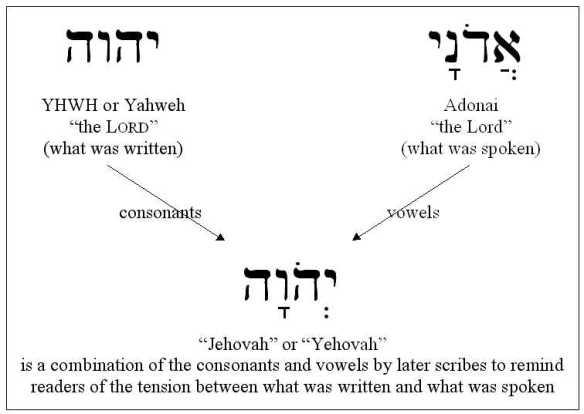
The name “Yahweh”—usually abbreviated as YHWH—appears frequently throughout the Old Testament. Have you ever noticed that some English Bibles spell the word “LORD” with all capital letters? It’s the publishers’ way of cluing us in as to when the name YHWH appears in the Hebrew.

But wait, you might be thinking. What about the name “Jehovah?” That’s actually an interesting story.

See, the name Yahweh is so deeply personal that the Jews preferred not to say it—fearing that doing so would be to utter God’s name in vain and violate the third commandment. So what they would do is they would deliberately substitute the name “Adonai” instead.

How did they know when to do this? The Hebrew language doesn’t usually use written vowels—only consonants. But in the ancient world they found it helpful to write vowels underneath the words to help in religious ceremonies. So what they did was they went through the Old Testament, and every time they saw the name “Yahweh,” they would write the vowels for the word “Adonai.” This was to remind them that when they came across the name “Yahweh,” they were to say the word “Adonai.” Does this sound complicated? Sure; but it was what they did when they desired to retain the Holiness of God.

Now imagine you don’t know about this practice. You learn some Hebrew, and you decide to read along—and then you encounter “Yahweh” with the vowels for “Adonai” underneath. When you mash them together, you get the word “Jehovah.” That’s literally where it comes from—the ancient equivalent of a typo.  So the word “Jehovah” never appears in the Bible; it’s just not one of God’s names.

yhwh

THE EMERGENCE OF “FATHER”

So what about “Father?” Naturally, the role of “Father” became most prominent with the arrival of Jesus, the Son, but this is not to say that the Old Testament lacks reference to God as Father. In the Psalms we read:

Father of the fatherless and protector of widows
is God in his holy habitation. (Psalm 68:5)

Elsewhere God’s Fatherhood is emphasized in relationship to the nation of Israel. That is, God didn’t just create the natural world; He also formed the nation as His people:

Do you thus repay the Lord,
you foolish and senseless people?
Is not he your father, who created you,
who made you and established you? (Deuteronomy 32:6)

But now, O Lord, you are our Father;
we are the clay, and you are our potter;
we are all the work of your hand. (Isaiah 64:8)

WHY THIS MATTERS

Why is this so important? Because while the New Testament clarifies God’s role as Father, there’s no actual change in His character from the world of the Old Testament to the New.

But because God the Father has a definite name and a definite identity, it defies our attempts to alter God to suit our needs—or, more accurately, our wants. After their escape from Egypt, the people of Israel grew restless and impatient, with God as well as with Moses. So Aaron helped the people melt down their jewelry and make a golden calf. “These are your gods,” they said, “who brought you up out of the Land of Egypt” (Exodus 32:4). Aaron even declared that the next day would be a “feast to the LORD” (32:5)—and yes, the word YHWH appears there.

It’s tempting, of course, when moments seem desperate, to re-fashion God into something that serves our immediate wants and felt needs. But if God has a name, if God reveals Himself as Father, then we have to put His name to His face. That is, we have to take God as He is, not merely who we’d like Him to be. Because in both the quieter moments of loneliness and amidst the noise of human desperation, I need to know that I can trust a God who transcends—nay, defies the limits of human imagination. That’s a God I can depend on. That’s a God worth believing in. And the most spectacular news of all is not only do we know Him by name, but He knows each of ours as well.

Be a Monkey, Copy This

I grew up wanting to be just like my older brother-in-law, who today in his upper 80s is still one of the finest human beings the world has ever known. If you want to be like someone, you need to know them, observe them, identify their attributes, and commit to copying them and deploying them in your life.

We are encouraged to be like God – to be like the visible expression of God in Jesus Christ. So we need to know the attributes of God – the topic we’ve studied these past two weeks.

Again, the attributes of God are broken into two large categories. Chris spoke and wrote about the first group last week, and today we finish the second category.

In theology the words used to title those two categories are communicable and incommunicable. These are not words we use very much in common speech. I had to laugh immediately last Sunday during the sermon when I asked for a show of hands as to who recently had used these words, and immediately all the hands of the medical workers in the congregation went up. These words are used to speak of diseases.

Communicable diseases are those that can be spread from person to person. Some examples are the Common Cold, Chicken Pox, and Strep Throat. So, if you’re dealing with one of these, sneeze into your elbow!  It is easy to share these diseases.

Incommunicable (or non-communicable) diseases are those that can’t travel from person to person. These diseases include allergies, diabetes, and sickle cell disease. It is not possible to share these diseases.

Chris wrote last week about the various incommunicable attributes that God possesses. We do not have these, as much as we might want them …

  • Self-sufficient – that God is not dependent upon anything or anyone else – I can think and say that I am like that, but after about five or six hours, I’m ready for a hamburger or something.
  • Unchanging / Immutable — I want to consistently love everyone all of the time, but then I look at Facebook and see what people say and think, and I might change loving them quite so much.
  • Omnipotent – We might like to be this, but it would be dangerous without also having all of the other characteristics of God. I might wish to have it, and if I did I’m sorry to tell you Redskins, Steelers and Patriots fans that your teams would never again win a game – even when they played each other; and even though that’s not logically possible to have two losses out of one game, in my mind that would be a display of justice as well. But I sadly cannot make that happen.
  • Omniscience – I thought I knew it all until I realized I didn’t know I didn’t know it all; and I thought I made a mistake one time, but I was wrong … you get the picture.
  • Omnipresence – My goodness, I go months at a time and never even leave Washington County, not even for the Alps in the summer or the South Pacific in the winter. Hot or cold, I’m stuck in one place.

So these are incommunicable attributes.

This week we have written about those attributes that are communicable. Or another way of saying it is that we are speaking about God’s “nearness” rather than His “uniqueness.”  These are attributes we may share with God as a result of being created in the image of God. We should seek to exemplify these qualities more and more as we mature in the faith.

And finally today, the greatest characteristic that defines God in summary fashion is that He is love and mercy. This is sort of the “default” characteristic of God, though others of which we have written, like wrath and judgment due to his justice, are necessary and consistent in certain circumstances.

There are so many ways to speak of God’s love and to illustrate it – from creation, to mankind, to the nation of Israel, to the love within the Trinity, love for the lost, and down to the specific love of God for those who come to Christ for salvation …

Romans 5:8 – But God shows his love for us in that while we were still sinners, Christ died for us.

Galatians 2:20 – I have been crucified with Christ. It is no longer I who live, but Christ who lives in me. And the life I now live in the flesh I live by faith in the Son of God, who loved me and gave himself for me.

And in terms of us being like God and emulating His character, the emphasis upon this attribute will take us far in every other way. It is a summary attitude that finds action both toward God and others.

Jesus silenced the Pharisees with this summary idea in Matthew 22…

Matthew 22:34-40 – Hearing that Jesus had silenced the Sadducees, the Pharisees got together. One of them, an expert in the law, tested him with this question: “Teacher, which is the greatest commandment in the Law?”

Jesus replied: “‘Love the Lord your God with all your heart and with all your soul and with all your mind.’ This is the first and greatest commandment. And the second is like it: ‘Love your neighbor as yourself.’  All the Law and the Prophets hang on these two commandments.”

So there is our summary and practical challenge. Having seen what God is like and wanting to be like Him, the attitude and action of genuinely loving and serving others is the very best use of our life-long energies.

So, even though you can’t be LIKE God, I’ve told you that you should try to be like God in the (communicable) ways that you can. Be a monkey and copy this! See, this theological study stuff really is practical! So, just do it! No pressure, just don’t mess up!

Righteous Wrath

A long-time former nurse told me a story this week about an incident in her early medical career. She was with a hospitalized patient who was not making progress and was in a serious, life-threatening condition. The doctor was more absent than in touch with the situation and did not seem to grasp the gravity of the situation as this nurse knew it certainly to be. She went to her supervisor and so on up the chain – each person being unwilling to challenge this notoriously arrogant doctor who ranked high in the hospital chain of command. Finally, at about 2:00 in the morning, the nurse risked everything and called the hospital chief physician at his home, describing the problem. The doctor was thereby ordered back to his patient, did the correct procedure, and then took the credit and adulation for saving the patient’s life.

Has something ever made you so angry that you could not contain your emotions about an injustice or wrongful event you saw transpiring? Finally, it all came erupting out of you?

Whenever we think of anger, we almost always associate it with a negative characteristic… “He’s such an angry guy.”  Wrath is listed as one of the attributes of God. How can that be?

There really is an anger directed at wrong that is not sinful or inappropriate – think of Jesus and the cleansing of the Temple, for example.  Yet it is not our role or authority to aggressively act out in vengeance against the wrongful things that may justly anger us – that is a role reserved for God… “Do not take revenge, my dear friends, but leave room for God’s wrath, for it is written: ‘It is mine to avenge; I will repay,’ says the Lord.”

God’s wrath is demanded by God’s justice. How could God, with omnipotent power, be truly just and righteous and not finally judge and eliminate wrongdoing and injustice?  Some folks, who struggle to believe, misunderstand that God’s grace-filled delay in instituting justice is because He either does not care or that He is unable to do anything about it. But to perfectly fix every wrong and make everything right at every turn is not what earth is about – perfection is what heaven is about. And God’s delayed judgment and display of wrath now is His grace that many may be saved from the curse of sin and death, and flee to Him for salvation.

John 3:36 – Whoever believes in the Son has eternal life; whoever does not obey the Son shall not see life, but the wrath of God remains on him.

We can be thankful for a God with an attribute of wrath. What justice or fairness would there be otherwise? It seems that many people want to see God as a doting old grandfather or a flippant and jovial judge who good-naturedly overlooks wrong. That would essentially celebrate lawlessness and be ultimately worthless and totally subjective.

But God’s anger at sin was such that His even greater grace is extended as the cure for those who will receive it. To not love and honor a God like this would sort of be like standing guilty before a judge who is offering you a free get-out-of-jail card if you’ll receive it from him (who paid the price for it), but rather refusing the gift and blaming the judge for allowing the situation to happen that eventuated in you standing before him. That’s kinda dumb, but it’s how much of the world thinks.

Creatively Created to be Creative

As I write these devotionals this week, we have three grandchildren staying with us while their parents are at a trade show in the southwest. My seven-year-old granddaughter is a bundle of creative energy. She is constantly drawing or cutting and gluing papers into artistic shapes. She likes to sit down with me and let her imagination dream up stories for her story blog I set up with her. Beautiful things catch her eye all day long.

We are all drawn to things of beauty. Whereas it may be the fine strokes of Rembrandt for one person, another may find creative beauty in the fine strokes of a specially-built, high horsepower engine. I am somewhere in the middle of those two people – I never was drawn much to art, and anyone who can understand that tangle of belts and hoses and moving parts under the hood of a car is a lot smarter than me!

But as a child I was always captured by the splendor of the night sky. Living in the country and away from metropolitan lights, the sight could be quite dramatic. In middle school I ordered the varied parts from a scientific catalog to build my own telescope, and it worked! The sights were amazing, bringing to my eyes the planets of the solar system and varied galaxies and nebulae from outer space.

The Scripture in Psalm 8:3-4 always resonated deeply within me, “When I consider your heavens, the work of your fingers, the moon and the stars, which you have set in place, what is mankind that you are mindful of them, human beings that you care for them?”  Those words would go through my mind on many an evening when my parents thought I was crazy for getting up by alarm at 3:00 a.m. to catch some particular stellar event. While looking at the sky (with an eye out for skunks), I would imagine that David himself had 3,000 years earlier looked up at the heavens and seen the very same sight.

It is correct to state that one of the attributes of God is creativity, speaking of God’s beauty, glory and creative power. Though not as frequently codified as an attribute as many others we mention in this series, the basic idea is that being created in the image of a creative God, we create because we share something of God’s creative energies. The reason we enjoy such things as art, music, movies, books, stories, hobbies—everything we do with our hands—is a reflection of God’s creative power. We create because we are formed in the image of a Creator.

Some other Scriptures that speak of God’s beauty and creativity …

Ps. 19:1,2 – The heavens declare the glory of God; the skies proclaim the work of his hands. Day after day they pour forth speech; night after night they reveal knowledge.

Ps. 40:5 – Many, Lord my God, are the wonders you have done, the things you planned for us.

None can compare with you; were I to speak and tell of your deeds, they would be too many to declare.

It is a wonderful gift from God to have the ability to apply our interests and energies to creative things that may well last beyond ourselves. Whenever I am in New Jersey or the Lehigh Valley and near the places where ancestors of my family lived, I enjoy driving past the farmsteads – many of them with structures built by great, great-grandparents. They found God to be faithful to them as they forged out a life in the rugged countryside. Many are buried in the churchyards of churches they helped to found, support and construct – using their creative energies for eternal impact. As I’ve often shared with you, it is a worthy endeavor to consider how we may creatively work to have an impact in generations of family beyond our few years.

And beyond these brief years, we who know Christ are headed toward a place of unimaginable beauty. The end of the Scriptures picture it with these words:  And the city has no need of sun or moon to shine on it, for the glory of God gives it light, and its lamp is the Lamb.” (Revelation 21:23)