Formal and Informal Biblical Education (Acts 18:24-28)

I burned up a lot of years of my life in just going to school, more and more – until there weren’t any more degrees to get. Looking back now much later, I’m surprised I did that, because I honestly didn’t especially like the rigors and pressures of academia.

And I sometimes wonder about the value of it all. I don’t regret it, and indeed the academic skills learned at Dallas Theological Seminary are a part of just about every day of my life. Even so, the experience gained in the large church in Dallas where I was privileged to serve on the eight-pastor staff as minister of music was even more influential and enriching.

Just this past weekend I made a biblical Greek reference in a local pastors’ forum – a remark that I thought was rather basic for clergy with a biblical education. But it apparently blew over everyone’s head except for one guy who caught the humor in it. I could tell that others thought it was just strange, at best. Oh well.

Sometimes people seem a bit in awe of formal theological education, as if I had spent years at the very feet of Jesus and gained a level of insight they could never attain. Other times I have encountered people who make off-the-wall theological assertions fully in error, and when I politely attempt to bring a biblical precision to the issue, they blow it off as the foolishness of a know-it-all who wasted his life in a classroom.

The enrichment that can come from a formal program of biblical and theological education can be a wonderful tool in life. Yet such is not a necessity for a person to have a very high-level, working knowledge of the Scriptures – that informs one’s own life and positions a person to instruct and disciple others.

We will see in today’s passage both types of people in Apollos and in the couple Priscilla and Aquila. All of them were a part of Paul’s close acquaintances and co-workers in ministry for the establishment of the local church throughout the Roman world. Recall from our earlier discussion that Aquila and Priscilla were Jews who shared the same occupational skill as Paul: tent making. They had interpersonal skills and leadership abilities, surely having been discipled by Paul while they stitched leather together. And this couple meets a true academic in a fellow name Apollos, a highly-educated university fellow.

Apollos was from Alexandria in Egypt, which was a significant center of education. As a man who would stand and teach in the synagogue, his messages were true to the Old Testament Scripture; and he was accurate about the Messiah in the same vein of teaching as was heralded by John the Baptist. However, he was unfamiliar with the rest of the story and its fulfillment in Jesus. Priscilla and Aquila take him aside and explain all of this to him. Get the picture here? Tentmakers are teaching the slick university dude! And it works. Apollos becomes a great early spokesman for the cause of the Gospel and heads out on his own tour of proclamation, crossing the Aegean and going presumably to Corinth.

Here is the passage …

Acts 18:24 – Meanwhile a Jew named Apollos, a native of Alexandria, came to Ephesus. He was a learned man, with a thorough knowledge of the Scriptures. 25 He had been instructed in the way of the Lord, and he spoke with great fervor[a] and taught about Jesus accurately, though he knew only the baptism of John. 26 He began to speak boldly in the synagogue. When Priscilla and Aquila heard him, they invited him to their home and explained to him the way of God more adequately.

27 When Apollos wanted to go to Achaia, the brothers and sisters encouraged him and wrote to the disciples there to welcome him. When he arrived, he was a great help to those who by grace had believed. 28 For he vigorously refuted his Jewish opponents in public debate, proving from the Scriptures that Jesus was the Messiah.

Formal education is a grand thing when it is available. But that is not the only way to be biblically literate at a high level. This is especially true in our modern era where advanced learning is only a few clicks away. If you’ve been in my office you know that I have thousands of books, many of them of the reference sort. They were expensive when purchased during my seminary years, as we were encouraged to build our own personal libraries. Now, most of those resources are available online for a fraction of the cost.

We live in a time with a wealth of information available to us. If there was ever a time when there was little excuse for not knowing the Scriptures, it is now. Paul encouraged Timothy with this timeless truth: Do your best to present yourself to God as one approved, a worker who does not need to be ashamed and who correctly handles the word of truth.

Frequent Flyer Miles (Acts 18:18-23)

As a guy who can go months and months at a time and never travel outside the Tri-State area, I’m the last person to gain frequent flyer miles or bonus travel points. It is too bad for the Apostle Paul that such deals did not exist in his day. I cannot imagine that there were many people in the ancient world who ever logged the total number of miles that Paul did on his various journeys.

Those who study and write about the New Testament era often include this following passage from Galatians 4:4-5 as a part of the background for understanding this unique era …

But when the set time had fully come, God sent his Son, born of a woman, born under the law, to redeem those under the law, that we might receive adoption to sonship.

The King James Version began verse 4 with the famous phrase, “In the fullness of time …”  So what does this mean? Several items are encompassed to explain this, including the fervent Jewish expectation of a Messiah, a common trade language throughout the world (Greek), the “Pax Romana” (Roman peace and ruling authority) that lessened major conflicts, and finally the Roman system of roads. All of these contributed to the spread of the gospel. And of that final item, never before were people able to travel great distances from city to city with such relative ease.

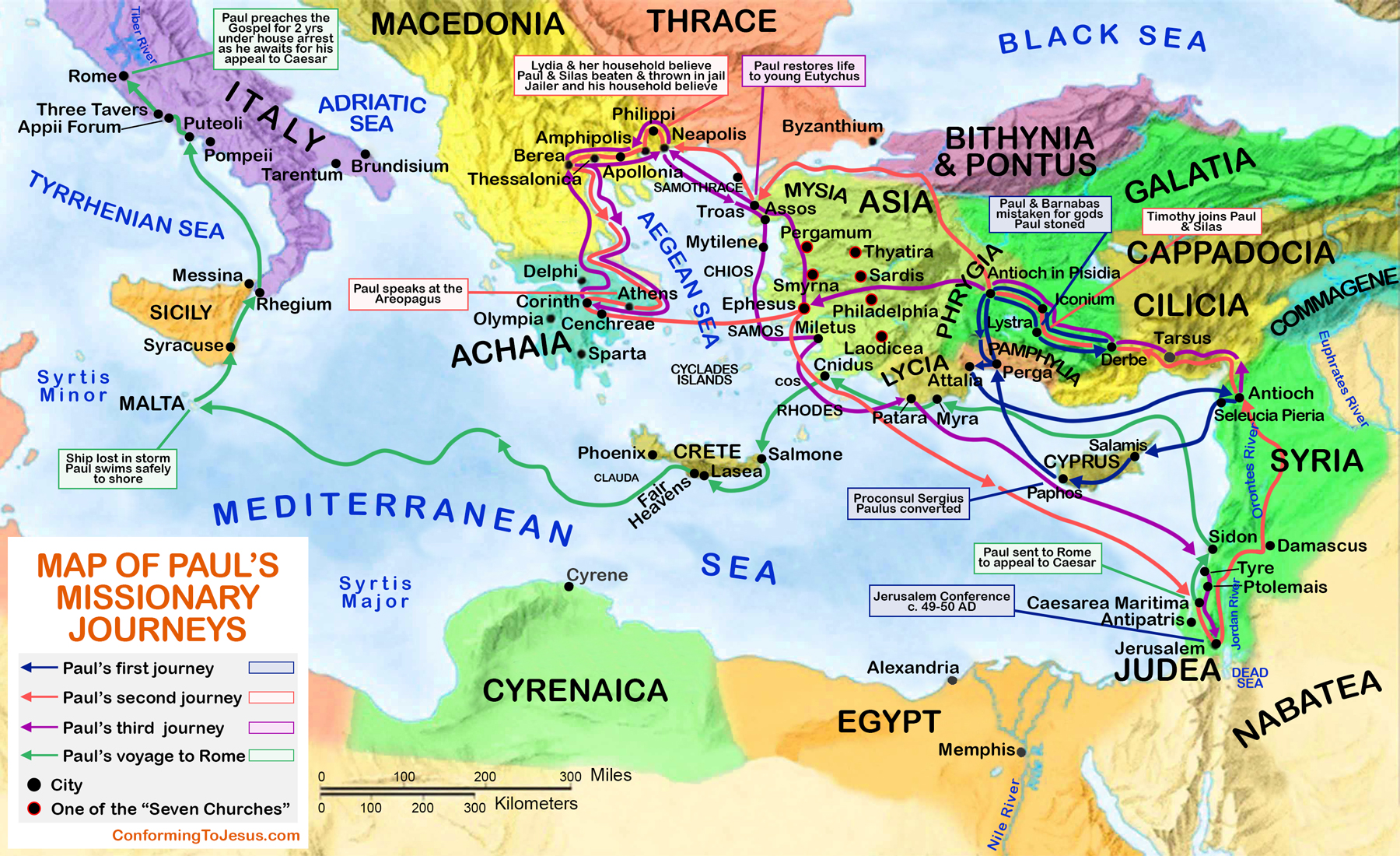
However, by our standards, it was still quite an ordeal for someone like Paul to undertake his varied journeys. The distances are really substantial – then and now. Perhaps the point could be illustrated best by taking a look at a map of Paul’s three missionary journeys and his ultimate trip to Rome. You can click HERE to see one and to note the incredible distances.

Our passage today details events as Paul’s second journey ends, followed by what appeared to be a rather brief time in Jerusalem and the sending church of Antioch of Syria, before our writer Luke has Paul on the road again for the third journey.

Acts 18:18 – Paul stayed on in Corinth for some time. Then he left the brothers and sisters and sailed for Syria, accompanied by Priscilla and Aquila. Before he sailed, he had his hair cut off at Cenchreae because of a vow he had taken. 19 They arrived at Ephesus, where Paul left Priscilla and Aquila. He himself went into the synagogue and reasoned with the Jews. 20 When they asked him to spend more time with them, he declined. 21 But as he left, he promised, “I will come back if it is God’s will.” Then he set sail from Ephesus. 22 When he landed at Caesarea, he went up to Jerusalem and greeted the church and then went down to Antioch.

The third journey begins

Acts 18:23 – After spending some time in Antioch, Paul set out from there and traveled from place to place throughout the region of Galatia and Phrygia, strengthening all the disciples.

Just these few verses involve hundreds and hundreds of miles of travel by both land and sea. And the accommodations must have surely been oft difficult, especially on ships sailing the Mediterranean (as we’ll see graphically written about later in our studies).

We see our missionaries today when they report to us of their travels and foreign service, and we may at times see it all as an exotic adventure. Indeed they do get to see many things that most of us are not privileged to see in our lifetimes, but the personal cost of it all is very taxing physically and emotionally.

Missionary work is hard – then and now. It involves great effort to cover great distances, enduring all of the inconveniences of living in a foreign culture. But to be involved in it on either the going or sending end is our calling as God’s people. It is complicated; it is expensive; and it can be sometimes rather dangerous. But it is worth it to take the gospel to the ends of the earth. But best of all are Christ’s words in the great commission that he will be with us to the very end of time.

Time Together is Short (Thessalonian Letters)

Many years ago as a younger man I was leading a teen missions trip to Scotland, doing VBS ministry on the English Channel beach in Scarborough by day, while doing concerts at night with the musical group of high school kids we took over there. Some of the local Scottish young men we served with were intent upon learning American football, so I spent an hour or so each morning on the beach with them by dividing into teams and going over the basics (which aren’t very basic or obvious in another culture!).  I played quarterback for both teams since none of them could throw a spiral pass.

They did get better every day and remembered more and more of the many rules. But every so often, even toward the end of my time with them, they would simply forget what was taught or a unique game situation would rise that I had not yet covered. The competition at that point would immediately fall apart and essentially devolve into a rugby contest. Bedlam!

I just didn’t have enough time with them to really get them grounded in how to play the game so that they could do it on their own. We had to move on, but I gave the football to them in hopes they would keep playing and learning.

That is a “wee illustration me lads” (to speak Scottish with you) of how Paul felt about the Thessalonians. His stay with them was very brief before controversy arose and he had to leave town. There were some wonderful folks who had come to faith and who could be strong leaders in a church, if only someone had the time and access to disciple them. Paul was frustrated and sad that he could not personally see this happen, and he also had a great concern for them. So it was during his 18-month time in Corinth that most scholars believe he wrote twice to these new Christians.

So today we think about the second and third of Paul’s letters in the order that he composed them: 1st and 2nd Thessalonians. Previously we looked at his first letter: Galatians.

We immediately see Paul’s affection for them and his thanks for their faith and their endurance even in the midst of suffering …

1 Thess. 1:2 – We always thank God for all of you and continually mention you in our prayers. 3 We remember before our God and Father your work produced by faith, your labor prompted by love, and your endurance inspired by hope in our Lord Jesus Christ.

4 For we know, brothers and sisters loved by God, that he has chosen you, 5 because our gospel came to you not simply with words but also with power, with the Holy Spirit and deep conviction. You know how we lived among you for your sake. 6 You became imitators of us and of the Lord, for you welcomed the message in the midst of severe suffering with the joy given by the Holy Spirit. 7 And so you became a model to all the believers in Macedonia and Achaia. 8 The Lord’s message rang out from you not only in Macedonia and Achaia—your faith in God has become known everywhere.

When Paul went from Berea to Athens, he sent Timothy back to Thessalonica, knowing he could not himself dare to go there. He knew they would face difficult times, and Paul’s heart for them is again evident …

1 Thess. 3:4 – In fact, when we were with you, we kept telling you that we would be persecuted. And it turned out that way, as you well know. 5 For this reason, when I could stand it no longer, I sent to find out about your faith. I was afraid that in some way the tempter had tempted you and that our labors might have been in vain. 6 But Timothy has just now come to us from you and has brought good news about your faith and love. He has told us that you always have pleasant memories of us and that you long to see us, just as we also long to see you.

Much of the rest of these two letters deal with what appears to be a series of questions about faith and doctrine that were likely passed on to Paul from Timothy’s visit with them. These involve matters of morality and godly living, an exhortation to not be lazy but rather to be industrious, and also some of the best instruction we have about the coming again of the Lord and of the final times. Paul summarizes some of these thoughts in the second letter …

2 Thess. 2:15 – So then, brothers and sisters, stand firm and hold fast to the teachings we passed on to you, whether by word of mouth or by letter. 16 May our Lord Jesus Christ himself and God our Father, who loved us and by his grace gave us eternal encouragement and good hope, 17 encourage your hearts and strengthen you in every good deed and word.

A devotional thought that comes to me today is to remind ourselves that we only have a window of time – in our lives, and in our lives together – to learn, grow, and apply God’s Word in service with and to each other. This is a precious time, every bit of it. Let us make the most of that time, before it passes.

Just Keep On Talking (Acts 18:1-17)

It is difficult to endure and maintain doing anything when there are few visible results relative to the efforts applied, or worse yet when your activity seems personally disadvantageous. The response to Paul’s gospel preaching in Athens was rather minimal, and all of the controversies in Macedonia were not very far in the past.

Paul goes on to Corinth where we see that he meets and stays with a Jewish couple – Aquila and Priscilla.

Acts 18:1 – After this, Paul left Athens and went to Corinth. 2 There he met a Jew named Aquila, a native of Pontus, who had recently come from Italy with his wife Priscilla, because Claudius had ordered all Jews to leave Rome. Paul went to see them, 3 and because he was a tentmaker as they were, he stayed and worked with them. 4 Every Sabbath he reasoned in the synagogue, trying to persuade Jews and Greeks.

We don’t know if they all knew each other previously, if this couple had become Christians in the past, or if their salvation was through this association with Paul. Perhaps they merely came into partnership because of the common trade of tent making (leather working). This likely also indicates that Paul needed to make some money for personal sustenance. But when Silas and Timothy arrive, they bring an offering that thereby set Paul free to concentrate on preaching.

Acts 18:5 – When Silas and Timothy came from Macedonia, Paul devoted himself exclusively to preaching, testifying to the Jews that Jesus was the Messiah. 6 But when they opposed Paul and became abusive, he shook out his clothes in protest and said to them, “Your blood be on your own heads! I am innocent of it. From now on I will go to the Gentiles.

Ugh! It happens again – Jewish opposition. You can’t blame Paul for being very disgusted and exclaiming how he would focus now on Gentile ministry.

Acts 18:7 – Then Paul left the synagogue and went next door to the house of Titius Justus, a worshiper of God. 8 Crispus, the synagogue leader, and his entire household believed in the Lord; and many of the Corinthians who heard Paul believed and were baptized.

There is a humorous component to this story, in that Paul ends up teaching immediately next door to the synagogue, along with Crispus (the former synagogue leader) coming to faith. Surely it was a daily irritation for the stubborn and intransigent Jews to see the life of the growing church immediately next door, including their former leader! And I could imagine how this difficulty would add to all of the other wearying elements in Paul’s life. And the Lord gives Paul a timely word of encouragement …

Acts 18:9 – One night the Lord spoke to Paul in a vision: “Do not be afraid; keep on speaking, do not be silent. 10 For I am with you, and no one is going to attack and harm you, because I have many people in this city.” 11 So Paul stayed in Corinth for a year and a half, teaching them the word of God.

I’ve never had a vision in the night, but I have had a couple of incidents in ministry where the weariness, discouragement and opposition brought me to a point of nearly quitting it all … and God intervened with a timely and unexpected encouragement from some person or circumstance to keep me going.

Also on this occasion, Paul gets the encouragement of a positive outcome in court, seeing his opponents disgraced and driven away…

Acts 17:12 – While Gallio was proconsul of Achaia, the Jews of Corinth made a united attack on Paul and brought him to the place of judgment. 13 “This man,” they charged, “is persuading the people to worship God in ways contrary to the law.” 14 Just as Paul was about to speak, Gallio said to them, “If you Jews were making a complaint about some misdemeanor or serious crime, it would be reasonable for me to listen to you. 15 But since it involves questions about words and names and your own law—settle the matter yourselves. I will not be a judge of such things.” 16 So he drove them off. 17 Then the crowd there turned on Sosthenes the synagogue leader and beat him in front of the proconsul; and Gallio showed no concern whatever.

So the new synagogue leader takes a beating, this event probably also revealing some anti-Semitic sentiment in this secular city. It also set a legal precedent that this Jesus teaching was (in Roman eyes) just a dispute within Judaism rather than an illegal new religion.

Just keep on talking – that was the encouragement from the Lord to Paul. Out of Paul’s talking in these 18 months in Corinth would come the effective discipling of Aquila and Priscilla. As well, many in the church at Corinth would be discipled toward the growth of a substantial body of believers.

Likewise for us, we should not be discouraged but continue to keep on speaking truth. Someone said in the Scriptures to “not become weary in doing good, for at the proper time we will reap a harvest if we do not give up.”  Oh … wait … Paul said that!  (Galatians 6:9)

Results are Overrated (Acts 17:16-34)

Let us imagine what living arrangements will be like in the Celestial City.

There will be an elite section of town with all of the biggest mansions on Goldstone Street. These residences will be the eternal abode of the most famous preachers in the history of the church. Spurgeon will be living next to D.L. Moody, with Martin Luther just across the road. The largest mansions will house American mega-church pastors of 15,000+ congregations. Smoke machines on the front porch will run 24/7 so as to capture the glow of the varied-colored spotlights shining upon the home from the front yard. To enter the mansion, a man needs to wear a three-piece suit and sport a continuous grin, even when talking… although, for those who came to inherit these homes after 2012 in earth years, one may enter with blue jeans over European-styled, shiny, pointed shoes, along with a plaid shirt purchased from Untuckit.com.

There will also be a poor part of the city, on the other side of the river and near the edge of town. Though still nicer than earthly homes (this is heaven, after all), these basically functional structures will serve as the eternal abode of those who just didn’t pull in the results (numbers) during their earthly ministries. The worst of these comparative cottages will house those missionaries who spent a lifetime in a remote, third-world country that was hostile to the gospel. It is only logical that a mere 15 converts to Christ over 40 years of preaching simply cannot buy you much of an eternal crib. In homes only slightly more upscale are those pastors who labored in rural America and never once grew a church to a point of needing a building campaign.

Really? Is that how God operates? It’s all about results, right?  Is that not what we are led to believe? And Paul always had huge results with his preaching, right?

Today’s passage about Paul’s time in Athens is our text today from Acts 17, where it says …

Acts 17:16 – While Paul was waiting for them in Athens, he was greatly distressed to see that the city was full of idols. 17 So he reasoned in the synagogue with both Jews and God-fearing Greeks, as well as in the marketplace day by day with those who happened to be there. 18 A group of Epicurean and Stoic philosophers began to debate with him. Some of them asked, “What is this babbler trying to say?” Others remarked, “He seems to be advocating foreign gods.” They said this because Paul was preaching the good news about Jesus and the resurrection. 19 Then they took him and brought him to a meeting of the Areopagus, where they said to him, “May we know what this new teaching is that you are presenting? 20 You are bringing some strange ideas to our ears, and we would like to know what they mean.” 21 (All the Athenians and the foreigners who lived there spent their time doing nothing but talking about and listening to the latest ideas.)

22 Paul then stood up in the meeting of the Areopagus and said: “People of Athens! I see that in every way you are very religious. 23 For as I walked around and looked carefully at your objects of worship, I even found an altar with this inscription: to an unknown god. So you are ignorant of the very thing you worship—and this is what I am going to proclaim to you.

24 “The God who made the world and everything in it is the Lord of heaven and earth and does not live in temples built by human hands. 25 And he is not served by human hands, as if he needed anything. Rather, he himself gives everyone life and breath and everything else. 26 From one man he made all the nations, that they should inhabit the whole earth; and he marked out their appointed times in history and the boundaries of their lands. 27 God did this so that they would seek him and perhaps reach out for him and find him, though he is not far from any one of us. 28 ‘For in him we live and move and have our being.’ [From the Cretan philosopher Epimenides]  As some of your own poets have said, ‘We are his offspring.’ [From the Cilician Stoic philosopher Aratus]

29 “Therefore since we are God’s offspring, we should not think that the divine being is like gold or silver or stone—an image made by human design and skill. 30 In the past God overlooked such ignorance, but now he commands all people everywhere to repent. 31 For he has set a day when he will judge the world with justice by the man he has appointed. He has given proof of this to everyone by raising him from the dead.”

32 When they heard about the resurrection of the dead, some of them sneered, but others said, “We want to hear you again on this subject.” 33 At that, Paul left the Council. 34 Some of the people became followers of Paul and believed. Among them was Dionysius, a member of the Areopagus, also a woman named Damaris, and a number of others.

This passage will be our focus for more detailed discussion this coming Sunday. But quickly here today – Here is Paul in Athens, having been recently tossed out of another city for preaching. He is waiting for Silas and Timothy to finish in Berea and catch up to him. You could not blame him for taking some time off and having a tourist-like good time in the ancient city of Athens.

But while walking around town, the sight of the city full of idols was just too much for him. And when it says “full of idols,” read that very literally. Someone wrote that it was easier to find an idol in Athens than to find a man. And Paul begins preaching and evangelizing in a place where folks spent all of their time (again, literal) listening to see if someone had any sort of new ideas to consider that had never been debated before. And Paul’s preaching about what sounds like a god named “resurrection” and a god named “je-sus” fit the bill… enough to humor them by bringing him before the official town council.

Paul begins with the familiar – their own admission that they did not know everything, evidenced by the fact of a god labelled as “unknown.”  Wanting to be thorough and to also not massively irritate some god they simply did not know about, there were statues to unknown gods so that they could be pacified.

Let’s hurry to the results: they were huge, right?  Not really. Most of them wrote off Paul completely. Some said they would listen again another time, and finally there were just a few who responded positively. Among them was Dionysius, a member of the Areopagus, also a woman named Damaris, and a number of others.

Paul really blew it, didn’t he?  Nope. I don’t think so. I think this is among his best sermons.

Here’s the point. Results aren’t our responsibility; they are the work of God, through the Word of God, by the power of the Spirit. Our responsibility is to be faithful and speak the truth. And when we do, we will get the same results as Paul: most will blow it off, some will be willing to listen again another time, and by God’s life-giving grace a few will respond in faith. We plant; we water; but God gives the increase – Paul said that too!

Yes, results are overrated, but faithfulness is not!

Winning the NOBLE Prize (Acts 17:10-15)

It is seen as a great honor to be a winner of the Nobel Prize, though some recent winners have tainted it in my view. However, I’ve got something better for you to gain: it is not the Nobel Prize, but rather the “noble prize.”

In any endeavor, true success comes when you get to the center of understanding how to do something the proper and best way. Do you desire to live life the right way? Then you need to gain a deep understanding of the manual about what life is all about – God’s Word. It contains all of the big ideas of what life is about – what makes it difficult, and how a relationship with God brings victory over that difficulty. Knowing the Bible is THE big difference-maker in life.

Paul and Silas had to escape from Thessalonica because of the uproar created by the hostile Jewish element in that town. They travel on through a couple of smaller towns before coming to the city of Berea, where again they commence ministry through the synagogue. And we read that there is a marked difference with this particular Jewish group as compared to others encountered in their missionary travels …

Acts 17:10 – As soon as it was night [in Thessalonica], the believers sent Paul and Silas away to Berea. On arriving there, they went to the Jewish synagogue. 11 Now the Berean Jews were of more noble character than those in Thessalonica, for they received the message with great eagerness and examined the Scriptures every day to see if what Paul said was true. 12 As a result, many of them believed, as did also a number of prominent Greek women and many Greek men.

13 But when the Jews in Thessalonica learned that Paul was preaching the word of God at Berea, some of them went there too, agitating the crowds and stirring them up. 14 The believers immediately sent Paul to the coast, but Silas and Timothy stayed at Berea. 15 Those who escorted Paul brought him to Athens and then left with instructions for Silas and Timothy to join him as soon as possible.

So these Jews were said to be more noble of character – the Greek word literally meaning that they were more noble-minded in a desire for deep understanding. As well, they had great eagerness – a word that speaks of energetic zeal and a quick readiness of mind. Man, you put all of that together in the direction of studying God’s Word, you’ve really got something – then or now.

Paul’s preaching would have involved what we know as the Old Testament. Surely he majored on the prophetic Scriptures that anticipated the Messiah, thereby proving that Jesus was the fulfillment of this expectation. Whereas the vast majority of Jews everywhere else were more interested in maintaining old traditions than discovering the fulfillment of truth, this group was committed to gaining truth from the objective source of all truth.

But the same pattern repeats as before. The militant faction from the previous town hears of the next place of missionary activity and follows Paul, Silas and company to that location. There again they agitate (a Greek word that means to move something from side to side) and stir up a crowd of opposition. The focus was particularly on Paul, so he is escorted by some of the faithful brothers to move on, ultimately to Athens as we will study tomorrow. Silas and Timothy are able to stay for a time and do some more work is setting up a church community.

Over the decades of my ministry work I have been occasionally told that I am too academic in approach. I’m recognize a personal weakness in that I am too thin-skinned for leadership and have been too often easily wounded, but this accusation is one that never much bothered me. There is simply no substitute for knowing (and of course, applying) the Word of God. Those who do, they live successful Christian lives. Those who don’t, they struggle to put the pieces together. Be noble!

More than Meets the Eye (Acts 17:1-9)

Very few people can understand how I could possibly enjoy what is one of my favorite activities. For most folks, it is a terrible chore. But I love doing it! I look forward to it each week and am often sad when it is all done. I love cutting grass!

I myself have tried to analyze this, attempting to understand why I find such satisfaction in it. I know that it reminds me of my country-life childhood – where I regularly did this at my own home and for my grandparents who lived across the road.

But I think it is more than just that. I like the roar of the mower and the solitude that comes with being detached from the rest of the world. The phone and computer can’t get me.

Yet it is still something more than that. I have concluded that it relates to investing time in doing something and seeing the visible fruit of it. When cutting grass, you can see results.

In the work of ministry there are not always a lot of visible results. To some extent there are metrics like numbers of church attenders, people getting baptized, etc.  But true and lasting spiritual fruit is difficult to quantify.

As we turn to Acts chapter 17, it looks at first glance like another new city (Thessalonica) on Paul’s missionary journey, another set of angry people, another riot, and another instance of Paul either getting thrown out of town or having to narrowly escape. But there is more than just that …

Acts 17:1 – When Paul and his companions had passed through Amphipolis and Apollonia, they came to Thessalonica, where there was a Jewish synagogue. 2 As was his custom, Paul went into the synagogue, and on three Sabbath days he reasoned with them from the Scriptures, 3 explaining and proving that the Messiah had to suffer and rise from the dead. “This Jesus I am proclaiming to you is the Messiah,” he said. 4 Some of the Jews were persuaded and joined Paul and Silas, as did a large number of God-fearing Greeks and quite a few prominent women.

5 – But other Jews were jealous; so they rounded up some bad characters from the marketplace, formed a mob and started a riot in the city. They rushed to Jason’s house in search of Paul and Silas in order to bring them out to the crowd. 6 But when they did not find them, they dragged Jason and some other believers before the city officials, shouting: “These men who have caused trouble all over the world have now come here, 7 and Jason has welcomed them into his house. They are all defying Caesar’s decrees, saying that there is another king, one called Jesus.” 8 When they heard this, the crowd and the city officials were thrown into turmoil. 9 Then they made Jason and the others post bond and let them go.

10 As soon as it was night, the believers sent Paul and Silas away to Berea.

Though we see some recorded results of a number of Jews who followed the gospel message along with a larger number of Gentiles (as referenced in 1 Thess. 1:9), it sounds like Paul and Silas were merely there for three weeks before having to high-tail it out of town. This is because of the text referencing three Sabbaths in the synagogue. But we know from other passages that the Philippians (4:15-16) sent a couple of offerings to them during this time, implying a longer stay. As well, Paul spoke in both of his letters to this church about supporting himself there by working at his trade.

In any event, the preaching was done, converts came to faith, and what would prove to be a significant church was planted.

God is going to get His work done. The big idea of this week will be to talk about how our role is faithfulness, while God’s role is giving success to His word through bringing people to biblical understanding and salvation. It is a nice bonus when we can see and experience results.

We all have different places in the vineyard of his service. Some are led to serve in more difficult areas than others. Some are more on the planting and production end, whereas others have the assignment on the fruit gathering end. In both cases, our responsibility is to be faithful where were are.

Ministry is not as simple as cutting grass. It is not as measurable as the profit margin of a business. But God’s Word bears fruit over time as we are faithful to live it and share it with others. And that fruit is always more than just what meets the eye.

Can You Sing in the Rain? (Acts 16:25-40)

For some reason, the passage today about Paul and Silas singing in a Philippian jail makes me think of the old Doris Day / Gene Kelley song called “Singing in the Rain.” The words go like this …

I’m singing in the rain

Just singing in the rain

What a glorious feelin’

I’m happy again

I’m laughing at clouds

So dark up above

The sun’s in my heart

And I’m ready for love

Well, I’m not singing in the rain or anything else as I type this (late Thursday night). I can’t get my computer to work, and so I am doing this on an old computer from about seven years ago — it is an antique. So I have no idea how this is going to format. If it looks crazy, I’m sorry.  It looks like my first stop tomorrow morning is going to be at Best Buy, with my Lenovo computer and receipt of purchase from 14 months ago. Pray for the Geek Squad to fix it.

We are so attached to our devices these days. When the computer or phone goes down on us, we are totally out of sync with the rest of the world and life around us. I’m not a happy guy right now! I don’t feel like singing! I feel like complaining.

But Paul and Silas have been beaten unjustly and thrown in prison. I suppose that hurts a good bit, especially with their feet in stocks. But they begin singing! And their songs become a testimony to the prison keeper and the other prisoners. God intervenes with an earthquake and many come to Christ through the whole situation.

Passages like this remind us that God is able to use the darkest and worst days and situations in our lives for great good for us, and for His glory. We would be well to remember that more. I’d like to write more, but I’m going to be content with these few words and include the passage below (I hope) …

25 About midnight Paul and Silas were praying and singing hymns to God, and the other prisoners were listening to them. 26 Suddenly there was such a violent earthquake that the foundations of the prison were shaken. At once all the prison doors flew open, and everyone’s chains came loose. 27 The jailer woke up, and when he saw the prison doors open, he drew his sword and was about to kill himself because he thought the prisoners had escaped. 28 But Paul shouted, “Don’t harm yourself! We are all here!”

29 The jailer called for lights, rushed in and fell trembling before Paul and Silas. 30 He then brought them out and asked, “Sirs, what must I do to be saved?”

31 They replied, “Believe in the Lord Jesus, and you will be saved—you and your household.” 32 Then they spoke the word of the Lord to him and to all the others in his house. 33 At that hour of the night the jailer took them and washed their wounds; then immediately he and all his household were baptized. 34 The jailer brought them into his house and set a meal before them; he was filled with joy because he had come to believe in God—he and his whole household.

35 When it was daylight, the magistrates sent their officers to the jailer with the order: “Release those men.” 36 The jailer told Paul, “The magistrates have ordered that you and Silas be released. Now you can leave. Go in peace.”

37 But Paul said to the officers: “They beat us publicly without a trial, even though we are Roman citizens, and threw us into prison. And now do they want to get rid of us quietly? No! Let them come themselves and escort us out.”

38 The officers reported this to the magistrates, and when they heard that Paul and Silas were Roman citizens, they were alarmed. 39 They came to appease them and escorted them from the prison, requesting them to leave the city. 40 After Paul and Silas came out of the prison, they went to Lydia’s house, where they met with the brothers and sisters and encouraged them. Then they left.

Fake News in Philippi (Acts 16:16-24)

Today I will spare you a running illustration by using one that is 99% as good – one about baseball. Imagine you are watching some kids play baseball and you note rather quickly and easily that the game is totally out of control. Among crazy antics are the following scenarios …

  1. The batter pops up a ball to the second baseman, and just as he is about to catch it, the runner who was on first base flattens him so that the ball hits the ground and everyone is safe.
  2. Next there is a ground ball to the shortstop with runners on first and second. The shortstop does not choose to throw to a base; rather, he hits the baserunner going toward third in the back of the head with a throw, rendering him momentarily unconscious.
  3. A batter hits a ball between the outfielders and immediately runs to second base, returning to home plate over top of the pitcher’s mound, doing a chicken dance at the end and claiming he hit a home run.

After these events, everyone on both sides is totally frustrated and a gang fight breaks out between teams.

At that point you feel you need to restore order and safety, so you step between them and explain the rules of the game as Abner Doubleday invented them in the 1800s!  Those children who listen are able to learn the game of baseball and enjoy playing it correctly. But another group of them simply think you are no fun at all, and they write you off as a legalistic lawgiver who is interfering with everyone’s individual rights and creativity. In fact, this second group goes to the police station and tells the authorities that you are a child stalker, getting you temporarily thrown into jail.

I admit that this is a pretty wild story, but it is no more “out there” than the one that Paul and Silas experienced in our passage for today from Acts 16 …

Acts 16:16 – Once when we were going to the place of prayer, we were met by a female slave who had a spirit by which she predicted the future. She earned a great deal of money for her owners by fortune-telling. 17 She followed Paul and the rest of us, shouting, “These men are servants of the Most High God, who are telling you the way to be saved.” 18 She kept this up for many days. Finally Paul became so annoyed that he turned around and said to the spirit, “In the name of Jesus Christ I command you to come out of her!” At that moment the spirit left her.

19 When her owners realized that their hope of making money was gone, they seized Paul and Silas and dragged them into the marketplace to face the authorities. 20 They brought them before the magistrates and said, “These men are Jews, and are throwing our city into an uproar 21 by advocating customs unlawful for us Romans to accept or practice.”

22 The crowd joined in the attack against Paul and Silas, and the magistrates ordered them to be stripped and beaten with rods. 23 After they had been severely flogged, they were thrown into prison, and the jailer was commanded to guard them carefully. 24 When he received these orders, he put them in the inner cell and fastened their feet in the stocks.

This is a rough start for the gospel ministry in Europe. The slave girl was possessed by a demon, and she was used by her owners for their personal gain. A humorous fact here is that the demon spoke the truth about the missionary team, whereas the crowd told a lie. Though her description was factual, the association with her constantly being nearby was a distraction that Paul finally addressed boldly.

Since Timothy was a half-Gentile and Luke fully Gentile, they did not get the same treatment. The Emperor Claudius had recently thrown all of the Jews out of Rome, and likely this impact and prejudicial feeling extended to the Roman city of Philippi.

The gospel message is not going to be popular in a secular world – then or now. It calls people to a submission to God rather than their own desires – to submit to the rules of the Life Race as God instituted them, so as to have any hope of true success. The messenger of this teaching is therefore going to be discredited and ridiculed as holding to dangerous teachings. The preacher of the gospel is going to be pictured as extreme and eccentric, even with efforts directed toward marginalization.

But none of this should deter us from sharing the words of life with those who are lost. God uses even the worst of circumstances for good and for the gospel message to have impact, so let us not lose heart in being faithful to do and speak what is true and right.

Building a Spiritual Family Tree (Acts 16:11-15)

Currently I have a friendly competition going with my good pal Arnold Horst. He’s not nearly as competitive as I am about this, but I’ve drawn him into the contest of counting grandchildren. He’s leading me at this moment by a score of 13-9, but I have another on the way and the deeper bench for the future. (My slogan for the family is: “We’ve only just begun to reproduce!”)

I have several family members (particularly my mother-in-law) who are really into ancestral research, using the incredible wealth of varied internet resources to build unbelievable family trees of hundreds and hundreds of people. She even found out that we are cousins from seven generations back – into the 1700s! (Hey, we’re all cousins somewhere back there!)

What would it look like to have a spiritual life family tree? Think about the person who brought the gospel to you and to your understanding. Who brought that person to Christ? And before that, who was your “spiritual great-grandparent?”  And then, looking in the other direction, how many children, grandchildren and great-grandchildren can you claim, spiritually speaking?

As we move on today into the next section of Paul’s life as recorded in Acts 16, we see the missionary party heading into Europe for the first time – to the Macedonian (northern Greece) city of Philippi. And we see also that the pronoun of the writer Luke changes from a third person reporter, to a first person plural “we” … indicating that Luke has now personally become a part of the team.

Acts 16:11 – From Troas we put out to sea and sailed straight for Samothrace, and the next day we went on to Neapolis. 12 From there we traveled to Philippi, a Roman colony and the leading city of that district of Macedonia. And we stayed there several days.

13 On the Sabbath we went outside the city gate to the river, where we expected to find a place of prayer. We sat down and began to speak to the women who had gathered there. 14 One of those listening was a woman from the city of Thyatira named Lydia, a dealer in purple cloth. She was a worshiper of God. The Lord opened her heart to respond to Paul’s message. 15 When she and the members of her household were baptized, she invited us to her home. “If you consider me a believer in the Lord,” she said, “come and stay at my house.” And she persuaded us.

Clearly there was a very minimal Jewish element in the Roman colony of Philippi – a place established to be a sort of mini-Rome, populated by Roman citizens and soldiers. Lacking a synagogue, Paul and his travelling companions knew that the place to find any worshippers of Yahweh would be along a riverside. And there they find only some women, including a successful businesswoman named Lydia who was a God-fearer – meaning a Gentile who worshipped the one true God of Israel but who was not an official proselyte. The sovereign hand of God is evident in the story, as she is obviously prepared to hear the story of Christ and, along with her substantial household, become the beginning of a movement of the gospel into Europe.

At first glance, this does not seem to be a very auspicious beginning. One would more likely expect that God should prepare the message to first go to some prominent male leader of great standing in the community. But great things can become of small beginnings. In fact, if we could make a spiritual family tree, probably most of us would be eternal-life-descendants of Lydia. As we’ll talk about later in this series, the church at Philippi would prove to be the one that most blessed Paul and created the least difficulties for him.

Not everyone is a great evangelist by gifting. In fact, most people are not. But all of us have a commission to be witnesses of the gospel within our spheres of influence. And who know what all God might accomplish through some single person any of us may be used by God to introduce to faith. We might find (perhaps only later in heaven above) that we have a huge number of grandchildren and generations descending from us. That is a very cool thought!