
Unknown's avatar

About Randy Buchman

I live in Western Maryland, and among my too many pursuits and hobbies, I regularly feed multiple hungry blogs. I played college baseball, coached championship cross country teams at Williamsport (MD) High School, and have been a sportswriter for various publications and online venues. My main profession was as the lead pastor of a church in Hagerstown called Tri-State Fellowship for 28 years before retiring in 2022. I'm also active in Civil War history and work/serve at Antietam National Battlefield with the Antietam Battlefield Guides organization. Occasionally I sleep.

Incarnation and Kenosis (Philippians 2:1-11)

We preachers like to think that from time to time we come up with a word picture about a biblical concept that so perfectly nails it, we call such a thing a “killer illustration.”  When you’ve got one of these, Saturday night cannot turn over fast enough until Sunday when you can deliver it!

Hey, while I’m letting you behind the curtain of “pastor world” here by that confession above, let me tell you something else that goes on inside us church shepherds. There are times when in a church family you have two people who are really good folks – good workers, dependable, etc.  But they don’t get along well with each other. They just see differently about the way certain things should be done. And along the way you see a few other people gravitating behind each of these folks. In a way, you hate to say anything, because as a pastor you really appreciate the good side of the two leaders; so you end up enduring the negatives to not upset the positives. But invariably a day comes when you’ve got to say something to try to get the situation toward a better place. That is difficult. It can backfire “bigly.”e92l8pwchd4-ben-white

It seems that Paul had such a situation going on in Philippi. He was hearing about it from a distance. There is a hint of the problem in 2:14 where he writes, “Do everything without grumbling or arguing…”  And then finally it all comes spewing out in the final chapter (4:2,3) where he says, I plead with Euodia and I plead with Syntyche to be of the same mind in the Lord. Yes, and I ask you, my true companion, help these women since they have contended at my side in the cause of the gospel, along with Clement and the rest of my co-workers, whose names are in the book of life.”

Boom!  Nothing like getting your names written in the Scriptures because you were having a junior high girl fight! I’d like to know how it turned out. But it might have worked out well, and that is because prior to confronting them in the text, Paul had the greatest “killer illustration” of them all…

2:1 — Therefore if you have any encouragement from being united with Christ, if any comfort from his love, if any common sharing in the Spirit, if any tenderness and compassion, 2 then make my joy complete by being like-minded, having the same love, being one in spirit and of one mind. 3 Do nothing out of selfish ambition or vain conceit. Rather, in humility value others above yourselves, 4 not looking to your own interests but each of you to the interests of the others.

5 In your relationships with one another, have the same mindset as Christ Jesus:

So there is the set-up … or what we call in Bible study the “context.”  Paul is saying that if you’ve got anything good going on at all in your life in relation to the Spirit working within, then be of one mind, one spirit, loving, forgetting ambition or personal interest, and in humility placing a greater value upon the values of others than upon yourself. Nice words, but what does such a thing look like?  Paul says to model the mindset of Jesus Christ …

6 Who, being in very nature God, did not consider equality with God something to be used to his own advantage; 7 rather, he made himself nothing by taking the very nature of a servant, being made in human likeness. 8 And being found in appearance as a man, he humbled himself by becoming obedient to death—even death on a cross!

The humiliation of Christ in his incarnation was so much bigger than any preferring of others that ought to be going on in Philippi … or Phillipsburg … or even Hagerstown!  There is simply no greater voluntary condescension than the attitude and action of Jesus. Check out the downward path >> Though totally God, he didn’t tenaciously hang onto that exalted position >> he became like a servant and took on human flesh >> he allowed himself to be so fully human as to even experience death >> but it was not just an easy natural death, but the worst imaginable – that of a cross.

This passage is called “kenosis” (from the verb ‘kenao’ in the passage) because it speaks of how Jesus emptied himself of the full use of his divine attributes in coming to earth.  This meant that he no longer exercised his omnipotence or other divine powers—except through the power of the Spirit, like when it says that Jesus was “led by” or “full of” the Holy Spirit. So, Jesus was fully God, but while living on earth he voluntarily limited himself to that which the Spirit could do through him.

Christ is an example of how to live and walk by the Spirit. And this “illustration” passage also teaches the great truth of the true humanity of Jesus Christ. He was not some sort of phantom spirit of a higher order than mankind. He was fully human, yet without sin.

9 Therefore God exalted him to the highest place and gave him the name that is above every name, 10 that at the name of Jesus every knee should bow, in heaven and on earth and under the earth, 11 and every tongue acknowledge that Jesus Christ is Lord, to the glory of God the Father.

I’ll pause for a moment while you try to think of a more beautiful passage in the Scripture than is this one … … … OK, yes, didn’t think you could come up with anything.

Did Jesus Always Exist?

Many of you who see me around church or wherever seem to have the same delusion. You keep telling me that I’m limping! There are even times when I’m walking along, and with that inner voice of conversation we have with ourselves inside our head, I say to myself, “Wow, you’re really walking well today … no pain or anything!”  Only to have the next person I see say to me, “So what are you limping about?”  More delusion.

Well I recently met a doctor who says he can fix this and remove this delusion from the minds of other people. It involves some nastiness of cutting this and that. It’s just too gruesome to talk about in a devotional blog. But before I allow this fellow to attempt this (or to even see him long enough to talk about it), I had to know a lot about who he is, where he’s been, what he’s done, and what are his exact credentials to do what he says he can do.

If Jesus is to be what we want him to be and believe him to be as our savior from sin, we should want to know and understand his background and credentials. How long has he been around as a part of the Godhead? Is he an eternal part of God? How long did he exist before being born in Bethlehem? Did God create Jesus the day before the incarnation, outfit him for a perfect human experience and say to him, “You look good Son; you’re going to do a great job!”

All of this discussion is a part of the larger topic of understanding exactly who Jesus is—what we’ll be talking about all of this week. And answering the question as to the eternal preexistence of Jesus is more than the academic stuff of theological debate. Everything rides on it. Because if you don’t have Jesus as an eternal, self-existent part of the Godhead, you have a created being—insufficient to be the payment for sin.

Biblical heresies old and new (as in various cult groups) fall short on this, somehow seeing Jesus as less than the eternal God who always existed. Early on, in Colossians for example, we see Paul battling an emergent form of Gnosticism—a group who saw Jesus as some sort of intermediate spiritual being between God and man. In church history, the eternal preexistence of Christ was affirmed at the Council of Nicaea in A.D. 325 to combat the error of Arianism. Arius believed that Jesus was the first and foremost of created spirits, but not eternal.

Ultimately we affirm the eternality of Jesus Christ as the Divine Son, not because our theology demands it in order to have a qualified savior, but because the Scriptures teach it quite affirmatively. Here are the primary passages to which we would point …

  • The prophet Micah (5:2) in writing of the prophecy of Christ’s birth in Bethlehem says that Jesus will be one who will be ruler over Israel, whose origins are from of old, from ancient times.
  • Likewise Isaiah (9:6), in foretelling the incarnation, wrote that the child to be born was the Wonderful Counselor, Mighty God, Everlasting Father, Prince of Peace.
  • John (1:1-3) begins his gospel by referencing Jesus as the Logos—the Word—saying that In the beginning was the Word, and the Word was with God, and the Word was God. He was with God in the beginning. Through him all things were made; without him nothing was made that has been made.yw2ucaj6oau-martin-sattler
  • The Apostle Paul wrote of the supremacy of Christ to the Colossians (1:16,17), affirming of Jesus: For in him all things were created: things in heaven and on earth, visible and invisible, whether thrones or powers or rulers or authorities; all things have been created through him and for him. He is before all things, and in him all things hold together.  
  • And in John’s Revelation of Jesus Christ (1:11) he reported, “I am the Alpha and the Omega,” says the Lord God, “who is, and who was, and who is to come, the Almighty.”

To deny the eternality of Christ, you would have to deny the authority of Scripture. So Jesus is not a last-minute creation by God to fix everything that went wrong, rather he is the Creator God and the expression of God’s love and grace to redeem a lost creation in the only way it could be saved. This is who loves you and has died for you.

Be a Monkey, Copy This

I grew up wanting to be just like my older brother-in-law, who today in his upper 80s is still one of the finest human beings the world has ever known. If you want to be like someone, you need to know them, observe them, identify their attributes, and commit to copying them and deploying them in your life.

We are encouraged to be like God – to be like the visible expression of God in Jesus Christ. So we need to know the attributes of God – the topic we’ve studied these past two weeks.

Again, the attributes of God are broken into two large categories. Chris spoke and wrote about the first group last week, and today we finish the second category.

In theology the words used to title those two categories are communicable and incommunicable. These are not words we use very much in common speech. I had to laugh immediately last Sunday during the sermon when I asked for a show of hands as to who recently had used these words, and immediately all the hands of the medical workers in the congregation went up. These words are used to speak of diseases.

Communicable diseases are those that can be spread from person to person. Some examples are the Common Cold, Chicken Pox, and Strep Throat. So, if you’re dealing with one of these, sneeze into your elbow!  It is easy to share these diseases.

Incommunicable (or non-communicable) diseases are those that can’t travel from person to person. These diseases include allergies, diabetes, and sickle cell disease. It is not possible to share these diseases.

Chris wrote last week about the various incommunicable attributes that God possesses. We do not have these, as much as we might want them …

  • Self-sufficient – that God is not dependent upon anything or anyone else – I can think and say that I am like that, but after about five or six hours, I’m ready for a hamburger or something.
  • Unchanging / Immutable — I want to consistently love everyone all of the time, but then I look at Facebook and see what people say and think, and I might change loving them quite so much.
  • Omnipotent – We might like to be this, but it would be dangerous without also having all of the other characteristics of God. I might wish to have it, and if I did I’m sorry to tell you Redskins, Steelers and Patriots fans that your teams would never again win a game – even when they played each other; and even though that’s not logically possible to have two losses out of one game, in my mind that would be a display of justice as well. But I sadly cannot make that happen.
  • Omniscience – I thought I knew it all until I realized I didn’t know I didn’t know it all; and I thought I made a mistake one time, but I was wrong … you get the picture.
  • Omnipresence – My goodness, I go months at a time and never even leave Washington County, not even for the Alps in the summer or the South Pacific in the winter. Hot or cold, I’m stuck in one place.

So these are incommunicable attributes.

This week we have written about those attributes that are communicable. Or another way of saying it is that we are speaking about God’s “nearness” rather than His “uniqueness.”  These are attributes we may share with God as a result of being created in the image of God. We should seek to exemplify these qualities more and more as we mature in the faith.

And finally today, the greatest characteristic that defines God in summary fashion is that He is love and mercy. This is sort of the “default” characteristic of God, though others of which we have written, like wrath and judgment due to his justice, are necessary and consistent in certain circumstances.

There are so many ways to speak of God’s love and to illustrate it – from creation, to mankind, to the nation of Israel, to the love within the Trinity, love for the lost, and down to the specific love of God for those who come to Christ for salvation …

Romans 5:8 – But God shows his love for us in that while we were still sinners, Christ died for us.

Galatians 2:20 – I have been crucified with Christ. It is no longer I who live, but Christ who lives in me. And the life I now live in the flesh I live by faith in the Son of God, who loved me and gave himself for me.

And in terms of us being like God and emulating His character, the emphasis upon this attribute will take us far in every other way. It is a summary attitude that finds action both toward God and others.

Jesus silenced the Pharisees with this summary idea in Matthew 22…

Matthew 22:34-40 – Hearing that Jesus had silenced the Sadducees, the Pharisees got together. One of them, an expert in the law, tested him with this question: “Teacher, which is the greatest commandment in the Law?”

Jesus replied: “‘Love the Lord your God with all your heart and with all your soul and with all your mind.’ This is the first and greatest commandment. And the second is like it: ‘Love your neighbor as yourself.’  All the Law and the Prophets hang on these two commandments.”

So there is our summary and practical challenge. Having seen what God is like and wanting to be like Him, the attitude and action of genuinely loving and serving others is the very best use of our life-long energies.

So, even though you can’t be LIKE God, I’ve told you that you should try to be like God in the (communicable) ways that you can. Be a monkey and copy this! See, this theological study stuff really is practical! So, just do it! No pressure, just don’t mess up!

Righteous Wrath

A long-time former nurse told me a story this week about an incident in her early medical career. She was with a hospitalized patient who was not making progress and was in a serious, life-threatening condition. The doctor was more absent than in touch with the situation and did not seem to grasp the gravity of the situation as this nurse knew it certainly to be. She went to her supervisor and so on up the chain – each person being unwilling to challenge this notoriously arrogant doctor who ranked high in the hospital chain of command. Finally, at about 2:00 in the morning, the nurse risked everything and called the hospital chief physician at his home, describing the problem. The doctor was thereby ordered back to his patient, did the correct procedure, and then took the credit and adulation for saving the patient’s life.

Has something ever made you so angry that you could not contain your emotions about an injustice or wrongful event you saw transpiring? Finally, it all came erupting out of you?

Whenever we think of anger, we almost always associate it with a negative characteristic… “He’s such an angry guy.”  Wrath is listed as one of the attributes of God. How can that be?

There really is an anger directed at wrong that is not sinful or inappropriate – think of Jesus and the cleansing of the Temple, for example.  Yet it is not our role or authority to aggressively act out in vengeance against the wrongful things that may justly anger us – that is a role reserved for God… “Do not take revenge, my dear friends, but leave room for God’s wrath, for it is written: ‘It is mine to avenge; I will repay,’ says the Lord.”

God’s wrath is demanded by God’s justice. How could God, with omnipotent power, be truly just and righteous and not finally judge and eliminate wrongdoing and injustice?  Some folks, who struggle to believe, misunderstand that God’s grace-filled delay in instituting justice is because He either does not care or that He is unable to do anything about it. But to perfectly fix every wrong and make everything right at every turn is not what earth is about – perfection is what heaven is about. And God’s delayed judgment and display of wrath now is His grace that many may be saved from the curse of sin and death, and flee to Him for salvation.

John 3:36 – Whoever believes in the Son has eternal life; whoever does not obey the Son shall not see life, but the wrath of God remains on him.

We can be thankful for a God with an attribute of wrath. What justice or fairness would there be otherwise? It seems that many people want to see God as a doting old grandfather or a flippant and jovial judge who good-naturedly overlooks wrong. That would essentially celebrate lawlessness and be ultimately worthless and totally subjective.

But God’s anger at sin was such that His even greater grace is extended as the cure for those who will receive it. To not love and honor a God like this would sort of be like standing guilty before a judge who is offering you a free get-out-of-jail card if you’ll receive it from him (who paid the price for it), but rather refusing the gift and blaming the judge for allowing the situation to happen that eventuated in you standing before him. That’s kinda dumb, but it’s how much of the world thinks.

Creatively Created to be Creative

As I write these devotionals this week, we have three grandchildren staying with us while their parents are at a trade show in the southwest. My seven-year-old granddaughter is a bundle of creative energy. She is constantly drawing or cutting and gluing papers into artistic shapes. She likes to sit down with me and let her imagination dream up stories for her story blog I set up with her. Beautiful things catch her eye all day long.

We are all drawn to things of beauty. Whereas it may be the fine strokes of Rembrandt for one person, another may find creative beauty in the fine strokes of a specially-built, high horsepower engine. I am somewhere in the middle of those two people – I never was drawn much to art, and anyone who can understand that tangle of belts and hoses and moving parts under the hood of a car is a lot smarter than me!

But as a child I was always captured by the splendor of the night sky. Living in the country and away from metropolitan lights, the sight could be quite dramatic. In middle school I ordered the varied parts from a scientific catalog to build my own telescope, and it worked! The sights were amazing, bringing to my eyes the planets of the solar system and varied galaxies and nebulae from outer space.

The Scripture in Psalm 8:3-4 always resonated deeply within me, “When I consider your heavens, the work of your fingers, the moon and the stars, which you have set in place, what is mankind that you are mindful of them, human beings that you care for them?”  Those words would go through my mind on many an evening when my parents thought I was crazy for getting up by alarm at 3:00 a.m. to catch some particular stellar event. While looking at the sky (with an eye out for skunks), I would imagine that David himself had 3,000 years earlier looked up at the heavens and seen the very same sight.

It is correct to state that one of the attributes of God is creativity, speaking of God’s beauty, glory and creative power. Though not as frequently codified as an attribute as many others we mention in this series, the basic idea is that being created in the image of a creative God, we create because we share something of God’s creative energies. The reason we enjoy such things as art, music, movies, books, stories, hobbies—everything we do with our hands—is a reflection of God’s creative power. We create because we are formed in the image of a Creator.

Some other Scriptures that speak of God’s beauty and creativity …

Ps. 19:1,2 – The heavens declare the glory of God; the skies proclaim the work of his hands. Day after day they pour forth speech; night after night they reveal knowledge.

Ps. 40:5 – Many, Lord my God, are the wonders you have done, the things you planned for us.

None can compare with you; were I to speak and tell of your deeds, they would be too many to declare.

It is a wonderful gift from God to have the ability to apply our interests and energies to creative things that may well last beyond ourselves. Whenever I am in New Jersey or the Lehigh Valley and near the places where ancestors of my family lived, I enjoy driving past the farmsteads – many of them with structures built by great, great-grandparents. They found God to be faithful to them as they forged out a life in the rugged countryside. Many are buried in the churchyards of churches they helped to found, support and construct – using their creative energies for eternal impact. As I’ve often shared with you, it is a worthy endeavor to consider how we may creatively work to have an impact in generations of family beyond our few years.

And beyond these brief years, we who know Christ are headed toward a place of unimaginable beauty. The end of the Scriptures picture it with these words:  And the city has no need of sun or moon to shine on it, for the glory of God gives it light, and its lamp is the Lamb.” (Revelation 21:23)

Perfectly Perfect – God’s Holiness and Goodness

I am sometimes surprised to find out that a person’s first name by which I’ve known them for years is not actually their given name. They may go by a middle name, or even a name they adopted as a preference along the way. God has a clear preference for the attribute by which He most clearly likes to be known and referenced – and that is “holy.”  More often than being described as mighty or loving or anything else, God is referenced as holy and the embodiment of holiness.

Holiness – This speaks of God’s perfection – his perfect character that is flawless and beyond reproach. More than any other attribute, the Scriptures say that it is celebrated around the throne itself.  “Holy, holy, holy is the Lord of hosts; the whole earth is full of his glory!” it says in Isaiah 6:3. And this triplet of ascription is picked up again in Revelation 4:8 – “And the four living creatures, each of them with six wings, are full of eyes all around and within, and day and night they never cease to say, ‘Holy, holy, holy, is the Lord God Almighty, who was and is and is to come!’”

Obviously we live in a very fallen world, and it often feels like everything is going wrong. So it is a wonderful comfort to know that there is a perfect and divine person who is ultimately in control of it all and who will make all things right in the end.

We can be thankful for the perfect standard that was not undone by sin entering the created order through the Evil One and his cohorts, extending ultimately to mankind. And though there was a curse of death for sin, a holy plan was launched from Day 1 (actually before that, if we understand theology properly!). This redemptive story that would bring a restored state of holiness to sinners who trusted in this gracious provision was marvelously illustrated and pre-figured through the sacrificial system of the Old Testament. And it was fulfilled and transacted perfectly in the work of Christ. Being offered to us and received by us, it gives the penitent believer a perfect standing of holiness and righteousness with God in ultimate sanctification upon our translation out of this world.

Since our future is to be perfectly sanctified through new life in Christ, it would make sense that we should even now find motivational interest in being progressively more and more what we truly are in Christ. By doing so, we are fulfilling the admonition of 1 Peter 1:13-16 – “Therefore, with minds that are alert and fully sober, set your hope on the grace to be brought to you when Jesus Christ is revealed at his coming. As obedient children, do not conform to the evil desires you had when you lived in ignorance. But just as he who called you is holy, so be holy in all you do; for it is written: ‘Be holy, because I am holy.’”

Goodness – An expression of God’s character of holiness is evident in His display of consistent goodness.

We may say of someone, “He’s a good guy.”  This is because we have learned through experience with a person that they can be trusted to have our best interests in mind.  But we’ve all had experiences where someone has turned on us and displayed the very opposite trait.

We can count on God consistently to be good. “For the Lord is good; his steadfast love endures forever, and his faithfulness to all generations.” (Psalm 100:5)  There is never a time – in our lives or anyone else’s – where God has not been good. Now that does not mean He always gives us what we want when we want it, or answer every prayer as we would like. But we can count on Him in the big picture that He is good to us. Even when He does not answer the prayer that saves our life, He is still good to have prepared an eternal and better home for us – if we have trusted in Him.

It would behoove us to seek to be like God in desiring to function with everyone around us in goodness – looking to enhance peoples’ lives toward their greatest good, even if it involves saying some hard things. And the foundation of being able to do this is to have a life that is characterized by goodness, which is essentially the outgrowth of the attribute of holiness. We can always grow more and more toward being like God, increasingly having these attributes that are perfectly possessed by the Lord.

The Possibility of Being Like God

Can we be like God? The answer is both a “yes” and a “no.”  It might be said of a person that “he is a chip off the ole block” – meaning that he is just like his father … or that “the apple doesn’t fall far from the tree.”  But even so, no two people are completely alike, even those genetically related. So there is a matter of degree in the reference to ever being like God. We may be a lot like God, yet still actually far from being truly like God.

Of course there is also the matter of the divine creator versus the human creation. There are certain qualities or characteristics – called “attributes” when studying the person of God – that are simply “other” than us.  These attributes were those of our studies and writings last week – things like God’s total self-sufficiency, immutability, and His omnipresence, omnipotence and omniscience.

In the theological realm of discussion, we speak about God’s attributes in two broad categories: communicable and incommunicable. Those are a couple of big words, and you’ve probably not heard them very often.

As I think about it, the only time I’m very familiar with these words being used is in the context of speaking about diseases as either communicable or non-communicable. I had to laugh yesterday during the sermon when using this illustration – asking how many people use these words in conversation – that quickly the hands being raised were all of the medical field people in the church.

Communicable diseases are diseases that can be spread from person to person. Some examples are the Common Cold, Chicken Pox, and Strep Throat. It is easy to share and pass on these diseases.

Non-communicable diseases are those that can’t travel from person to person. These diseases include such as allergies, diabetes, and sickle cell disease. During my teen and early adult years, I had a lot of trouble with seasonal allergies, and I always felt bad that I made people nearby think I was contagious when all it was, was the pollen count. Likewise, I’m not worried about getting diabetes by being around my diabetic son.  It is not possible to share these diseases.

The attributes of last week that Chris spoke and wrote about are those in the category of incommunicable – God has them, and we aren’t going to get them. But this week we turn to the other category as we examine some of the long list of attributes that we call “communicable.”  You can catch these!  You can grow in these areas toward the end of being more like God. And yes, that’s a good thing.

Another way of saying all of this is that we turn our attention this week to study about God’s “nearness” rather than His “uniqueness.”  These “near” attributes we may share with God as a result of being created in the image of God. In three large categories, we may speak of them as follows…

  1. God is personal—attributes that relate more directly to His person, such as wisdom and faithfulness
  2. God is creative—attributes that relate to God’s beauty, glory, and creative power
  3. God is moral—attributes that relate to God’s unchanging moral character and standards

Under this third category we have scheduled for today to mention the attribute of justice.

Justice

It is one of the great sadnesses of life to see the prevalence of injustice in our contemporary world. We see it on display every day with the news. Evil prospers in varied corners of the world, with the fallout of refugees by the millions and the sadness especially of children’s lives ruined.

In that injustice is sin, it is hated by God … For I the Lord love justice; I hate robbery and wrong; I will faithfully give them their recompense, and I will make an everlasting covenant with them. (Isaiah 61:8)

As well, the #1 persecuted entity in the world today is Christians – much being written about this fact in just the last month of published statistics from around the planet. Obviously, if God was about bringing justice upon the earth now, there would be no martyrs. But justice prevails in the end.

And in that God loves justice, it is a “just” calling for us to contend for it wherever we may have ability and opportunity.

It is a wonderful truth to know that there is a God of justice – being that it defines him characteristically – as a final judge of the affairs of this world. Often judges in our fallen world are thought to be either too lenient in sentencing or else very arbitrary and inequitable. This is not (and in the final day will not be) a problem with God. There is great peace in that knowledge, especially knowing that in Christ we are not under a debt of transgression – that debt having been paid for by Christ. Therefore God is faithful and JUST to forgive us our sins and cleanse us from all unrighteousness.

Unison and Harmony: Are the Members of the Trinity Equal?

As a vocal music major in college, I was required to participate and sing in a wide variety of groups. There was the annual oratorio choir and orchestra, the college chorale, and a smaller select group called the Chamber Singers. At various times I toured and concertized with all of them, sometimes as a tenor, though more often later as baritone/bass.

There was a regular sort of competition that went on among the voice parts as to which was the best and most important. The sopranos were often a bit high and mighty (pun intended); and while carrying the melody most of the time (though not always) they perceived themselves as the most indispensable. I always thought the bass section had a strong argument as saying that they were the foundation of the chordal structure upon which all else musically rested (though colorful chord inversions messed with this theory – just went music geek on you there). And the altos and tenors would argue that they were responsible for the bulk of the harmonies that made a choral production colorful and beautiful.

The fact is of course that all of the parts were necessary, and though they played different roles, none was more technically important than the others. The strength expressed in unison singing brought power to a composition, whereas the delicate harmonies contributed a rich context of refinement.

We may apply this to the discussion of the roles of the Trinity, though as with any and all natural world explanations, it will fall short of fully illustrating the impossible to completely grasp and comprehend.

The members of the Trinity are co-equal and co-eternal. There is equality, yet mutual submission in the roles each plays.

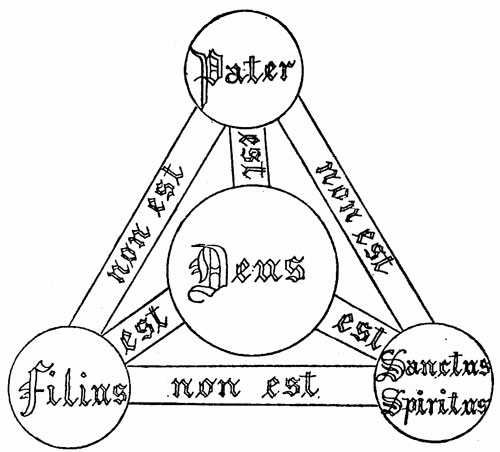
One of the early statements of the faith (The Athanasian Creed) affirmed this truth, and out of it came a graph called the Shield of the Trinity. I shared it on Sunday as a projection in English, but here it is as it looked in Latin …

trinity_triangle_shield_of_trinity_diagram_1896

You can probably figure it out, but a translation would roughly say: The Father is God, The Son is God, The Holy Spirit is God; God is the Father, God is the Son, God is the Holy Spirit; The Father is not the Son, The Son is not the Father, The Father is not the Holy Spirit, The Holy Spirit is not the Father, The Son is not the Holy Spirit, The Holy Spirit is not the Son.

Now doesn’t that just clear up everything?

In biblical study there is a discussion called the theology of procession. This says that the Father sends the Son, and the Father and the Son send the Spirit. That might seem to suggest that the Father is most important, whereas it speaks of the relationship that exists in terms of function. There is yieldedness within the Trinity.

Again, illustratively – is the husband greater than the wife? It speaks in the Scripture of headship for the husband, but he is not greater. Likewise, are certain gifts and positions of service in the church better than others – the speaking gifts better than the serving gifts? No, not really. All parts of the body are necessary and needful.

The Trinity is a model of diversity of roles, yet unity of essence and purpose.

But when the kindness of God our Savior and His love for mankind appeared, He saved us, not on the basis of deeds which we have done in righteousness, but according to His mercy, by the washing of regeneration and renewing by the Holy Spirit, whom He poured out upon us richly through Jesus Christ our Savior, that being justified by His grace we might be made heirs according to the hope of eternal life. (NASB) Titus 3:4-7

Slicing and Dicing: Trinitarian Heresies

We stand on the shoulders of those who have gone before us. This is true is so many areas of endeavor and knowledge – such as science and medicine, for example – and it is true as well in the field of theology. It is a wonderful era in which we live, inheriting two millennia of theological thinking and articulation that is available literally at our fingertips. The early church fathers of course did not have such resources, and they struggled to fully and accurately articulate complicated truths such as the Trinity and all of the implications of the divinity of the Son and the Holy Spirit. Recall also that the several early centuries of the Church age involved as well the final codification of what were the accepted divine Scriptures (we call this canonization).

Yes, it is all rather complicated. We said from Day 1 of this series on the study of God – called “Theology Proper” – that this was a more academic endeavor than most we take on. But our topic this week of the Trinity is one that is surely taught throughout the Bible and is one that we cannot deny or pull out of the cloth of Scripture without unraveling the integrity of the whole garment. If you lose the Trinity, you lose everything.

And over the years, there are several basic errors espoused by some at various times that result ultimately in nothing short of heresy. In attempting to present these briefly (gigantic tomes have been written upon all that follows), let me use a delineation presented by a theologian of our own denomination and theological seminary – Wayne Grudem (from Systematic Theology: An Introduction to Biblical Doctrine, chapter 14).

Grudem writes that there are three basic statements to be affirmed about the biblical teaching on the Trinity …

  1. God is three persons.
  2. Each person is fully God.
  3. There is one God.

A denial of any one of these three statements leads to one of the historical errors about the Trinity.

To deny the first point – that God is three distinct persons – is an error known within Church history as Modalism.

The idea here is that God is one person who appears in three different ways at different times. In the Old Testament he was God the Father. In the New Testament he is God the Son. And in the church age after the ascension he is the power and influence as the Holy Spirit. It is as if he has three hats and shows up at different times in different forms.

This of course denies the personal relationships within the Trinity, as when Jesus prays to the Father. And think about the baptism of Jesus where the Father speaks from heaven and the Spirit descends as a dove. And if this is true, the atonement for sin is lost – the truth that God sent the Son to be the atoning, substitutionary sacrifice for sin.

To deny the second point – that each person is fully God – is an error known within Church history as Arianism.

This is the more common error that has taken various forms down to our day. It is named after Arius, a Bishop of Alexandria (Egypt). He taught that Jesus and the Spirit were logically creations of the Father. This view was condemned at the Church Council of Nicea in A.D. 325 with a famous creedal statement about the nature of the Trinity.

An Arian way of thinking (then or now) is to say that Jesus was created before the rest of creation and is “like” the Father, but is not the same nature or essence as God the Father. Bolstering this view is an understanding of verses like Colossians 1:15, which calls Christ “the first-born of all creation.”  But the idea of being first here is not #1 in order, but rather #1 in preeminence (supremacy, importance, authority, etc.).

To deny the third point – that there is one God – is an error known within Church history as Tritheism.

Honestly not that many people over the years have held to this view, as it is obviously not much different than pagan religions with multiplicities of gods.

And again, all of this discussion is admittedly rather academic, but it is also of the utmost central importance. Yet also, it is of immense practical understanding. I don’t want a Jesus who is less than divine – nothing more than a great moral example or most-empowered human creation. We need a perfect savior, not an ideal model of godly living. And we need more than a powerful spiritual presence or influence within us. We need not only God the Father; we must have God the Son, and God the Holy Spirit … or all is lost.

Explaining the Impossible: Definitions of Trinity

There are many things that seem impossible to explain, like how the Dallas Cowboys could lose a playoffs game this season! Inexplicable. But somehow it happened.

Today we take an attempt at explaining and defining the Trinity. Alert: this is going to be ultimately impossible, and no attempt or illustration is quite adequate enough to do it. People have sometimes used the three properties of H20 – Ice / Water / Vapor to describe it, but this falls short.

So let’s go all academic and get a historic definition of the Trinity as outlined in the Westminster Confession:

“In the unity of the Godhead there be three persons, of one substance, power, and eternity: God the Father, God the Son, and God the Holy Ghost: the Father is of none, neither begotten, nor proceeding; the Son is eternally begotten of the Father, the Holy Ghost eternally proceeding from the Father and the Son.”  (Westminster Confession of Faith, II/iii)

Christianity, therefore, is not totally and merely monotheistic, but Trinitarian. God exists as an eternal community of persons—Father, Son, and Spirit. The three essential teachings are:

(1)       There is one God

(2)       God exists as three persons—Father, Son, and Spirit

(3)       Each of these persons is fully God

Think of it this way using math: It is not 1+1+1=3, but 1x1x1=1.  But that illustration falls short also.

St. Augustine had famously said of the Trinity: “Try and understand it and you lose your mind; try and deny it and you lose your soul.”

With the concept of the Trinity, we are getting into a realm that is beyond our minds and experiential frame of reference in the material world to understand. But the Trinity is important simply because that is what God is like. To understand God—and to know Him relationally—we mustn’t ignore certain truths because they are difficult. The contemporary theologian, J.I. Packer writes:

“The historic formulation of the Trinity…seeks to circumscribe and safeguard this mystery (not explain it; that is beyond us), and it confronts us with perhaps the most difficult thought that the human mind has ever been asked to handle.  It is not easy; but it is true.”

Similarly, we should also recognize that the doctrine of the Trinity holds value in distinguishing the Christian faith from other major world religions. Not surprisingly, the brilliant C.S. Lewis wrote that the difficult teachings of Christianity prove that it is not something that man would ever have dreamed up:

“If Christianity was something we were making up, of course we could make it easier.  But it isn’t.  We can’t compete, in simplicity, with people who are inventing religions. How could we?  We’re dealing with Fact.  Of course anyone can be simple if he has no facts to bother about!”

Gregory of Nazianus (4th century bishop of Constantinople) wrote that this truth always directed him toward worship:

“I cannot think of the One, but I am immediately surrounded by the Three; nor can I clearly discover the Three, but I am suddenly carried back to the One.”

If you have walked at all with the Lord and studied his Word, you know how incredibly true and insightful is that assertion.

While the Christian faith is reasonable and rationally defensible, there is a point at which faith enters the equation. It is believing in things that are beyond us, as it says in Hebrews 11 – “Now faith is confidence in what we hope for and assurance about what we do not see.”  Without the Trinity, the gospel falls apart, there is no true savior, and there is no indwelling of God within His people. You lose everything.

But the doctrine of the Trinity is true, and that holds all things together for life and eternity. It is essential.