
Unknown's avatar

About Randy Buchman

I live in Western Maryland, and among my too many pursuits and hobbies, I regularly feed multiple hungry blogs. I played college baseball, coached championship cross country teams at Williamsport (MD) High School, and have been a sportswriter for various publications and online venues. My main profession was as the lead pastor of a church in Hagerstown called Tri-State Fellowship for 28 years before retiring in 2022. I'm also active in Civil War history and work/serve at Antietam National Battlefield with the Antietam Battlefield Guides organization. Occasionally I sleep.

Don’t Get Blown Away (Psalm 1)

view out TSF windowI have some wonderful distractions that my ADD eyes can see out my office window. Looking across the fields I can see Martin’s Elevator, watch trains go by on the CSX line, and even see how the traffic is moving on Interstate 81.

And I can also check out the weather to see if my new #1 enemy is at work. That is the wind. There are few bushes in the foreground and a maple tree beyond the side parking lot. They give me a sense of the wind movement here on the knoll where the church sits – one of the windiest places anywhere. Actually the church is on some of the highest ground locally, which is not immediately obvious at first glance.

I say the wind is my enemy now because of all of the cycling miles that I do. Even the cold only stops me once it goes under about 40 degrees. The wind is the real problem that makes it a rough experience in any temperature.

And in Psalm 1 that we have been looking at this week, the wind represents trials and troubles and judgment.

Psalm 1:4 – Not so the wicked! They are like chaff that the wind blows away. 5 Therefore the wicked will not stand in the judgment, nor sinners in the assembly of the righteous.

6 For the LORD watches over the way of the righteous, but the way of the wicked leads to destruction.

Here we see the rooted life described in contrastive terms, comparing the strength of those rooted in righteousness like a tree with a strong foundation to the wicked who are like the chaff – all that extra stuff around the grain at the time of harvest.

While sitting in my office last week, I was able to look out my window at the wheat fields being harvested. I should have taken a picture at that time, as it was like a total dust storm with the chaff blowing away. Last year at the season of the harvest of this field (which we actually own and rent to the folks at Martin’s) I was biking back to the church from Cearfoss. And you could see it almost a mile away, it looked like a dark storm on the horizon.

Now, a week later, where is the grain that was harvested? It is saved in silos to be used. We can find it. But where is the chaff? It is gone … blown away … it cannot be found and is not wanted to be found.

These final verses look beyond even this life to the bigger picture of both this life and the next. There is a way of living that gives success in each, and a way of living that is the pathway to destruction.

The godly man’s roots are in God’s Word and connected to truth; the ungodly are rooted in what looks permanent – materialism and man’s philosophy – but proves to be weak in the end at the day of judgment.

The writer (likely David) brings back some of the verbs and nouns from the beginning, where the righteous stands, walks, sits…

Here, the wicked …

does not stand in the judgment. The righteous stands, though not in their own righteousness but rather in that of the Righteous One.

will not be seated in the assembly of the righteous. They don’t have a seat with God at the end of it all. So why would you want to regularly hang out with someone who doesn’t even have a ticket (other than to encourage them to receive the free ticket that is available for them)?

do not walk in the way of the righteous – a way that God oversees, guides and protects. They have their own way, described as a path to destruction. Jesus picked up this very theme of the two ways – of one that seems right to a man, while encouraging rather to choose the narrow path that leads to life.

So, be rooted!  Don’t get blown away by the wind.

There is a tendency I notice in ministry with every sermon, and that is to think or to say, “This today – this topic – this is the answer to it all.” Well, this Psalm 1 topic of rootedness is pretty close to being just that. There is a reason it is Psalm #1 and placed at the beginning of the Psalter, for it gives us the macro categories of life and of timeless truth. It’s not actually that complicated.

Where are Your Roots? (Psalm 1)

river treesAs we continue through the first of the Psalms, we have the seen the rooted life described in both negative and positive terms. Now we see it described pictorially, and it stands as the key verse to the Psalm.

Psalm 1:3 – That person is like a tree planted by streams of water, which yields its fruit in season and whose leaf does not wither—whatever they do prospers.

Much of the Holy Land is rather arid. The picture of vast regions of stone with green swaths through which streams travelled, dotted with isolated trees, would be a common one.

And though we live in an area where it (this year) seems to rain every day whether it really needs to or not, it is not always that way. And we know as well that trees growing alongside streams have an easier time, especially in drought conditions. Think about the beautiful views we see of stately trees growing along the Potomac, the Antietam or the Conococheague.

The picture is one of constant nourishment and steady health. This sort of tree is not dependent upon intermittent showers, and is therefore not susceptible to dry times. The roots do not need to stay close to the surface, but are able to go deeply into the soil, providing a better foundation for the tree in perilous times – when the winds of adversity come.

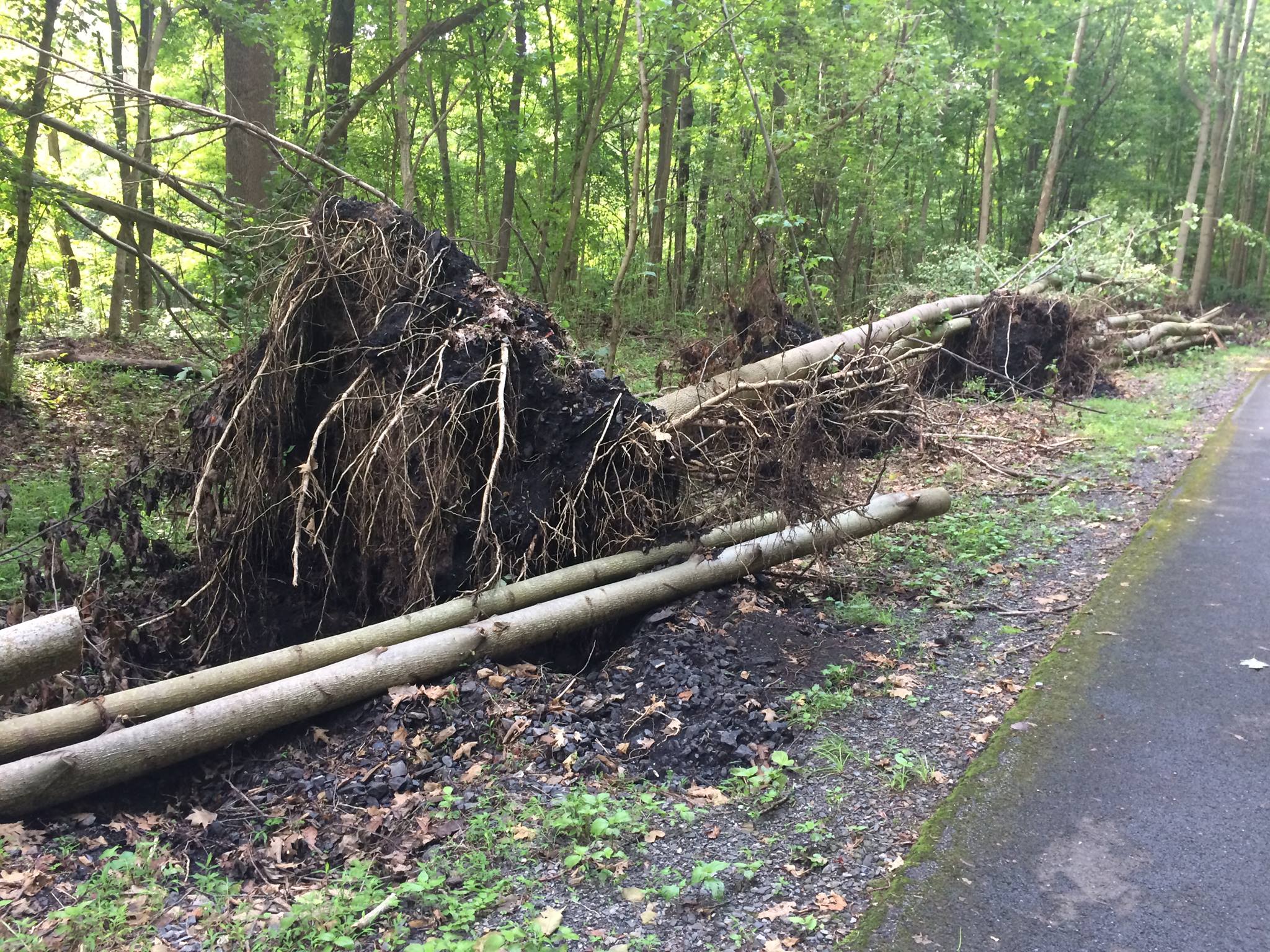
trees knocked down

This second tree pictured is from west of Hancock on a mountain several hundred feet above the surface of the Potomac River.  Note how minimal is the roots system for the size of the tree. It could not withstand the storm, nor did quite a number of others nearby. They look like dominoes knocked over in a recent storm that spawned tornadoes.

Beyond simply standing and looking good, the tree by the water produces fruit at the right time, in season. It is regular and dependable.

The picture is a beautiful one and as obvious for application as any in Scripture. Is your life, your roots, deeply embedded in the Scriptures, or do you depend upon occasional “showers of blessing” for your spiritual sustenance? If you are depending only upon the occasional sermon for biblical enrichment, you are going to have your “leaves” wither and your “roots” be insufficient foundations for the inevitable sorrows of life.

Are you able to be described like the tree by the water in terms of your life and service to others?  If not, it may be that an examination of the roots is in order more than a reflection upon the nature of the storm systems.

And beyond standing alone, there is greater strength in standing together. What is better: a tree by itself (even well-rooted) or a tree growing near others around it? With others trees and roots systems intertwined, there is mutual support. And so it is in the body of Christ and your regular connection to it. If you do not connect deeply in the church family, you are essentially being an independent tree – be it in a field or along a stream.

So how are your roots?

Delighting in Meditating (Psalm 1)

We probably too much have a picture of meditating as sitting on the floor with legs cross and fingers curled (for some reason I cannot imagine) in a sort of “OK” sign. Weird. I think this is called the “lotus position.” At this stage of life, I also think I’m physiologically disqualified from that particular contortion.

But you don’t need to do something so “Eastern mystical” to be in a position of meditation. You simply need to have your spiritual roots sunk into the Word of God on a regular basis.

Today we look at the second of four descriptions of the truly rooted person, noting from Psalm 1:2 the positive description of a person who is well-resourced by the Scriptures …

Blessed is the one who does not walk in step with the wicked or stand in the way that sinners take or sit in the company of mockers, but whose delight is in the law of the Lord, and who meditates on his law day and night.

Do you delight in meditating on God’s Word?  You find time for what you delight in and what you know you truly need. At some points of my life, I’ve delighted in the good benefit of an exercise program, but at other times I have not valued it highly enough. In both instances I have reaped the consequent gains and losses.

Speaking of both exercise and meditation, these have really come together for me over the past two years. As you hear me talk about cycling a lot, when I want to really think about things without the distraction of getting run over by a truck, I’ll go ride on a trail of some sort. And I have come off such rides with fully thought-out plans of action for various topics.

Your brain tends to meditate upon that which it has most recently been fed. The illustration I shared in the sermon Sunday about this relates to the classic book “Gone With the Wind.” I saw this past week that it was published 80 years ago. I read that in high school and have seen the movie a long time ago and remember parts of it. But if I re-read that book today, over the next week or two, when seeing certain sights, they would trigger something from my reading … like a large old mansion house, or an antique carriage, or a long formal dress, or any mention of the word “Scarlett” or “Rhett”.  Even the reason that this came to my mind illustratively is because it was already in my mind from the past week.

So also, if your mind is regularly being filled with Scripture – even reading a passage for the 50th time – it will be there when you see something that triggers your memory of it.  AND, it will be there for you in the time of crisis.

Recalling the story I opened with in the sermon and in yesterday’s devotional, the father of the girl said to me in the first moments after the incident, “You know, it hits me right now, you don’t have time to get ready for something like this, you either are ready or not.”

A few horrible and unexpected events are going to happen in all of our lives. One of them is rather permanent. The time to be ready is now.

Beyond that, for daily life, in the same way that we physically are what we eat – what we choose to nourish ourselves with, good or bad – we are spiritually what we feed upon for our thinking / our minds. What we think determines what we are and what we do and how we evaluate and live all of life. God designed us this way, and He has given us a resource to guide us into a life of success as we live in covenant relationship with him.

Consider this great passage given to Joshua as he took over leading the nation of Israel after the death of Moses …

7 “Be strong and very courageous. Be careful to obey all the law my servant Moses gave you; do not turn from it to the right or to the left, that you may be successful wherever you go. 8 Keep this Book of the Law always on your lips; meditate on it day and night, so that you may be careful to do everything written in it. Then you will be prosperous and successful. 9 Have I not commanded you? Be strong and courageous. Do not be afraid; do not be discouraged, for the Lord your God will be with you wherever you go.”

So how is your life of meditation? It doesn’t need to always be in a planned and quiet place. But you need to have a full tank of Scriptural resources to draw upon at the exact time it is needed. Most of the time the airbag in your dashboard is not very practical, though the day may come when you really appreciate that it is there as a resource in a moment of crisis. You get the idea.

The Rooted Life – There’s Just No Better Way to Go! (Psalm 1)

It is not our necessary intent each week to just give a review of the sermon as a sort of transcript of what was preached, though that would not be worthless, especially in the summer months when many are travelling. (And I gave you yesterday off because of the holiday). We regularly write here a mix of ideas verbally shared along with additional thoughts.

But today I will begin with the opening illustration from Sunday, since many people afterward asked about a detail that I failed to include in the end of the story (as it was not related to my main idea, but the omission left people hanging).

It was 34 years ago, the actual date being June 13, 1982. Having just graduated from Dallas Seminary, I was still working as the minister of music in a church in Dallas. Our morning services had ended and probably about 80-90% of the people had already gone home. My oldest son Nathan was a two-month old baby, and I had seen Diana hand him to one of the sweet teenage girls in our church – who wanted to hold him.

I went around the corner and down the hall toward my church office to gather my things, when there was a sudden, horrible crashing sound of broken glass … then people screaming and running toward the area around the corner of the hallway from which I had been only a moment ago.

Before I could also run to see what was happening, someone yelled to me as I was standing in the office doorway near the only phones in the building, to call 911 and get an ambulance – saying that a car had crashed into the church and hit Jane (the girl who I had just seen holding Nathan). Hesitating a second due to that thought, I collected myself and made the call … then going down the hall to the scene.

A car went out of control when pulling up to the door, hitting two of our teen girls exiting the church, shoving them both back through the double glass doors. One of them, however, had her leg pinned against the brick doorframe. Both were quite bloody from the sheets of glass that had fallen on them, and at the scene, things looked very bad for Jane in particular.

The ambulance took her to the hospital, and I spent some moments with her father – one of our best church servants and leaders – helping him gather things and get ready to go to the hospital as well. He was amazingly calm in the storm. As I was a young man then just beginning in ministry, this fellow who was about 12-15 years older had been very kind and encouraging to me personally. And he took several moments even then to reflect upon Scriptural truths that were sustaining him in the crisis, as he did throughout the day at the hospital.

The experience was a rude introduction to “official” ministry. That evening was the occasion of my ordination by the church into the gospel ministry. The theme of the day – both for the family and for the ordination – was that we do not know what a day may bring or what calamity may come into our lives or the lives of others close to us, or in our flock as shepherds. But in any event, we need to be rooted in the Lord and in his Word for the strength and resource to meet the challenge.

(As an additional note – the girl survived with only some minimal permanent damage to her ankle. And the driver of the car was the teenage son of the Senior Pastor of the church. Several years later, in the course of time and human affairs, he married the girl he almost killed!)

(And here is the additional note that I failed to include: the girl held Nathan briefly before handing him back to Diana and then immediately walking out the door. There was some flying glass around them, but the door frame stopped the car.)

In dozens and dozens of situations of church ministry over the intervening years – including even this past week, I have visited with people in the most dire and heart-breaking of situations – at the very scenes of tragedy and death and pain and loss – and seen an unnatural strength that undergirds people of faith and trust.

However, in more than a few other circumstances and situations, I have seen the pain overwhelm people – short-term and long-term – as others are unable to endure and move on from difficulties. Sometimes it results in a sort of depression, others with anger – perhaps even at God for not doing enough. Some others react with a sort of escapism and detachment, disappearing from connection with God and his people in the church family.

What makes the difference? Those with deep roots into God’s Word and interconnection with God’s people find their way through tragedy and pain over time through the strength and nourishment their roots provide. Those who do not make it cleanly to the other side demonstrate that the few roots they had were very shallow and insufficient.

In this series we are asking you to consider your own personal roots, and looking beyond that to how you can help others be rooted and nourished (watered) in the truth.

This week we look at one of the great passages that talk about roots – Psalm 1. We all want success in life, or stated in the words of this week’s title, a “Yield.”  But that can only come if we stay rooted, even through the winds and trials of life.

The Psalm begins by talking about the blessed life … “Blessed in the one…”  This term is one that speaks of a concept of happiness, related to contentment and peacefulness – a quiet pleasure that comes from deep perspective and satisfaction.

In the past I have preached on this sermon as describing the “truly happy person.”  But this week, let us in the theme of this series make the subject of this Psalm be called “the truly rooted person.”  We are describing the fruit, the yield, of a rooted life.

We will see these six verses describe the rooted person in four ways …

  • In negative terms (1)
  • In positive terms (2)
  • In pictorial terms (3)
  • In contrastive terms (4-6)

The rooted life described in negative terms … verse 1 …

Blessed is the one who does not walk in step with the wicked or stand in the way that sinners take or sit in the company of mockers, but whose delight is in the law of the Lord, and who meditates on his law day and night

Let’s break down the first verse with these three categories …

3 Verbs… 3 Nouns … 3 People …
Walk Counsel (in step) Wicked
Stand Way Sinners
Sit Company (seat) Mockers (scoffers)

Verbs … There is an increasing involvement and commitment, from walking in a certain place to sitting down in a specific place.

Nouns … counsel = thinking / way = behaving / seat = belonging (note the progression).

People … wicked = no room for God / sinner = openly break God’s law / scoffer = mocker of God’s word and people.

So there is the progression from interest, to doing, to being fully at home in the fellowship of those who ridicule God.

A drift away from God and truth is not something that happens immediately, but is progressive over time. And a self-examination from time to time is a healthy discipline.

In any event, people who are away from God, be it from drifting or perhaps because they never really were connected, are simply not able to be truly blessed with a contented happiness even in the inevitable sorrows of life.

So, how are your roots? Where are your roots? Like the car commercial from that dealership in Frederick says about the “Fitz-Way” … there’s just no better way to go. That’s true of faith and life; there is no successful way other than being rooted in the Lord.

Don’t Worship the Worms – (1 Corinthians 3:18-23)

I will say that there are elements of the traditional church ministry that was a part of my childhood and early pastoral years that I liked and miss, thinking we’ve likely moved away from at least a few things that were good and healthy.

But there is one tradition that I am very, very glad to be beyond. That is the obligatory singing of the Doxology at the end of the service which gave walking time for the pastor to make his way to the central door at the rear of the auditorium for the hand-shaking of congregants as they exited.

In my New Jersey church, I had a cranky and eccentric elderly man who EVERY week sat on the center aisle about two rows from the back. As I walked past him to take my position at the door, he would reach into his pocket and pull out a wintergreen lifesaver for me. It often also contained pocket lint.

I attempted to make the event more about asking people passing by about things in their lives, rather than having the focus upon me or the sermon, etc. Yet at the same time I had to keep the line moving and not irritate those who wanted to get out, but who also felt an obligation to LIE say something to the pastor about his wonderful sermon.

Many of you will remember one of my famous professors from Dallas Seminary – Howie Hendricks – who was well-known around the country from Christian radio, Focus on the Family, Promise Keepers, etc.  He called this weekly ritual at the back door of a church “the ceremony of the worm.”  We might recall the phrase from the famous hymn that speaks of the death of Christ “for such a worm as I.”Slow_worm_closeup

The fact of the matter is that being rooted in Scriptural truth and the fruit that comes from it is about the message itself and not the deliverer of the message – no matter how gifted he is. The power is in the message, not the worm delivering it. To pedestalize (I just made up that word) preachers is sort of like being sent a million dollars from your grandfather on the other side of the country, but thinking little about thanking or honoring him while throwing a party for the mailman simply because he delivered the check!

But the Corinthians were doing this when they made a big deal about different public, upfront personalities around them. In these final words of chapter 3, Paul basically says, “Stop thinking you are so smart, knock off the fan clubbing, stop having a ceremony for the worm you like, and focus on God as the source.”

18 Do not deceive yourselves. If any of you think you are wise by the standards of this age, you should become “fools” so that you may become wise. 19 For the wisdom of this world is foolishness in God’s sight. As it is written: “He catches the wise in their craftiness”[from Job 5:13]; 20 and again, “The Lord knows that the thoughts of the wise are futile.”[from Ps. 94:11] 21 So then, no more boasting about human leaders! All things are yours, 22 whether Paul or Apollos or Cephas[Peter] or the world or life or death or the present or the future—all are yours, 23 and you are of Christ, and Christ is of God.

It really is all about God and his Word. The power is in the truth, quickened by the work of the Holy Spirit, merely delivered through the mouths of worms who only know anything or have any ability because God first gave it to them. So don’t be rooted in the ministry of people (especially preachers), but be rooted in the Word of God, trusting also that he will use you as an effective worm to help others.

So remember, at the end of the day, I’m a worm; you’re a worm!  Let’s make that our greeting to each other this Sunday (though not at the door!) … got it?  “Hi Randy, I’m a worm, you’re a worm.”

You are a Builder – (1 Corinthians 3:10-17)

The energy that is resident in the young adult stage of life – that time when you have a young family and are setting out on your own to get established – is really an amazing thing as you look back on it some years later. I am doing that now with my older boys who are all in the throes of wrestling with housing arrangements with varied homes and construction or renovation projects. It is exhausting to me to just look at.

But when I was in my late 20s, I was in that stage of life and did one of the more bold and crazy things I have ever taken on. My father-in-law and I built a 2500-square-foot two-story colonial home in New Jersey in a field very close to the elementary school I attended two decades earlier. When I say that “we built” it, I mean that in the most literal sense. Other than the poured foundation, the drywall, and sanding the hardwood floors, we did every last bit of it between us (frankly he did much more, since he was the one who knew what he was doing!). My own father was totally skeptical that this would work out; he thought we were crazy to attempt this. I now find myself looking back on that and understanding his point of view more clearly.

As we were nearing the end of the construction, I can very clearly recall several occasions of doing some finishing work inside the house while violent storms were raging outside. And I remember wondering to myself, “Is this place really going to withstand this? Did we build it appropriately and strong enough? I know we used a lot of nails!” (Actually, with 2×6 exterior walls, the place was a fortress!)

The proof of the quality of any construction project comes when storms arrive or time passes. Does it stand? What remains on the other side?

Paul picks up this analogy when talking to the Corinthians about the labors that Apollos and he and others were doing in the process of building the church of Jesus Christ. Just as in my NJ house, someone else did the foundation and we just built upon it, and Jesus Christ is the foundation of the church that others over time build upon through their labors. The quality of that construction may vary according to the diligence and care of the laborers and the composition of the materials. But a day comes when it will be revealed – a day that Paul pictures as one with fire, speaking of the Day of Judgment. There will be reward for excellence, while nothing but the smell of the fire on the clothing of those who escaped alone with nothing to show in terms of reward.

Paul writes in 1 Corinthians 3 …

10 By the grace God has given me, I laid a foundation as a wise builder, and someone else is building on it. But each one should build with care. 11 For no one can lay any foundation other than the one already laid, which is Jesus Christ. 12 If anyone builds on this foundation using gold, silver, costly stones, wood, hay or straw, 13 their work will be shown for what it is, because the Day will bring it to light. It will be revealed with fire, and the fire will test the quality of each person’s work. 14 If what has been built survives, the builder will receive a reward. 15 If it is burned up, the builder will suffer loss but yet will be saved—even though only as one escaping through the flames.

16 Don’t you know that you yourselves are God’s temple and that God’s Spirit dwells in your midst? 17 If anyone destroys God’s temple, God will destroy that person; for God’s temple is sacred, and you together are that temple.

There are both sobering and comforting components in this communication. The business of the church is serious stuff, as it is the outworking of God’s plan of the ages. Those who are a part of it are a part of the big thing that God is doing in the world. And those who serve in teaching and communication of truth on all levels have a responsibility of doing it with accuracy in accord with God’s revelation.

A problem that existed even in the early years of the church was that of false teachers. Paul would reference this later as the preaching of “a different gospel.” (See the early verses of 2 Corinthians 11.)

On the other hand, there is great comfort in knowing that God sees and remembers our labors for him in the church of Christ. Though we may be forgotten and our efforts at advancing the truth of the gospel and the mission of the church may be lost to human memory, God does not forget nor fail to reward that service. The church universal is going to be successful. The gates of hell will not prevail against it. This is the winning team, and in teaching the Scriptures as we have opportunity on whatever level in the home or church, we are advancing God’s kingdom. We are growing our roots; we are watering the roots of others, and by the Spirit’s work we are a part of the fruit that never fades away.

Behind the Christian Celebrity – (1 Corinthians 3:5-9)

The Christian celebrity movement has been around a long time, as we see today that it dates back to the early years of the church with characters like Paul and Apollos. I’m sure they were impressive in some way, being able to publicly handle the presentation of incredible truths detailing this relatively new message of the gospel.

So I guess it is not that incredible that there are still celebrities in church ministry, particularly of those who have visible successes like large congregations, media ministries and a shelf full of written materials.

One of the interesting experiences of ministry life in this generation is the opportunity to attend the vocational Christian college and seminary, both of which are a part of my background. On the whole, college and seminary were rich experiences for me, though I was pondering again just earlier today that the accompanying church experiences of that stage of my life probably marked me more and had greater educational and impactful influence.

Dallas Seminary in particular, along with my pastoral staff ministry in one of the primary churches connected to it, brought across my path some very interesting and well-known characters in the Christian movement worldwide over the past 50+ years. Some were on the faculty, while others visited as guests at our church. And now that 34 years have passed since my master’s graduation and 22 since the doctoral, some of my classmates have become well-known personages, even Christian celebrities. If you are familiar with Christian radio at all, or know of some pastors of regional multi-site churches, more than a couple of these names are guys who sat in the same classes with me.

I have not kept in touch with many of them, but here is what I can tell you about them: they are in reality nothing that special. In fact, personally, they are often rather boring people and loners away from the spotlight and podium. In reality, these guys are often introverts. They probably don’t have time for you unless you too are really important in some way. They really don’t have the time; it takes a lot of time to keep all the balls in the air of a big-time multi-faceted ministry.

What they simply have is a God-given gift to understand Scriptural truth and package it in a communicative way that is compelling and, along with the Spirit’s power, helpful to listeners and followers. But at the end of the day, it is just a gift from God. Other people have other gifts. For Apollos and Paul … for any teacher of the Scriptures … they are servants …

5 What, after all, is Apollos? And what is Paul? Only servants, through whom you came to believe—as the Lord has assigned to each his task. 6 I planted the seed, Apollos watered it, but God has been making it grow. 7 So neither the one who plants nor the one who waters is anything, but only God, who makes things grow. 8 The one who plants and the one who waters have one purpose, and they will each be rewarded according to their own labor. 9 For we are co-workers in God’s service; you are God’s field, God’s building.

Some plant, some water, but it is God who makes the seed grow. And that is the miracle – that growing in the life of the believer is the fruit of an eternal relationship with God through Christ.

So it is not about the messenger practically at all. It is about the message and what becomes of it in the life of the hearer as it takes root.

Speaking of Dallas Seminary, I remember a homiletics class (that is a class on how to teach and preach) where the rather well-known prof reminded us of the big idea about preaching. He said, “When have people really ‘got it’ when you speak … when have they actually ‘caught it?’  Is it when they can regurgitate your catchy three-point outline? Is it when they remember your stories and illustrations? Is it when they understand the full content of what you have said?  No!  It is when they have understood how to apply it in their lives and they go home and do it.”

That is another way of saying that people understand preaching, be it great or mediocre in terms of presentation, when it takes root in their lives through personal application and growth.

Beyond that, we are all teachers of the Word with our families and with people of whom we cross paths daily who need to know the truth of God’s Word. I love a good talker as much as anyone, but the core reality is the life-changing message of the gospel that is being preached, celebrity or not.


Being More Than Merely Human – (1 Corinthians 3:1-4)

The primary passage of interest for us this week is found in 1 Corinthians 3:5-9, a Scripture we will especially look at and comment upon tomorrow. But for this week, let us take that whole 3rd chapter of Paul’s letter to the Corinthians and study it again with its five natural paragraph breaks, as this will set the broader context for us.

Our “Rooted” theme this week is to talk about the role of teaching in the growth process of the seed of God’s Word being planted, tended and brought along to fruition in the lives of people.

The immediate risk we run is that folks will look at this passage and theme and say, “Well, there’s a Scripture that is for Randy, Chris and Tim … hope it speaks to them.”

But our point this week is to say that we all have a role to play in the process of seeing God’s Word rooted and growing, not only in ourselves, but in the lives of others.

The church in Corinth is well-known to us all for a variety of problems that form a list of topics for the Apostle Paul to address with them in this first letter. He begins in chapter 1 by diving right into a problem that has been reported to him …

that there are quarrels among you. 12 What I mean is this: One of you says, “I follow Paul”; another, “I follow Apollos”; another, “I follow Cephas”; still another, “I follow Christ.”

The feeling we get is almost as if it is primary season for a political party. Many of you have heard me talk and write about my five-year foray into the political world. Though there were worthy, valuable and honorable elements to that involvement, the major problem I saw (and that drove me crazy and ultimately out the door) was that there was never a true party unity. At every state convention, there were some offices up for election. And so there were always people campaigning for this or that position, replete with buttons and stickers and posters, etc. It was a continual context of division as groups had their favorite.

And that is what was happening in Corinth. Some folks liked the energy of Paul, or the university scholarship of Apollos, or the working-man’s populism of Peter … while some others saw themselves as more spiritual (at least in their own minds), forming a divisive group under the name of Christ.

What this did was essentially demonstrate that they were not rooted and bearing the good fruit of the spirit. And Paul clearly addresses the core issues …

3 Brothers and sisters, I could not address you as people who live by the Spirit but as people who are still worldly—mere infants in Christ. 2 I gave you milk, not solid food, for you were not yet ready for it. Indeed, you are still not ready. 3 You are still worldly. For since there is jealousy and quarreling among you, are you not worldly? Are you not acting like mere humans? 4 For when one says, “I follow Paul,” and another, “I follow Apollos,” are you not mere human beings?

At the end of the preceding chapter, Paul spoke to them of teaching about the “deep things of God” and about “spiritual realities.”  It was stuff that was to be spiritually discerned … beyond the understanding of basic natural conversation of this world. But the Corinthians were not really ready for this; they were not plugged into (or rooted) in such a way as to be nourished by this sort of teaching and instruction.

Surely we have all had experiences where we are around some folks who are talking about a topic upon which we are well-informed, being so perhaps because it is in our career field or in some area of special interest and study. And these folks, not knowing how much you know about the subject are talking in your presence like they are an expert on the topic. You can tell that they really see themselves as having a deep understanding, but the actual shallowness of their knowledge is abundantly obvious to you while being oblivious to them. It is sort of sad, as often you have to just smile and choke down the corrections you would like to give them.

Paul was tired of being polite and letting the Corinthians only think they were so advanced and fruitful in their knowledge and experience of truly deep spiritual realities. The Apostle rather bluntly drops the truth upon them. The party spirit that divided them was in fact evidence that they were “merely human.”

That doesn’t sound so bad to be “merely human” does it?  It is a common phrase to hear someone say, “After all, I’m just human!”

Being truly rooted in Christ and mature in faith and knowledge does not make one super-human. But it does establish a broad understanding of timeless truth that transcends the “mere” viewpoint of the natural man. That ordinary viewpoint is that we live, we die, and in between we fight for our personal ascendance in a sort of battle known as the survival of the fittest. Being rooted in Christ yields a viewpoint that transcends this world and connects a person to eternal realities and the Creator God. And a result of such spiritual knowledge should be a different way of living with one another.

So why be a “mere” anything when you can be a special something through rootedness in Christ?

The Seed Ain’t the Problem (Mark 4)

IMG_1150Over the years of growing gardens, I’ve become disappointed often with the results. Sometimes I am amazed at how much did grow, but many other times I’ve found myself saying, “That’s it? That’s all I’m getting out of this effort?”

Some of the problem here in Maryland is the soil where I have more recently had the garden, though it is far from terrible (even if it’s not New Jersey soil!). More of it has had to do with the location that is too shaded too much of the day.

But one thing I know I can’t do, and that is to blame the seed. There is nothing wrong with that; it is a soil condition and location issue that has thwarted more recent efforts. Or failure to nurture and water appropriately.

In the parable we have been looking at in Mark 4, the seed speaks of God’s Word, and there is nothing wrong with that. Where there was no fruit, the past three days we have detailed the soil conditions that contributed to the absence. And now today, even with fruit being produced, there is a variety to the amount of yield. Jesus told the story like this …

Still other seed fell on good soil. It came up, grew and produced a crop, some multiplying thirty, some sixty, some a hundred times.”

Then Jesus said, “Whoever has ears to hear, let them hear.”

In the later interpretation in verse 20, Christ said …

20 Others, like seed sown on good soil, hear the word, accept it, and produce a crop—some thirty, some sixty, some a hundred times what was sown.”

It was 40 years ago that I remember a sermon on this passage being preached in my home church by a new assistant pastor, a man who came into ministry out of being a regular attender in the pews of the church. He introduced it by saying that, in his early months of serving and working with the congregants he often asked our older, long-term pastor why it was that some people seemed to “get it” and move ahead, while others heard all of the same stuff but never appeared to be impacted. And our senior pastor would just answer, “Read the parable of the sower and the seed.”

It is so true, and I’ve lived to see it now over the past 40 years of ministry. Some people come and look interested for a time, but they’re gone almost as quickly as they came … something else caught their attention. Others hang around longer before some life event, good or bad, drives them away. And others produce fruit for a while, even good fruit, but they don’t sustain it over the years and the thought that changing their garden location will make all the difference leads them up the road or down the road … often over and over.

But there are people, lots of them, who are what I called in this week of soul conditions the “producers,” who regularly bring to fruition a good yield in the life of ministry and service. Yet even here, there is room for us to ask if we are producing at the level we should, given the gifts and skills the Lord gives to each individually.

So be a producer, don’t settle for tasting, dabbling and seasonally treating church and faith like a hobby.

And we conclude this theme by asking, “How is your heart? How is your soul?”  What can you do to become a producer, or to produce at a higher level?

Treating Faith as a Mere Hobby (Mark 4)

IMG_1148Weeds are a curse. I mean really, they are. In the first breath of God’s curse upon man because of Adam’s sin, God said, “Cursed is the ground because of you; through painful toil you will eat food from it all the days of your life. It will produce thorns and thistles for you, and you will eat the plants of the field.” (Genesis 3:17-18)

I’ve often when pulling weeds in a garden said aloud into the air, “Oh Adam, how could you do this to us?”  Of course, I’ve heard that women in childbirth have had some choice words for Eve as well!

The third type of soil that Jesus spoke of in his parable was that filled with weed seed as well as good seed. From Mark 4:7 …

Other seed fell among thorns, which grew up and choked the plants, so that they did not bear grain. 

Dealing with weeds growing with grain is a persistent agricultural problem as can be seen everywhere in grain fields right now. As in the picture, we can see the tire tracks of the device called a “high boy sprayer” – those tractors with the giant, thin wheels and long arms … spraying both weed killer and fertilizer. I often think sadly about all the grain that is smashed, though I’m assured that the net positives outweigh that negative.

But really, just think about how much more of a difficulty dealing with weeds must have been in the first century world of Jesus and the disciples, a time without chemical treatments.

Jesus gave this interpretation of the third soil (and hence the third type of soul) in verses 18 and 19 … IMG_1151

18 Still others, like seed sown among thorns, hear the word; 19 but the worries of this life, the deceitfulness of wealth and the desires for other things come in and choke the word, making it unfruitful. 

This third type of soul is what I have called “the hobbyist.”  I have had lots of seasons of life where I had varied hobbies. At the time I was into them, I would have told you that these were interests that I would have and carry for a lifetime. But many have come and gone. I was into muzzle-loading antique, historic guns for a while and even built a replica. I have not had it out of the closet in 20+ years. I was very into woodworking, and our home is filled with things I built years ago. Now, doing anything like that is a terrible chore.

Other interests I’ve stuck with throughout life … like baseball, family, pursuit of Scriptural knowledge applied to life, writing. What you really value will stay with you and inform your life.

And so it should be about the Word of God. It should not be something that is a seasonal interest or hobby, not something to think about only in terms of if it serves you well at this stage of life.

If we have not been guilty of this ourselves, we have all seen the person who gets very excited about the Lord and his Word, like after some sort of retreat or conference. But over time, the enthusiasm does not stick with them. Other events or people come along to crowd their attention.

Some of the “cares of the world” that take us away from God may be good things in their proper place, but be also out of an appropriate line of priorities. And they can become those things that consume us rather than us consuming them.

Jesus speaks of three items in the passage …

  • “The worries of this life” – making a go of it, financially and relationally. This can become consuming.
  • “the deceitfulness of wealth” – I know that we all find ourselves believing that if we only just had a nice chunk more of financial resources our lives would be so much easier. I’ve often told you about the one little season of my life of living with the wealthy in Texas. And I can report that they really weren’t happier, and they had to spend so much of their time worrying about what to do with it and how to protect it from a dozen dangers.
  • “the desire for other things” – we all have stuff we find interesting that we’re going to get someday or do someday. Diana and I, on the whole, are rather boring people; but we have this interest in returning to Europe to see more of that continent. But we never get around to it, though we could make it the defining thing of our lives, dropping everything else.

Don’t make faith a hobby, merely something you do or use when you really need it like a tool in the garage, or a car you take for a Sunday ride. Being a person of faith, and doing faith with other people (called the church) is a way of life, not a hobby.

But I have seen decades of hobbyists in my various churches, people for whom life is going pretty well right now. Some previous crises have resolved, and coming in and enjoying what goes on around here fits their schedule nicely. Their evaluation of a church – be it this one, or any other one where they’ve given some time here and there – is honestly by the criteria of “what do I get from it, and how does it serve my interests and needs right now?”  The issue is honestly not “how can I serve God here?”

So don’t just be a hobbyist about faith. Don’t just make it a seasonal convenience that can get trumped by other interests … like the summer. Like the old song goes, “Will I see you in September, or lose you to the summer moon above?”