
Unknown's avatar

About Randy Buchman

I live in Western Maryland, and among my too many pursuits and hobbies, I regularly feed multiple hungry blogs. I played college baseball, coached championship cross country teams at Williamsport (MD) High School, and have been a sportswriter for various publications and online venues. My main profession was as the lead pastor of a church in Hagerstown called Tri-State Fellowship for 28 years before retiring in 2022. I'm also active in Civil War history and work/serve at Antietam National Battlefield with the Antietam Battlefield Guides organization. Occasionally I sleep.

The Sap in Every Family Tree (Ruth 4)

Today’s passage is one that Chris and/or I will go into with greater detail in the coming sermon series for the Christmas season. It will be on the genealogy and family ancestry of Jesus Christ, and we will call it “The Roots of Redemption.” So we will only deal with it briefly here today.

The end of the story of Ruth in the final of the four chapters of the book of that name leads into a genealogy of David. Of course, Jesus is of the family of David, of the tribe of Judah – the importance being the right to kingship in accordance with God’s covenants.

So you would expect the family tree to be especially pristine, right? Well, there aren’t really any pristine family trees. Every family tree has some “sap” running through it!

I have messed around a lot with family trees over the past handful of years, and it is a mess. Being adopted adds some complication, because there is the legal part of it. But then there is another whole biological side as well. Working with Ancestry.com in developing this, the only way I could make it work was to have two separate trees. Messy.

David’s tree was not particularly pure either. As we look at this story we see that his great grandmother was from Moab – a Gentile. So there was that side of it, yet the greater legal side of the heritage that went back to Perez in the tribe of Judah.

And for this story to make sense, one needs to remember the events of the first chapter of Ruth – the death of all the men in the family, which leaves the family line without inheritance. Additionally, one needs to understand the times – where in this situation a kinsman-redeemer would step in to marry a childless widow in order that children may rise up in the name of family that might otherwise have died out … along with the associated property.

Boaz steps in to be that redeemer, marries Ruth, and ultimately Obed is born, who is the father of Jesse, and in turn of David.

The sap in our family tree dating back to Adam is the issue of sin. Jesus is the ultimate kinsman-redeemer, who has the right to the family line, but who is also (through the virgin birth) not afflicted with the disease that spreads from father to son throughout the entire lineage.

As I said, more on that in December!

Boaz Marries Ruth

4:1 Meanwhile Boaz went up to the town gate and sat down there just as the guardian-redeemer he had mentioned came along. Boaz said, “Come over here, my friend, and sit down.” So he went over and sat down.

2 Boaz took ten of the elders of the town and said, “Sit here,” and they did so. 3 Then he said to the guardian-redeemer, “Naomi, who has come back from Moab, is selling the piece of land that belonged to our relative Elimelek. 4 I thought I should bring the matter to your attention and suggest that you buy it in the presence of these seated here and in the presence of the elders of my people. If you will redeem it, do so. But if you will not, tell me, so I will know. For no one has the right to do it except you, and I am next in line.”

“I will redeem it,” he said.

5 Then Boaz said, “On the day you buy the land from Naomi, you also acquire Ruth the Moabite, the dead man’s widow, in order to maintain the name of the dead with his property.”

6 At this, the guardian-redeemer said, “Then I cannot redeem it because I might endanger my own estate. You redeem it yourself. I cannot do it.”

7 (Now in earlier times in Israel, for the redemption and transfer of property to become final, one party took off his sandal and gave it to the other. This was the method of legalizing transactions in Israel.)

8 So the guardian-redeemer said to Boaz, “Buy it yourself.” And he removed his sandal.

9 Then Boaz announced to the elders and all the people, “Today you are witnesses that I have bought from Naomi all the property of Elimelek, Kilion and Mahlon. 10 I have also acquired Ruth the Moabite, Mahlon’s widow, as my wife, in order to maintain the name of the dead with his property, so that his name will not disappear from among his family or from his hometown. Today you are witnesses!”

11 Then the elders and all the people at the gate said, “We are witnesses. May the Lord make the woman who is coming into your home like Rachel and Leah, who together built up the family of Israel. May you have standing in Ephrathah and be famous in Bethlehem. 12 Through the offspring the Lord gives you by this young woman, may your family be like that of Perez, whom Tamar bore to Judah.”

Naomi Gains a Son

13 So Boaz took Ruth and she became his wife. When he made love to her, the Lord enabled her to conceive, and she gave birth to a son. 14 The women said to Naomi: “Praise be to the Lord, who this day has not left you without a guardian-redeemer. May he become famous throughout Israel! 15 He will renew your life and sustain you in your old age. For your daughter-in-law, who loves you and who is better to you than seven sons, has given him birth.”

16 Then Naomi took the child in her arms and cared for him. 17 The women living there said, “Naomi has a son!” And they named him Obed. He was the father of Jesse, the father of David.

The Genealogy of David

18 This, then, is the family line of Perez: Perez was the father of Hezron,

19 Hezron the father of Ram, Ram the father of Amminadab,

20 Amminadab the father of Nahshon, Nahshon the father of Salmon,

21 Salmon the father of Boaz, Boaz the father of Obed,

22 Obed the father of Jesse, and Jesse the father of David.
A Place at the Table (Psalm 23)

Not many of us personally know anyone who is very important at all. I know I don’t. I know some people who think they are famous, but …

One time on a Sunday in the introduction to a sermon, I asked people to think about the most important person they knew who knew them in return well enough to look at them and call them by name. And then I went around the room and asked some volunteers to tell us the famous person they actually knew one-to-one. The best answers I got were actually all people I did not know by name, without a description of who they were and what made them famous.

In my few years of political activism, there were a couple of occasions of having small group dinners with some congressmen and folks of that sort. It was cool to sit and talk the big ideas of the day with them.

Connecting today’s reading with yesterday’s story of Mephibosheth being granted the pleasure of eating all meals with the king, it causes one to recall Psalm 23 and the greater blessing that is ours of being adopted family of the King of Kings. Verses five and six are especially precious to us as we consider the gracious blessings with have from God.

Psalm 23

A psalm of David.

1 The Lord is my shepherd, I lack nothing.
2 He makes me lie down in green pastures, he leads me beside quiet waters, 3 he refreshes my soul. He guides me along the right paths for his name’s sake.

4 Even though I walk through the darkest valley, I will fear no evil, for you are with me; your rod and your staff, they comfort me.

5 You prepare a table before me, in the presence of my enemies. You anoint my head with oil; my cup overflows.

6 Surely your goodness and love will follow me all the days of my life, and I will dwell in the house of the Lord forever.

I have occasionally shared my life story with you all … of being an adopted child. I am not sure what would have happened to me if I had not been adopted at a point of my life when I was entirely helpless. I was given a new family and a new name. I did nothing to make it happen; it found me.

And that is how our adoption by God transpired. He found us when we were lost. He adopted us into his family and he cares for us all along the way as his children … if we will be submissive to his fatherly care.

And in the end, he has a table in an eternal home prepared for us. Yes, to be at the table of the creator God. That supersedes anything else we could possibly imagine.

We have a place at the table.

Dead Princes Don’t Become Kings (2 Samuel 9)

Even in our modern era of world history, we have seen instances around the globe where former dictators or presidents of countries would be ousted, only to return later or to have one of their family come back and claim rights to governmental leadership.

In Haiti, former President Jean-Claude Duvalier – known as “Baby Doc,” being the son of his life-president father “Papa Doc” Francois Duvalier – returned after years of exile in France with hopes of regaining the presidency. It created a mess in the country until he died last year.

In the Philippines in the 1980s, strong-man President Ferdinand Marcos was overthrown by Corazon Aquino – the wife of slain Benigno Aquino, opposition leader. She restored democracy to the land, and the Marcos family was exiled with their billions of dollars stolen from the country. Imelda Marcos, the wife of the late Ferdinand, has now returned to the country and in her mid-80s has even been elected to government, inciting much controversy.

This would have never happened in antiquity. If you were part of the family of the overthrown regime, you were simply eliminated, thus there would be no possibility of any return to “the good old days.”

When Israel was routed by the Philistines in battle on the day that Jonathan and Saul would die, the lone surviving member of that dynasty was Mephibosheth, the infant son of Jonathan. In the haste of running from the Philistines, his nurse fell on him and he was lame in both feet.

Largely forgotten, he grew up in obscurity, which was certainly just fine with him. But David sought out information about any of Saul’s surviving family, and a servant of Saul knew of the location of Mephibosheth. David sent for him; and as he came in before the king, he must surely have expected the worst. The following is the story of what really happened …

David and Mephibosheth

9:1  David asked, “Is there anyone still left of the house of Saul to whom I can show kindness for Jonathan’s sake?”

2 Now there was a servant of Saul’s household named Ziba. They summoned him to appear before David, and the king said to him, “Are you Ziba?”

“At your service,” he replied.

3 The king asked, “Is there no one still alive from the house of Saul to whom I can show God’s kindness?”

Ziba answered the king, “There is still a son of Jonathan; he is lame in both feet.”

4 “Where is he?” the king asked.

Ziba answered, “He is at the house of Makir son of Ammiel in Lo Debar.”

5 So King David had him brought from Lo Debar, from the house of Makir son of Ammiel.

6 When Mephibosheth son of Jonathan, the son of Saul, came to David, he bowed down to pay him honor.

David said, “Mephibosheth!”

“At your service,” he replied.

7 “Don’t be afraid,” David said to him, “for I will surely show you kindness for the sake of your father Jonathan. I will restore to you all the land that belonged to your grandfather Saul, and you will always eat at my table.”

8 Mephibosheth bowed down and said, “What is your servant, that you should notice a dead dog like me?”

9 Then the king summoned Ziba, Saul’s steward, and said to him, “I have given your master’s grandson everything that belonged to Saul and his family. 10 You and your sons and your servants are to farm the land for him and bring in the crops, so that your master’s grandson may be provided for. And Mephibosheth, grandson of your master, will always eat at my table.” (Now Ziba had fifteen sons and twenty servants.)

11 Then Ziba said to the king, “Your servant will do whatever my lord the king commands his servant to do.” So Mephibosheth ate at David’s table like one of the king’s sons.

12 Mephibosheth had a young son named Mika, and all the members of Ziba’s household were servants of Mephibosheth. 13 And Mephibosheth lived in Jerusalem, because he always ate at the king’s table; he was lame in both feet.

What a turn of events! What an unexpected outcome, and what grace was shown by David.

But the story of Mephibosheth is our story. Because of sin we are exiles and far from God. There was no way we could stand in the king’s presence. But the true and greater David paid the price for us that we may be reconciled and brought near – adopted as it were into the new royal family as a child of the king. We have access with him, and we may come and eat at his table, even forever.

As it says in Ephesians chapter 2 …

But now in Christ Jesus you who once were far away have been brought near by the blood of Christ. … For he himself is our peace … Consequently, you are no longer foreigners and strangers, but fellow citizens with God’s people and also members of his household, built on the foundation of the apostles and prophets, with Christ Jesus himself as the chief cornerstone.

No Good Deed Goes Unpunished – (1 Samuel 23:1-29)

So, you’re walking along in the woods and you come across a wild animal caught in a trap. Feeling compassion for the beast, you free it, only to have it attack and bite you before running off through the woods. Next, the trapper/hunter comes along and shoots you in the arm for letting his game loose.

You’ll probably never have that scenario happen, but there are dozens of others in life where you help someone through a good deed, only to have the person turn on you; or perhaps you end up being criticized or hassled by another party who did not know of your good deed or disagreed with it as an appropriate action.

David must have had such feelings. In our story today, he and his motley crew deliver a Jewish city from Philistine raids and oppression by defeating these thieves and scoundrels as God promised David he would. David’s men were at first hesitant to come out of hiding against a superior military force, but God promised success and delivers on a victory through them.

The people of the city named Keilah are thankful … to a point. Saul hears that David is there and he goes after him to catch David and his men in an enclosed place. David inquires of the Lord if Saul is coming after him, and secondly, will the people hand him over to Saul?  The answers are “yes” and “yes.”  Thanks for the gratitude!

So it is back on the road again for David and his men as they are off and hiding, staying just a step or two ahead of Saul and his army. Let’s read the story, and I’ll share a couple of thoughts after it …

David Saves Keilah

23:1 When David was told, “Look, the Philistines are fighting against Keilah and are looting the threshing floors,” 2 he inquired of the Lord, saying, “Shall I go and attack these Philistines?”

The Lord answered him, “Go, attack the Philistines and save Keilah.”

3 But David’s men said to him, “Here in Judah we are afraid. How much more, then, if we go to Keilah against the Philistine forces!”

4 Once again David inquired of the Lord, and the Lord answered him, “Go down to Keilah, for I am going to give the Philistines into your hand.” 5 So David and his men went to Keilah, fought the Philistines and carried off their livestock. He inflicted heavy losses on the Philistines and saved the people of Keilah. 6 (Now Abiathar son of Ahimelek had brought the ephod down with him when he fled to David at Keilah.)

Saul Pursues David

7 Saul was told that David had gone to Keilah, and he said, “God has delivered him into my hands, for David has imprisoned himself by entering a town with gates and bars.”8 And Saul called up all his forces for battle, to go down to Keilah to besiege David and his men.

9 When David learned that Saul was plotting against him, he said to Abiathar the priest, “Bring the ephod.” 10 David said, “Lord, God of Israel, your servant has heard definitely that Saul plans to come to Keilah and destroy the town on account of me. 11 Will the citizens of Keilah surrender me to him? Will Saul come down, as your servant has heard? Lord, God of Israel, tell your servant.”

And the Lord said, “He will.”

12 Again David asked, “Will the citizens of Keilah surrender me and my men to Saul?”

And the Lord said, “They will.”

13 So David and his men, about six hundred in number, left Keilah and kept moving from place to place. When Saul was told that David had escaped from Keilah, he did not go there.

14 David stayed in the wilderness strongholds and in the hills of the Desert of Ziph. Day after day Saul searched for him, but God did not give David into his hands.

15 While David was at Horesh in the Desert of Ziph, he learned that Saul had come out to take his life. 16 And Saul’s son Jonathan went to David at Horesh and helped him find strength in God. 17 “Don’t be afraid,” he said. “My father Saul will not lay a hand on you. You will be king over Israel, and I will be second to you. Even my father Saul knows this.”18 The two of them made a covenant before the Lord. Then Jonathan went home, but David remained at Horesh.

19 The Ziphites went up to Saul at Gibeah and said, “Is not David hiding among us in the strongholds at Horesh, on the hill of Hakilah, south of Jeshimon? 20 Now, Your Majesty, come down whenever it pleases you to do so, and we will be responsible for giving him into your hands.”

21 Saul replied, “The Lord bless you for your concern for me. 22 Go and get more information. Find out where David usually goes and who has seen him there. They tell me he is very crafty. 23 Find out about all the hiding places he uses and come back to me with definite information. Then I will go with you; if he is in the area, I will track him down among all the clans of Judah.”

24 So they set out and went to Ziph ahead of Saul. Now David and his men were in the Desert of Maon, in the Arabah south of Jeshimon. 25 Saul and his men began the search, and when David was told about it, he went down to the rock and stayed in the Desert of Maon. When Saul heard this, he went into the Desert of Maon in pursuit of David.

26 Saul was going along one side of the mountain, and David and his men were on the other side, hurrying to get away from Saul. As Saul and his forces were closing in on David and his men to capture them, 27 a messenger came to Saul, saying, “Come quickly! The Philistines are raiding the land.” 28 Then Saul broke off his pursuit of David and went to meet the Philistines. That is why they call this place Sela Hammahlekoth. 29 And David went up from there and lived in the strongholds of En Gedi.

  1. When it feels like you are winning some occasional battles but generally losing the war, remember that it is God’s score that really counts. David is doing well in serving God, even if his resume is not being particularly enhanced by the visible marks of success in this world. So do what is right, and leave the rewards with God. Yes, I know how hard this is … every day I think about it.
  2. Look to God for direction and wisdom in the daily affairs of life. In this passage, one cannot help but notice that David is constantly inquiring of God about what to do, while Saul is continuously inquiring of others or seeking the answer in his own mind. Saul never had a natural proclivity for looking toward God. A humorous detail lost in the translation from Hebrew to English is that the word for “inquire” sounds ironically like Saul’s name… “sa’al.”
  3. God sends occasional encouragements to get us through the darkest times. In the passage, it is Jonathan who comes again to David and reaffirms the truth underlying David’s belief system and actions. I have seen this happen over and over in my own life over the years. There are many times when I’ve come to the very threshold of giving up the calling of serving God, and at the darkest moments, someone has shown up out of the blue (in many cases) to stop my impulsive action in a moment of despair.

I believe God works with us in these ways if we will allow him and look to him. I’m not going to tell you that it is easy. It often is not. It usually is not. It almost always is not.

Don’t trust me or anyone else… trust God on this one. That’s the point. Good deeds of obedience to God’s truth only get punished in the scoring system of this world.

Many Malcontents and One Miscreant (1 Samuel 22)

Since today’s application of the passage is rather obvious, I’ll begin with the end and work back to the beginning.

If you find yourself estranged and out of touch with the government and it seems like God isn’t working fast enough in your life, here is what you do. You drop everything and head for the hills and live in a cave. You gather together every other dissident with a gripe, form a vigilante army, and live like doomsday preppers.

Seriously, these were difficult times in Israel. The king was completely unglued and a psychological “Exhibit A” who was haunted by an evil spirit. Certainly David was not the only one negatively impacted by the social unrest and disorder to naturally descend from such leadership disarray.

Fearing the possible reprisals of Saul, David moves his family to the area of Moab – perhaps to be with distant relatives related to his great grandmother Ruth?

David at Adullam and Mizpah

22:1 David left Gath and escaped to the cave of Adullam. When his brothers and his father’s household heard about it, they went down to him there. 2 All those who were in distress or in debt or discontented gathered around him, and he became their commander. About four hundred men were with him.

3 From there David went to Mizpah in Moab and said to the king of Moab, “Would you let my father and mother come and stay with you until I learn what God will do for me?” 4 So he left them with the king of Moab, and they stayed with him as long as David was in the stronghold.

5 But the prophet Gad said to David, “Do not stay in the stronghold. Go into the land of Judah.” So David left and went to the forest of Hereth.

Saul Kills the Priests of Nob

Saul was of the family of Kish of the tribe of Benjamin – an oft rather rugged and impulsive clam within the nation. These were his advisors that he gathered around him, expressing his irritation and paranoia that none of them were letting him know what was going on with this “David, son of Jesse” character running around the countryside.

6 Now Saul heard that David and his men had been discovered. And Saul was seated, spear in hand, under the tamarisk tree on the hill at Gibeah, with all his officials standing at his side. 7 He said to them, “Listen, men of Benjamin! Will the son of Jesse give all of you fields and vineyards? Will he make all of you commanders of thousands and commanders of hundreds? 8 Is that why you have all conspired against me? No one tells me when my son makes a covenant with the son of Jesse. None of you is concerned about me or tells me that my son has incited my servant to lie in wait for me, as he does today.”

Demonstrating that political patronage is as old as, well, the hills of Jerusalem, one person takes the bait, a man named Doeg – an Edomite (descendent of Esau). He relates to Saul the story of seeing David being cared for by a priest at Nob (see Tuesday’s devotional) and where David picked up the sword of Goliath. This infuriates Saul who calls these priests, and Ahimelek in particular, to appear and give an account.

9 But Doeg the Edomite, who was standing with Saul’s officials, said, “I saw the son of Jesse come to Ahimelek son of Ahitub at Nob. 10 Ahimelek inquired of the Lord for him; he also gave him provisions and the sword of Goliath the Philistine.”

11 Then the king sent for the priest Ahimelek son of Ahitub and all the men of his family, who were the priests at Nob, and they all came to the king. 12 Saul said, “Listen now, son of Ahitub.”

“Yes, my lord,” he answered.

13 Saul said to him, “Why have you conspired against me, you and the son of Jesse, giving him bread and a sword and inquiring of God for him, so that he has rebelled against me and lies in wait for me, as he does today?”

14 Ahimelek answered the king, “Who of all your servants is as loyal as David, the king’s son-in-law, captain of your bodyguard and highly respected in your household? 15 Was that day the first time I inquired of God for him? Of course not! Let not the king accuse your servant or any of his father’s family, for your servant knows nothing at all about this whole affair.”

As a wonderful example of living for God in face of civil power (something more imaginable for religious leaders here lately than in former times – I might add with no extra charge), Ahimelek speaks the truth of the situation. Doeg is the only one willing to take on the task of carrying out Saul’s edict to execute these servants of God and their families.

16 But the king said, “You will surely die, Ahimelek, you and your whole family.”

17 Then the king ordered the guards at his side: “Turn and kill the priests of the Lord, because they too have sided with David. They knew he was fleeing, yet they did not tell me.”

But the king’s officials were unwilling to raise a hand to strike the priests of the Lord.

18 The king then ordered Doeg, “You turn and strike down the priests.” So Doeg the Edomite turned and struck them down. That day he killed eighty-five men who wore the linen ephod. 19 He also put to the sword Nob, the town of the priests, with its men and women, its children and infants, and its cattle, donkeys and sheep.

20 But one son of Ahimelek son of Ahitub, named Abiathar, escaped and fled to join David. 21 He told David that Saul had killed the priests of the Lord. 22 Then David said to Abiathar, “That day, when Doeg the Edomite was there, I knew he would be sure to tell Saul. I am responsible for the death of your whole family. 23 Stay with me; don’t be afraid. The man who wants to kill you is trying to kill me too. You will be safe with me.”

This Doeg character is a despicable creature – a miscreant even. Now there is a word you don’t hear much. It is infrequently used of someone who is the worst category of persons imaginable. I can tell you that any Civil War buff can relate that they know that word to have been used famously by Robert E. Lee to describe a particular Union General named John Pope – due to that general’s belief that the civilian population in Virginia should feel the effects of war and their secessionist philosophy and decisions. It was unusually harsh language for the verbally circumspect Lee.

Doeg is a true miscreant … killing priests, families, townsmen and children, and even their herds. The entire situation grieved David terribly. Could it get much worse?

What can we take away from this passage? Though it may seem like stretching things a bit, it is true that many of those who were coming to David would eventually be a big part of his life and story later when he became king. And the one priest who escaped – Abiathar – would also serve long as the high priest.

So even in times when it seems that everything is upside-down and God seems distant and disinterested, God is always at work – often in circumstances and ways that cannot be seen or measured. And God is very good with records and is the avenger of injustice in the long-run.

Our need is to obey and serve God today with what is right and what can be done now – even if it seems small and insignificant. Do what is right and true with what can be seen and accomplished this day, and trust God with the rest and for his timing to complete what is good and just.

A Dark Decade of Troubles (Psalm 56)

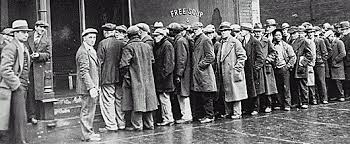
Being adopted by my grandparents, I grew up with a different generation of parents than did the rest of my friends. They were survivors of the Great Depression, and it impacted the rest of their lives and their thinking on many topics.

My parents were married on September 7th of 1929. This was four days after the highest point achieved ever by the Dow Jones Average. Black Tuesday hit on October 29th, seven weeks into their marriage.  depression soup line

My father lost most of his savings in the bank. He did maintain a job throughout The Depression, but he never trusted any sort of speculative investment ever after. He was a classic “cash and carry” guy. The stories of what they went through in the first decade of their marriage to make a living and support also my mother’s parents and three infants were absolutely amazing … and at times, heartbreaking.

But in it all, my father always gave God a minimum of 10%, and at the end of his life he testified to the church I was pastoring (and that he was attending in our home town) that God had taught him through this dark period how his needs would always be faithfully met in some way.

As we have entered into our readings on the life of David upon a period of time where the future king spent likely a decade running from Saul, David was learning valuable lessons that would serve him well in the role he would play as Israel’s king. Make no mistake about it, these were tough times. There were experiences where he could not see how he could possibly survive. Fear and looming demise were his constant companions, but so also was God’s faithfulness.

David would take his pen to write songs that spoke of these times and the lessons he was learning and declaring for others to hear. Psalms that have a direct foundation in this horrific period of David’s life are 18, 34, 52, 54, 56, and 57.

Here today we read just one of these, the historical situation of which we read about just yesterday…

Psalm 56

For the director of music. To the tune of “A Dove on Distant Oaks.” Of David. A miktam. When the Philistines had seized him in Gath.

1 Be merciful to me, my God, for my enemies are in hot pursuit; all day long they press their attack.
2 My adversaries pursue me all day long; in their pride many are attacking me.

3 When I am afraid, I put my trust in you.

4 In God, whose word I praise—in God I trust and am not afraid. What can mere mortals do to me?

5 All day long they twist my words; all their schemes are for my ruin.
6 They conspire, they lurk, they watch my steps, hoping to take my life.
7 Because of their wickedness do not let them escape; in your anger, God, bring the nations down.

8 Record my misery; list my tears on your scroll—are they not in your record?
9 Then my enemies will turn back when I call for help. By this I will know that God is for me.

10,11 In God, whose word I praise, in the Lord, whose word I praise—in God I trust and am not afraid. What can man do to me?

12 I am under vows to you, my God; I will present my thank offerings to you.
13 For you have delivered me from death and my feet from stumbling, that I may walk before God in the light of life.

We may never have a situation where people are actually out to seek our lives. But we will all face difficult times where people who are not motivated by God or yielded to him will seek to portray us in a difficult and negative way that could have dire consequences upon the details of our lives. We will have dark times; there is no escaping that reality.

But in those times, like David, we have God to cry out to for justice and endurance in the midst of our sufferings. We can ultimately rest in knowing that there is no harm that can come to us that is outside God’s control.

Fugitive Lessons (1 Samuel 21:1-15)

It is now over 20 years ago that Harrison Ford and Tommy Lee Jones starred in the 1993 film “The Fugitive” – based upon a 1960s television series of the same name. Harrison Ford plays the role of a wrongfully-convicted killer of his wife, and he escapes from custody and sets out to prove his innocence, all the while being pursued by U.S. Marshals.

The story of David on the run from Saul is not really a categorically different sort of action-packed adventure.

As we saw yesterday, David’s life is not safe in the presence of King Saul. He bids farewell to his friend Jonathan and sets out for what will be likely about a decade of his life on the run from the government as a fugitive. Today’s chapter is the first of several that talk about some of his adventures. And a number of Psalms are written by David during this time of his life as well, and we’ll look at one of them tomorrow.

In 1 Samuel 21 we see two fugitive stories. The first is about David going to a place where the Ark was and where there were the priests of Nob. David finds help here – he finds food at a time when he was near starving, being allowed to each the de-consecrated bread that was actually only to be eaten by the priests.

David at Nob

21:1 David went to Nob, to Ahimelek the priest. Ahimelek trembled when he met him, and asked, “Why are you alone? Why is no one with you?”

2 David answered Ahimelek the priest, “The king sent me on a mission and said to me, ‘No one is to know anything about the mission I am sending you on.’ As for my men, I have told them to meet me at a certain place. 3 Now then, what do you have on hand? Give me five loaves of bread, or whatever you can find.”

4 But the priest answered David, “I don’t have any ordinary bread on hand; however, there is some consecrated bread here—provided the men have kept themselves from women.”

5 David replied, “Indeed women have been kept from us, as usual whenever I set out. The men’s bodies are holy even on missions that are not holy. How much more so today!”6 So the priest gave him the consecrated bread, since there was no bread there except the bread of the Presence that had been removed from before the Lord and replaced by hot bread on the day it was taken away.

7 Now one of Saul’s servants was there that day, detained before the Lord; he was Doeg the Edomite, Saul’s chief shepherd.

Remember this name – Doeg – as he is essentially a spy for Saul, and he will return in the story of the next chapter. This is not a good guy.

8 David asked Ahimelek, “Don’t you have a spear or a sword here? I haven’t brought my sword or any other weapon, because the king’s mission was urgent.”

9 The priest replied, “The sword of Goliath the Philistine, whom you killed in the Valley of Elah, is here; it is wrapped in a cloth behind the ephod. If you want it, take it; there is no sword here but that one.”

David said, “There is none like it; give it to me.”

The principle is that life itself is more holy than bread. Jesus referenced this very passage, as it reads in Matthew 12:1-8 …

12:1 At that time Jesus went through the grain fields on the Sabbath. His disciples were hungry and began to pick some heads of grain and eat them. 2 When the Pharisees saw this, they said to him, “Look! Your disciples are doing what is unlawful on the Sabbath.”

3 He answered, “Haven’t you read what David did when he and his companions were hungry? 4 He entered the house of God, and he and his companions ate the consecrated bread—which was not lawful for them to do, but only for the priests. 5 Or haven’t you read in the Law that the priests on Sabbath duty in the temple desecrate the Sabbath and yet are innocent? 6 I tell you that something greater than the temple is here. 7 If you had known what these words mean, ‘I desire mercy, not sacrifice,’ you would not have condemned the innocent. 8 For the Son of Man is Lord of the Sabbath.”

David at Gath

10 That day David fled from Saul and went to Achish king of Gath. 11 But the servants of Achish said to him, “Isn’t this David, the king of the land? Isn’t he the one they sing about in their dances: “‘Saul has slain his thousands, and David his tens of thousands’?”

12 David took these words to heart and was very much afraid of Achish king of Gath. 13 So he pretended to be insane in their presence; and while he was in their hands he acted like a madman, making marks on the doors of the gate and letting saliva run down his beard.

14 Achish said to his servants, “Look at the man! He is insane! Why bring him to me?15 Am I so short of madmen that you have to bring this fellow here to carry on like this in front of me? Must this man come into my house?”

Desperate times call for desperate measures, and David goes to a place where Saul will not pursue him – into enemy territory of the Philistines. There he feigns being a madman. It was not a practice in ancient times to kill the insane, as superstitions were that this would offend the gods in some way and bring trouble upon oneself for doing so.

A tough faith comes out of tough times

So, have you been going through a rough stretch of life? Does it seem like God is far away? You know what is right, you are seeking to live rightly, but you don’t seem to be finding the rewards for it?

Look at David here … is your life that bad right now?

More questions … looking back over your life if you’ve known the Lord for a longer period of time … when did you grow the most in your faith? When things were going swimmingly well? Or when times were difficult and you had to throw yourself upon the Lord?

The well-known women’s Bible teacher and former missionary Elizabeth Elliott had some years ago a program on Christian radio called “Gateway to Joy.”  I remember hearing her say one time that she was asked by another woman, “How can I become such a great woman of faith as you are?”

Sensing that the questioner was seeking some sort of immediate “fix” or “magical spiritual pill,” Elizabeth said something to this effect, “Well, you can have your husband killed by a hostile Indian tribe in Ecuador and then live among those savages, raise a child as a widow, marry a second time and become a widow a second time, and deal with dozens of others challenges of life, and then maybe you too can have a great faith.”

David was anointed as a boy to become the king of the nation. You would think that God would take better care of him. But God was with him in everything, teaching and preparing him – even through years of trauma – to be dependent upon the Lord for all things.

This theme of suffering and carrying the cross before wearing the crown – our subtitle of the series – is a timeless truth that resounds to our day and our lives as well. God is so much more interested in our heart relationship of dependence upon him than he is that we have success and comfort.

Look to him today, right now, this moment, for whatever challenge you have … whatever fugitive feeling you possess about life in this unjust world.

The Treasure of Loyalty (1 Samuel 20:1-42)

If you have had lifelong or long-term friends who have been faithful and loyal to you through all of the ups and downs of your life, you possess a great and rare treasure.

Through the wonder of the computer age and social media, I have the opportunity to have occasional contacts with friends from childhood and high school. There are an additional few from college and grad school. A great disappointment is the loss of contact with the vast majority of friends from my previous ministry.

In all of these stages of life, while I remain thankful and in possession of warm memories of people along those pathways, I am sad that so few have remained very close at all.

But there is one friend from New Jersey that is still unique. We ran about 10,000 miles together when marathon training in our younger years. Our parents were friends and our families always went to the same two churches – one of which he has become the pastor of in these latter years of life. There is nothing we can’t talk about and have not discussed.

Today we look at the famous passage of the loyal friendship of David and Jonathan – a relationship that was based upon a covenant of love. It is an imperfect picture of the perfect covenant of relationship that we have with the true king – one that was bought by the blood of Christ.

To review the background leading to this passage, recall that after David killed Goliath, he was put in charge of a segment of the army in Israel, and he had great success in all that he did – because God was with him and blessed his efforts. He was loved by the army and the people, who sang a song about him—that Saul killed his thousands, but David his ten thousands.

All of this created both a jealousy and a fear in Saul, who was haunted by an evil spirit that had come after the Holy Spirit had departed. He twice threw spears at David to try to kill him.

Saul devised plots to put David in battle situations that were very difficult and where he may well have been killed by the Philistines. But God was with David.

Through a whole variety of circumstances, it had become very clear that David could simply no longer safely be in Saul’s presence, as the king had become unhinged in every way.

20:1  Then David fled from Naioth at Ramah and went to Jonathan and asked, “What have I done? What is my crime? How have I wronged your father, that he is trying to kill me?”

2 “Never!” Jonathan replied. “You are not going to die! Look, my father doesn’t do anything, great or small, without letting me know. Why would he hide this from me? It isn’t so!”

3 But David took an oath and said, “Your father knows very well that I have found favor in your eyes, and he has said to himself, ‘Jonathan must not know this or he will be grieved.’ Yet as surely as the Lord lives and as you live, there is only a step between me and death.”

4 Jonathan said to David, “Whatever you want me to do, I’ll do for you.”

5 So David said, “Look, tomorrow is the New Moon feast, and I am supposed to dine with the king; but let me go and hide in the field until the evening of the day after tomorrow. 6 If your father misses me at all, tell him, ‘David earnestly asked my permission to hurry to Bethlehem, his hometown, because an annual sacrifice is being made there for his whole clan.’ 7 If he says, ‘Very well,’ then your servant is safe. But if he loses his temper, you can be sure that he is determined to harm me. 8 As for you, show kindness to your servant, for you have brought him into a covenant with you before the Lord. If I am guilty, then kill me yourself! Why hand me over to your father?”

9 “Never!” Jonathan said. “If I had the least inkling that my father was determined to harm you, wouldn’t I tell you?”

10 David asked, “Who will tell me if your father answers you harshly?”

11 “Come,” Jonathan said, “let’s go out into the field.” So they went there together.

12 Then Jonathan said to David, “I swear by the Lord, the God of Israel, that I will surely sound out my father by this time the day after tomorrow! If he is favorably disposed toward you, will I not send you word and let you know? 13 But if my father intends to harm you, may the Lord deal with Jonathan, be it ever so severely, if I do not let you know and send you away in peace. May the Lord be with you as he has been with my father. 14 But show me unfailing kindness like the Lord’s kindness as long as I live, so that I may not be killed, 15 and do not ever cut off your kindness from my family—not even when the Lord has cut off every one of David’s enemies from the face of the earth.”   

16 So Jonathan made a covenant with the house of David, saying, “May the Lord call David’s enemies to account.” 17 And Jonathan had David reaffirm his oath out of love for him, because he loved him as he loved himself.

18 Then Jonathan said to David, “Tomorrow is the New Moon feast. You will be missed, because your seat will be empty. 19 The day after tomorrow, toward evening, go to the place where you hid when this trouble began, and wait by the stone Ezel. 20 I will shoot three arrows to the side of it, as though I were shooting at a target. 21 Then I will send a boy and say, ‘Go, find the arrows.’ If I say to him, ‘Look, the arrows are on this side of you; bring them here,’ then come, because, as surely as the Lord lives, you are safe; there is no danger. 22 But if I say to the boy, ‘Look, the arrows are beyond you,’ then you must go, because the Lord has sent you away. 23 And about the matter you and I discussed—remember, the Lord is witness between you and me forever.”

24 So David hid in the field, and when the New Moon feast came, the king sat down to eat. 25 He sat in his customary place by the wall, opposite Jonathan, and Abner sat next to Saul, but David’s place was empty. 26 Saul said nothing that day, for he thought, “Something must have happened to David to make him ceremonially unclean—surely he is unclean.” 27 But the next day, the second day of the month, David’s place was empty again. Then Saul said to his son Jonathan, “Why hasn’t the son of Jesse come to the meal, either yesterday or today?”

28 Jonathan answered, “David earnestly asked me for permission to go to Bethlehem. 29 He said, ‘Let me go, because our family is observing a sacrifice in the town and my brother has ordered me to be there. If I have found favor in your eyes, let me get away to see my brothers.’ That is why he has not come to the king’s table.”

30 Saul’s anger flared up at Jonathan and he said to him, “You son of a perverse and rebellious woman! Don’t I know that you have sided with the son of Jesse to your own shame and to the shame of the mother who bore you? 31 As long as the son of Jesse lives on this earth, neither you nor your kingdom will be established. Now send someone to bring him to me, for he must die!”

32 “Why should he be put to death? What has he done?” Jonathan asked his father. 33 But Saul hurled his spear at him to kill him. Then Jonathan knew that his father intended to kill David.

34 Jonathan got up from the table in fierce anger; on that second day of the feast he did not eat, because he was grieved at his father’s shameful treatment of David.

35 In the morning Jonathan went out to the field for his meeting with David. He had a small boy with him, 36 and he said to the boy, “Run and find the arrows I shoot.” As the boy ran, he shot an arrow beyond him. 37 When the boy came to the place where Jonathan’s arrow had fallen, Jonathan called out after him, “Isn’t the arrow beyond you?” 38 Then he shouted, “Hurry! Go quickly! Don’t stop!” The boy picked up the arrow and returned to his master. 39 (The boy knew nothing about all this; only Jonathan and David knew.) 40 Then Jonathan gave his weapons to the boy and said, “Go, carry them back to town.”

41 After the boy had gone, David got up from the south side of the stone and bowed down before Jonathan three times, with his face to the ground. Then they kissed each other and wept together—but David wept the most.

42 Jonathan said to David, “Go in peace, for we have sworn friendship with each other in the name of the Lord, saying, ‘The Lord is witness between you and me, and between your descendants and my descendants forever.’” Then David left, and Jonathan went back to the town.

David’s fear about Saul seeking his life proved to be of real substance. And Jonathan’s fears were not without merit as well. Saul’s son knew and understood that David was to become the next king. He knew that in ancient times (as is seen even today is certain military coups around the world) the royal family being deposed was often fully exterminated. This made it impossible for uprisings and rival claimants to the throne in opposition to the new regime.

Jesus is to be crowned the true and better King ultimately. The fleshly nature of Adam within us, and the connection we have to Satan through this evil world of which he is the prince, tells us to make ourselves the king – to see self as our own sovereign ruler of our lives.

Rather, we need to trust in Christ as the King. There has been a covenant of loyal love established – that God will be faithful through his hesed (covenant love) to his people because of the sacrifice of his Son Jesus.

Because of Jesus, the descendants of Adam are not wiped out when Jesus takes the throne, but instead are brought near—very much like the covenant established between David and Jonathan.

So we have a choice – to act like Saul – essentially in self-centered interest like our original father Adam and refuse to trust in God; or we can be like Jonathan in knowing who the king is going to be, and walk in trust and loyal and faithful relationship with Jesus – our brother and friend – who loves us so much as to give his life for us to cover our transgressions.

A Musician a Day Drives the Devil Away (1 Samuel 16:14-23)

As most of you who know me are aware, I was a double major in college that included a degree in music. The music department was looked upon by the rest of the school as being a bit … well … more than a bit weird – inhabited by an odd mix of artsy people. And frankly, it was true; it was a pretty weird bunch. We were called “Twinks.”  I was one of only two or three normal people there … I think – at least that’s how I remember it! As an athlete, I was my college’s version of Justin Tucker – the Baltimore Raven’s player who was an opera singing music major at the University of Texas.

But where would the world be without musicians? Who doesn’t listen to music for soothing enjoyment?  (Actually, to be truthful, I don’t … just another area where I’m weird.)  When things in life get tough, what do people do? They call for a musician on their iPod or phone playlist.

The French poet Alphonse de Lamartine said that “music is the literature of the heart; it commences where speech ends.”

“Music is the medicine of the mind,” said Civil War General and Congressman John A. Logan.

And it was a medicine for the mind that King Saul needed …

David in Saul’s Service

14 Now the Spirit of the Lord had departed from Saul, and an evil spirit from the Lord tormented him.

Say what? God sends evil spirits?

The way we should read this is that God allowed an evil spirit in the absence of the withdrawal of the Holy Spirit. The indwelling Spirt of the Lord was not a universal experience of God’s people until the Day of Pentecost – which is what is so great about knowing Christ and being a part of his body, the church. We possess what was only given by God in the Old Testament to certain people at certain times.

15 Saul’s attendants said to him, “See, an evil spirit from God is tormenting you. 16 Let our lord command his servants here to search for someone who can play the lyre. He will play when the evil spirit from God comes on you, and you will feel better.”

17 So Saul said to his attendants, “Find someone who plays well and bring him to me.”

The secret service agents around King Saul knew that something had to be done to calm him down at these times of torment. And yes, maybe music would be the soothing answer. So they went on a search for the best Twink they could find, and look who it turned out to be …

18 One of the servants answered, “I have seen a son of Jesse of Bethlehem who knows how to play the lyre. He is a brave man and a warrior. He speaks well and is a fine-looking man. And the Lord is with him.”

19 Then Saul sent messengers to Jesse and said, “Send me your son David, who is with the sheep.” 20 So Jesse took a donkey loaded with bread, a skin of wine and a young goat and sent them with his son David to Saul.

21 David came to Saul and entered his service. Saul liked him very much, and David became one of his armor-bearers. 22 Then Saul sent word to Jesse, saying, “Allow David to remain in my service, for I am pleased with him.”

23 Whenever the spirit from God came on Saul, David would take up his lyre and play. Then relief would come to Saul; he would feel better, and the evil spirit would leave him.

That’s quite a coincidence isn’t it? Actually, no, it is not. Rather, it was the sovereign hand of God at work. God was giving young David the experience and exposure to the royal house – putting him behind the curtains and into the context of the sphere of the king, for better and worse.

On the day that I write this, I spent several hours with a young man who sought out my counsel to discuss knowing the “calling of God.”  I think some pastors and others I know have had a dramatic moment-in-time experience of hearing God’s call to do a particular work.

But I think most people discover God’s call in their life in the cumulative experiences of life where God sovereignly opens and closes doors. And the pattern and pathways that He orchestrates can only be fully seen after it is all done.

Those paths are not always straight and not always pleasant. But God is at work at all times and in all things, composing within us a life symphony that is a crescendo of glory to his praise if we will yield to the Devine Composer’s notations and rhythms for our lives.

A heart for God is more than skin deep (1 Samuel 16:1-13)

One of my mother’s favorite sayings was that “beauty is only skin deep.”  I don’t really recall when she would use that phrase – perhaps when she thought I should be interested in some girl that I was not finding interesting? I remember that happening a lot. Haha! Or maybe she was just quoting the lyrics of a 1966 song of this title by The Temptations? Nah… had to be the former!

The phrase actually dates back to literature from the 1600s. But the truth of its meaning dates back essentially to the beginning of human history.

There is no doubt that we live in an age of external appearance. Name a couple of musical stars who are ugly. When is the last time you saw an unattractive female news anchor?

Without doubt, the natural proclivity we have is to judge a book by its cover – to make evaluations about people by external appearance over inner character and quality. God is not given toward this malady however.

And today as we begin our readings that introduce the character of David, we have one of the great verses in all of Scripture – a quote of God himself speaking and saying that “people look at the outward appearance, but the Lord looks at the heart.”

Samuel Anoints David

16:1 The Lord said to Samuel, “How long will you mourn for Saul, since I have rejected him as king over Israel? Fill your horn with oil and be on your way; I am sending you to Jesse of Bethlehem. I have chosen one of his sons to be king.”

2 But Samuel said, “How can I go? If Saul hears about it, he will kill me.”

The Lord said, “Take a heifer with you and say, ‘I have come to sacrifice to the Lord.’3 Invite Jesse to the sacrifice, and I will show you what to do. You are to anoint for me the one I indicate.”

Have you ever heard of someone described as “loyal to a fault?”  That was Samuel. Even while fully faithful to God, he so very much longed to see Saul be a successful king with a desire to obey God. But it was not in Saul’s character to ever be that person. God wanted Samuel to move on, sending him to a tiny place called Bethlehem and to the family of a man named Jesse.

Samuel’s concern, given the broken relationship he now had with Saul, was that the King would eliminate him for anointing the next king. But God directs that the purpose need not be identified … that going as the spiritual leader in Israel for the purpose of sacrifice and worship was sufficient reason for the occasion.

4 Samuel did what the Lord said. When he arrived at Bethlehem, the elders of the town trembled when they met him. They asked, “Do you come in peace?”

5 Samuel replied, “Yes, in peace; I have come to sacrifice to the Lord. Consecrate yourselves and come to the sacrifice with me.” Then he consecrated Jesse and his sons and invited them to the sacrifice.

Perhaps some of you have worked for very large companies with multiple sites. And then a day came when the CEO arrived unannounced at your little location. What would you think? Why is he there? Is it good news or bad news? Did your facility perform something extraordinary, or is he there to consider shutting it down?

Bethlehem was not a place a person of Samuel’s importance came without some reason. But there he was to sacrifice and to invite, among others, the family of Jesse.

As with all the greatest of families, the home of Jesse consisted of a household full of boys.

6 When they arrived, Samuel saw Eliab and thought, “Surely the Lord’s anointed stands here before the Lord.”

7 But the Lord said to Samuel, “Do not consider his appearance or his height, for I have rejected him. The Lord does not look at the things people look at. People look at the outward appearance, but the Lord looks at the heart.”

8 Then Jesse called Abinadab and had him pass in front of Samuel. But Samuel said, “The Lord has not chosen this one either.” 9 Jesse then had Shammah pass by, but Samuel said, “Nor has the Lord chosen this one.” 10 Jesse had seven of his sons pass before Samuel, but Samuel said to him, “The Lord has not chosen these.” 11 So he asked Jesse, “Are these all the sons you have?”

As a father of five boys, I’ve always laughed at this point of the text. What? Seven boys aren’t enough?

The outward appearance criteria of judging by size had certainly not worked well in Israel with King Saul – who was head and shoulders taller than anyone else. And Jesse had one hunk after another of sons to present. And when the parade stopped, Samuel presumed there had to be another.

“There is still the youngest,” Jesse answered. “He is tending the sheep.”

Samuel said, “Send for him; we will not sit down until he arrives.”

And the final son was called in from the fields to stand before Samuel. We can clearly infer from this passage that he was almost an after-thought – not much more than a servant kid in his own household. Literature from the time would seem to indicate that a seventh son was highly favored; but add one more, and you were really into extra innings.

12 So he sent for him and had him brought in. He was glowing with health and had a fine appearance and handsome features.

Then the Lord said, “Rise and anoint him; this is the one.”

13 So Samuel took the horn of oil and anointed him in the presence of his brothers, and from that day on the Spirit of the Lord came powerfully upon David. Samuel then went to Ramah.

It is not at all certain what the brothers, or even David himself, thought or understood about this anointing. I don’t think it was perceived at the moment to be for the role of the king of the nation. Perhaps he was seen as being randomly selected to be set aside for training and education by Samuel at varied intervals – a sort of college scholarship. Whatever, we later see that his oldest brother was not impressed with the youngest boy when he shows up where Goliath is threatening the Israelites.

Timeless lessons – This passage today at once gives us both a challenge and an encouragement.

The challenge is to be reminded about what it is that God really values and to make our lives disciplined toward the cultivation of an inner heart for God – to know him and to value that which he values, having an eternal values system. Rather, our natural tendency is to be consumed with the things of this world in terms of material assets and places of prestige. We work hard at maintaining an outer image, while too often neglecting the more important inner character of knowing God and walking in truth with him.

The encouragement is that though we are all pretty much mostly plain and ordinary people, we can be extraordinary by virtue of relationship with the creator of the universe. That is pretty amazing. Probably most of us don’t know practically anyone important – like congressmen or governors or the President … or anyone else of fame and prominence in the news and culture. But we can know God intimately – which is better than anything else we could imagine. That is pretty awesome, and it is more than skin deep.