Unknown's avatar

About Christopher J Wiles

Hey there. My name's Chris. I'm a teaching pastor at Tri-State Fellowship, and a research writer for Docent Research Group. Thanks for stopping by; be sure to stay connected by subscribing to blog updates and more.

Confession is good for the soul (Psalm 6)

Phone Booth starring Colin Farrell.

Tensions were high.  Sweat ran cold across the stern faces focused on the figure in the phone booth.  His name was Stu Shepherd—the character played by Collin Farrell in the 2002 film Phone Booth.

 As the target of a sophisticated terrorist plot, Shepherd is held hostage in a New York City phone booth—his unseen captor controlling him through the telephone.  Framed for the terrorist’s crimes, the booth is surrounded by police, reporters—and eventually Stu’s wife.  His unseen captor assures him that the only way out of his nightmare is to confess—to his wife, to the world—his affair, his selfishness, and his various indiscretions.  At the climax of the film, Stu Shepherd makes his confession:

“I have never done anything for anybody who couldn’t do something for me. I string along an eager kid with promises I’ll pay him money. I only keep him around because he looks up to me.…I lie in person and on the phone. I lie to my friends.…I am just a part of a big cycle of lies…I wear all this [fancy Italian clothing]because underneath I still feel like the Bronx. I think I need these clothes and this watch. My two-thousand-dollar watch is a fake and so am I. I’ve neglected the things I should have valued most.… I mean, I work so hard on this image, on Stu Shepherd…I have just been dressing up as something I’m not for so long, I’m so afraid no one will like what’s underneath.”

They say that confession is good for the soul.  If you were to write your own “Stu Shepherd” speech, what would you say?  Are there things that weigh on your conscience?  Perhaps like Stu, you live with the persistent fear that “no one will like what’s underneath.”  In one of his diaries, author Franz Kafka wrote: “The state in which we find ourselves today is sinful, quite independent of guilt.” Do you hear what he’s saying?   If you’re living in today’s world, you may be thinking: “No one has the right to judge me.  No one has the right to label what I do as a ‘sin.’”  Like Stu Shepherd, most of us spend our lives trying to either hide our “bad” qualities or emphasize our “good” qualities in order to manage the judgments of others.  Yet deep down, we live with a secret fear that if our souls were truly exposed, we would be judged, condemned, and rejected.

DAVID’S STU SHEPHERD SPEECH (PSALM 6)

O Lord, rebuke me not in your anger,nor discipline me in your wrath.
Be gracious to me, O Lord, for I am languishing; heal me, O Lord, for my bones are troubled.
My soul also is greatly troubled.    But you, O Lord—how long?

Turn, O Lord, deliver my life; save me for the sake of your steadfast love.
For in death there is no remembrance of you; in Sheol who will give you praise?

I am weary with my moaning; every night I flood my bed with tears; I drench my couch with my weeping.
My eye wastes away because of grief; it grows weak because of all my foes.

Depart from me, all you workers of evil, for the Lord has heard the sound of my weeping.
The Lord has heard my plea; the Lord accepts my prayer.
10 All my enemies shall be ashamed and greatly troubled; they shall turn back and be put to shame in a moment.

In his commentary on the Psalms, Derek Kidner writes that this “psalm gives words to those who scarcely have the heart to pray, and brings them within sight of victory.”  How?  David writes that “the Lord has heard the sound of my weeping” (v. 8).  David’s trust could lie in the character of God.  And so can ours.

See, we have to view the words of David in light of the work of Christ.  What David knew in part, we can experience in whole.  When Christ came, He finished the work of redemption that God had set in place since the day our ancestors were kicked out of paradise.  When we read Psalm 6, we can know that God delivers our lives because He offers His own.

BECOMING SIN

In his letter to the church in Corinth, Paul says that on the cross, Jesus “became sin…so that we might become His righteousness” (2 Corinthians 5:21).  We experience deliverance only because Christ endured condemnation.   And in so doing, we trade reputations.  Now it’s Christ who owns my “Stu Shepherd speech.”  It’s Christ who stands guilty for what I’ve done.  And me?  I now stand before God a free man, delivered from God’s just anger over my guilt.

That’s why Christianity is of such enormous and vital importance.  If Christianity isn’t true, then I have no hope for what to do with my guilt.  If Jesus Christ is just a man, then He can condemn my sin, but never purge me of it.  Religion alone can only magnify my guilt; only the cross can set me free from it.

Are you hurting?  Struggling?  Guilty?  Let David’s words become your own.  And only because of the finished work of Christ can you claim such words as your deliverance.

Life as worship; worship as Life (Psalm 150)

SysiphusIs there a meaning to life?

It’s a basic question, one that has plagued man’s heart for as many centuries as he’s been on earth.  In today’s world, life has only as much meaning as you assign to it.  In other words, it’s up to each person to decide his own meaning and destiny, to come to terms with his place within the world.

On the surface, this must sound liberating.  But look a layer deeper, and you begin to realize just how imprisoning this really is.  If I am my own master, am I not equally my own slave?  If I am the answer to my own questions, what point is there in even asking them?  It was in the last century that we met philosophers who—for the first time—shrugged their shoulders when it came to questions of ultimate meaning.  “There is only one real question,” said Albert Camus, “and that is suicide.”  Camus used the image of the Greek myth of Sisyphus—the man condemned to rolling the boulder up the hill for all eternity, only to watch it roll back down time and again.  That’s what life is like, insists Camus.  And for a lot of us, there are days when life is precisely like this.  Another day at a menial job.  Another day changing diapers.  Another day pushing the boulder of our work feeling endlessly tired and strung out and empty.

Is there a meaning to all this?  The gospel says there is.

WestminsterIf you have a background in traditional church, you might be familiar with something called the Westminster Catechism.  Think of a “catechism” as a spiritual question-and-answer book.  When you open the Westminster Catechism, the first question is: “What is the chief end of man?”  The answer is simple, yet profound: “To glorify God and enjoy Him forever.”

In other words, worship is man’s ultimate purpose.

THE WEIGHT OF GLORY

But that probably sparks a series of questions in your mind.  How can a limited human being bring “glory” to an unlimited God?  We can best understand this if we unpack the word “glory.”  The word “glory” comes from the Hebrew word qabod.  The word originally meant “weight” or “mass”—it’s why C.S. Lewis would title one of his books The Weight of Glory.  It’s easy, then, to see how the word came to form something of a word picture.  Even today we speak of important topics as having “weight.”  Or, if you’re a child of the 60’s, you might occasionally say: “Oh man; that’s heavy.

What is it we’re really saying, then?  “Glory” can be taken to mean significance.  When I glorify God, I reveal His significance.  Is God the most significant thing in your life?  Can we worship—can we glorify God—in every facet of our lives?

The Psalmists seem to think so.  Listen to what we find in Psalm 150, the last Psalm we find in our Hebrew Testament:

Praise the LORD! Praise God in his sanctuary! Praise him in the sky, which testifies to his strength!  2 Praise him for his mighty acts! Praise him for his surpassing greatness!  3 Praise him with the blast of the horn! Praise him with the lyre and the harp!  4 Praise him with the tambourine and with dancing! Praise him with stringed instruments and the flute!  5 Praise him with loud cymbals! Praise him with clanging cymbals!  6 Let everything that has breath praise the LORD! Praise the LORD! (Psalm 150:1-6)

In only six verses, there are more than a dozen commands to praise God.  Our entire lives are meant to be an act of worship before the Lord.

GLORY IN SMALL SPACES

In 1 Corinthians 10:31, Paul tells the Corinthian church that regardless of the controversies that face them, they are to glorify God.  “Whether you eat or drink, or whatever you do, do it for the glory of God.”  In his commentary on Romans, William Barclay writes:

“The humblest and the most unseen activity in the world can be the true worship of God. Work and worship literally become one. Man’s chief end is to glorify God and to enjoy him forever; and man carries out that function when he does what God sent him into the world to do. Work well done rises like a hymn of praise to God. This means that the doctor on his rounds, the scientist in his laboratory, the teacher in his classroom, the musician at his music, the artist at his canvas, the shop assistant at his counter, the typist at her typewriter, the housewife in her kitchen—all who are doing the work of the world as it should be done are joining in a great act of worship.”

Often it’s tempting to think of worship as merely the weekly activity that happens in the walls of a local church.  But Psalms tells us that worship is meant to explode out the doors of the local sanctuary and spill into the streets of everyday life.

JOY IN PUSHING BOULDERS

What does that mean for those who work for a living?  This means that even if your job is to “push a boulder,” then worship infuses your work with dignity and meaning.  Christian author Dallas Willard says it this way:

“Consider your job, the work you do to make a living. This is one of the clearest ways possible of focusing upon apprenticeship to Jesus. To be a disciple of Jesus is, crucially, to be learning from Jesus how to do your job as Jesus himself would do it. New Testament language for this is to do it “in the name” of Jesus. Once you stop to think about it, you can see that not to find your job to be a primary place of discipleship is to automatically exclude a major part, if not most, of your waking hours from life with him. It is to assume to run one of the largest areas of your interest and concern on your own or under the direction and instruction of people other than Jesus. But this is right where most professing Christians are left today, with the prevailing view that discipleship is a special calling having to do chiefly with religious activities and ‘full-time Christian service.’” (Dallas Willard, The Divine Conspiracy)

If worship is my primary objective, then work ceases to be a simple means toward a paycheck.  Parenthood becomes more than cleaning up crayon marks—or worse.  Life ceases to be a mere system of rewards and punishments, but a story that we inhabit, and a song that points us toward lasting joy.


Worship wars and the means of our worship (Psalm 104)

Worship CrowdIf you’ve been in church for a while, you’re undoubtedly familiar with the concept of the “worship wars.”  As much as we’d prefer not to use the words “worship” and “war” in the same sentence, it’s hard to ignore the embattled positions over the relative merits of “traditional” or “contemporary” worship.  Talk about your First World Problems, right?

But even the categories of “traditional” and “contemporary” don’t really do justice to the wide variety of styles present in today’s American Church.  It used to be that you’d identify a church by its denomination—that is, by a set of doctrines or shared beliefs that distinguish one church from another.  Now, we live in an age that some are calling “postdenominational” (try saying that with your mouth full).  Worship styles define the identity of the worshipping community more than actual beliefs.

In this series, we’re defining worship as the means by which we express and form our love—and for Christians this means our love for God and His Kingdom.  We’ve already addressed the nature of “expression” and “formation;” today we examine the “means” by which we worship.  And we might as well start off with a bit of history.

REDEEMING FORMS

It was the fourteenth century B.C.  Though Israel had departed Egypt roughly 100 years earlier, Egyptian culture moved forward.  Pharaoh Amenhotep and his wife Nefertiti changed the face of Egyptian religion: they replaced the worship of many gods with the worship of one—the sun god Aton.  They even wrote hymns to this god, some of which were probably well-known to the people of Israel.

See for yourself: look at the following selections between the Song of Aton and Psalm 104:

Song of Aton Psalm 104 (selections)
A) Praise of Re Har-akhti … Thou appearest beautifully on the horizon of heaven, Thou living Aton, the beginning of life! Thou art risen on the eastern horizon, thou hast filled every land with thy beauty. Thou art gracious, great, glistening … thy rays encompass the lands to the limit of all thou hast made. A) Bless the Lord, O my soul. O Lord my God, thou art very great: thou art clothed with honor and majesty: who covers thyself with light as with a garment: who stretches out the heavens like a curtain… who laid the foundations of the earth


B) Every lion is come forth from his den; All creeping things, they sting. Darkness is a shroud, and the earth is in stillness, for he who made them rests in his horizon.


B) Thou makest darkness, and it is night: wherein all the beasts of the forest do creep forth. The young lions roar after their prey and seek their meat from God.


C) At daybreak, when thou arisest on the horizon, when thou shinest as the Aton byday,… their arms are raised in praise at they appearance. All the world, they do their work. All beasts are content with their pasturage; trees and plants are flourishing.


C) The sun ariseth, they gather themselves together, and lay them down in their dens. Man goeth forth unto his work and to his labor until the evening. They give drink to every beast of the field…. He watereth the hills from his chambers: the earth is satisfied with the fruit of thy works.


D) How manifold it is, what thou hast made! Thou didst create the world according to thy desire.


D) O Lord, how manifold are thy works! In wisdom hast thou made them all: the earth is full of thy riches.


E) For thou hast set a Nile in heaven, that it may descend for them and make waves upon the mountains, . . to water their fields in their towns. E) He sendeth the springs into the valleys, which run among the hills.


What’s going on here?  Is it possible that Israel cribbed lines from the local radio station?  Well, kinda.  In his excellent study of the Jewish temple, G.K. Beale observes that many facets of Israelite religion strongly resembled those of other, neighboring religions.  A cynical observer might allow this to fuel his skepticism: “See?  There’s nothing unique about Israel’s religion; it was just adapted from the nations around them.”  Not to belabor the point, but I can actually attest that if you were to take an Old Testament or religions course in a University setting, you could probably expect your professor to hand you something like I’ve shown you above—in the hopes of dispelling any vision you may have had of Israel’s uniqueness.

But Beale goes further in his study to emphasize the sharp contrasts between Israel and her neighbors.  Sure, Israel borrowed from Egypt’s cultural forms—but not her content.  Beale suggests that Israel borrowed from others as a way of showing God’s superiority to the rival religions that surrounded Israel.  Or, he suggests, it could simply be that every human soul yearns to touch the face of God—other religions are simply failed attempts at connecting with man’s creator.

What does this have to do with worship?  It’s simple, really: the form of worship is less significant than the object of worship.  Believe it or not, there are churches that argue that certain styles or genres of music can never be used to worship God.  But even the Psalms reveal that certain cultural styles can be adapted to reflect God’s truth and character.  Even many of today’s traditional hymns are adaptations of popular tunes sung during the days of Martin Luther and—later—John Wesley.

This also means that there can be no real point in arguing the superiority of one style or another.  In truth, each style may impact different people in different ways.  Personally you’ll never, ever get me to listen to country music—but I don’t fault those who find value and meaning in country-based music.

SACRED AND THE SECULAR?

This also means that the line between “sacred” music and “secular” music isn’t always as clear as we’d like to think.  In some churches, worship leaders are strategically incorporating songs from non-Christian artists into their overall worship experience.  Why?  We can’t revise the artist’s original meaning—a love song is still a love song, after all—but surely some songs speak to a universal human longing, a longing that can only be fulfilled in God.  Obviously, this requires wisdom, discernment, and a clear communication of purpose, but there may be times when even the most secular artists reveal the most sacred of human longings.

LEX ORANDI, LEX CREDENDI

But why all the “worship wars?”  Why do so many people in our churches end up “church-hopping” so regularly and so willingly?  Why are we so quick to grow bored with our worship?

I believe the answer to these questions is very simple: in these instances, it is not Christ we worship, but Christianity.  The difference is simple: our devotion is not to Christ alone, but to the actual means by which we worship Him.  Said another way, what we worship is worship itself.

Historically the church has expressed this through the Latin phrase: lex orandi, lex credendi.  Literally it means “the church believes as she prays,” but I prefer Dr. Martin Lloyd Jones’ modern paraphrase: “What you win them with, you win them to.”  In other words, if we “win” people to our church through impassioned, cutting edge worship experiences, then there’s a possibility that we have won them to those experiences rather than Jesus.  If people are won to the emotion that colors so much of today’s worship music, then they will always be looking for their next emotional “fix.”  And “worship wars” will always erupt between those more devoted to the style of worship than the object of worship. Cater to preferences, and you cultivate a generation of consumers.  Devote oneself to the gospel, and you cultivate a generation of disciples.

So what is to be done?  The answer, I believe, is to actively pursue the same attitude as the One we worship—who lowered Himself by becoming a human being and ascend to the agony of the cross.  If we abandon our often-selfish demands to worship the way we want, then we can enjoy the things that draw our brothers and sisters closer to God.  And in so doing, we lay a greater foundation for unity and lasting joy.

Regional dialects, liturgies, and worship as “thick practice” (Psalm 100)

USA MapWhere you from?

It’s apparently easier to tell than you might think.  Late in 2013, the New York Times released an online test to determine what part of the country you come from, based solely on your dialect—that is, the way you pronounce certain words, or certain phrases that are specific to a given region.  You can take the quiz for yourself, if you like.  Go ahead.  It’s surprisingly accurate; I was pegged as a D.C. resident, which is probably only because Hagerstown was lumped into the same region.

Think about what this means.  Our environments have direct influence over the way we speak.  And if these “regional dialects” are common to a particular time and place, then surely there are other parts of ourselves that are shaped by our environment.

We defined worship as the means by which we express and form our love.  The “expressing” part seems obvious—we devote our time, money, energy toward some particular interest.  But the “forming” may not be so obvious.  What we worship changes who we are?  Yep.  And just like a “regional dialect,” it might affect us in ways we don’t even realize.

LITURGY

The word, of course, is liturgy.  If you grew up in a more traditional church, the word “liturgy” might conjure up images of formal church practices: robes, candles, incense—that sort of thing.  But the word “liturgy” simply refers to the system by which we worship.  In his excellent book Desiring the Kingdom, James K. Smith defines “liturgies” as “rituals of ultimate concern that are formative of our identity—they both reflect what matters to us and shape what matters to us.”  Smith argues that liturgies are everywhere—not just in church.

Think about the “liturgy” of the shopping mall.  What goes on?  You park your car.  You walk to the entrance.  Depending on your familiarity with the shopping center, you might stop at a mall directory to get your bearings.  Then you stop at a handful of stores to compare prizes, styles, etc.

So what if you’re a guy?  Football has a liturgy of its own.  You throw on your Peyton Manning jersey.  You hit the couch with a beer in time to catch a leggy starlet singing “waiting all day for Sunday night” as the players enter the temple—I mean stadium.  And in between plays you are bombarded with commercial messages offering you a slice of the “good life” if you buy this, drive that, or stay tuned for the latest television debut.

It’s not that shopping or sports are negative.  It’s just that left unchecked, the liturgies of consumerism and consumption can drive our focus inward toward self.

WORSHIP AS A “THICK” PRACTICE

In his book, Smith makes a distinction between what he calls “thick” and “thin” practices.  Thin practices have little bearing on our character, but are instead “instrumental to some other end. They also aren’t the sort of things that tend to touch on our identity” (p. 82).  Brushing one’s teeth, for example, has little to do with personal desire or character development.  Thick practices, however, reveal and shape our deeper vales.   “These are habits that play a significant role in shaping our identity, who we are. Engaging in these habit-forming practices not only says something about us, but also keeps shaping us into that kind of person.”

iphoneThink of it this way: which way is your heart slanted?  Toward God and my neighbor?  Or toward my own self-fulfillment?  Granted, not every liturgy pushes me directly into sin, but might my actions make me more prone to loving self rather than loving others?  Think of the “liturgy” of the cell phone.  If I use my phone to screen unwanted calls or to avoid face-to-face interactions, is it possible that this “liturgy” causes my heart to be slanted toward self-interest?  And, over time, I might find it harder and harder to experience empathy for others.  Don’t write this off as mere alarmism—recent studies have found that young adults are less empathetic than any other generation, and its being attributed to the fact that young people have grown numb to the transient news reports that skip across social media like stones across a pond.

We need a new liturgy, a new “thick practice” to lift our eyes beyond the cold horizon of self and to expose us to the radiant glow of God’s glory.  This is what Christian worship does for us; the Psalms merely serve as a set of guiderails, and offer us a new “regional dialect” that colors our speech and character.

So when we look at Psalm 100, we should not be surprised to find it loaded with imperatives—with commands.

A Psalm for giving thanks. Make a joyful noise to the LORD, all the earth!  2 Serve the LORD with gladness! Come into his presence with singing!  3 Know that the LORD, he is God! It is he who made us, and we are his; we are his people, and the sheep of his pasture.  4 Enter his gates with thanksgiving, and his courts with praise! Give thanks to him; bless his name!  5 For the LORD is good; his steadfast love endures forever, and his faithfulness to all generations. (Psalm 100:1-5)

I count at least seven distinct commands in a span of five verses.  God is deeply concerned with the character of His people—so much so that He prescribes a lifetime of worship to make our character more like His own.

The problem, of course, is that this does not come at all naturally—nor all at once.  Christian author N.T. Wright likens the process to learning a language or a new instrument:

“If learning virtue is like learning a language, it is also like acquiring a taste, or practicing a musical instrument.  None of these ‘comes naturally’ to begin with.  When you work at them, though, they begin to feel more and more ‘natural,’ until that aspect of your ‘character’ is formed so that, at last, you attain the hard-won freedom of fluency in the language, happy familiarity with the taste, competence on the instrument.”  (Wright, After You Believe, p. 42)

This means that spiritual formation doesn’t happen on any given Sunday—it happens over a lifetime of Sundays.  There is no substitute for deep spiritual commitment—nor is there any greater source of joy.


Pinterest, elephants, and the true and better rock of Moses (Psalm 95)

PinterestEllen spends hours scanning through the images that populate her online Pinterest account.  In this virtual world, Ellen shares her favorite things with others and gathers new ideas for future projects, fashion tips—all the necessary ingredients for the “good life.”  Meanwhile her husband Rick is lost on his smart phone—scanning through his various apps to find the latest scores and stats of his favorite team.  In the background, Ellen can even hear him periodically break the silence to yell at the TV—though never really winning his argument with the umpire.

What’s happening here?  It’s simple, really.  It’s worship.  It may not look like a typical church service, but Ellen and Rick are entranced in desire—whether it be for the various images offered on Pinterest, or desire for vicarious greatness achieved by living for your favorite sports team.

The Germans have a word it, actually.  They call it sehnsucht, what we might call a “desire for desire itself,” a sense of longing that goes deeper than eye can see and imagination can fathom.  It’s addictive, because it’s hard-wired into each of our souls.  In an article for New York Times Magazine, Corina Chocano observed the way that technology offers a natural outlet for such longings:

…your average Pinterest board or inspiration Tumblr basically functions as a longing machine… Someone on Pinterest once posted a slide that read: “Pinterest: Where women go to plan imaginary weddings, dress children that don’t exist and decorate homes we can’t afford.” But to focus on the “aspirational” aspect is to miss the point. People don’t post stuff because they wish they owned it, but because they think they are it, and they long to be understood, which is different.

I love her phrase: “longing machine.”  But in truth, each of our hearts serves as a “longing machine,” or perhaps a “longing factory,” built to turn the things we love into a source of significance.  In short: we’re made to worship.

WHAT IS WORSHIP?

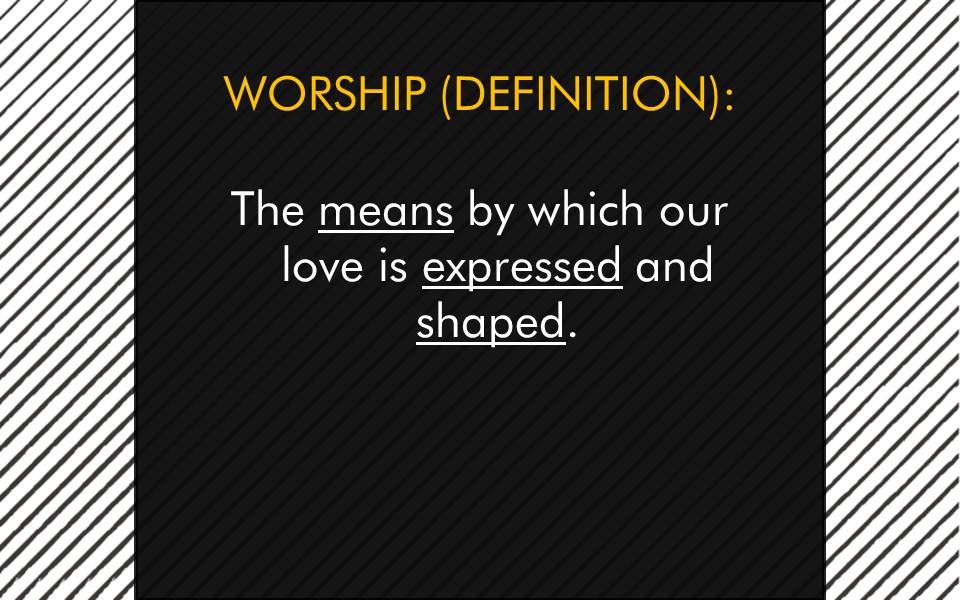
Worship definitionThroughout our series we’re relying on a simple yet specific definition of worship.  Worship is the means by which we express and form our love.  So yes, this could easily happen through Pinterest boards or in front of our TV sets, cultivating a sense of excitement and failure over the big game or the latest political event.

This means that even if you think you’ve no real “use” for “religion,” you can’t get away from the nature of worship.  Everybody worships something—this was the message of David Foster Wallace in his graduation speech to Kenyon College some years ago.  Though not remotely a “spiritual” person, Wallace argued that worship is a fundamental part of human reality:

“Everybody worships. The only choice we get is what to worship. And the compelling reason for maybe choosing some sort of god or spiritual-type thing to worship—be it JC or Allah, be it YHWH or the Wiccan Mother Goddess, or the Four Noble Truths, or some inviolable set of ethical principles—is that pretty much anything else you worship will eat you alive. If you worship money and things, if they are where you tap real meaning in life, then you will never have enough, never feel you have enough. It’s the truth. Worship your body and beauty and sexual allure and you will always feel ugly. And when time and age start showing, you will die a million deaths before they finally grieve you. …Worship power, you will end up feeling weak and afraid, and you will need ever more power over others to numb you to your own fear. Worship your intellect, being seen as smart, you will end up feeling stupid, a fraud, always on the verge of being found out. But the insidious thing about these forms of worship is not that they’re evil or sinful, it’s that they’re unconscious. They are default settings.”

How do we know what we worship?  It’s easier than we may think.  Paul Tillich—a writer and philosopher—once define “religion” as a society’s “ultimate concern.”  What sorts of things “concern” you?  You could look at this question in a number of ways:

  • Where do I spend my money?
  • Where do I spend most of my time?
  • What do I get deeply passionate about?  What makes me angry?  What do I fear losing?
  • What do I daydream about?  What do I consistently find myself thinking about—a new job promotion?  A relationship?  Sex?  These desires reflect the object of our worship.

THE RIDER AND THE ELEPHANT

ElephantFor literally centuries, philosophers have struggled to understand the relationship between reason and desire.  I believe it was Plato who first used the analogy of the rider and the elephant.  The elephant represents desire.  The rider represents reason.  The reason so much of our lives is out of control is simple: I can’t use my brain alone to control the raging elephant of my desire.  I can’t “think” my way out of every temptation.  Not to be too pointed, but this is why sexual sin has such a high number of repeat offenders.  Biologically, we are hard wired for sexual desire.  It seems nearly impossible to “control” these natural impulses, and to most non-Christians, the suggestion that we try to do so is regressive, repressive, unhealthy.

Many religions teach the avoidance or repression of desire.  Buddhism, for example, argues that existence is suffering brought on by selfish desires.  The path to salvation is the elimination of desire.  Christianity says that’s preposterous.  God intends that humans experience God’s perfect design as pure joy.  Christianity says that our desires, our longings—that sehnsucht we spoke of above—reveals a deeper longing for something beyond ourselves.  It’s why C.S. Lewis so famously argued that hunger would seem preposterous if food were not real.  Romantic love would be an abnormality if not for the existence of the opposite sex.  So, he concludes, “if I find in myself nothing else on earth can satisfy, it must be that I was made for another world.”

Christian worship, then, is the means by which we express and form our love for God and His kingdom.  It’s not about trying to suppress desire.  Those who do usually fail—repeatedly.  The rider of my intellect cannot possibly control the elephant of my desires.  But Christianity isn’t about trying to “manage” our sins.  On the contrary; Christianity is about replacing my unhealthy desires with a desire for God and God alone.

This is why the Psalms are so beneficial, because they orient me towards God’s kingdom, and give me a bigger picture of God than I’d ever dare dream.  It’s no wonder, then, that the Psalms have been a vital part of Christian worship for centuries.

CALL TO WORSHIP

We can turn our attention to Psalm 95—one in a series of praise Psalms designed to orient Israel’s hearts toward God.

Oh come, let us sing to the LORD; let us make a joyful noise to the rock of our salvation!  2 Let us come into his presence with thanksgiving; let us make a joyful noise to him with songs of praise!  3 For the LORD is a great God, and a great King above all gods. (Psalm 95:1-3)

Other gods?  By that David—the writer of this Psalm—meant the other things Israel looked toward for comfort, security and protection.  But God is superior to all of these lesser substitutes:

4 In his hand are the depths of the earth; the heights of the mountains are his also.  5 The sea is his, for he made it, and his hands formed the dry land.  6 Oh come, let us worship and bow down; let us kneel before the LORD, our Maker!  7 For he is our God, and we are the people of his pasture, and the sheep of his hand. Today, if you hear his voice,  8 do not harden your hearts, as at Meribah, as on the day at Massah in the wilderness,  9 when your fathers put me to the test and put me to the proof, though they had seen my work.  10 For forty years I loathed that generation and said, “They are a people who go astray in their heart, and they have not known my ways.”  11 Therefore I swore in my wrath, “They shall not enter my rest.” (Psalm 95:1-11)

Meribah and Massah represent the time when Israel demanded water from God (Exodus 17)—in other words, wanting a relationship with God on their own terms.  God provided water, having Moses strike the rock with his staff, and water sprang forth (Exodus 17:6).

God’s answer to our desires is to give us more of Himself.  Roughly 1500 years later, God’s Son would be struck by another staff—a soldier’s spear—and blood and water sprang forth.  The gospel promises us the forgiveness of sins and new life in His name.  Though we are creatures of a thousand lesser loves and desires, God provides a way for us, through Jesus—the true and better rock of Moses—so that we might enter into God’s rest.

“The Anatomy of Praise” (Psalm 24)

KONICA MINOLTA DIGITAL CAMERAI love music.  Visit my apartment, and you’ll witness my collection of vinyl records lining the shelves of my IKEA furniture—along with a turntable that’s older than I am.  In A Song to Sing, A Life to Live: Reflections on Music as Spiritual Practice, Don Saliers notes that almost everything in creation fits some sort of rhythm: our heartbeats, the rise and fall of our breathing, the seasons, the orbit of celestial bodies—even toddlers who get their start by clanging a wooden spoon against a metal pan.  Music is everywhere, and as we grow older music begins to be an increasing reflection of what we think, how we feel, and where exactly we find ourselves.

In the film High Fidelity, John Cusack plays an eccentric record store owner whose life is defined by every groove of the records that line his shelves.  Every victory, every heartache, every failed attempt at romance had its own song.  In one pivotal scene, his friend marvels at the complex new system by which he’s organized his collection.  “Not alphabetical,” they mutter.  “Autobiographical.”  Music became his story.

THE ANATOMY OF PRAISE

bonoJohn Calvin once referred to the Psalms as “the anatomy of praise.”  Though David is the author of many of these songs, throughout history men and women have taken his words and made them their own.  Bono—the frontman of the band U2—credits David as a major influence of his own music:

“At the age of 12, I was a fan of David. He felt familiar, like a pop star could feel familiar. The words of the psalms were as poetic as they were religious, and he was a star. Before David could fulfill the prophecy and become the king of Israel, he had to take quite a beating. He was forced into exile and ended up in a cave in some no-name border town facing the collapse of his ego and abandonment by God. But this is where the soap opera got interesting. This is where David was said to have composed his first psalm – a blues. That’s what a lot of the psalms feel like to me, the blues. Man shouting at God – “My God, my God, why hast thou forsaken me? Why art thou so far from helping me?” (Psalm 22).

The Psalms are where ideas about God meet the harsh terrain of human experience.   Do you have a favorite record, or maybe just a song that you look toward and say, “That’s my song.”  Maybe you and your spouse have a song that is “our song.”  It wasn’t written by you, but you’ve absorbed its meaning and in so doing the music became deeply personal.   The book of Psalms is God’s way of saying, “here’s your song.  This is what life looks like when you live it with me.”  And in that sense, not every part of this “anatomy of praise” looks happy or bright.  We find hymns of praise, yes.  But we also find the blues.  We find folk rock protest anthems.  We find an entire record collection of what life with God really looks like.

A PSALM FOR ALL SEASONS

As an introductory example, we can look at Psalm 24.  The Psalm is originally attributed to David.  But scholars have recently argued that most Psalms came to be used outside of their original context and can be equally understood as forming the backbone of Israel’s worship.  For instance, Psalm 24 was written by David, but it came to be used by Israel during their time of exile in Babylon—sung every Sunday as a reminder of God’s power over every circumstance.

Here’s what they sang:

A Psalm of David. The earth is the LORD’s and the fullness thereof, the world and those who dwell therein,  2 for he has founded it upon the seas and established it upon the rivers.  3 Who shall ascend the hill of the LORD? And who shall stand in his holy place?  4 He who has clean hands and a pure heart, who does not lift up his soul to what is false and does not swear deceitfully.  5 He will receive blessing from the LORD and righteousness from the God of his salvation.  6 Such is the generation of those who seek him, who seek the face of the God of Jacob. Selah  7 Lift up your heads, O gates! And be lifted up, O ancient doors, that the King of glory may come in.  8 Who is this King of glory? The LORD, strong and mighty, the LORD, mighty in battle!  9 Lift up your heads, O gates! And lift them up, O ancient doors, that the King of glory may come in.  10 Who is this King of glory? The LORD of hosts, he is the King of glory! Selah (Psalm 24:1-10)

This Psalm can generally be categorized as a “Praise Psalm,” though it also fits a sub-category known as “Enthronement Psalms” describing the might of God’s kingship.  Don’t worry about understanding all the categories just yet—stick with us this summer and you’ll gain a better picture of the diversity contained in the Psalter.

Notice as well the presence of musical terms in the Psalms—such as David’s use of the word Selah, above.  What does this word mean?  No one really knows.  Suggestions have been made that it represents some sort of musical term, like today’s musical notations of fortissimo or D.C. al coda.  Other suggestions have been more scattered—one person even speculates it’s what David uttered when he broke a harp string!  Our English Bibles leave words like this untranslated—but they remind us of the way the Psalms were meant to be experienced: sung out and rising in a crescendo of human voices.

SINGING OUR LIVES

A Christian writer named Walter Brueggeman suggested that all Psalms can fit one of three categories:

  • Psalms of orientation: Psalms that reflect regular human experience and life with God.
  • Psalms of disorientation: Psalms that reflect a disruption of our experience—such as suffering or injustice.
  • Psalms of new orientation: Psalms that reflect a change in our attitude toward God and His Kingdom—that is, Psalms that orient us away from self and toward a love for God and neighbor.

It seems to me that these categories could actually be said to vary from person to person.  For instance, a song of praise might certainly be disorienting when I spend my life devoted to the worship of self (!).  And this might also push me towards a new orientation as a result.  The larger point, though, is simple.  As we read the Psalms—both individually and as a church—we find our hearts increasingly shaped by the beauty of God and His Word.  Worship therefore stretches beyond the borders of a traditional Sunday morning gathering and into every waking facet of our lives.  If Calvin was right in calling this book the “anatomy of praise,” then it is God’s church that animates this body that we might walk into the world with God’s new song in our hearts, and a song of praise on our lips.

Between Two Thieves (Part 2) (Philippians 3:12-21)

What you worship you become.

About a year ago my nephew became enamored—as three-year-olds do—with an app on his mom’s iPhone.  The app functioned as something of a moving storybook, complete with narration.  It even taught him some new words.  But there was one word in particular that seemed a bit out-of-place in his vocabulary: stawk.  Stawk?  Yes; stawk.  It’s a bird, silly.  It’s usually the bird that brings new babies to their home.  Oh…stork.  See, the app my nephew had been enjoying was manufactured across the pond, and the British accent had rubbed off on him.

If that can happen with something as simple as an accent, think of what happens with the things we worship?  And let’s also be clear: everybody worships something.  This was even the point made by David Foster Wallace—a mathematician and author who spoke at Kenyon College’s graduation in 2005:

“Everybody worships. The only choice we get is what to worship. And the compelling reason for maybe choosing some sort of god or spiritual-type thing to worship—be it JC or Allah, be it YHWH or the Wiccan Mother Goddess, or the Four Noble Truths, or some inviolable set of ethical principles—is that pretty much anything else you worship will eat you alive. If you worship money and things, if they are where you tap real meaning in life, then you will never have enough, never feel you have enough. It’s the truth. Worship your body and beauty and sexual allure and you will always feel ugly. And when time and age start showing, you will die a million deaths before they finally grieve you. …Worship power, you will end up feeling weak and afraid, and you will need ever more power over others to numb you to your own fear. Worship your intellect, being seen as smart, you will end up feeling stupid, a fraud, always on the verge of being found out. But the insidious thing about these forms of worship is not that they’re evil or sinful, it’s that they’re unconscious. They are default settings.”

Keep in mind, Wallace is hardly a Christian.  But you understand his point, don’t you?  It’s actually not that different from Augustine’s notion of sin: that sin is loving something else higher than God.  The problem—both for my nephew and for us—is that what we worship actually shapes us, whether we want it to or not.

HOPE SEEKING UNDERSTANDING

In yesterday’s post, we looked at Tertullian’s idea of there being “two thieves” of the gospel.  We looked at the way the religious thief replaces the gospel with self-righteousness; today we’ll look at how the un-religious thief replaces the gospel with self-absorption.

But notice, first, what Paul says about his own life.  After pointing out the superiority of knowing Christ,  he observes that this doesn’t actually mean that he himself is superior:

12 Not that I have already obtained this or am already perfect, but I press on to make it my own, because Christ Jesus has made me his own.  13 Brothers, I do not consider that I have made it my own. But one thing I do: forgetting what lies behind and straining forward to what lies ahead,  14 I press on toward the goal for the prize of the upward call of God in Christ Jesus.  15 Let those of us who are mature think this way, and if in anything you think otherwise, God will reveal that also to you.  16 Only let us hold true to what we have attained.  (Philippians 3:12-16)

Much of Christianity is about goal-setting; it’s about hope.  Very often I meet people who say things like, “I tried Christianity; it didn’t work for me,” or perhaps: “I went to church for a while, but it didn’t meet my needs.”  Maybe you’ve said similar things yourself.  But notice the words “work” and “needs” are paired with words like “for me” and “my.”  It’s just another form of self-absorption.

Paul’s attitude is radically different.  For Paul, Christianity isn’t about having it all together.  Christianity is a lifestyle of transformation.  Want to be mature?  says Paul, Then persevere.  If faith is a journey, then nothing will derail our progress like stopping along the freeway.  It’d be like stopping at a roadside diner and calling it a family vacation.  Better things lie ahead—it just takes patience in getting there.

THE NON-RELIGIOUS THIEF

We now turn to the non-religious thief.  Paul starts by inviting his readers to learn from his own life—a life that stands in contrast to those who oppose the gospel through self-interest:

17 Brothers, join in imitating me, and keep your eyes on those who walk according to the example you have in us.  18 For many, of whom I have often told you and now tell you even with tears, walk as enemies of the cross of Christ.  19 Their end is destruction, their god is their belly, and they glory in their shame, with minds set on earthly things.  20 But our citizenship is in heaven, and from it we await a Savior, the Lord Jesus Christ,  21 who will transform our lowly body to be like his glorious body, by the power that enables him even to subject all things to himself. (Philippians 3:17-21)

Do you hear the list of descriptors Paul uses?  We can even list them:

  • Enemies of the cross (v. 18)
  • Their end is their destruction (v. 19)
  • Their god is their belly (v. 19)
  • Their glory is their shame (v. 19)
  • Minds set on earthly things (v. 19)

These verses frame the portrait of someone who worships self instead of God.  As we saw through Wallace’s graduation speech, you don’t even have to believe in God to believe that this kind of attitude is caustic—to yourself and to other relationships.

But wait.  Aren’t some decisions personal?  Society makes progress, after all.  We don’t need to regress to a list of rigid, religiously-motivated restrictions.  What I do in the privacy of my own home—or bedroom—is my own business.  As long as I’m not hurting anyone, what does it matter?

The answer, of course, is found in verse 21: “our citizenship is in heaven.”  For Christians, identity isn’t found in behavior but through relationship.  And yet, this relationship provokes us to alter our behavior.  Why?  Because Christianity teaches us that this world is not all there is.  Therefore there is a higher goal than merely promoting freedom.  There is a higher goal than merely not offending or hurting anyone. So to be an “enemy of the cross” might be little more than a dogged insistence on living life on your own terms.  That’s not citizenship in heaven—that’s being tied to the city of man.

RAZOR’S EDGE

G.K. Chesterton once wrote that there are many ways for Christianity to fall—but only one way for it to remain upright.  If I can blend metaphors here, there are many variations of these two “thieves” of the gospel.  It may be tempting to see the gospel as some sort of “middle ground,” a balance struck between extremes.  But that’s not the case at all.  No; the gospel is a different road altogether—a road that leads God’s people on a new exodus away from the tyranny of self.  It’s about abandoning self-absorption and self-righteousness—nay, all self-interest and pursuing a radical life of self-sacrifice.  It’s why C.S. Lewis writes that “the Christians who did most for the present world were just those who thought most of the next…It is since Christians have largely ceased to think of the other world that they have become so ineffective in this. Aim at Heaven and you will get earth ‘thrown in’: aim at earth and you will get neither” (Mere Christianity, p. 134).

The more we live as citizens of heaven, the more our “accents”—our lifestyles, our stories—will come to be shaped by God’s kingdom rather than our own empires.  Follow self-interest and you’ll never find happiness.  Follow Christ and you’ll find everything you never knew you wanted.

Between Two Thieves (Part 1) (Philippians 3:7-11)

If you take even a casual glance at church history, you’ll see the name Tertullian crop up quite a bit.  Living in the second century, Tertullian gave us much our Christian vocabulary (words like Trinity, for example).  But Tertullian also wrote that there are two “thieves” of the gospel.  Just as Jesus was crucified between two thieves, so too can we find the gospel wedged between two equal and opposite extremes.  We might call the first thief the “religious thief,” because it replaces the gospel with an idol of self-righteousness.  We might call the second thief the “non-religious thief,” because it replaces the gospel with an idol of self-absorption.

We’ll unpack these further as we go, but for now you almost certainly notice what both hold in common: they both focus on self, albeit in different ways.  Do you remember how Augustine defined sin?  The human heart, he said, is a pyramid.  Joy will never be found unless God is at its apex.  Sin is loving anything more than God—and few things are more caustic than self-interest.

So when we examine Paul’s letter to the Philippians, we see him turn his attention to the two “thieves,” the two things that distract us from the gospel.   Today, we turn our attention to the first of these: the religious thief.

HOLY CRAP

Paul had already given his readers a glimpse of his impressive resume (3:1-6).  No one could claim to be more religious than Paul.  But what does Paul think of all this?

7 But whatever gain I had, I counted as loss for the sake of Christ.  8 Indeed, I count everything as loss because of the surpassing worth of knowing Christ Jesus my Lord. For his sake I have suffered the loss of all things and count them as rubbish, in order that I may gain Christ  9 and be found in him, not having a righteousness of my own that comes from the law, but that which comes through faith in Christ, the righteousness from God that depends on faith–  10 that I may know him and the power of his resurrection, and may share his sufferings, becoming like him in his death,  11 that by any means possible I may attain the resurrection from the dead. (Philippians 3:7-11)

Compared to Christ, what else is there?  I actually hate English Bibles here, because they sugar-coat the force of what Paul is saying.  Verse 8 says “rubbish,” or if you have an older translation, they might go as far as to say “dung.”  But if you read it in Paul’s original Greek, the word is skubala.  Skubala?  According to Daniel Wallace—arguably the world’s leading expert on Greek grammar—the word is (in his words) “roughly equivalent to the English ‘crap, s**t.’”

This is one of those that’s in the Bible?!?!? kinds of moments.  And yes; it is.

Why so harsh?  Why so coarse and vulgar?  It’s simple, really.  Paul is saying that focusing on religious performance is little more than (ahem) “holy crap.”  It’s worthless.  No one ever made it to heaven on “Christian values.”  Again, we have to distinguish between things that are wise, from things that are necessary.  Christian values aren’t bad—in fact, because they reflect God’s character, they can shape our lives in radical ways.  But Christian values never saved anyone.

When Matt Chandler—a pastor in the Dallas-Fort Worth metroplex—was diagnosed with cancer, it gave him a new perspective on the Law.  The Law, he said, is like the MRI machine.  An MRI machine can help diagnose you, can help expose your innermost flaws.  But the MRI machine will never cure you.  And that’s what the Law does, Chandler explains.  When we read the Law—God’s standards revealed to His people—we recognize that we are deeply flawed people.  But the Law can never cure us, and the more we try to cure through obedience, the deeper we sink into our own flaws.  It’s hopeless—unless someone could fulfill the Law for us.

ALIEN RIGHTEOUSNESS

In the sixteenth century, a young monk lay awake tormented by a singular thought: What if I’m not good enough for God?  What if I die without having confessed all my sins?  Maybe you’ve been haunted by a similar question.  The young monk was awakened by the book of Romans—another of Paul’s letters.  In those pages this young monk found the answer he’d been looking for.  Grace wasn’t a reward for religious service, he discovered.  Grace was a free gift of God based solely on God’s love poured out through Jesus.

The young monk’s name was Martin Luther, and the rest, as they say, is history.

Luther would later make a distinction between what he called “active” and “passive” righteousness.  Active righteousness is what comes through the religious thief.  Active righteousness is trying to earn it on my own.  Active righteousness means convincing myself that the (ahem) skubala of my self-righteousness is a fine perfume (hint: it’s not).  Active righteousness will always produce profound psychological, social, and spiritual damage.

I love sushi.  So one night on Netflix I watched the documentary Jiro Dreams of Sushi, which focuses on the career of a world-renowned sushi chef—a man so famous people wait for months for a reservation at his restaurant.  Jiro was deeply dedicated to his craft, so much so that film critic Roger Ebert looked at him with a sense of pity:

“… I found myself drawn into the mystery of this man. Are there any unrealized wishes in his life? Secret diversions? Regrets? If you find an occupation you love and spend your entire life working at it, is that enough?…Half an hour of [preparation] was good enough to win three Michelin stars. You realize the tragedy of Jiro Ono’s life is that there are not, and will never be, four stars.”

Active righteousness produces this same level of perfectionism—and this same level of regret.  Am I good enough?  Am I at least better than that person?   And the list goes on.

That’s why we need to focus on Christ’s passive righteousness.  Luther also called this an “alien” righteousness.  Why?  Because Christ’s righteousness is not unique to me; it comes from outside myself.  Let’s read what Paul said about this again:

“…not having a righteousness of my own that comes from the law, but that which comes through faith in Christ, the righteousness from God that depends on faith–  10 that I may know him and the power of his resurrection, and may share his sufferings, becoming like him in his death,  11 that by any means possible I may attain the resurrection from the dead.” (Philippians 3:9b-11)

The gospel isn’t about self-righteousness.  It’s not about “self” at all.  If anything, it’s about the transformed self—a new identity in Christ, and the hope of resurrection from the dead.

“Religion says ‘do this,’ and it is never done,” writes Luther.  “The gospel says ‘believe in this’ and it is already done.”

“Lay your deadly doing down,

Down at Jesus’ feet.

Stand in him and him alone,

Gloriously complete.

It is finished; it is finished.

What more can I ever do?”

(James Proctor, “It is Finished,” 19th Century)


The enemies of the gospel (Philippians 3:1-6)

They say that you should be cautious about saving a drowning man.  When a person is drowning, their survival instincts take over.  If you don’t hand them a flotation device, they’ll attempt to climb on top of you, pushing you under to give themselves a breath of oxygen.

Such behavior is excusable at the local pool.

Such behavior is inexcusable at the local church.

It’s human nature to want to be on top.  The whole of life becomes a giant quest for superiority—even in church.  In “Choruses from the Rock,” the poet T.S. Eliot asks:

“Why should men love the Church? Why should they love her laws?…They constantly try to escape from the darkness outside and within, by dreaming of systems so perfect that no one will need to be good.”

In a very real sense, that’s what “religion” boils down to: a “system so perfect no one will need to be good.”  I grew up in the land of evangelical subculture.  Christianity—at least to my mind—became reduced to a list of things to avoid, like R-rated movies, heavy metal music, and the science teacher.  Most of us can probably create a list of “do’s” and “don’ts” that defined our faith at one time or another.

Don’t get me wrong; I’m sure there are some for whom such lists are wise. 

But there is no one for whom such lists are necessary. 

The problem comes when we begin to think of our wise habits as necessary—and impose them on other people.  Can you believe that the Johnsons send their kids to “that” school?  I heard that the Millers like to watch “that” TV show—with their kids!  Someone told me that some of our pastors don’t listen to Christian radio.  And the list goes on, ad infinitum, ad nauseum.  And, you’ll notice, gossip becomes the currency of the comparison game.  We can judge one another’s religious habits and—like the drowning man—push one another down in a way that builds ourselves up.

And you know what?  That’s selfish.  That’s stupid.  And, Paul says, it’s the opposite of the gospel.

JOY REPLACES FEAR

In Philippians 3, Paul’s letter changes course:

Finally, my brothers, rejoice in the Lord. To write the same things to you is no trouble to me and is safe for you.  (Philippians 3:1)

The word “finally” sounds strange—as if Paul’s winding down to his conclusion.  But if you glance at the text, you’ll notice we’re only about halfway through.  What’s Paul saying?  If chapter 2 laid out the theological framework—that is, Christ’s example—then now Paul turns to further explain how that framework operates in the gritty reality of the Church.

“Rejoice,” he says.  Joy, once again, takes center stage in Paul’s letter.  And notice that he says that such a command “is safe for you.”  What’s going on, exactly?  It’s simple.  Paul knows full well that there will always be false teachers lurking in the shadows, waiting to insist on some form of religious ritual as the way to God.  And if you live your life in the shackles of duty, then you live your life in fear.  Am I doing enough for God?  Did I remember to pray for forgiveness for what I said yesterday?  If I live in this frame of mind, my natural tendency is to feel disqualified—as if I’ve let God down in some way.

Paul says No, no, no.  You can’t live your life in fear.  Pursue Christ.  Pursue Godly character.  But never assume that such pursuits earn God’s favor.  Instead, they are a response to God’s already lavish goodness—which is also our source of great joy. 

ENEMIES OF THE GOSPEL

Now Paul can turn his attention to the actual false teachers:

2 Look out for the dogs, look out for the evildoers, look out for those who mutilate the flesh.  3 For we are the circumcision, who worship by the Spirit of God and glory in Christ Jesus and put no confidence in the flesh–  4 though I myself have reason for confidence in the flesh also.  (Philippians 3:2-4a)

One of the problems of Paul’s letters is we don’t always know the full story.  It’s very much like listening to someone else’s phone conversation: we hear the things they say, but since we can’t hear the person on the other line, we’re often lost for context.  The same thing seems to be happening here.  Who were these “dogs,” these “evildoers?”  It’s really not that clear.  The context seems to indicate that Paul is dealing with people who insist that only way to really worship God is through strict obedience to the Law—of which circumcision was a key symbol.  If you’ve been in church for a while, you might know that something similar happened to the Galatian church.

In other words, these were the religious moralists of Paul’s day.  And Paul would never allow such false teachings to supersede the overflowing joy of the gospel.  That’s why “dogs” is such an insult.  Dogs weren’t housepets in Paul’s day; they were unclean, wild animals.  So what is Paul saying?  Maybe you guys aren’t as squeaky-clean as you thought you were…

THE PAST DOES NOT DEFINE THE FUTURE

Paul plays their game—at least temporarily.  He says Wanna play the “religious” card?  I call:

If anyone else thinks he has reason for confidence in the flesh, I have more:  5 circumcised on the eighth day, of the people of Israel, of the tribe of Benjamin, a Hebrew of Hebrews; as to the law, a Pharisee;  6 as to zeal, a persecutor of the church; as to righteousness under the law, blameless. (Philippians 3:4b-6)

This is basically Paul’s resume.  Let’s pull it apart a little:

  • “Circumcised on the eighth day:” The “eighth day” refers to Paul’s strict conformity to the law (cf. Ge 17:12; Lev 12:3; see also Lk 1:59; 2:21). But in context, it also means that Paul received circumcision before any of the false teachers did.
  • “Of the people of Israel:” Circumcision might lead to religious inclusion (at least in the mind of Paul’s opponents), but Paul was biologically Jewish – shouldn’t this be an even greater reason for superiority?
  • “Of the tribe of Benjamin:” Benjamin was the favored tribe: “beloved of the Lord” (Dt. 33:12).
  • “A Hebrew of Hebrews:” This term might easily be seen as a summation of all the other titles.  A friend of mine paraphrases it (a bit crassly) as “the Jewiest of the Jews.”  The term is simply meant to exaggerate his qualifications.
  • “In regard to the Law, a Pharisee:” Paul uses similar descriptions in Acts 23:6-9; Acts 26:5 and Gal 1:14.  The description means that Paul had devoted himself to the teachings of the law.
  • “As for zeal, persecuting the church:” No one had persecuted the church as much as Paul—certainly not these two-bit false teachers in Philippi.
  • “As to the righteousness in the Law, blameless:” Paul is saying is that he has an unblemished record of keeping the traditions such as circumcision, Sabbath, etc.  Basically Paul is saying that he got the perfect attendance award in Vacation Bible School growing up and he memorized more verses than anyone else in youth group.

In other words, no one can really measure up to Paul’s impressive resume.  Which is good, because Paul says That’s not the point.  Instead he says that there is “no confidence in the flesh.”

Our past does not define our future—not even our religious past.  Instead, Christ’s past accomplishment–an act none of us deserved or could even ask for–defines who we are at present, and through whose Spirit leads us to a greater future.

The gospel destroys our tendency to feel superior over our accomplishments—or inferior over our failures and struggles.  We are sinners, through and through—but we are also redeemed sinners, who live a life of gradual transformation.  Take your eyes off of God’s grace, and you have only your small pile of accomplishments to rule and reign over.  Place your eyes on God’s grace, and you find a source of overflowing joy.

The church’s identity and relevance (Philippians 1:27-30)

We live in a world of paradox.  On the one hand, evangelical Christians raise the alarm about the corrosion of religious freedoms.  Yet on the other hand, my progressive friends often lament about the power and dominance of the religious right—as if these are shackles to be freed from.

Who’s right?  Who’s wrong?  Could it be some of both?  To be honest, I don’t know if I can parse out such a complex issue—I can only be sure that today’s culture is becoming increasingly polarized.  The divide between religious conservatives and non-religious progressives is at an all-time high, and destined only to become larger.   How is the church to cope?

The church has always struggled with just exactly how to be “in the world but not of the world.”  It seems almost a balancing act between the church’s identity—what she believes—and the church’s relevance—the way we show love to a dying world.

That’s what Paul is getting at when he writes to the church in Philippi.  Did Paul have any specific conflicts in mind?  Unlikely.  I think it’s way more probable that Paul had seen what happens when the church collides with the world—and he didn’t want the Philippian church to experience hardship, or worse: to fall away entirely.

Listen to what he tells the church about their own destiny to suffer:

27 Only let your manner of life be worthy of the gospel of Christ, so that whether I come and see you or am absent, I may hear of you that you are standing firm in one spirit, with one mind striving side by side for the faith of the gospel,  28 and not frightened in anything by your opponents. This is a clear sign to them of their destruction, but of your salvation, and that from God.  29 For it has been granted to you that for the sake of Christ you should not only believe in him but also suffer for his sake,  30 engaged in the same conflict that you saw I had and now hear that I still have. (Philippians 1:27-30)

I believe a good way to unpack this section is to look at it through the lens of Christian identity and Christian relevance.  Do you see what Paul’s saying?  The church will never be relevant to a dying world until the church learns to stand unified in her identity in the gospel.  And when she does, even conflict and suffering can be seen as a sign of spiritual health.

So let’s do something: let’s extrapolate a bit on what Paul’s saying.  What would it look like for a church to get off track in these areas?

ISOLATION (ALL IDENTITY; NO RELEVANCE)

This isn’t hard to imagine, unfortunately.  Today’s churches have become adept at forging an identity that never needs to come into contact with the outside world.  If we’re painfully honest with ourselves, we’ve allowed our greatest dreams to become a steady paycheck, kids who don’t cuss, and a pleasing worship service on Sunday mornings.

I know I can be a little bit…caustic in this area.  I’m not saying these aren’t great things.  But when we take a great thing and make it the greatest thing, it’s the worst thing that can happen to the contemporary church.  I believe that the church will never experience revival until people within the walls begin to believe the gospel for the first time.

Thus, the church can never truly experience identity until she also recognizes her relevance to the surrounding world.  As Christ’s example shows, self-sacrifice can never remove us from the world; it presses us further into it.

ACCOMODATION (ALL RELEVANCE; NO IDENTITY)

Of course, it’s quite possible to be so focused on loving the surrounding world that we sacrifice the message of the Bible for the safety of cultural relevance.  We saw this a generation or so ago.  Many of the so-called “mainline” denominations became increasingly focused on social issues: alleviating poverty, promoting peace, preaching tolerance.  And then a strange thing happened: the battle was soon won—maybe not by churches themselves, but by a larger cultural movement.  In other words, the church’s values very quickly came to match those of the Democratic party.   The church no longer had anything to offer that couldn’t be found inside a piece of political literature.  So why bother at all?

Or—to get a bit more personal—maybe we’ve experienced the cold sweat that comes from the fear of being labeled “a fanatic.”  Nothing is more deadly in our world than being too committed to any one thing—especially a religious belief.  “I don’t want to shove religion down anyone’s throat,” we might say.  But what are we really saying?  I’m not comfortable making anyone uncomfortable.  So we mumble something about how “it’s not a religion; it’s a relationship,” and the conversation rolls on without us ever having to truly reveal our Christian identity.  It’s safe; but it’s far from good.

MISSION (BOTH IDENTITY AND RELEVANCE)

So when we return to Paul’s message to the Philippian church, we see that he emphasizes both identity and mission.  Suffering, it seems, is the price—or maybe even consequence—of commitment, but also the surest badge of unity.  Christianity has always thrived under persecution.  This was true in Paul’s day, and it can be true again today.