
Unknown's avatar

About Christopher J Wiles

Hey there. My name's Chris. I'm a teaching pastor at Tri-State Fellowship, and a research writer for Docent Research Group. Thanks for stopping by; be sure to stay connected by subscribing to blog updates and more.

Real Men Don’t Show Their Legs (Luke 15)

A Father’s heart never stops searching; a Father’s heart abandons anything but hope.

When Jesus tells the story of the so-called “prodigal son,” He does so because He wants us to understand—beyond the shadow of a doubt—that this is what God the Father is like, this is what it is like to be restored to Him.

“YOU’RE DEAD TO ME”

Jesus’ parable begins familiarly enough:

11 And he said, “There was a man who had two sons. 12 And the younger of them said to his father, ‘Father, give me the share of property that is coming to me.’ (Luke 15:11-12a)

Make no mistake, this was unheard of. People didn’t typically take their inheritance from a living relative—they only received it once they’d passed. The son’s request came with all the subtlety of a slap in the face, as though he’d told his father: “You’re worth more to be dead than alive.”

Nonetheless, the father complied, and the son’s raucous journey began:

And he divided his property between them. 13 Not many days later, the younger son gathered all he had and took a journey into a far country, and there he squandered his property in reckless living. (Luke 15:12b-13)

The point, of course, is that all of us have been there. All of us have rebelled against the authority of our God because we wanted a taste of the high life, a taste of life without constraint, or rules, or anything to hold us back from that taste of the forbidden. A Father’s love, after all, seems such a small price for such incredible freedom…

A FATHER’S HEART

Sadly, what goes up must come down, and for this wayward son, it’s not long before he realizes that to be one’s own master is to equally be one’s own slave:

14 And when he had spent everything, a severe famine arose in that country, and he began to be in need. 15 So he went and hired himself out to one of the citizens of that country, who sent him into his fields to feed pigs. 16 And he was longing to be fed with the pods that the pigs ate, and no one gave him anything.

17 “But when he came to himself, he said, ‘How many of my father’s hired servants have more than enough bread, but I perish here with hunger! 18 I will arise and go to my father, and I will say to him, “Father, I have sinned against heaven and before you. 19 I am no longer worthy to be called your son. Treat me as one of your hired servants.”’ 20 And he arose and came to his father. (Luke 15:14-20a)

The son’s journey had begun by taking his father’s money to go find himself. His journey home begins when “he came to himself.” He came to his senses, that is, and he devises a plan to return—in disgrace, but with a roof over his head.

The son imagines his father as unwilling to treat him as anything but a servant, but we’re told that the father’s heart had never stopped looking, waiting, hoping. We can imagine the father looking out the window, scanning the distance for some clue regarding his son’s return. That’s why, I think, we’re told that the son doesn’t make it all the way home before the reunion with his father:

 But while he was still a long way off, his father saw him and felt compassion, and ran and embraced him and kissed him. 21 And the son said to him, ‘Father, I have sinned against heaven and before you. I am no longer worthy to be called your son.’22 But the father said to his servants, ‘Bring quickly the best robe, and put it on him, and put a ring on his hand, and shoes on his feet. 23 And bring the fattened calf and kill it, and let us eat and celebrate. 24 For this my son was dead, and is alive again; he was lost, and is found.’ And they began to celebrate. (Luke 15:20b-24)

The father runs to him, embraces him, restores him, honors him. Given our distance from the culture, I suspect it’s easy to overlook the shocking nature of this scene. Grown men didn’t run, you see. To do so would risk showing one’s legs, and in that culture real men don’t show their legs. To run, to embrace the wayward son, to adorn him with “the best robe,” to celebrate his return—these aren’t the acts of a “dignified” man; these are the acts of a father with trembling hands and tear-lined cheeks.

The gospel is fundamentally a family affair. Because of what Christ has done for us, we are welcomed into God’s family.  Paul tells us that all of us are “adopted as sons,” and can call God not our master, but our Father:

3 In the same way we also, when we were children, were enslaved to the elementary principles of the world. 4 But when the fullness of time had come, God sent forth his Son, born of woman, born under the law, 5 to redeem those who were under the law, so that we might receive adoption as sons. 6 And because you are sons, God has sent the Spirit of his Son into our hearts, crying, “Abba! Father!” 7 So you are no longer a slave, but a son, and if a son, then an heir through God. (Galatians 4:3-7)

There’s something radically, shockingly undignified about this, because it places blessing on those who deserve none, and stirs up love and forgiveness because of the Father’s goodness—and never our own.

SAVED FROM RIGHTEOUSNESS

Still, such a spectacle chafes against what we have long held as true: that good things come only to good people. In Jesus’ story, there are two brothers; that’s partly His point. And while the father is throwing a party for the returning son, the older brother is seething with resentment:

 25 “Now his older son was in the field, and as he came and drew near to the house, he heard music and dancing. 26 And he called one of the servants and asked what these things meant. 27 And he said to him, ‘Your brother has come, and your father has killed the fattened calf, because he has received him back safe and sound.’ 28 But he was angry and refused to go in. His father came out and entreated him, 29 but he answered his father, ‘Look, these many years I have served you, and I never disobeyed your command, yet you never gave me a young goat, that I might celebrate with my friends. 30 But when this son of yours came, who has devoured your property with prostitutes, you killed the fattened calf for him!’ 31 And he said to him, ‘Son, you are always with me, and all that is mine is yours. 32 It was fitting to celebrate and be glad, for this your brother was dead, and is alive; he was lost, and is found.’” (Luke 15:25-32)

The story ends abruptly here, as though Jesus is challenging us to consider who we most resemble in the story. For some of us are much like the older brother. We feel we are deserving of the Father’s love through lives of obedience. We squint our eyes at those we regard as less deserving of God’s love—the “hard cases” that we think are too far-gone for God’s mercy, the folks too “undignified” to find a place at the Father’s table.

But the most undignified thing of all is that the gospel is for the broken as well as the put together. The gospel calls us away from our self-indulgence but also our self-righteousness. The gospel promises that all are adopted into God’s family—the left-outs, the cast-aside, but also the church kids, the choir boys, and the morally “pure.”

Because it’s always, always been about the Father’s goodness—never our own. Don’t you see what electrifying good news this is? It means rather than labor in our perceived righteousness, we rest in the Father’s love. The party is about to begin; the bill has already been paid for.

Won’t you join us at the Father’s table?
 

Fatherly Discipline

One of the natural consequences of having a Father is that we are under His authority. Violate that authority, and you bear the brunt of a Father’s discipline. The fact that the Father bears the lion’s share of this burden is evident from every time a mother tells her child: “Just wait until your Father gets home.”

There are two ways that earthly fathers distort this. The first and obvious way is for discipline to give way to abuse—whether it be physical, verbal, or emotional. The second way is less obvious, but it occurs when fathers fail to properly train their children in Godliness. The result of the first style is often a wild child, a “party girl” or guy who’s always trying to get back at daddy. The result of the second isn’t much different; it’s an unruly young adult whose lack of focus or direction leaves them listlessly searching for who they are.

When we consider God, we are confronted by a God who holds His creation to His infinitely righteous standards. This has profound implications for those inside and outside the Church.

THE FATHER’S JUDGMENT

When Paul was in Athens, he begins his speech by highlighting the fact that God is the creator of the universe, and we are his “offspring.” He then derives a conclusion—namely, that our tendency to fashion gold and silver idols is insufficient for real relationship, and apart from repentance mankind faces the danger of God’s righteous judgment:

29 Being then God’s offspring, we ought not to think that the divine being is like gold or silver or stone, an image formed by the art and imagination of man. 30 The times of ignorance God overlooked, but now he commands all people everywhere to repent, 31 because he has fixed a day on which he will judge the world in righteousness by a man whom he has appointed; and of this he has given assurance to all by raising him from the dead.” (Acts 17:29-31)

God’s Holy character—revealed in Himself as well as His Son—becomes the yardstick by which He measures all humanity. Peter echoes this same point when he tells his readers: “if you call on him as Father who judges impartially according to each one’s deeds, conduct yourselves with fear throughout the time of your exile (1 Peter 1:17).”

Peter, of course, emphasizes God’s judgment as a reason to conduct oneself with righteousness even when surrounded by a non-Christian culture. But for those outside the Church, this judgment is all the more severe, because it naturally involves just punishment.

And that’s a good thing. Why? Because a Father who loves but fails to set wrongs to right is really not much of a Father at all. I know that the idea of judgment sounds…well, terrifying, but even if it weren’t true, we should want it to be true. Because deep inside we should long for a God who establishes justice by putting wrongs to right and establishing His goodness across the whole world. And we can be equally thankful that we can experience freedom from the Father’s wrath through the atoning work of the Son.

THE FATHER’S DISCIPLINE

So what about those of us inside the Church? The writer of the book of Hebrews dedicates an extended passage to the Father’s discipline:

4 In your struggle against sin you have not yet resisted to the point of shedding your blood. 5 And have you forgotten the exhortation that addresses you as sons?

“My son, do not regard lightly the discipline of the Lord,
nor be weary when reproved by him.
6 For the Lord disciplines the one he loves,
and chastises every son whom he receives.”

7 It is for discipline that you have to endure. God is treating you as sons. For what son is there whom his father does not discipline? 8 If you are left without discipline, in which all have participated, then you are illegitimate children and not sons. 9 Besides this, we have had earthly fathers who disciplined us and we respected them. Shall we not much more be subject to the Father of spirits and live? 10 For they disciplined us for a short time as it seemed best to them, but he disciplines us for our good, that we may share his holiness. 11 For the moment all discipline seems painful rather than pleasant, but later it yields the peaceful fruit of righteousness to those who have been trained by it. (Hebrews 12:4-11)

It’s difficult, of course, to draw a one-to-one correspondence between our immediate circumstances and the Lord’s discipline. That is, I can’t always know whether a bad experience is something the Lord is specifically using to discipline me—but that’s all the more reason to press into God’s character in all circumstances. Not every experience we have may be pleasant, but all may be enriching.

This is where the gospel makes all the more difference. The gospel promises that Jesus bore the Father’s wrath that I might only experience the wounds of the Lord’s discipline. Our loving Father doesn’t walk us around harm, but sometimes through it, so that we might better understand His love and His grace. This is a far cry from either the abusive or absentee fathers of today’s world.

And ultimately, we can trust that the righteousness God sees in us comes not from our works, but through the finished work of the Son.  Because of this, we trust in God’s goodness, even amidst the storms.


Our Father, Our Creator

One of the primary roles of every father is to provide life. Not just in biological terms, mind you, but to provide the means for understanding life in all its sheer vastness and brute complexity. In nearly every human culture, it is the role of the father to provide instruction and direction for his family, to hold them to common purpose, and to be their source of common strength.

So if God describes Himself as “Father,” then it stands to reason that He would have very much this same role.

CREATOR OF ALL

There was a point in Paul’s career when he found himself standing in the city of Athens. The city had reached its heyday long before Paul’s arrival; nevertheless it maintained a reputation for both public spirituality and the intellectually elite.

22 So Paul, standing in the midst of the Areopagus, said: “Men of Athens, I perceive that in every way you are very religious. 23 For as I passed along and observed the objects of your worship, I found also an altar with this inscription: ‘To the unknown god.’ What therefore you worship as unknown, this I proclaim to you. 24 The God who made the world and everything in it, being Lord of heaven and earth, does not live in temples made by man, 25 nor is he served by human hands, as though he needed anything, since he himself gives to all mankind life and breath and everything. (Acts 17:22-25)

Paul stands before a council of learned men and proclaims several fundamental truths about God. Now granted, the text here does not specify that Paul refers to God the Father, but if we step back and look at the scope of Scripture we see that Paul’s description fits the character of the Father primarily.

Paul describes God primarily as creator. Every member of the Trinity is involved in creation in some way, but we tend to associate the Father with creation more closely than anyone else. Members of the ancient church went as far as labeling the Father as the fons divitatis, the fountain from whom all things proceed—which helps understand why the Father is given pride of place even among the Trinity.

To the church in Corinth, Paul writes:

yet for us there is one God, the Father, from whom are all things and for whom we exist, and one Lord, Jesus Christ, through whom are all things and through whom we exist. (1 Corinthians 8:6)

So the Father’s role is first and foremost seen in creation.

CREATOR OF ISRAEL

This creative work is more than the creation of people in general; it also applies to the formation of Israel in particular:

Do you thus repay the Lord,
you foolish and senseless people?
Is not he your father, who created you,
who made you and established you? (Deuteronomy 32:6)

Here the “you” refers specifically to the Israelites. God was the “Father” of the nation; He created this people through Abraham and others to be a people after Himself. Similar language appears in the book of Isaiah:

But now, O Lord, you are our Father;
we are the clay, and you are our potter;
we are all the work of your hand. (Isaiah 64:8)

For Israel, recognizing God as creator demanded a yieldedness to His will and character.

SUSTAINER OF LIFE

Paul, before the council in Athens, makes similar claims about all people. Because God is the source of life, He is likewise the sustainer of life:

26 And he made from one man every nation of mankind to live on all the face of the earth, having determined allotted periods and the boundaries of their dwelling place, 27 that they should seek God, and perhaps feel their way toward him and find him. Yet he is actually not far from each one of us, 28 for

“‘In him we live and move and have our being’;

as even some of your own poets have said,

“‘For we are indeed his offspring.’ (Acts 17:26-28)

Paul knows his audience. He basically quotes from their Top-40 stations and applies the poetry and lyrics of their culture to the gospel.

Paul is emphasizing that only through God can mankind find his or her destiny. And in so doing, he affirms that people are indeed hungry for the knowledge of God.

See, when we think about life, we often get the order backwards. Science tells us that we begin with created matter, and through complex processes eventually life arises. But the gospel tells us this is altogether backward. Because “the Father has life in Himself” (John 5:26), all of creation proceeds from Him.

Too often we go searching for life through all the wrong things. Smart phones, social media, career, what have you. And the more our identities get spread out across electronic networks, the more our souls feel stretched thin.

But if God is the source of life, if my meaning and purpose are found in Him, then I needn’t go looking for meaning and purpose elsewhere. To acknowledge God as Father means we can rest from the exhaustive business of being our own masters, the captains of our own misguided souls. Instead we can trust our Father, who leads us and shepherds us through His good, pleasing, and perfect will.

Is God really a man?

Fathers don’t exactly have the best reputation these days. The days of “Father Knows Best” have given way to a world of Homer Simpsons—and that’s if we see families on TV at all. Men are often portrayed as bumbling accessories, necessary for the relationship but redeemable only through a woman’s gentle insistence.

I don’t mean to say that there’s some sort of “war on men” out there. After all, men are still seen as being in a position of greater power, socially speaking. But the lines between masculinity and femininity have blurred—so much so that both men and women are expected to occupy both ends of the gender spectrum. That’s why you might see a young man with a flannel shirt, a big ferocious beard—but he’s wearing skinny jeans and eating a kale salad.

So in some ways, I suspect that being distinctively “masculine” carries some cultural baggage. For some, labeling God as “Father” might seem culturally repressive, maybe even a little sexist. Some modern denominations have even taken to praying to “Mother-Father” God as a way to be more gender-inclusive.

What does the Bible say? Is God really a man?

DOES GOD HAVE A BODY?

Several clues help us. First, we acknowledge that the Bible never really confirms that God the Father has a body at all—let alone a “male” body. Again, let’s be clear: God the Son became a man when He arrived on earth as Jesus, and He remains a man in His resurrected body today. But God the Father? Jesus hints that the Father has no body, He is only “Spirit:”

24 God is spirit, and those who worship him must worship in spirit and truth.” (John 4:24)

This helps explain why John opens His gospel by saying that “no one has ever seen God” (John 1:18), meaning that Jesus is the first and only direct encounter we can ever have with God.

But wait. If you’ve grown up in Church you can probably remember lots of examples of people in the Old Testament seeing God in one form or another. Moses catches a glimpse of God’s back as He passed by the mouth of the cave (Exodus 33:18-34:9). Isaiah saw the throne of God, whose robe filled the temple (Isaiah 6:1). Didn’t these men see God?

Some would actually say that in these examples, these men were actually seeing Jesus before Jesus officially came to earth. Personally, I’m not that confident. I think we should see these examples as ways that God chose to reveal Himself to these people for a specific purpose. I mean, God also appeared in a burning bush, a pillar of fire, a smoking fire pot and a flaming torch—but I don’t know anybody who wants to argue that God is any of those things.

The Old Testament may even affirm that God has no form:

You saw no form of any kind the day the LORD spoke to you at Horeb out of the fire. Therefore watch yourselves very carefully (Deuteronomy 4:15)

Elsewhere we’re told that “God is not human that He should lie” (Numbers 23:19), and if we look at the whole scope of the Bible, I think we find a God who is so utterly different from us that God the Father does not share a physical form.

GOD’S FEMININE SIDE

The second clue comes from the fact that occasionally, the Bible uses feminine imagery to describe God. This is actually consistent with the idea that both men and women are created in God’s image (Genesis 1:26); this seems to indicate that God has feminine characteristics. For example, we read:

As one whom his mother comforts,
so I will comfort you;
you shall be comforted in Jerusalem. (Isaiah 63:13)

And in the New Testament we hear similarly “motherly” language:


34 O Jerusalem, Jerusalem, the city that kills the prophets and stones those who are sent to it! How often would I have gathered your children together as a hen gathers her brood under her wings, and you were not willing! (Luke 13:34)

Later in Luke Jesus likens God to a housemaid searching for a lost coin. Feminine imagery is rarely applied to God, but it is there, it is part of God’s word, and it is therefore good and beautiful and true.

REVEALED AS FATHER

Still, there’s a distinction to be made between being described as “motherly” and being described as a mother. In the above examples, the authors are saying “God is like a mother,” and never “God is a mother.”

Furthermore, the dominant imagery we have of God is that of a Father. He reveals Himself in distinctively masculine terms. And so while we acknowledge that God is not like us, we should also treat Him the way that He has chosen to reveal Himself—as man, as Father, as King.

In the novel Fight Club, the author describes a pair of young men who—having not grown up with the best fathers, turn to violence and aggression as the truest expression of their masculinity. “Our fathers were our models for God,” one man says to the other. “Our fathers abandoned us. What does this tell you about God?”

I suspect for many the idea of “God the Father” seems challenging because your earthly father left much to be desired. But what if instead of using earthly fathers as the standard by which we judge our heavenly Father, we looked to God’s character as the standard for today’s male leadership? Maybe then we could truly see God as our truest and best Father, the One who knows us, loves us, and the One who welcomes us home.

What’s in a name?

“What’s in a name?”

Actually, quite a bit. Usually a person’s name is the first thing you learn about them. When we meet someone with whom we’ve had prior connections, we often speak of putting a “name to a face,” or something like that. And one of the most awkward social settings occurs when you forget someone’s name.

Names are important, because names convey a sense of connectedness. So what about God? How did God become “Father?” To understand this we have to dig through the Hebrew Scriptures a bit, but ultimately we’ll see how the character of God spans both the Old and New Testaments.

NAMES OF GOD

If we only had the Old Testament to work with, we wouldn’t have the easiest time finding examples of God referred to as “Father.” This is at least partially due to God’s holiness. Israel was surrounded by nations whose religions included emphasis on fertility cults and pagan ceremonies. To overuse the word “Father” might have prompted some Israelites to see God on equal footing with these other gods.

Instead, we find a constellation of other words used for God. The top three are:

  • Elohim (“God”)
  • Yahweh (meaning something like “I Am” or maybe “He is”)
  • Adonai (meaning “my Lord”)

What’s interesting is that the names Elohim and Adonai contain plural components to the words—emphasizing, to one degree or another, God’s three-in-oneness.

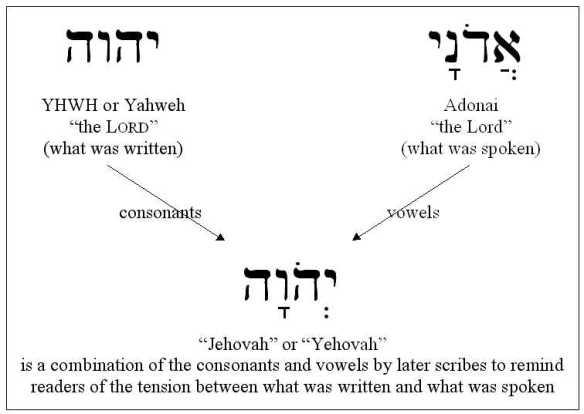
The name “Yahweh”—usually abbreviated as YHWH—appears frequently throughout the Old Testament. Have you ever noticed that some English Bibles spell the word “LORD” with all capital letters? It’s the publishers’ way of cluing us in as to when the name YHWH appears in the Hebrew.

But wait, you might be thinking. What about the name “Jehovah?” That’s actually an interesting story.

See, the name Yahweh is so deeply personal that the Jews preferred not to say it—fearing that doing so would be to utter God’s name in vain and violate the third commandment. So what they would do is they would deliberately substitute the name “Adonai” instead.

How did they know when to do this? The Hebrew language doesn’t usually use written vowels—only consonants. But in the ancient world they found it helpful to write vowels underneath the words to help in religious ceremonies. So what they did was they went through the Old Testament, and every time they saw the name “Yahweh,” they would write the vowels for the word “Adonai.” This was to remind them that when they came across the name “Yahweh,” they were to say the word “Adonai.” Does this sound complicated? Sure; but it was what they did when they desired to retain the Holiness of God.

Now imagine you don’t know about this practice. You learn some Hebrew, and you decide to read along—and then you encounter “Yahweh” with the vowels for “Adonai” underneath. When you mash them together, you get the word “Jehovah.” That’s literally where it comes from—the ancient equivalent of a typo.  So the word “Jehovah” never appears in the Bible; it’s just not one of God’s names.

yhwh

THE EMERGENCE OF “FATHER”

So what about “Father?” Naturally, the role of “Father” became most prominent with the arrival of Jesus, the Son, but this is not to say that the Old Testament lacks reference to God as Father. In the Psalms we read:

Father of the fatherless and protector of widows
is God in his holy habitation. (Psalm 68:5)

Elsewhere God’s Fatherhood is emphasized in relationship to the nation of Israel. That is, God didn’t just create the natural world; He also formed the nation as His people:

Do you thus repay the Lord,
you foolish and senseless people?
Is not he your father, who created you,
who made you and established you? (Deuteronomy 32:6)

But now, O Lord, you are our Father;
we are the clay, and you are our potter;
we are all the work of your hand. (Isaiah 64:8)

WHY THIS MATTERS

Why is this so important? Because while the New Testament clarifies God’s role as Father, there’s no actual change in His character from the world of the Old Testament to the New.

But because God the Father has a definite name and a definite identity, it defies our attempts to alter God to suit our needs—or, more accurately, our wants. After their escape from Egypt, the people of Israel grew restless and impatient, with God as well as with Moses. So Aaron helped the people melt down their jewelry and make a golden calf. “These are your gods,” they said, “who brought you up out of the Land of Egypt” (Exodus 32:4). Aaron even declared that the next day would be a “feast to the LORD” (32:5)—and yes, the word YHWH appears there.

It’s tempting, of course, when moments seem desperate, to re-fashion God into something that serves our immediate wants and felt needs. But if God has a name, if God reveals Himself as Father, then we have to put His name to His face. That is, we have to take God as He is, not merely who we’d like Him to be. Because in both the quieter moments of loneliness and amidst the noise of human desperation, I need to know that I can trust a God who transcends—nay, defies the limits of human imagination. That’s a God I can depend on. That’s a God worth believing in. And the most spectacular news of all is not only do we know Him by name, but He knows each of ours as well.

Omniscience: The God of Limitless Knowledge

Say what you will, but I maintain that the smart phone is the closest I’ll ever come to knowing everything. In my pocket is a device that grants me access to just about every fact you can ever come up with. And with Siri, I just have to verbally ask her the weight of the earth, and she replies instantly—and backs up her sources.

But there are certain “facts” we just can’t Google. What’s the meaning of life? Should I take that job or not? What’s my kid struggling with that he’s not telling me?

But God knows. He knows it all, even the facts that Google just can’t shake out.

OMNISCIENCE

In theology, we say that God is “omniscient”—meaning “all-knowing.” And like His other characteristics, God’s limitless knowledge stems from the fact that He exists outside of creation and outside of time. He never has to “learn” anything, because He Himself is the very author of history. “He counts the number of the stars,” the psalmist writes. “He gives names to all of them” (Psalm 147:4). Isaiah also records God as saying:

remember the former things of old;
for I am God, and there is no other;
I am God, and there is none like me,
10 declaring the end from the beginning
and from ancient times things not yet done,
saying, ‘My counsel shall stand,
and I will accomplish all my purpose,’ (Isaiah 46:9-10)

God knows everything there is to know—His knowledge is truly limitless.

DID JESUS KNOW EVERYTHING?

What about Jesus, though? Did He know everything? On the one hand, John tells us that Jesus would “not entrust Himself to [the people], because he knew all people and needed no one to bear witness about man, for he himself knew what was in man” (John 2:24-25). Because Jesus is both fully God and fully man, He shared God’s ability to know all things.

But what about the second coming? Jesus tells His listeners that “no one knows” the “day and hour…not even the angels in heaven, nor the Son, but the Father only” (Matthew 24:36). Some might insist that when Jesus became human, He only possessed the knowledge His Father allowed Him to have—and this lay outside that scope. This is possible, though it seems to drive a bit of a wedge between Jesus’ divine and human natures.

I would take it this way: there is a difference between knowing everything and having the ability to know anything. Jesus didn’t have to know everything to be truly omniscient; He simply had to have the ability to “stretch out” His mind, so to speak, and take hold of whatever knowledge He wished. But I think that because He lived in submission to His Father’s will, Jesus chose not to know this detail of God’s plan; it simply wasn’t for Him to know. And that tells us something of our own submission to the Father: He knows our steps, we can only trust Him.

FULLY KNOWN, FULLY LOVED

For David, God’s knowledge was deeply intimate:

O Lord, you have searched me and known me!
2 You know when I sit down and when I rise up;
you discern my thoughts from afar.
3 You search out my path and my lying down
and are acquainted with all my ways.
4 Even before a word is on my tongue,
behold, O Lord, you know it altogether.
5 You hem me in, behind and before,
and lay your hand upon me.
6 Such knowledge is too wonderful for me;
it is high; I cannot attain it (Psalm 139:1-6)

It’s difficult, I think, for us to be known. We go to such great lengths to avoid being known. We go to social media and self-edit; we want to put our best foot forward by selecting just the right profile picture and crafting just the right status update to make our friends think of us as witty, attractive, and charming. We fear that if anyone knew us—and I mean really knew us—they would reject us outright.

In other words, our desire to be loved supersedes our desire to be known. Pastor and author Tim Keller writes:

“To be loved but not known is comforting but superficial. To be known and not loved is our greatest fear. But to be fully known and truly loved is, well, a lot like being loved by God. It is what we need more than anything. It liberates us from pretense, humbles us out of our self-righteousness, and fortifies us for any difficulty life can throw at us.”

Jesus tells His listeners that even “the very hairs on your head are numbered” (Matthew 10:30). If it weren’t for the mercy of the gospel, being known by God would be terrifying. But because Jesus takes the burden of our darkest secrets, then in Christ we can be fully known, and fully loved.

Omnipresence: The God of Limitless Presence

Ever have those days when you wish you could be in two places at once? When life gets busy, you start to feel your limitations—not just physically, but geographically. Fighting traffic to “get it all done” is a reminder—once again—that we are limited, while God is limitless.

OMNIPRESENCE

When Solomon contemplates the task of building God’s temple, he remarks:

27 “But will God indeed dwell on the earth? Behold, heaven and the highest heaven cannot contain you; how much less this house that I have built! (1 Kings 8:27)

Solomon is only affirming what we’ve said earlier this week: that God is eternal, and distinct from His creation. Here, though, the text indicates that God cannot be “contained” by physical structures. Likewise, Jeremiah remarks that God’s presence is infinite:

24 Can a man hide himself in secret places so that I cannot see him? declares the Lord. Do I not fill heaven and earth? declares the Lord. (Jeremiah 23:24)

In theology we call this “omnipresence”—literally meaning “all-present.” It refers to God being unlimited in His ability to make Himself known at anywhere at anytime. Again, this naturally flows from God’s simplicity. Because God is independent of His creation, He is not limited by things like space or distance.

For David, this truth was deeply personal:

Where shall I go from your Spirit?
Or where shall I flee from your presence?
If I ascend to heaven, you are there!
If I make my bed in Sheol, you are there!
If I take the wings of the morning
and dwell in the uttermost parts of the sea,
10 even there your hand shall lead me,
and your right hand shall hold me.
11 If I say, “Surely the darkness shall cover me,
and the light about me be night,”
12 even the darkness is not dark to you;
the night is bright as the day,
for darkness is as light with you (Psalm 139:7-12)

For David, God’s omnipresence was reason for praise, reason for joy. Why? Because there was nowhere in creation—or beyond—that was outside the limits of God’s will, and if God’s presence is without limit, our trust in Him can be also.

IS GOD PRESENT IN HELL?

David mentions that God is present in “Sheol.” Now, it’s unclear what Israel believed about the afterlife at this time—it wasn’t until Jesus came on the scene that a clear understanding of “heaven” and “hell” began to emerge. But David’s mention of “Sheol” or “the grave” might prompt some to wonder: can God be present in Hell?

Once again, we must admit that we are only human minds seeking to understand an infinite God. We have good reason to admit our confusion and our lack of understanding. We can at least start by re-framing the question a bit.

First, what does it really mean to be “present?” Does this mean that God is literally, physically present everywhere? Well, if God is independent of creation, He can’t be—because to be everywhere at once would unite Him with creation. So in one sense, God can’t physically be present everywhere because to do so would be to violate His nature.

So what does it mean to “fill heaven and earth,” as Scripture affirms? Well, it means that God can make His character and His will known anywhere at anytime. There is nowhere in creation–or perhaps even the world beyond–that is outside of God’s jurisdiction. So is God present in Hell? Well, as bleak as the subject may be, do we not see God’s justice made known, His judgment carried through? So yes; God is truly present in all places.

IS JESUS OMNIPRESENT?

What about Jesus, then? We’ll learn in a week or so that Jesus is fully God but also fully human. Since Jesus became a human being, did His lose His ability to be omnipresent?

The short answer is “no,” though this is also hard to fathom. Jesus, of course, never stopped being human. Following His resurrection His body transformed into some sort of glorified state, but remained human nonetheless. This means that Jesus is still human, today.

But that doesn’t stop Jesus from being present among His people. On two separate occasions Jesus affirms that His presence is limitless:

“…where two or three are gathered in my name, there am I among them.” (Matthew 18:20)

“…behold, I am with you always, to the end of the age.” (Matthew 28:20)

In the sixteenth century, John Calvin wrote:

“Here is something marvelous: the Son of God descended from heaven in such a way that, without leaving heaven, he willed to be home in the virgin’s womb, to go about the earth, and to hang upon the cross; yet he continuously filled the world even as he had done from the beginning!” (John Calvin, Institutes, 2:13:4)

I admit that I can’t quite understand how Jesus’ divine and human natures relate to one another in this context. But we can be thankful that this means that Jesus has no blind spots. There is not a single square inch of creation that is not His. And that also means there is nowhere we can go that lies outside of God’s protection and care. And that is a reason for trust.


Omnipotence: The God of Limitless Power

Few feelings are worse than powerlessness. You turn the key in the ignition—and the engine won’t turn over. You need to make a phonecall—but your battery is dead. These sorts of minor inconveniences remind us that we are not as in control of our destiny as we might think. And when we face the far more difficult challenges of broken hearts and oncology reports, we see our powerlessness writ large.

OMNIPOTENCE

God’s power is limitless. In theology, we call this His omnipotence, meaning that God is “all-powerful.” His greatness is revealed in His power and accomplishments:

For I know that the Lord is great,
and that our Lord is above all gods.
Whatever the Lord pleases, he does,
in heaven and on earth,
in the seas and all deeps. (Psalm 135:5-6)

We should point out that in the context of this psalm, the Lord’s power makes Him superior (that is, “above”) to gods of Israel’s neighbors. Nothing in our world can ever match or rival the power of the God we serve.

This is why Jeremiah writes:

17 ‘Ah, Lord God! It is you who have made the heavens and the earth by your great power and by your outstretched arm! Nothing is too hard for you. (Jeremiah 32:17)

I’d really like to think of myself as powerful. With just the phone in my pocket, I can take calls, order food, watch movies, order products, predict the weather—even find a romantic partner so long as I have the right app. But think about just the weather app for a moment. We think we have power over something just because we can predict its patterns (and even then, not so reliably).  But our ability to do that is dependent on the fact that God, in His limitless power, has established rhythm and order to His creation that ultimately points to His character. We have no control over it; we can only marvel at God’s faithfulness in the regular rising of the sun or the changing of the seasons.

CAN GOD REALLY DO ANYTHING?

But can God really do anything?  Are there things beyond His ability?  If I were to show you the sheer volume of ink that’s been spilled debating and discussing this subject throughout history, it would overwhelm you.

Historically, there have been those who say that God’s power is truly and completely limitless. Others have said that God’s power is always dependent on the circumstances around Him. I think there’s an alternative, and that is to say that “omnipotence” means that God can do anything that is consistent with His character. That is, God’s omnipotence can’t be understood apart from God’s goodness, His love, or His ordered nature.

This means two things. First, God can do nothing that violates the laws of logic. God is a God of order and truth; His actions must be consistent with that. This means that God can’t do something like make a four-sided triangle, or create a married bachelor. But wait, you might object; what about miracles? Turning water into wine seems an awful stretch.  True, but in the case of miracles, God transcends the laws of nature, not the laws of logic. We can conceive of a miraculous healing or the transformation of water into wine. But a four-sided triangle can’t be conceived of; it makes no sense.

Secondly, and more simply, God can do nothing that violates His moral character. It is not possible for God to sin, because to do so would be a direct violation of God’s holiness and perfection.

But what about evil? Did God create evil?  If we read Isaiah, we might stumble on this verse:

I form light and create darkness;
I make well-being and create calamity;
I am the Lord, who does all these things. (Isaiah 45:7)

The old King James translation actually uses the phrase “create evil.” But thankfully, the ESV translation above helps us see that the original Hebrew word refers to “calamity” or “disaster.” God is not the author of moral evil, but—in the context of Isaiah—God does bring justice to wayward people.

SO WHY DOES GOD SEEM SO POWERLESS?

The question of evil raises another, far more troubling set of questions. If God is all powerful, why would He allow people to suffer? Even if we grant that God enacts justice on those who disobey Him, why would God allow seemingly innocent people to suffer?

Historically, this question has been used to challenge belief in God. The argument has been variously stated, but it boils down to two objections:

  • If God is all-loving, but allows evil to exist, then He must lack the power to stop it.
  • If God is all-powerful, but allows evil to exist, then He must lack the love to stop it.

Let’s start by admitting that there is no easy answer to this question, nor, I suspect, a satisfactory one. Most often, we’ve understood evil and suffering to be the product of sin and the evil choices of man. And we can’t have it both ways. We can’t have a God who allows us freedom of choice and a God who protects us from the consequences of those choices.

Still, I suspect those seem hollow words for those facing the pain of real situations. The gospel might not have an immediate answer to these questions, but it helps us see what the answer can’t be.

The cross shows us that God can’t be unloving, because He sent His only Son to die in our place. And the empty tomb shows us that God can’t be powerless, because through His power He raised His Son from the dead, proclaiming victory over the grave.

In a world of power—and the illusion of power—we can be thankful we serve a God beyond limits.

“You never change…” Can God change His mind?

They say the only constant in life is change.

Life bombards us with an endless sequence of events.  Sometimes that sequence rushes by us like the swift currents of a river.  As much as we try to grab them, hold on to them, never let them go, time slips through our hands with terrifying swiftness.

Sometimes change is good: it speaks to our ability to grow, to mature.  The downside to this is that time brings on the problems of age: graying hair, aching joints, fading memories of happier years and the laughter of children.  And, of course, the currents of time often bring us circumstances that challenge us, hurt us—or break us entirely.

God isn’t like that.  We’ve pointed out that God exists independently of His creation, therefore God is not affected by time.  Without time, there can be no change, therefore God is eternal and changeless.  In theology we therefore say that God is “immutable,” which simply means He is unable to change. He doesn’t need to grow toward maturity; He’s already perfect in every way.  He will never be slowed by age, for He is already ageless.

DOES GOD CHANGE HIS MIND?

This leads to a natural question: can God change His mind?  It’s a fair question, and actually a deeply practical one.  Because if God is changeless, how does prayer work?

The Hebrew Scriptures testify to a God that is changeless, and whose word is binding:

God is not man, that he should lie,
or a son of man, that he should change his mind.
Has he said, and will he not do it?
Or has he spoken, and will he not fulfill it? (Numbers 23:19)

This sounds simple enough.  God does not change His mind.  Yet we can find other passages that seem to challenge this.  During their years of wandering, Israel strayed from their faith commitments by constructing an idol to worship in place of God.  God is naturally incensed by this, and says to Moses:

“I have seen this people, and behold, it is a stiff-necked people. 10 Now therefore let me alone, that my wrath may burn hot against them and I may consume them, in order that I may make a great nation of you.”

11 But Moses implored the Lord his God and said, “O Lord, why does your wrath burn hot against your people, whom you have brought out of the land of Egypt with great power and with a mighty hand? 12 Why should the Egyptians say, ‘With evil intent did he bring them out, to kill them in the mountains and to consume them from the face of the earth’? Turn from your burning anger and relent from this disaster against your people. 13 Remember Abraham, Isaac, and Israel, your servants, to whom you swore by your own self, and said to them, ‘I will multiply your offspring as the stars of heaven, and all this land that I have promised I will give to your offspring, and they shall inherit it forever.’” 14 And the Lord relented from the disaster that he had spoken of bringing on his people. (Exodus 32:9-14)

The reason this is confusing is because in verse 10 God seems bent on delivering justice, but in verse 14 He “relented from the disaster that He had spoken.”  Does this mean that God changed His mind?

Let’s at least start by admitting that so many of our questions are the result of time-bound human minds trying to understand a timeless, infinite God.

What we find throughout Scripture is a God who reveals Himself in various ways throughout human history, and sometimes this takes on a relational dynamic.  Robert Chisholm of Dallas Theological Seminary writes:

“When we say that God changes His mind, are we denying His immutability, which affirms that God’s essential being and nature do not change? No. God is sovereign, but our sovereign God is also personal and often enters into give-and-take relationships with people. While the human mind cannot fully understand the relationship between divine sovereignty and human freedom, the Bible teaches that God sometimes announces His intentions and then subordinates His actions to the human response. When God announces His intentions conditionally, He allows people to help determine the outcome by how they respond to His word.”[1]

SO WHAT ABOUT PRAYER?

Naturally, we can see how this applies to prayer.  God may be in sovereign control, but He pursues relational connections with His people—including through prayer.

Think of it this way. Imagine you’re a kid, and your parents decide to get you a bicycle for your birthday, but they are waiting for you to ask them for it. Time goes by; your birthday approaches. Then one day you ask your mom or dad if you could get a bike for your birthday. And then, on your birthday, you get a bike. Did your request “work?” Didn’t your parents intend to get you a bike all along? Perhaps, but they were also lovingly waiting for you to ask them for it.

The same is true of God.  Granted, the analogy above only works because we know the bicycle is in your parents’ will.  We don’t always know what God’s will is.  But this also means that we should pray all the more boldly, because it is in God’s eternal will to bless His children with good and perfect gifts.  That’s why Jesus teaches His followers to “ask, seek, and knock:”

7 “Ask, and it will be given to you; seek, and you will find; knock, and it will be opened to you. 8 For everyone who asks receives, and the one who seeks finds, and to the one who knocks it will be opened. 9 Or which one of you, if his son asks him for bread, will give him a stone? 10 Or if he asks for a fish, will give him a serpent? 11 If you then, who are evil, know how to give good gifts to your children, how much more will your Father who is in heaven give good things to those who ask him! (Matthew 7:7-11)

Granted, God doesn’t always say “yes,” but we mustn’t let the abuses of the “prosperity gospel” (the belief that God’s greatest purpose is to bless us with health and wealth) to diminish our confidence that God desires our joy.

WHY DOES IT MATTER?

There are many people in our lives that we might place confidence in.  Pastors, politicians, maybe even our family members.  But sooner or later these people will let us down. God does not change.  His “immutability” leads us to trust Him more, because only God can be our true constant in the rushingly unpredictably waters of time.


[1] Dr. Robert Chisholm, “Does God Change His Mind?” in Kindred Spirit Magazine, Summer 1998

“From everlasting:” Why God is simple and eternal

“Great is the Lord,” David once wrote; “his greatness is unsearchable” (Psalm 145:3). There are certain characteristics of God that we share with Him. We call these “communicable” attributes, and they include things like love, holiness, wisdom, etc. While we don’t manifest these character traits to the infinite degree as God, we nevertheless can display something of God’s moral character, His love, His wisdom.

But there are other characteristics that are unique to God Himself.  We call these “incommunicable” attributes, and they include things that center around God’s essential greatness. What this means is that while we may have no trouble seeing God’s love in ourselves or others, we can’t possibly place ourselves in David’s Psalm without it seeming…well, silly.  “Great am I…My greatness is unsearchable.” Sure, we may have days when we think it, but we’re a far cry from God’s greatness.

This week our aim is to explore at least some of God’s unique, incommunicable attributes. God is wholly different from you and I—and that’s a good thing.

IMMEASURABLE

In her book on  God’s unique attributes, Jen Wilkin points out that the difference between ourselves and God is obvious from the day we’re born.  Every time a new mother has a baby, everyone wants to know the details: length, weight, eye color, you name it.  And the measuring doesn’t stop there.  Every day of our lives from birth to death we are measured, evaluated, judged.  So ingrained is this in us that we probably do it without thinking.  Grades.  Salary.  Brand of smart phone or automobile.  The number of social media followers we have, the number of “likes” we receive on Instagram, the numbers on our bathroom scale—all of these can be a source of measurement, and all of these can lead to feelings of either pride or self-reproach.  God isn’t like this.  God is beyond measure.  We see this in two distinct ways:

  • GOD IS SIMPLE

First, God is “simple.”  Simple?  Isn’t this the same God who invented particle physics?  “Simple” means that God is self-sufficient; He is self-sustaining. He needs nothing to exist; He is perfect in Himself.

We see this from the Bible’s opening pages:

“In the beginning, God created the heavens and the earth.”  (Genesis 1:1)

The creation story affirms that there is an essential difference between Creator and His creation.  God exists independently of the created world, a point that Paul repeats in front of a panel of skeptics in the city of Athens:

24 The God who made the world and everything in it, being Lord of heaven and earth, does not live in temples made by man, 25 nor is he served by human hands, as though he needed anything, since he himself gives to all mankind life and breath and everything. (Acts 17:24-25)

What this means is that God isn’t what we would call “high maintenance.”  We’ve all seen couples where one partner is high maintenance.  We usually blame the woman for her chronic need to re-apply makeup or for her massive collection of shoes.  But really men can be just as high-maintenance, with their expressed need for their “man-cave” with their deer heads positioned just right.  Every single one of us depends on everything else in creation to be happy—even to survive.  You’re only here because your parents created you.

God isn’t like that.  He needs nothing. Jesus even affirmed that “as the Father has life in Himself, so He has granted the Son also to have life in Himself” (John 5:26). Everything in modern science today tells us that creation comes first, then life begins. God’s story tells us that life has always existed, and creation springs up as an extension of the life that has always been in God.

You may have wondered from time to time: Who created God?  But divine simplicity tells us that no one created God; no one had to. Like an artist at his canvas, God paints His character across the fabric of the universe—but He always remains separate from the painting.

  • GOD IS ETERNAL

Secondly, God’s simplicity naturally means that God is eternal.  Why are these ideas connected?  Because if God is independent of His creation, He is likewise independent of time.  What is time?  Time is a sequence of events: one rotation of the earth gets called a “day;” one trip around the sun gets called a “year.”  But if God is self-sufficient, He is unaffected by these events and these changes.  He is outside of time, and therefore can’t be measured the same way.

This seems positively mind-boggling.  As much as we might appreciate the explanatory power of science, I for one am thankful that these truths are recorded in the more-universal language of poetry:

Before the mountains were brought forth,
or ever you had formed the earth and the world,
from everlasting to everlasting you are God.

You return man to dust
and say, “Return, O children of man!”
For a thousand years in your sight
are but as yesterday when it is past,
or as a watch in the night. (Psalm 90:2-4)

Again, God is not limited by time in the same way that we are.  This same truth is repeated in the text of Isaiah:

Have you not known? Have you not heard?
The Lord is the everlasting God,
the Creator of the ends of the earth.
He does not faint or grow weary;
his understanding is unsearchable. (Isaiah 40:28)

God is eternal because God cannot be measured by time.

Now, this might provoke a question: What was God doing before the world was created?  Well, that’s simple—yet unfathomable(!). There was no “before.”  Where there is no time, there can be no “before.” Time came into existence only when God spoke the universe into being. If we insist on asking about God’s activity “prior” to that, we can only speak of God’s self-sufficient community of persons (Father, Son, and Spirit) existing in perfect, timeless harmony

WHY IT MATTERS

Why does any of this matter? Because all of us are changed and affected by circumstance. All it really takes is for our car to break down and we feel like life is in shambles.  God is immeasurable; He is beyond limits.  I can’t trust my car to keep running, I can’t trust my career not to end, I can’t trust my spouse or my friends to always keep me happy.  I can trust that the God of the universe, the God of interstellar space and the Higgs Boson, is immeasurable and beyond my wildest dreams.  He never changes.  He never fails.