What’s Old is New (Hebrews 2:5-13)

I have remarkably few enemies.  Yet there is one in particular that I’d like to introduce you to today.  Her name is Kate Turabian.  If you or your kids have been around school at any time in recent history, you know the name not for the person, but for the classic “Kate Turabian” style of formatting.  This means that everything you write not only has to match the “Turabian” style in both font and spacing, but headings and subheadings require a set number of spaces.  Your citations have to be carefully footnoted in the exactly proper form.  The white edges on the sides of your papers have to be a certain width.  And if you’re a student, you know the perplexing sting of learning you lost points on a paper because—and I’m not exaggerating—your hyphens were too wide.

Turabian.  The name has become synonymous with an environment of strict standards and rigorous literalism.  So it’s actually a bit exasperating to open the book of Hebrews to see the way the author often plays fast and loose with the way he haphazardly quotes Old Testament texts—with no citations, mind you.  It’s no wonder the author remained unnamed—who’d want their graders to see how sloppy this sermon is?

What’s the author doing, exactly?  The author of Hebrews is demonstrating something fundamental about the Christian Bible: that no Scripture is complete until it is understood in light of Jesus.  This doesn’t mean that the Bible is open to being interpreted and re-interpreted, but it does mean that we understand the Bible only when we learn to see Jesus on every page.  So in Hebrews 2:5-13, we see the author of Hebrews using a series of Old Testament quotations to explain just how awesome Jesus truly is.  Let’s look at this text with the citations supplied (by me) in bold:

5 For it was not to angels that God subjected the world to come, of which we are speaking. 6 It has been testified somewhere,

“What is man, that you are mindful of him,

or the son of man, that you care for him?
7 You made him for a little while lower than the angels;
you have crowned him with glory and honor,
8     putting everything in subjection under his feet.” [PSALM 8:4-6]

 Now in putting everything in subjection to him, he left nothing outside his control. At present, we do not yet see everything in subjection to him. 9 But we see him who for a little while was made lower than the angels, namely Jesus, crowned with glory and honor because of the suffering of death, so that by the grace of God he might taste death for everyone.

10 For it was fitting that he, for whom and by whom all things exist, in bringing many sons to glory, should make the founder of their salvation perfect through suffering. 11 For he who sanctifies and those who are sanctified all have one source. That is why he is not ashamed to call them brothers, 12 saying,

“I will tell of your name to my brothers;

in the midst of the congregation I will sing your praise.” [PSALM 22:22]

13 And again,

“I will put my trust in him.” [Psalm 18:2]

And again,

“Behold, I and the children God has given me.” [ISAIAH 8:18]

 In today’s world, it’s tempting to select certain “favorite” verses or passages and make them something of a “life verse.”  There’s certainly nothing wrong with having a few favorite passages, but the author here is saying that the Bible must be read as a continual story of God working in the world.  One author writes:

 “…the author [reads] non-narrative texts against the backdrop of the narrative of salvation history.  He ‘narrativized’ material from Psalms and Proverbs, sometimes taking them as scripts on the lips of Christ or as prophetic words of God in relation to events in the new covenant.  Words in non-narrative genres are read as words within the overarching narrative of salvation history.” (Ken Schenck, “God has Spoken,” in The Epistle to the Hebrews and Christian Theology, p. 324)

This is why the division between “Old Testament” and “New Testament” is somewhat misleading.  The division came in the early centuries of the church, when a man named Jerome noted the contrast between the “old covenant” described by the prophets and the “new covenant” described by Jesus and his followers (the book of Hebrews will later make fuller explanation of this difference).  So, he concluded, we should call the earlier scriptures the “Old Testament,” and the writings featuring Jesus and his followers the “New Testament.”  But really, we need to recognize that the kinds of quotations we find in Hebrews aren’t that unusual.  In his commentary on the Bible, A.E. Hill estimates that about 32 percent—yes, a third—of the New Testament is composed of quotations from the Old Testament (!).  That’s a lot.  And it highlights the way that the Bible is meant to be one unified story.

This also helps us understand how the Bible differs from other ancient and other religious writings.  Even now we’re seeing some friction (to put it mildly) between Western cultures and the nature of Islam.  Two articles from The Atlantic magazine (both in the last month or so) have been particularly telling.  In the first, called “What ISIS Really Wants,” Graeme Wood highlights the deep connection of Islamic beliefs and the recent escalation of violence.  In a counter-article, called “The Phony Islam of ISIS,” Caner K. Dagli notes the ways that ISIS has really just hijacked religious language—the Quran, after all, is a starting point, and must be coupled with other writings such as the Hadith (the sayings of Muhammad).  The result is a confusing web.  We needn’t get stuck in the details of this, only to note that when a religious text is intended only to reflect a person’s experiences, we are left only with questions of interpretation.   Does Islam promote violence?  Or peace?  Even these questions are partially obscured by the Muslim doctrine of “abrogation,” where certain texts are thought to “replace” pre-existing ones (!).

The Christian Bible is radically different.  Yes, there are passages that generate confusion.  Yes, there have been passages used (inappropriately) to justify violence and oppression.  But the overarching story—the one the writer of Hebrews bids us to lose ourselves in—is one of salvation and redemption, a promise fulfilled in the arrival of Jesus.

But what about you and me?  Sometimes it’s easy to flounder in our Bible reading because, well, we’re separated from the original culture by a few centuries or more.  There’s a book on my shelf called The Hermeneutical Spiral.  It’s one of those books you only read once, but the author’s central image is extraordinarily helpful.  Grant Osborne (the author) suggests that when we read and interpret a part of the Bible, we’re really sort of drawing circles around it.  The more we read, the more we interpret, the more our circles will spiral closer and closer toward the center—that is, toward the exact meaning.  We may start of spinning in circles around a particular text, but with time, with experience, with community, we draw closer and closer toward the truth.  This is partly why attending a Sunday morning worship service is so spiritually vital—because it is there that we grow in our understanding of God’s word as we hear it unfolded and explained.  This is partly why a mid-week community group is important—because it is there that we see how God’s word impacts the everyday lives of those with whom we share life.  Everyone loves a good story.  And the Bible is the greatest of all.

Signs, Wonders, and Spiritual Boredom (Hebrews 2:1-4)

“Belief” is a funny thing.  In today’s world, the degree of your belief is often seen as a reflection of your character.  Specifically, we tend to admire those who make a “leap of faith,” and the greater the leap the higher the admiration.  Faith, we assume, is about making a commitment independent of intellect.  And it’s no wonder, then, that Christianity’s harshest critics have specifically targeted this aspect of Christianity.  In his book Letter to a Christian Nation, Sam Harris defines faith as “nothing more than the license religious people give one another to keep believing when reasons fail.”

But historically speaking, Christianity has not rested on “blind faith.”  Rather, faith was deeply, intricately connected to the human experience, touching our intellects, our emotions, and our actions.  God’s earlier followers had been commanded to “love the Lord your God with all your heart and with all your soul and with all your might” (Deuteronomy 6:5)—that is, to connect faith to our thoughts, feelings, and actions.

Later in Christian history, the “reformers” of Christianity (the guys that brought us the Protestant reformation, that is) defined faith as having three essential components: (1) knowledge—that is, the knowledge of God, (2) agreement with that knowledge, and (3) a trust—usually a trust that emphasized some sort of response.  So Christianity has no history of “blind” faith or leaps in the dark.  On the contrary; Christianity has historically emphasized a holistic form of faith, one that defies our tendency to compartmentalize ourselves—or worse, to overemphasize the intellect to the neglect of obedience.

Tragically today’s North American church has done precisely that: we have overemphasized emotion above all else, and in many ways rendered ourselves indistinguishable from a culture in which “feeling is believing.”  In his book Bad Religion, Ross Douthat of the New York Times cites religious scholar Mark Lilla, who notes the way Christianity has turned not downward, but inward:

“A half-century ago, an American Christian seeking assistance could have turned to the popularizing works of serious religious thinkers…Those writers were steeped in philosophy and the theological traditions of their faiths, which they brought to bear on the vital spiritual concerns of ordinary believers…But intellectual figures like these have disappeared from the American landscape and have been replaced by half-educated evangelical gurus who either publish vacant, cheery self-help books or are politically motivated.”  (Mark Lilla, cited by Ross Douthat, Bad Religion, p. 177)

So what does this have to do with “signs and wonders?”  Well, if we take another look at Hebrews 2:1-4 (yes, the passage from yesterday), we see that the author of Hebrews places and emphasis on “signs and wonders and various miracles:”

“Therefore we must pay much closer attention to what we have heard, lest we drift away from it. 2 For since the message declared by angels proved to be reliable, and every transgression or disobedience received a just retribution, 3 how shall we escape if we neglect such a great salvation? It was declared at first by the Lord, and it was attested to us by those who heard, 4 while God also bore witness by signs and wonders and various miracles and by gifts of the Holy Spirit distributed according to his will.” (Hebrews 2:1-4)

Biblical writers used the phrase “signs and wonders” in several different ways.  It was a term used to describe God’s deliverance of his people from Egypt (Exodus 7:3, 9; 11:9-10), it was used to describe true prophecy (Isaiah 8:18; 20:3), and to describe the works of Jesus (John 20:29-31; Acts 2:19, 22). In his commentary on Hebrews, F.F. Bruce notes that the emphasis the New Testament places on such activities is “impressive in its range.”

But what’s it doing here?  In her commentary on Hebrews, Marie Isaacs helps us understand that such “signs and wonders” “are the means whereby God corroborates the truth of the definitive word spoken through his Son…the verbal testimony of those who originally heard Jesus’ proclamation of the gospel and the Spirit-inspired deeds of his contemporary followers validate the truth of his message.”   In other words, God’s Spirit was active in that climate as God’s way of “proving it.”

No doubt such miraculous signs had an impact on the community.  But if we understand this text correctly, the focus remains on what was “declared at first by the Lord”—a message of “such a great salvation.”  The gospel remained the primary focus.  The “signs and wonders” were a means to a much greater end.

Here is the point.  I know many people who have had tremendous religious experiences.  And I would never wish to rob them of these memories or from this intense joy.  I’m reminded of a fellow grad student who came to know Jesus after “meeting” him in a dream.  But the writer of Hebrews never made these experiences the focal point of his faith or ministry.

And neither should we.

Now mind you, I’m not suggesting our experiences should not be shared.  In fact, there is enormous value in sharing your faith story—what we often call our “testimony.”  But if our story never moves beyond our subjective experience to God’s objective truth, then spiritual outsiders might politely respond by saying: “That’s good for you.”  Only an emphasis on the gospel—the concrete truths of our need for Jesus and God’s power to forgive—can reach into someone’s heart and bring those far from God near to him.

If I were to identify any one significant problem with today’s Christianity, it would be the corrosive nature of spiritual boredom.  So much of contemporary Christianity seems bent on chasing an experience.  For some it might be literal miraculous encounters.  For others it might be chasing the spiritual “high” you felt when you first encountered God.  Is there any wonder why our Christian bookstores are bulging at the seams with the latest (and thereby greatest) books, worship albums, and DVD studies?  Whether we recognize it or not, we’ve put God inside a box: he’s only as real to me as his ability to keep impressing me with his tricks.

What, then, is the solution?  The solution is not to dismiss our experiences—this only stifles us emotionally and runs the risk of ignoring God entirely.  Rather, we must continually learn to connect God’s truth with the larger wealth of human experience—our own, as well as that of others.  Think about this for a second: how did you encounter God?  Maybe it was through a Sunday School lesson, a close friend, maybe even through some miraculous encounter.  But how did you come to understand God?  To encounter God without understanding him is to anchor one’s faith to the unstable moorings of human experience.  But to understand God without encountering personally is to pin him down to a lab table, treating the life-giving Savior as if he were a med-school cadaver.  We need both, you see.  We need knowledge.  We need feelings.  We need men and women of action.  And, as the writer of Hebrews continues to tell us, we find this radical unity by following in the footsteps of Jesus.


“Clinging or Drifting” (Hebrews 2:1-4)

Most of us know Stephen Colbert as the former host of the popular late-night comedy show The Colbert Show—and still more will come to know him this Fall as Letterman’s replacement on CBS’s Late Show.  But only a handful of 7-year-olds know him as their Sunday School teacher.  In a 2009 interview with Rolling Stone magazine, Colbert revealed that he teaches Sunday School at his Catholic church.

Colbert was raised Catholic, but by his own admission he’s “highly variable in [his] devotion:”

“From a doctrinal point of view or a dogmatic point of view or a strictly Catholic adherent point of view, I’m first to say that I talk a good game, but I don’t know how good I am about it in practice. I saw how my mother’s faith was very valuable to her and valuable to my brothers and sisters, and I’m moved by the words of Christ, and I’ll leave it at that.” (Neil Strauss, “Stephen Colbert on Deconstructing the Colbert Nation” in Rolling Stone Magazine, September 2, 2009)

You see, there was a time when Colbert had lost his faith.  In a separate interview, he describes it initially as “a college angst thing,” but when pressed by the interviewer he goes a bit deeper:

 “I had very sad events in my childhood. The death of my father and my brothers was understandably a shattering experience that I hadn’t really dealt with in any way. And there comes a time when you’re psychologically able to do so. I still don’t like talking about it. It still is too fresh.” (Neil Strauss, “The Subversive Joy of Stephen Colbert”)

For many, suffering proves the crucible in which faith is tested.  I use Stephen Colbert as a positive example, in that while he’s gone through a period of questioning his faith, he’s on an upward journey.  We could easily name others—celebrities and otherwise—that aren’t so lucky.

The writer of Hebrews understands this all too well.  Recall that we’ve been examining an early Christian community that experienced enormous pressure from the surrounding culture.  The author of Hebrews intends to encourage his readers to endure, to maintain a clear focus on the gospel even as they were increasingly regarded as social outcasts.  But, as Marie E. Isaacs notes in her commentary, the author’s encouragement is “both carrot and stick.”  Some of his encouragement comes in the form of several “warning” passages, such as the one we’ll look at today:

“Therefore we must pay much closer attention to what we have heard, lest we drift away from it. 2 For since the message declared by angels proved to be reliable, and every transgression or disobedience received a just retribution,3 how shall we escape if we neglect such a great salvation? It was declared at first by the Lord, and it was attested to us by those who heard, 4 while God also bore witness by signs and wonders and various miracles and by gifts of the Holy Spirit distributed according to his will.” (Hebrews 2:1-4)

If you read closely, we’ll see hints of the two dangers that dominate the writer’s thinking.  First, we see a clear warning against those who become spiritual burnouts—that is, who “drift away” from “what we have heard” (v. 1).  Second, we see a (subtle) warning against those who become functional atheists—that is, who “neglect such a great salvation” (v. 3) and live life as if God were never present.  These themes reappear in a total of (at least) five distinct warning passages throughout the book (2:1-4; 3:7-4:11; 6:4-8; 10:26-31; 12:14-29)—though we could probably name more depending on our exact interpretation of “warning.”

What point might we make here?  The author understands that the gospel is something that we either cling to or drift from.   What about you?  Would you define yourself as clinging to the gospel, or do you find yourself drifting now and again?

The good news is actually embedded in the very structure of the book—though we have to take a step or two backwards to notice it.  If you look at the larger context here, we see this “warning” embedded in the book’s larger scope of the majesty of Jesus.  Take a look:

HIGHER THAN THE ANGELS (1:5-14)

  • The Son of God (1:5-6)
  • The King of Israel (1:7-14)

WARNING! (2:1-4)

LOWER THAN THE ANGELS (2:5-18)

  • The nature of the incarnation (2:5-9)
  • The purpose of the incarnation (2:10-18)

The author is making a broader point about the person of Jesus—the One who steps from heaven’s glory to the sullied streets of humanity.  We’ll address this a bit further next week, but for now do you see how this “warning” serves as something of a “hinge” between these two themes?  It’s as if the author of Hebrews is saying: Keep holding on!  Jesus—though worthy of honor—endured the same shame you’re going through.  Keep going.  Endure. 

Sadly, we can all think of those who slip away far too easily.  The good news is that through God’s grace each of us can find our way home again.  Stephen Colbert had this experience earlier in his life:

“…once I graduated from college, some Gideon literally gave me a box of The New Testament, Psalms and Proverbs on the street in Chicago. I took one and opened it right away to Matthew, Chapter 5, which is the opening of the Sermon on the Mount. That whole chapter is essentially about not worrying. I didn’t read it – it spoke to me, and it was an effortless absorption of the idea. Nothing came to me in a thunderbolt, but I thought to myself, ‘I’d be dumb not to re-examine this.’” (Strauss, “The Subversive Joy…”)

If I sat down with Stephen, I don’t know that he and I would find perfect agreement on Christian doctrine.  Still, we may rejoice at the trajectory he seems to be on, and being “moved by the words of Christ” has often been a first step into a larger world of faith.  It will be interesting to see what influence—if any—this will have on CBS’s future Late Show comedian, but for now we can say simply this: there are many for whom faith is a prolonged journey.  Along its path there are many ups and downs, the ratio of which depends entirely on the person.  But what endures—what we cling to—is the person of Jesus, who stands fast regardless of culture or circumstance.  Wherever you are on your journey, my prayer is that you find joy, find life, find hope in the message of Jesus, whose death and resurrection provide the promise of forgiveness and transformation.

“Calling All Angels” (Hebrews 1:14)

Do you believe in angels?  If so, you’re hardly alone.  According to a 2005 study conducted by Baylor University, something like half of all Americans believe in angels, and a surprising number of respondents expressed a belief in personal “guardian” angels that intervene to keep us safe.

In the first chapter of Hebrews, the writer describes Jesus as superior to the angels.  After citing a collection of Bible verses to emphasize this point, the author describes angels as “ministering spirits sent out to serve for the sake of those who are to inherit salvation” (Hebrews 1:14).  At the close of the book of Hebrews, the author suggests that one of the motivations for Christian love to “strangers” is that by doing so “some have entertained angels unawares” (Hebrews 13:2).  So we actually see a significant overlap between popular belief about angels and the first-century world.

But what more can we say about angels?   Let’s take some time today to unpack this a bit further.

POPULAR BELIEFS

While beliefs about angels appear to be longstanding, there was a period in the mid-1990’s when their popularity really peaked.  We’d moved on from the self-esteem movement of the 1980’s to invest in personal spirituality.  TV shows like Touched by an Angel only revealed one avenue that we yearned to explore: connecting with the spiritual world through the world of angels.

In 1993, an article in Newsweek magazine reports:

“[T]hose who see angels, talk to them, and put others in touch with them are prized guests on television and radio talk shows.  Need inspiration?  There are workshops that will assist you in identifying early angel experiences or in unleashing your ‘inner angel.’  Tired of the same old spirit guide?  New Age channelers will connect you with Michael the Archangel.  Have trouble recognizing the angels among us?  Join an angel focus group.”  (“Angels: Hark!  America’s Latest Search for Spiritual Meaning Has a Halo Effect.”  Newsweek, Dec. 27, 1993, 52-53)

But why angels?  I mean, if you want to be “spiritual,” why not connect with God directly?  I think we can cite several reasons.

First, God seems distant.  And if you come near him at all, you risk being judged.  He’s like the distant angry stepfather.  Angels seem like the cool aunt or the cleaning lady that you get along with even when Dad gets upset about your report card.

Second, angels have a universal appeal.  They appear in many forms of religions—Judaism, Islam, Mormonism, to name a few.  So angels are a way of being spiritual in a way that doesn’t exclude or offend anyone.

Finally, angels—in our minds—are all about comfort, especially in the face of suffering and death.  I’m thinking of Sarah McLaughlin’s song in which she sings: “in the arms of an angel, may you find comfort here.”

BIBLICAL PERSPECTIVE

Let’s not be too hard on the modern world; even the characters of the Bible express some confused beliefs about angels.  In the book of Acts, Peter is delivered from prison.  But his closest family and friends believe him dead.  So when he knocks on the door, they don’t know what to think.  “Maybe it’s his angel,” one of them speculates (Acts 12:15)—does this reflect some early belief that each person has  a “guardian angel” that looks like them?

Belief in angels has always been around, and angels are recorded in the earliest beliefs of ancient civilizations.  God’s first followers—and I’m talking like 2000 B.C.—inhabited a world that believed in some sort of “council of gods.”  Spiritual beings were sort of everywhere.  But as the Jewish religion developed, a clearer understanding emerged of a separation between the one true God and the angels that served him.

The Bible mentions angels roughly 350 times—in 33 of its 66 books.  Both the Hebrew word (malakh) and Greek word (angelos) means “messenger,” though we only see this term used of angels.

Yet despite all these references, we have few texts that really helps us understand who they are and what they do.  So much of our understanding comes from surveying the whole story of scripture and making a few observations.

  • They were created by God. God eternally exists; no one created him.  Yet at some undisclosed point in history, God created an untold number of angels (Deuteronomy 33:2; Psalm 69:17; Hebrews 12:22; Jude 14; Revelation 5:11).  Did this happen only once?  That is, does God ever create more angels?  The Bible doesn’t say.  But we can be sure that God created angels.  So while it may be comforting to think that a loved one was taken because “God needed another angel,” people don’t turn into angels when they die.  Rather, they enter God’s presence for either judgment or for entrance into eternal joy.
  • They look nothing like their pictures. Most art tends to show angels as chubby infants or—perhaps more often—women with feathery wings and a halo.  But the Bible usually describes angels as adult men.  So telling your wife she has the “face of an angel” might not be the wisest idea.  There are two exceptions we might note, however.  First, Zechariah 5:9 describes two-winged females, though the word “angel” is never used.  Just who these creatures are is never specified.  Second, when Isaiah has a vision of God’s throne room, he sees a collection of six-winged creatures called seraphim that hover around the throne praising God (Isaiah 6).  However, these creatures seem specifically assigned to heavenly worship, not earthly service.
  • They’re highly organized. Apparently not all angels have equal roles—1 Thessalonians 4:16 tells us of the reality of “archangels.”  Michael is an archangel (Jude 9) and “one of the chief princes” (Daniel 10:13), a title that seems to have some relationship to Israel.  Gabriel is the principle messenger both before and after the birth of Jesus (Daniel 8:16; Luke 1:18).
  • They’re highly purposeful. Angels seem to have a range of duties.  They exist for heavenly worship and service (Psalm 103:20-21; 148:1; Isaiah 6:2-6; Daniel 7:9-10; Revelation 4:6-5:12); to carry out God’s judgment (Genesis 19:13; Exodus 13; 2 Samuel 24:16; 2 Kings 19:35; Matthew 13:39; 25:31; Acts 12:21-23; 2 Thessalonians 1:7-9); and to communicate with and guide God’s followers (Genesis 16:11; 18:9; Judges 13:3; Matthew 2:13; 4:11; Luke 22:43).
  • Yes; there are guardian angels (sort of). Scripture affirms that there are angels that watch over and protect human beings (Hebrews 1:14; Daniel 6:22; 10:13, 20; Psalm 34:7; 91:11).  But whether this means that there’s an angel assigned to each of us (like Clarence from It’s a Wonderful Life) has more to do with human imagination than scripture.  Still, we also see angels intimately involved with death and the afterlife (Luke 16:22; 2 Kings 2:11-12; Acts 6:51; Jude 9).  Testimonies abound of Christians who experience the presence of angels ushering them into heaven.  While we don’t want to place undue weight on human experience, such testimonies are a possible, biblical, though not necessarily normative experience.

We can go deeper, of course—to say nothing of the fact that Satan and his demons are fallen angels—but this helps to give us a general sense of what angels exactly are and what they do

USE IN HEBREWS

So why is the writer of Hebrews using angels so frequently?  Because his first century world needed to hear and understand that Jesus stood superior to the angels.

Our world’s longing for connection to the spiritual world represents an opportunity to further the conversation.  In 2005, Peter Steinfels, religion reported for the New York Times, wrote that our world was not just becoming postmodern or post-Christian, but postsecular.  What does that mean?  In a secular world, there was a clear division between heaven and earth.  But in a postsecular world, there is no such division.  Heaven invades earth.  Spirituality permeates all of existence.

When Jesus began to call his first followers, he promised that they “will see heaven opened, and the angels of God ascending and descending on the Son of Man” (John 1:51).  Jesus came to erase the division between heaven and earth.  You wish to be spiritual?  Then look to Jesus.  You wish to connect with God?   Then look to Jesus.  That’s the point of the early part of Hebrews.  And that’s why we need a vision of Jesus that goes beyond our usual conceptions of personal spirituality, and expands our minds into a broader and more joyous kingdom.

“Christ clothed in his gospel” (Hebrews 1:6-14)

Jesus is my homeboy.

Or, at least, that’s what a popular t-shirt reads.  They sell them not at Christian bookstores, but at places like Urban Outfitters, right next to ones that say things like: “Jesus surfs without a board.”  But Jesus isn’t just relegated to a t-shirt slogan.  Rap artist Kanye West made waves a few years ago when he appeared on the cover of Rolling Stone wearing a crown of thorns.  And—most recently—“Jesus” has actually appeared onstage at Kanye’s performances, offering forgiveness and love.

Today’s world has a genuine fondness for Jesus.  It’s just that they fear his message has been perverted and corrupted by institutional Christianity—an organization that has co-opted Jesus’ message and bent it for a personal and political agenda.

The love for Jesus fits broadly into a post-everything world, one wear “spirituality” has more fashionably superseded “religious” as a means of describing oneself.  A generation or so ago, we lived in a modern world.  We asked modern questions, like: “Should I believe in Jesus or not?”  Scholars told us of a “Christ of history,” so different from the “Christ of faith” we grew up admiring.  These two “Christs” were separated by what one scholar called “an ugly, broad ditch.”  But in a postmodern world, we’re asking different questions.  We’ve crossed that “ugly, broad ditch” only to find ourselves standing in a hall of mirrors.  If yesterday’s question was: “Should I believe in Jesus or not?” today’s question is: “What kind of Jesus should I believe in?”  We long for a vision of Jesus that is not merely a distant shadow cast by the dim light of religious tradition.  We want a Savior that can empathize directly with our experience.

We’ll find this Jesus in Sussex, England.  Above the door of a church hangs not a panel of stained glass but a seven-foot-tall statue of Jesus sporting a pair of jeans.  Many—including journalist Steve Case—readily identify with this “Jesus in jeans.”

“I’d like to have a cup of coffee with Jesus someday,” Case writes.  “Not the guy in the clean white robe who speaks in King James English…just a ‘guy.’  A son of God who laughs, hangs out with the outcasts, breaks the rules that need breaking, and calls the finger-pointers on the carpet.”

For Case, this earthy version of Jesus is essential to the future of faith.

“If we can find a way for people to see and touch and hear and smell Jesus, it might make it a little easier when we ask them to have faith in a Jesus that is beyond our senses.  Yes, what Jesus did…was an act of immeasurable compassion and love.  But isn’t it easier to hug someone whose arms aren’t nailed down?”

The writer of Hebrews gives special attention to explaining who Jesus is to his readers.  After his introduction (Hebrews 1:1-4) he turns his focus to the splendor and majesty of Christ.  More specifically, the author of Hebrews takes the time to explain that Jesus is superior to the angels.  Why?  Some have speculated that the original readers had become preoccupied with the worship of angels.  Others have speculated that maybe—in their confusion—they might have suspected that Jesus had been an angel.  But we really don’t have any historic basis for either suggestion.  Instead, we can read between the lines to see that the author of Hebrews is simply trying to further reveal the incredible supremacy of Jesus.  And he does so in two distinct ways.

THE SON OF GOD

First, the writer uses scripture to point to the reality of Jesus as the Son of God:

5 For to which of the angels did God ever say,

“You are my Son,
today I have begotten you”?

Or again,

“I will be to him a father,
and he shall be to me a son”?

6 And again, when he brings the firstborn into the world, he says,

“Let all God’s angels worship him.”

Mind you, “Son of God” was a term used frequently of ancient kings.  In neighboring cultures, kings saw themselves as either the gods’ representatives or some sort of demigod come to earth (if you saw the film 300, the Persian King Xerxes was an example of this—even in spite of Hollywood’s creative license).  But here the author of Hebrews cites three specific passages (Psalm 2:7; 2 Samuel 7:14; and Deuteronomy 32:43) to directly point to Jesus.  Even if kings like David had ever been “sons of God” in some political sense, only Jesus is the “Son of God” in the divine sense.  Even the term “firstborn” is heavy with meaning, showing that Jesus is the emphatically eternal revelation of God.

THE KING OF ISRAEL

Secondly, the writer points to the reality of Jesus as the true King of Israel:

7 Of the angels he says,

“He makes his angels winds,
and his ministers a flame of fire.”

8 But of the Son he says,

“Your throne, O God, is forever and ever,
the scepter of uprightness is the scepter of your kingdom.
9 You have loved righteousness and hated wickedness;
therefore God, your God, has anointed you
with the oil of gladness beyond your companions.”

10 And,

“You, Lord, laid the foundation of the earth in the beginning,
and the heavens are the work of your hands;
11 they will perish, but you remain;
they will all wear out like a garment,
12 like a robe you will roll them up,
like a garment they will be changed.
But you are the same,
and your years will have no end.”

13 And to which of the angels has he ever said,

“Sit at my right hand
until I make your enemies a footstool for your feet”?

14 Are they not all ministering spirits sent out to serve for the sake of those who are to inherit salvation?

This section begins and ends with a brief reflection on the nature of angels.  Yes, he says in verse 7, they are powerful and devoted servants (he quotes Psalm 104:4 to illustrate this), but they pale in comparison to the king of Israel.

So in verses 8-13 the author again draws from the wealth of scripture to reveal that Jesus is the ruler of all (Psalm 45:6-7; Psalm 102:25-27; and Psalm 110:1).  Psalm 110—the last psalm quoted—is a favorite among writers of the New Testament to emphasize Jesus’ superiority.

CLOTHED IN HIS GOSPEL

In one of his works on the life of Christ, N.T. Wright devotes considerable attention to the ways that the early Jews longed for two specific things to happen.  First, they longed for a day when God would physically be among them.  Second, they longed for the day when—once again—a King from the line of David would rule over them.  But, Wright observes, in the years surrounding the arrival of Jesus, no one seemed to ever expect that both of these expectations would be fulfilled in the same person.

Why should this matter?  Because Christianity insists that the identity of Jesus is anchored not in popular imaginations or t-shirt slogans, but instead it is deeply embedded in Israel’s history.  When we open the pages of Scripture, we find not a “Jesus in jeans” but instead what John Calvin once called a “Christ who is clothed in his gospel.”  The good news for folks like Steve Case is that we still get a Savior who identifies with us, who shares in our every human experience—both bad and good.  But if Jesus identifies with me it’s not because he’s “just another guy.”  I don’t want just another guy I can have coffee with.  Left to my own devices, I can only make my life a greater disaster.  I need a Savior with the capability and desire to lift me from the ruins and expand my vision of his Kingdom.  I need a Jesus clothed in his gospel.


Why Jesus? Spirituality and the gospel (Hebrews 1:1-4)

“We’re never gonna win the world,” sings contemporary blues artist John Mayer.  “We’re never gonna stop the war.  We’re never gonna beat this if belief is what we’re fighting for.”  Mayer’s 2006 song resonates with much of America’s contemporary spiritual state.  With so many religious and spiritual voices out there, why even bother trying to unite everyone under one belief system?

The irony, of course, is that much of America has at least begun to unite in their beliefs—the only difference is that we’re largely unwilling to give it a name.  According to data from 2012, roughly 1 in every 5 Americans is “religiously unaffiliated”—though the number will soon skyrocket, as roughly 1 in 3 Americans under 30 also considers themselves “unaffiliated.”  Mind you—these people believe earnestly in God; they’ve just lost their faith in traditional religion.  For many, religion is the problem—not the solution—to our social problems.

What we’re left with is what New York Times columnist Ross Douthat calls our “populist creed”—the beliefs that largely unite those who’d prefer to label themselves “spiritual” than overtly “religious.”  In Douthat’s 2012 book Bad Religion, he says that this “populist creed” takes the following form:

  • No religion offers a complete picture of God. Therefore God is not experienced through manmade teachings, but personal encounters.
  • God is everywhere—but he is best encountered by looking inside oneself. Self-discovery marks both the means—and the destination—of man’s spiritual quest.
  • Sin and evil—if they exist—will one day be reconciled, rather than defeated. Douthat cites Elizabeth Gilbert’s bestselling memoir Eat, Pray, Love, in which she writes: “There is no such thing in this universe as hell, except maybe in our own terrified minds.”
  • Perfect happiness is available right now—not in some distant heaven. What’s important is taking care of the world we currently inhabit.

Understandably, Christianity runs against the current of today’s culture.  Christianity teaches that only in Jesus do we see a complete picture of God.  God is found not within ourselves, but in the Truth he reveals most specifically in the Bible, and in Jesus.  Christianity teaches that sin and death are realities defeated through the work of Jesus, and that perfect happiness awaits us when God finally sets the world right.

This is hardly the first time in which Christianity has experienced conflict with the broader culture.  As we explore the book of Hebrews, we begin to see the ways in which early Christianity generated conflict with the culture around them.

You may recall that in the first century, the Roman government tolerated the Jews—but only barely.  So when Christianity emerged, it did so under threat of persecution from the Romans (who didn’t tolerate this new faith) and from the Jews (who feared a new faith would upset their uneasy peace with Rome).  At one point, Rome reacted against this “Jewish cult” by expelling Jewish Christians from their homes.  But regardless of whether any particular incident sparked the writing of Hebrews, one thing is certain: the early culture—one that placed high value on the categories of honor and shame—generated enormous external pressure for early Christians.

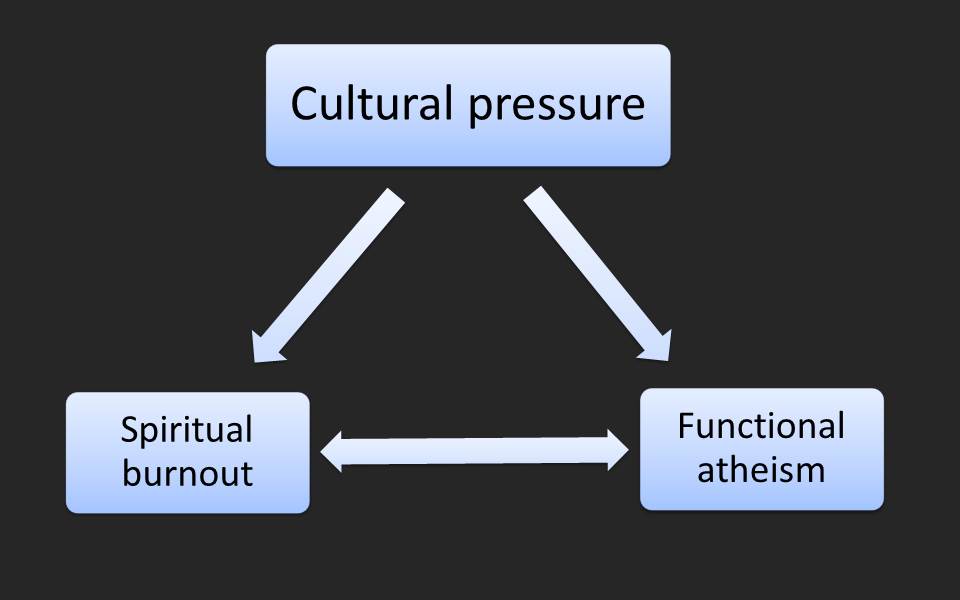
Cultural pressure hebrews hierarchyThis culture pressure gave birth to two dangers addressed in the letter to the Hebrews.  First was spiritual burnout—that the time seemed long between God’s promises and fulfillment.  What joy was there to be found in being social outcasts?  Second was functional atheism—that is, believing that God is real, but acting as if he’s not.  The early church struggled with those who abandoned the gospel for a life of pleasure-seeking.

Sound familiar?  Today we face similar kinds of cultural pressure.  It’s tough standing for the gospel in a world that sees Christianity as a social threat.  We may similarly face spiritual burnout—after all, is there any real value in going to church these days?  Aren’t I just as well-off staying home with my family?  Alternately we may face our own form of functional atheism.   We go to church faithfully, but our lives are ruled by devotion to the lesser gods of career, sexuality, money, power, and so on.

Thus the message of Hebrews is as clear as ever: endure.  But how?  Over the years a long litany of solutions have been raised, all of which seem to focus on technique.  But in his book God in the Wasteland, David Wells observes that this focus has been woefully inadequate:

“[T]he fundamental problem in the evangelical world today is not inadequate technique, insufficient organization, or antiquated music, and those who want to squander the church’s resources bandaging these scratches will do nothing to staunch the flow of blood that is spilling from its true wounds.  The fundamental problem in the evangelical world today is that God rests too inconsequentially upon the church.  His truth is too distant, his grace is too ordinary, his judgment is too benign, his gospel is too easy, and his Christ is too common.”  (David Wells, God in the Wasteland, p. 30)

What we need, then, is an “uncommon” Christ.  A Savior that transcends the boundaries of rationality and inward-gazing spirituality.  So it’s only fitting that the letter of Hebrews opens by directing our full attention at the person of Jesus:

Long ago, at many times and in many ways, God spoke to our fathers by the prophets, 2 but in these last days he has spoken to us by his Son, whom he appointed the heir of all things, through whom also he created the world. 3 He is the radiance of the glory of God and the exact imprint of his nature, and he upholds the universe by the word of his power. After making purification for sins, he sat down at the right hand of the Majesty on high, 4 having become as much superior to angels as the name he has inherited is more excellent than theirs. (Hebrews 1:1-4)

In his commentary on Hebrews, Paul Ellingworth takes note of how the author opens with “an interweaving of themes, as in musical composition.”  There’s music to be heard here, if we listen closely enough.  What is the writer saying?  He’s saying that the Bible serves us well in its ability to reveal God—but now that we have Jesus, we no longer see God embedded in a text, but embodied in flesh and blood and sinew.

Of course, this cuts both ways.  Why?  Because it also tells us that if Jesus is the perfect embodiment of God, then it doesn’t render our scriptures obsolete.  On the contrary; it infuses them with new meaning, because they all point to this magnificent Son.

To know Jesus is to know God, and what you think about Jesus you also think about God.  The original Greek here uses the term charakter—translated in verse 3 as “the exact imprint of [God’s] nature.”  It’s easy to see where we get the English word “character” here, though in the ancient world they also used the term to refer to the stamps on coins.

The whole passage resonates with other early Christian thought, such as that of Paul in writing to the church in Colosse:

15 He is the image of the invisible God, the firstborn of all creation. 16 For by[f]him all things were created, in heaven and on earth, visible and invisible, whether thrones or dominions or rulers or authorities—all things were created through him and for him. 17 And he is before all things, and in him all things hold together. 18 And he is the head of the body, the church. He is the beginning, the firstborn from the dead, that in everything he might be preeminent. 19 For in him all the fullness of God was pleased to dwell, 20 and through him to reconcile to himself all things, whether on earth or in heaven, making peace by the blood of his cross. (Colossians 1:15-20)

Barry Taylor—artist and professor at Fuller Seminary—has observed that today’s world seems bent on “rescuing” Jesus from the clutches of religious conservatives “who, the consensus s seems to say, have done Jesus a grave injustice by making him out to be just like them – uptight, overly religious in the pejorative sense, lacking a sense of humor, and disconnected from the way things really are.”  (Barry Taylor, Entertainment Theology, p. 153)

But in the world of the New Testament we find a Jesus who is fully and emphatically God.  In the sixteenth century Philip Melancthon—one of Luther’s students—wrote that “God indeed dwells in other holy people, but dwells spiritually.…But in Christ he dwells bodily…the very divine nature has poured itself into the flesh, with all its power.”  He eternally exists.  He is intimately involved in creation.  He holds authority over his followers—the church.  And only through his saving work can man find his way back to God.

Douglas Coupland is best-known for coining the term “Generation X” back in the 1990’s.  But he has also written a number of other books, including Life After God, a collection of short stories of what life looks like through the eyes of an atheist.  But at the book’s conclusion, he startles readers by revealing his “secret:”

“My secret is that I need God—that I am sick and can no longer make it alone. I need God to help me give, because I no longer seem to be capable of giving; to help me be kind, as I no longer seem capable of kindness; to help me love, as I seem beyond being able to love.” (Coupland, Life After God, p.359)

Do you need God?  Then read on.  The book of Hebrews may have something significant to say to you…

Nothing More Relevant than Studying the Book of Hebrews (Hebrews 1, Hebrews 4)

I am not exaggerating and just pumping you up at all when I say that I’m excited about our study of the book of Hebrews over the next 10 weeks. It really is a favorite for me and always has been, and it has been awhile since I’ve done this with a church.

The precision by which the writer to the Hebrews ties together the Old Testament and the work of Christ is simply so amazing and with such detail – it really bolsters one’s faith to see the incredible parallels in the master plan of God.

Yes, Hebrews is at times a bit on the academic and geeky side of biblical study. Yet at the same time, if you understand the background and the author’s purpose in writing, it really makes the book come alive in a most practical way.

Understanding the background and setting for the writing of any Bible text is important, but this is especially true for the book of Hebrews. And that is why I am sharing this devotional with you today even before we kick off the actual study on Sunday.

We do not know who wrote the book of Hebrews, and we don’t know the exact people who were the recipients. That doesn’t sound like a good start!  But this does not take away from the great writing that has been treasured by Christians since the dawn of the church age.

There are some people who believe it is the Apostle Paul who wrote the book. But the style is rather different, though proponents of Pauline authorship would say that such is accounted for by the different topical nature of what is written. Ultimately we just don’t know for sure. I would bet rather on it being the biblical character Barnabas. There was some early tradition that tied his name to this writing; and as a Levite by background, he would understand deeply all the details of the Old Testament system and how Christ was the perfect and true reality of those truths pictured and foreshadowed by the OT sacrificial system.

Another reason I am betting on Barnabas is the theme of encouragement that comes along with the deep teachings of the text. He was called the “son of encouragement” (Acts 4:36). And this leads us to discuss the purpose of the author’s writing.

Those receiving this letter would be a group of people who were Jewish Christians – having come to trust in faith in Christ as the Promised One. It had changed their lives; it was exciting at first. But then, over time, difficult times had come upon them. They were persecuted for their faith and there was great suffering. Life was hard.

These folks began to look back at the old days of the Jewish system when their lives were easier, almost longing for the good old days. Maybe they should go back to that time and that belief. Life would be easier, that was for sure. They could go to the Temple and actually see the priest; they could talk to him!  And so the writer says things like…

Therefore, since we have a great high priest who has ascended into heaven, Jesus the Son of God, let us hold firmly to the faith we profess. For we do not have a high priest who is unable to empathize with our weaknesses, but we have one who has been tempted in every way, just as we are—yet he did not sin. Let us then approach God’s throne of grace with confidence, so that we may receive mercy and find grace to help us in our time of need.

Does not understanding that background make this familiar text “pop out” for you a bit more?  It is not just a biblical writer saying “pray to Jesus because he’s right there with God.”  It is rather a writer saying something like, “Don’t whine about what you can’t see on earth, but rather be thankful that you are represented by and in connection with someone who fully understands you and who is right there at the throne of God to help you … so why would you want to do something so incredibly stupid as to walk away from a resource like that?”

Over and over the writer is saying to the readers to hang in there, to stick with it … in a word to “endure.”  And that is why we chose that single word as the title for our series!

It is difficult to endure in a sinful world. Sometimes you want to just give up … throw it all in and quit. But the book of Hebrews says to stay the course and finish the race … just as others have ahead of you … that the reward is worth it all.

This is a timely message for us. It is a good writing for us to devour anew as we look at a world where 21 of our brothers in Christ were beheaded a few days ago for being Christians – the same thing we are. Will someone someday come to the Tri-State area and desire to detach our heads from our bodies?  That may seem remote, and maybe it is. But to live increasingly in a world where our faith is rapidly becoming a despised minority is our lot in life, and will be even more for the generations following us. There is a need for endurance.

So let us run with perseverance the race marked out for us, fixing our eyes on Jesus, the pioneer and perfecter of faith. For the joy set before him he endured the cross, scorning its shame, and sat down at the right hand of the throne of God. Consider him who endured such opposition from sinners, so that you will not grow weary and lose heart.