
Divine choreography: Made in the image of community

If you take a good look at your average dollar bill, you’ll notice that the reverse side features the Great Seal of the United States—you know, the eagle holding both an olive branch and a bundle of arrows. And above the eagle’s head you’ll find the traditional national motto of the U.S.: E pluribus unum.  Don’t be scared off by the Latin; it simply means “Out of many, one” or “one from many.” It refers to the fact that though America is a land of great diversity, we still find common unity in our identity as American citizens.

Humans are, indeed, a diverse group. Social science has long insisted that we are not merely homo sapiens but homo duplex, meaning we exist on two distinct levels: as individuals and also as participants in a larger social fabric. We need each other. “No man is an island,” as they say. And what we’re talking about can ultimately be traced back to God’s perfect character.

In the creation story of Genesis, we’re told that men and women were created in the “image” of God (Genesis 1:26). In the original context, this had to do with being a ruling representative of God, an agent of God’s sovereign kingdom on earth. Human beings are capable of this because we share certain characteristics of God—we “take after” God, so to speak, much the way we might say a toddler “takes after” one of his parents.

But, as we’ve been emphasizing this week, God reveals Himself as an eternal community of persons: Father, Son, and Holy Spirit. These three are one, yet they fulfill unique roles within God’s divine community as well as the gospel story.

If you and I are made in the image of a divine community, it follows that we are made for community with one another. In Bruce Ware’s careful study of the Trinity, he points out that “we are created to reflect what God is like, and this includes a reflection of the personal relationships within the Trinity.”

So it should not surprise us that the pattern of unity-and-diversity can be found in so many places of our society. In what ways does the Trinity impact the way humans reflect God’s image? We can highlight three:

  • WE ARE WIRED FOR INTIMACY

First, we must acknowledge that the members of the Trinity exist in a perpetual state of intimacy. The early Church even found a word for this—they called it perichoresis. If you look closely enough you’ll see the resemblance to the word “choreography.” “God is not a static thing,” wrote C.S. Lewis, “but a dynamic, pulsating activity, a life, almost a kind of drama. Almost, if you will not think me irreverent, a kind of dance.” What we find in God is a kind of “divine choreography,” where the various members of the Trinity exist in close, intimate fellowship, such as when Jesus tells His followers: “I am in the Father and the Father in me” (John 14:11).

More recently, Cornelius Plantinga says it this way:

“The persons within God [Father, Son, and Spirit] exalt each other, commune with one each other, and defer to one another…Each divine person harbors the others at the center of his being.  In constant movement of overture and acceptance, each person envelops and encircles the others…God’s interior life [therefore] overflows with regard for others.”[1]

If we are made in the image of this “divine choreography,” then it follows that you and I are called for relationships with one another. Jesus hints at this when He prays that the Church “may all be one, just as you, Father, are in me, and I in you” (John 17:21).

Marital intimacy, of course, is the deepest expression of this divine community. Two becoming “one” is the closest expression we have to the intimacy found in the Godhead. But even outside of marriage, the Trinity forms a pattern for how we as individuals form relationships with one another in society as well as in the Church.

  • WE MAY SUBMIT TO AUTHORITY WITHOUT LOSING DIGNITY

Some of the hardest teachings in the Bible have to do with submitting to authority. Wives are called to submit to their husbands, children called to obey their parents, and all people are called to submit to human government.

In our Western way of thinking—nay, our human way of thinking—submission is more than a loss of personal freedom, but an affront to our personal dignity. Submission is assumed to be a sign of inferiority. “Who is he to tell me what to do?” we might catch ourselves thinking, and on a larger level we can see the consequences of a society that refuses to recognize anyone’s authority except their own.

In John’s gospel Jesus tells the religious leaders: “Truly, truly, I say to you, the Son can do nothing of his own accord, but only what he sees the Father doing. For whatever the Father does, that the Son does likewise” (John 5:19). Jesus submits to the Father’s authority. Granted, there are other passages that indicate that Jesus still had a will of His own, but Jesus emphasizes His desire to do the will of the Father who sent Him (John 4:34). Jesus never stopped being God, never ceased to be worthy of honor and praise. Yet Jesus was willing to obey the authority of His Father in His earthly mission.

If Jesus could submit to authority without losing dignity, why can’t we?  The Trinity helps us understand that sometimes hierarchy is necessary for an ordered society, and we should never see our submission to authority as indicating inferiority.

  • WE VALUE HARMONY, NOT MERE “UNITY”

Sometimes I suspect that we use the word “unity” all wrong. Sometimes we take the word “unity” to mean “uniformity”—that is, if we are to truly be “one,” we must think and act the same.

The Trinity teaches us that because Father, Son, and Spirit are one God yet different persons, they exist not only in unity but in harmony.  They are different pieces coming together to make a whole.

No one goes to the symphony to hear a group of flautists all playing the same note. No; a symphony—like all forms of art—requires both unity and diversity in the way the varied notes and instruments come together to form a unified, beautiful composition.

In the book of Revelation, we find something similar going on in the worship of God:

9 After this I looked, and behold, a great multitude that no one could number, from every nation, from all tribes and peoples and languages, standing before the throne and before the Lamb, clothed in white robes, with palm branches in their hands, 10 and crying out with a loud voice, “Salvation belongs to our God who sits on the throne, and to the Lamb!” (Revelation 7:9-10)

Read that carefully; note all the plural nouns: “all tribes…peoples…languages” but “crying out with a loud voice.” From the many, one.

If this is what God’s future is meant to look like, should we also not seek to embrace diversity in our midst even today?

*   *   *

It hasn’t escaped my notice that you’re reading this on inauguration day. Few things divide us like politics. In the coming years, I can easily imagine there will be a great many opportunities to witness social and political division. But this is all the more reason to pursue harmony and to not allow ideas—however precious they may seem—to damage the kinds of relationships that reflect God’s image.

And I realize, of course, that there are many ideas that cannot coexist harmoniously—just as there is a limited range of notes that can be played together to make a musical chord. This side of the resurrection, it’s rare that our ideas about morality and human society are ever in perfect agreement. There’s room for dialogue, even debate. What there’s not room for is anger and childish name-calling. For if we are indeed fashioned in the image of a divine community, there is something noble about seeking peace where others stir division. We are many indeed, but in God we can be unified.

[1] Cornelius Plantinga, Engaging God’s World: A Christian Vision of Faith, Learning, and Living. (Grand Rapids: Eerdman’s, 2002), 20-23.
Unison and Harmony: Are the Members of the Trinity Equal?

As a vocal music major in college, I was required to participate and sing in a wide variety of groups. There was the annual oratorio choir and orchestra, the college chorale, and a smaller select group called the Chamber Singers. At various times I toured and concertized with all of them, sometimes as a tenor, though more often later as baritone/bass.

There was a regular sort of competition that went on among the voice parts as to which was the best and most important. The sopranos were often a bit high and mighty (pun intended); and while carrying the melody most of the time (though not always) they perceived themselves as the most indispensable. I always thought the bass section had a strong argument as saying that they were the foundation of the chordal structure upon which all else musically rested (though colorful chord inversions messed with this theory – just went music geek on you there). And the altos and tenors would argue that they were responsible for the bulk of the harmonies that made a choral production colorful and beautiful.

The fact is of course that all of the parts were necessary, and though they played different roles, none was more technically important than the others. The strength expressed in unison singing brought power to a composition, whereas the delicate harmonies contributed a rich context of refinement.

We may apply this to the discussion of the roles of the Trinity, though as with any and all natural world explanations, it will fall short of fully illustrating the impossible to completely grasp and comprehend.

The members of the Trinity are co-equal and co-eternal. There is equality, yet mutual submission in the roles each plays.

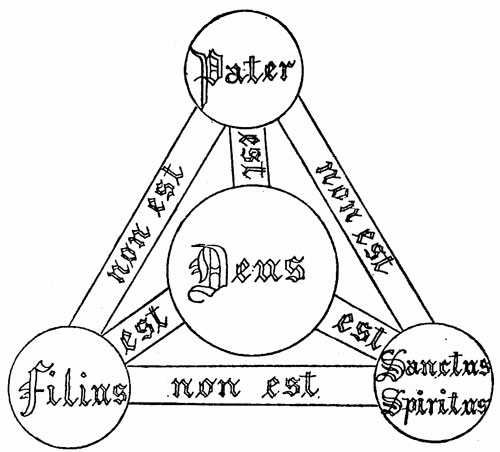
One of the early statements of the faith (The Athanasian Creed) affirmed this truth, and out of it came a graph called the Shield of the Trinity. I shared it on Sunday as a projection in English, but here it is as it looked in Latin …

trinity_triangle_shield_of_trinity_diagram_1896

You can probably figure it out, but a translation would roughly say: The Father is God, The Son is God, The Holy Spirit is God; God is the Father, God is the Son, God is the Holy Spirit; The Father is not the Son, The Son is not the Father, The Father is not the Holy Spirit, The Holy Spirit is not the Father, The Son is not the Holy Spirit, The Holy Spirit is not the Son.

Now doesn’t that just clear up everything?

In biblical study there is a discussion called the theology of procession. This says that the Father sends the Son, and the Father and the Son send the Spirit. That might seem to suggest that the Father is most important, whereas it speaks of the relationship that exists in terms of function. There is yieldedness within the Trinity.

Again, illustratively – is the husband greater than the wife? It speaks in the Scripture of headship for the husband, but he is not greater. Likewise, are certain gifts and positions of service in the church better than others – the speaking gifts better than the serving gifts? No, not really. All parts of the body are necessary and needful.

The Trinity is a model of diversity of roles, yet unity of essence and purpose.

But when the kindness of God our Savior and His love for mankind appeared, He saved us, not on the basis of deeds which we have done in righteousness, but according to His mercy, by the washing of regeneration and renewing by the Holy Spirit, whom He poured out upon us richly through Jesus Christ our Savior, that being justified by His grace we might be made heirs according to the hope of eternal life. (NASB) Titus 3:4-7

Slicing and Dicing: Trinitarian Heresies

We stand on the shoulders of those who have gone before us. This is true is so many areas of endeavor and knowledge – such as science and medicine, for example – and it is true as well in the field of theology. It is a wonderful era in which we live, inheriting two millennia of theological thinking and articulation that is available literally at our fingertips. The early church fathers of course did not have such resources, and they struggled to fully and accurately articulate complicated truths such as the Trinity and all of the implications of the divinity of the Son and the Holy Spirit. Recall also that the several early centuries of the Church age involved as well the final codification of what were the accepted divine Scriptures (we call this canonization).

Yes, it is all rather complicated. We said from Day 1 of this series on the study of God – called “Theology Proper” – that this was a more academic endeavor than most we take on. But our topic this week of the Trinity is one that is surely taught throughout the Bible and is one that we cannot deny or pull out of the cloth of Scripture without unraveling the integrity of the whole garment. If you lose the Trinity, you lose everything.

And over the years, there are several basic errors espoused by some at various times that result ultimately in nothing short of heresy. In attempting to present these briefly (gigantic tomes have been written upon all that follows), let me use a delineation presented by a theologian of our own denomination and theological seminary – Wayne Grudem (from Systematic Theology: An Introduction to Biblical Doctrine, chapter 14).

Grudem writes that there are three basic statements to be affirmed about the biblical teaching on the Trinity …

  1. God is three persons.
  2. Each person is fully God.
  3. There is one God.

A denial of any one of these three statements leads to one of the historical errors about the Trinity.

To deny the first point – that God is three distinct persons – is an error known within Church history as Modalism.

The idea here is that God is one person who appears in three different ways at different times. In the Old Testament he was God the Father. In the New Testament he is God the Son. And in the church age after the ascension he is the power and influence as the Holy Spirit. It is as if he has three hats and shows up at different times in different forms.

This of course denies the personal relationships within the Trinity, as when Jesus prays to the Father. And think about the baptism of Jesus where the Father speaks from heaven and the Spirit descends as a dove. And if this is true, the atonement for sin is lost – the truth that God sent the Son to be the atoning, substitutionary sacrifice for sin.

To deny the second point – that each person is fully God – is an error known within Church history as Arianism.

This is the more common error that has taken various forms down to our day. It is named after Arius, a Bishop of Alexandria (Egypt). He taught that Jesus and the Spirit were logically creations of the Father. This view was condemned at the Church Council of Nicea in A.D. 325 with a famous creedal statement about the nature of the Trinity.

An Arian way of thinking (then or now) is to say that Jesus was created before the rest of creation and is “like” the Father, but is not the same nature or essence as God the Father. Bolstering this view is an understanding of verses like Colossians 1:15, which calls Christ “the first-born of all creation.”  But the idea of being first here is not #1 in order, but rather #1 in preeminence (supremacy, importance, authority, etc.).

To deny the third point – that there is one God – is an error known within Church history as Tritheism.

Honestly not that many people over the years have held to this view, as it is obviously not much different than pagan religions with multiplicities of gods.

And again, all of this discussion is admittedly rather academic, but it is also of the utmost central importance. Yet also, it is of immense practical understanding. I don’t want a Jesus who is less than divine – nothing more than a great moral example or most-empowered human creation. We need a perfect savior, not an ideal model of godly living. And we need more than a powerful spiritual presence or influence within us. We need not only God the Father; we must have God the Son, and God the Holy Spirit … or all is lost.

Explaining the Impossible: Definitions of Trinity

There are many things that seem impossible to explain, like how the Dallas Cowboys could lose a playoffs game this season! Inexplicable. But somehow it happened.

Today we take an attempt at explaining and defining the Trinity. Alert: this is going to be ultimately impossible, and no attempt or illustration is quite adequate enough to do it. People have sometimes used the three properties of H20 – Ice / Water / Vapor to describe it, but this falls short.

So let’s go all academic and get a historic definition of the Trinity as outlined in the Westminster Confession:

“In the unity of the Godhead there be three persons, of one substance, power, and eternity: God the Father, God the Son, and God the Holy Ghost: the Father is of none, neither begotten, nor proceeding; the Son is eternally begotten of the Father, the Holy Ghost eternally proceeding from the Father and the Son.”  (Westminster Confession of Faith, II/iii)

Christianity, therefore, is not totally and merely monotheistic, but Trinitarian. God exists as an eternal community of persons—Father, Son, and Spirit. The three essential teachings are:

(1)       There is one God

(2)       God exists as three persons—Father, Son, and Spirit

(3)       Each of these persons is fully God

Think of it this way using math: It is not 1+1+1=3, but 1x1x1=1.  But that illustration falls short also.

St. Augustine had famously said of the Trinity: “Try and understand it and you lose your mind; try and deny it and you lose your soul.”

With the concept of the Trinity, we are getting into a realm that is beyond our minds and experiential frame of reference in the material world to understand. But the Trinity is important simply because that is what God is like. To understand God—and to know Him relationally—we mustn’t ignore certain truths because they are difficult. The contemporary theologian, J.I. Packer writes:

“The historic formulation of the Trinity…seeks to circumscribe and safeguard this mystery (not explain it; that is beyond us), and it confronts us with perhaps the most difficult thought that the human mind has ever been asked to handle.  It is not easy; but it is true.”

Similarly, we should also recognize that the doctrine of the Trinity holds value in distinguishing the Christian faith from other major world religions. Not surprisingly, the brilliant C.S. Lewis wrote that the difficult teachings of Christianity prove that it is not something that man would ever have dreamed up:

“If Christianity was something we were making up, of course we could make it easier.  But it isn’t.  We can’t compete, in simplicity, with people who are inventing religions. How could we?  We’re dealing with Fact.  Of course anyone can be simple if he has no facts to bother about!”

Gregory of Nazianus (4th century bishop of Constantinople) wrote that this truth always directed him toward worship:

“I cannot think of the One, but I am immediately surrounded by the Three; nor can I clearly discover the Three, but I am suddenly carried back to the One.”

If you have walked at all with the Lord and studied his Word, you know how incredibly true and insightful is that assertion.

While the Christian faith is reasonable and rationally defensible, there is a point at which faith enters the equation. It is believing in things that are beyond us, as it says in Hebrews 11 – “Now faith is confidence in what we hope for and assurance about what we do not see.”  Without the Trinity, the gospel falls apart, there is no true savior, and there is no indwelling of God within His people. You lose everything.

But the doctrine of the Trinity is true, and that holds all things together for life and eternity. It is essential.

The Trinity and the Old Testament

The oft-quoted remark that “God created man in his own image. And man, being a gentleman, returned the favor” has been attributed to a variety of people, from Rousseau to Mark Twain. In any event, there is surely truth in it. The nature of man, left to himself apart from divine revelation, has displayed a tendency to create gods that are agreeable and manageable.

In the modern era, the gods that are honored involve such as pleasure, individualism, science and reason. But in the pre-Christian era of the Old Testament, the gods were hand-crafted deities of all sorts, representations of the powers of nature, etc.  Often worshipped on high places in particular, they held an attraction for people longing to fill the God-shaped vacuum of the soul. And they so often even drew in the Jewish people, resulting in repeated disasters for the nation.

So the emphasis of the Old Testament was upon the essential oneness and singularity of God as the one and only true God. And probably the most famous and oft-quoted OT text would be the Shema prayer of Deuteronomy 6:4 – “Hear, Oh Israel. The Lord your God is one.”  This was distinctively different than the panoply of Gods worshipped in the surrounding nations.

We would therefore not expect to see the idea of the Trinity particularly elucidated in the Old Testament. But even from the very beginning there are more than just mild hints that God existed in more than one person, yet with unit. By the very beginning, I’m talking about the second sentence in the Bible …

In the beginning God created the heavens and the earth. Now the earth was formless and empty, darkness was over the surface of the deep, and the Spirit of God was hovering over the waters.

And we see throughout the Old Testament that the Spirit of God – the Holy Spirit – would come upon various prophets, priests and kings for the purpose of divine empowerment. This was more than just a powerful influence, as the work and words coming from these indwelt people had a divine empowerment and first-person authority. David, after his sin with Bathsheeba, was terrified of the thought of losing the presence of God living within, praying in Psalm 51:10,11 …

Create in me a pure heart, O God, and renew a steadfast spirit within me. Do not cast me from your presence or take your Holy Spirit from me.

As well, in various places in the OT, there is the presence of plural pronouns. For example, in Genesis 1:26 … Then God said, “Let us make mankind in our image, in our likeness, so that they may rule over the fish in the sea and the birds in the sky, over the livestock and all the wild animals, and over all the creatures that move along the ground.”

Though this may simply be a way of expressing noun-verb agreement, the early Church believed that this was an evidence of the Trinity, as have most scholars over the years.

And as the OT moves along, references to a future Messiah-King are seen. And though this looks forward to a physical and visible person, there are clearly divine attributes connected, the most well-known being those in Isaiah …

7:14 – Therefore the Lord himself will give you a sign: The virgin will conceive and give birth to a son, and will call him Immanuel.

9:6 – For to us a child is born, to us a son is given, and the government will be on his shoulders. And he will be called Wonderful Counselor, Mighty God, Everlasting Father, Prince of Peace.

That is about as clear as it can get for OT times, though comprehending this was a fuzzy experience before the incarnation. Fully understanding the eternal Trinity would take the events and writings of the time of Christ and the New Testament era. But the Old Testament is not without Trinitarian references as we look back upon it from our point on the continuum of time.

Speaking of the continuum of time, our minds cannot understand God’s position above and beyond this human limitation and sphere. He is above it and sees it all – past, present and future – all the same. And likewise, the limitations of the human mind make it difficult for us to grasp the three-in-one nature of the Trinity.

But there is a wonderful peace and comfort that can accrue to us as we grasp all that we are able about the knowledge of God, including the Trinity. It is wonderful to know that God is not locked-down as we are. Being above time, He is not limited … He is not making up the story and reacting to events as they happen. Rather, He is revealing the full story more and more as time goes by. We call this progressive revelation. The future is in God’s hands and is as certain as if it has already happened. Just as the doctrine of the Trinity was progressively revealed and understood as time passed, so also will all of God’s sovereign plan for the ages be increasingly evident as the years pass. And in that theological truth we may find great personal comfort, even in a broken world.

To see and know God: The revelation of Jesus

Chances are you’ve heard of the theory “six degrees of separation,” the idea that every human being in the world is connected to one another through six layers or “degrees” of friends.  You may be all the more familiar with the party game “six degrees of Kevin Bacon,” where you name an actor and connect him back to Kevin Bacon in some way.  In the real world, it’s really quite simple: maybe you know a guy who knows a guy who knows a lady who’s friends with Tom Hanks.  So you’re only four degrees removed from a major celebrity.  The world is smaller than we realize; social media has actually taught us that.  A recent study discovered that the number of “degrees” of separation between Twitter users is only about 3.43.  So, by Twitter standards, if you log into your account, you are only about 3-4 friends away from knowing literally every person on the planet.

You and I share a natural affinity for connectedness, and this desire extends as well into the spiritual realm.  The impulse to connect with God or a higher power is as alive today as it ever has been—and in some ways this desire is all the more prominent with our contemporary acceptance of human “spirituality.”

What if we had the capacity to know God directly?  What if the separation between us and him was by only a single degree—that we could come into the presence of God Himself and know Him and be known by Him?

Yesterday we highlighted the way that God reveals Himself more specifically through Scripture, through His Word.  Today we’ll look at the way that God reveals Himself most fully in the person of Jesus.

THE ARRIVAL OF JESUS

When the apostle John composed his biography of Jesus, he took special care to remind us that Jesus was—nay, is—God in the flesh (cf. John 20:31).  He begins by telling us that the Word of God—the same Word that created the universe from nothing, the same Word contained in the pages of the Bible—now becomes flesh in the person of Christ:

“In the beginning was the Word, and the Word was with God, and the Word was God….14 And the Word became flesh and dwelt among us, and we have seen his glory, glory as of the only Son from the Father, full of grace and truth…. 18 No one has ever seen God; the only God, who is at the Father’s side, he has made him known.” (John 1:1, 14, 18)

“No one has ever seen God,” John reminds us, but Jesus “has made Him known.”  If you’re reading that in the original Greek, you’ll notice that the English phrase “has made Him known” comes from the single Greek word exegesato.  The word referred to scholars and ancient scribes laboring over ancient texts, seeking to draw out the meaning of Scripture. Even today the science and art of Bible interpretation is called “exegesis,” which comes directly from this Greek term. John is telling us that if we want to know God in the truest, most direct way, we have to look no further than Jesus Christ.  It’s why Paul would later declare Jesus to be “the image of the invisible God” (Colossians 1:15); in Jesus God makes Himself known in a direct, personal way.

Have you ever wondered: If God is real, why doesn’t He just show Himself?  The answer is that God did just that: in Jesus God took on flesh that we might see and know Him.

THE BODY OF CHRIST

But how is Jesus made known today?  Christianity has long held that the Church is now the “body of Christ.”  Paul writes:

4 There is one body and one Spirit…[and] speaking the truth in love, we are to grow up in every way into him who is the head, into Christ,16 from whom the whole body, joined and held together by every joint with which it is equipped, when each part is working properly, makes the body grow so that it builds itself up in love. (Ephesians 4:4, 15-16)

The Church is God’s visible demonstration of His presence on earth.

Does God reveal Himself through the Church?  In a sense, yes—though admittedly not with the same authority as in His Word.  There is value in learning from the “great cloud of witnesses” (Hebrews 12:1) that have gone before us in the faith.  And there is also value in learning from one another, from being together and allowing our lives to intertwine as we grow in faith.

Social scientists have told us what we perhaps always knew: that human communities influence belief in profound ways.  This is perhaps why Paul told the young pastor Timothy that the Church is a “pillar and buttress of the truth” (1 Timothy 3:15).  The Church literally supports the Truth.  It’s true that human communities aren’t always right, but when we embrace the common truths of the gospel our social networks (that is, our congregations, our community groups, our families) can serve to reinforce and augment our faith in Christ.

And ultimately the Church is God’s visible witness to the world.  Harvard scientist Robert D. Putnam published a massive study in recent years in which he admits that yes; evangelical communities really do demonstrate charity and Christian love more than other communities:

“By many different measures religious observant Americans are better neighbors and better citizens than secular Americans—they are more generous with their time and money, especially in helping the need, and they are more active in community life.”[1]

The Church can testify to the reality of God by being a beacon of goodness and hope to the world.

LOOKING FORWARD

By now we’ve sought to emphasize that not only is God real, but the God of the Bible is real.  It’s undeniable that every major religion has competing things to say about God.  But if we pause and consider that God has revealed Himself through His Spirit, through His creation, through His Word, and through His Son, then we can discover that yes, Jesus is the way, the truth, and the life; He is our only road to the Father (John 14:6).

The road before us is one in which we seek to discover just what this God is truly like.  Our prayer is that as we journey together, we might all learn what it is like to be connected to God, not merely because of how we were raised or what we might have read in a book, but because of what God has revealed about Himself.  “Let it be the true You that I worship,” C.S. Lewis once wrote, “and the true I that worships You.”

Amen.

[1] Robert D. Putnam and David E. Campbell, American Grace: How Religion Divides and Unites Us. (New York: Simon and Schuster, 2010), 461.

The Word of God: Timeless truth in a “post-truth” era

This past year, the Oxford Dictionary declared the “word of the year” to be “post-truth.”  Post-truth?  Truth, it’s commonly assumed, has moved out of the realm of human absolutes and into the realm of personal perspective.  That’s why everyone is wary of the news media, fearful that journalists embellish and distort the truth to fit their own agenda.  As a young person, I would tell you this is old news—no pun intended.  My generation has rejected the idea of truth for years now, especially in the arena of professional journalism.  It’s no wonder that my peers often get their “news” from the likes of Stephen Colbert and John Oliver—because if everyone’s biased, you might as well listen to someone whose perspective you can enjoy and appreciate, right?

As we said yesterday, God is a God who speaks, who reveals Himself.  We classify this “revelation” in two broad ways: the “general” revelation we see in nature, and the “specific” revelation we find in Scripture.  For it is there, printed on every page, that the heart of God is most directly revealed to us.  Truth is personal because language itself is personal; communication implies a sort of intimacy.  And because of this, truth is not only knowable, but can be known with certainty thanks to a God who chooses to reveal Himself with the specificity of human language.

SPECIFIC REVELATION: THE WORD OF GOD

Part of what we have to remember about Scripture is that the very Word of God has a power unto itself.  The opening pages of the book of Genesis describe a God who literally spoke the universe into existence, a fact that later generations of God’s people would continually marvel at.  “By the Word of the Lord,” the psalmist writes, “the heavens were made” (Psalm 33:6).  Why was it so important to tell God’s people that God’s Word held such power?  Because the book of Genesis was recorded by Moses, who also led God’s people out of slavery and through the wilderness to the Promised Land.  During their years of wandering, they would hear the story of creation, of how God spoke and reality conformed to His will.  And the same Word that gave rise to creation also gave His people a promise of land and a promise of blessing.  They could trust God’s Word.  Why?  Because the promise was as real as the air they breathed. 

The “Word of the Lord” became synonymous with God’s revealed will and message; it’s why so many of the prophets speak of the “Word of the Lord” coming to them, such as when Jeremiah speaks of how “the Word of the Lord came to [him]” (Jeremiah 1:11), just as the Word came to various prophets throughout the Hebrew Scriptures.

And this same Word also finds itself recorded in the pages of today’s Bible.  To the young pastor Timothy, Paul writes:

16 All Scripture is breathed out by God and profitable for teaching, for reproof, for correction, and for training in righteousness, 17 that the man of God[b] may be complete, equipped for every good work. (2 Timothy 3:16-17)

And let’s not forget that Timothy lived in an age that was increasingly numb—if not hostile—toward absolute truth.   Paul’s message was one we all need to hear: in a “post-truth” age, we can rest on the unwavering Word of God.

THE NECESSITY OF DOCTRINE

Still, I know many who struggle with this idea.  Does not such an emphasis on the Bible negate the role of human experience?  After all, many times Christian theology seems dry and musty in comparison with the vibrant colors of human experience.

Some years ago a man named Ludwig Wittgenstein pointed out that human language is ultimately inadequate to describe anything.  For instance, no amount of language is sufficient to describe the robust taste and aroma of a cup of coffee.  When sharing this illustration to a gathering of college students, one young man raised his cup and offered a hearty “Amen!”  And he was right, you know.  No one wants to read about something when you can experience it directly.  So how can we ever expect to know what God is like just be reading about Him?

But human language is perfectly adequate to write directions to Starbucks.  Follow these directions and you can “taste and see” that their product is good.  So, too, can human language—in Scripture, in doctrine—provide a means by which we might “taste and see that the Lord is good.”

The alternative, of course, is to become enslaved to our experiences and our feelings.  And that’s dangerous, because God becomes subject to our perceptions and our biases.  What we end up worshipping isn’t God, it’s just a projection of what we want God to look like.  As C.S. Lewis points out, doctrine is meant to challenge us, and anything less will have no effect:

“The god of whom no dogmas are believed is a mere shadow. He will not produce that fear of the Lord in which wisdom begins and therefore will not produce that love in which it is consummated…. There is in the minimal religion nothing that can convince, convert, or (in the higher sense) console; nothing therefore which can restore vitality to our civilization. It is not costly enough. It can never be a controller or even a rival to our natural sloth and greed.”[1]

Doctrine should freak us out.  It should tear the masks from our faces like the wind tears doors from their hinges.  Only God’s truth has the power to do this, and we encounter this Truth in God’s Word.

WHAT IS THE BIBLE BASICALLY ABOUT?

For Christians, Truth is not merely a set of ideas; Truth is a person (cf. John 14:6).  What is the Bible basically about?  The Bible is ultimately a story about Jesus.  That’s why John tells us that Jesus is the very Word of God (John 1:1, 14).  To read the Bible is to come to know this Word in a way that is real and personal.  So we read the Bible not merely to find a set of answers to our problems; we read the Bible to encounter a Savior who we can know personally.  Because in a world that rejects truth, it’s easy to dismiss or “deconstruct” the words printed on a page—but I remain challenged by the Word made flesh.  I pray that as you read the Bible, your mind and heart would be filled with the knowledge of the Savior.

How do we know our God is real?  He is found in every page.


[1] C.S. Lewis , “A Christian Reply to Professor Price,” Phoenix Quarterly.

“The heavens declare:” How God is revealed in nature

Christianity’s most staggering claim isn’t that God exists (all religions say that); it’s that He communicates.  We call this revelation, the act by which God reveals Himself to the world.  For if man is to know God, it can only because God reveals Himself by speaking.  It is through God’s voice that we possess the knowledge of God.

This, of course, is what helps distinguish Christianity from every other major world religion.  How can we be sure that the God of Christianity is true?  Because the God of Christianity speaks to us in ways that are meaningful.

Christian theology teaches that God’s voice can be heard both directly as well as indirectly.  We call these distinct categories “General” (or “natural”) revelation and “Specific” (or “special”) revelation. We’ll start today with general revelation—the voice of God as heard in creation.

NATURE REVEALS GOD’S PRESENCE

David writes that “the heavens declare the glory of God, and the sky above proclaims his handiwork” (Psalm 19:1).    Elsewhere in the psalms, we read a song of praise to the God who “set the earth on its foundations so that it should never be moved… You covered it with the deep as with a garment; the waters stood above the mountains” (Psalm 104:5-6).  The universe and all that’s in it point toward a Creator.  Why else is there something instead of nothing?

One of the most fascinating things that we often take for granted is that the universe is an orderly place.  For centuries, men like Galileo and Newton understood this to be the fingerprints of a God who is Himself orderly and intelligible.  For instance, Sir Isaac Newton famously wrote that “this most beautiful system of the sun, planets and comets, could only proceed from the counsel and dominion of an intelligent and powerful being.”  And because God exists as a community of Father, Son, and Spirit, it should come as no surprise that the diversity of the Godhead would be reflected in the diversity in the universe.  “All that diversity of natural things,” wrote Newton, “could arise from nothing but the ideas and will of a Being, necessarily existing.”

In his letter to the Romans, Paul writes that God’s general revelation only solidifies the guilt of those who refuse to submit to God’s authority:

18 For the wrath of God is revealed from heaven against all ungodliness and unrighteousness of men, who by their unrighteousness suppress the truth. 19 For what can be known about God is plain to them, because God has shown it to them. 20 For his invisible attributes, namely, his eternal power and divine nature, have been clearly perceived, ever since the creation of the world, in the things that have been made. So they are without excuse.  (Romans 1:18-20)

Evolution, of course, has been long assumed to replace any explanatory need for God.  According to Oxford professor Richard Dawkins, “Darwin made it possible to be an intellectually satisfied atheist.”   If you know me well, you know that I studied science as an undergraduate student—specifically the field of biochemistry.  Biochemistry and molecular biology reveal a hidden world that evolution alone has yet to fully explain.  My suggestion is twofold: that the presence of complexity and the presence of information hint at the presence of a Creator.

  • The presence of complexity

I can still vividly remember turning the page in my cell biology textbook and seeing an image of the interior of the cell membrane.  Now, to be clear, Darwin knew shockingly little about the cell.  Technology had only allowed him to understand the cell as the simplest of parts; the years after him would reveal that each of our body’s cells is a complex network of molecular machinery.  The diagram in my textbook showed a basic molecular “circuit:” a series of proteins embedded in the membrane of your average cell.  The pieces were complex, and could only work together if they came together.

In his book Darwin’s Black Box, Michael J. Behem compares this to a mousetrap.  Sure, we can pull the mousetrap apart and find a use for each of the parts.  The base might make a nice paperweight; the clamp could maybe be used as a fishhook or something.  But the mousetrap can only work if all the pieces come together at once—and in the right arrangement.  And each cell is massively more complex than the average mousetrap.  How could the pieces have evolved separately and then come together just right to make our cells function?  The answer, Behe suggests, is that perhaps this complexity hints at a designer.

  • The presence of information

My mother recently got one of those ancestry DNA kits.  They compare your DNA to that of a database to trace your family relations.  This only works because your DNA contains such a massive library of information about you.  Everything about us, from our eye color to our shoe size is embedded in long, molecular code.  For DNA consists only as a long chain of four molecules, represented by the letters A, T, C, and G.  So if you were to write out your DNA code, it might look something like: “ATCCAGGGTTCCCAATTC…” and so on.  Francis Collins, former head of the human genome project, tells us that your DNA code is so long, that if you were to print it out on standard printer paper using standard font, the stack of pages would be taller than the Washington’s monument in D.C.  What’s more staggering is that if a single letter is out of place, this can result in genetic disease.

Years ago William Paley suggested that if you found a watch on a beach, the complexity of its design would suggest the existence of a Watchmaker.  But what if you found an entire library of books?  Surely the information in our DNA points toward a higher intelligence.

NATURE REVEALS GOD’S LOVE

But we must also not neglect the way that creation points toward the loving character of God.  Returning to Psalm 104, we read:

10 You make springs gush forth in the valleys;
they flow between the hills;
11 they give drink to every beast of the field;
the wild donkeys quench their thirst.
12 Beside them the birds of the heavens dwell;
they sing among the branches.
13 From your lofty abode you water the mountains;
the earth is satisfied with the fruit of your work.

14 You cause the grass to grow for the livestock
and plants for man to cultivate,
that he may bring forth food from the earth
15     and wine to gladden the heart of man,
oil to make his face shine
and bread to strengthen man’s heart. (Psalm 104:10-15)

Even Jesus points to the example of the birds and lilies as evidence of God’s loving care (Luke 12:24-27).  The shift in seasons from winter to spring to summer to fall reveal the regular ebb of time, just as the seasons likewise point toward a final day when the winter of our discontent should fade into Spring’s first blossoms.

Alister McGrath is a professor of theology at Oxford University, but before this he received a PhD. in microbiology.  He describes his own experience looking at the stars, and how his faith in God change the way he viewed his place in the universe:

“The more I learned about astronomy, the more I began to appreciate the vastness of the universe and the immensity of the distances between the stars.  I found reflecting on these distances to be a melancholy affair…The span of human life seemed insignificantly brief, in comparison with the vast distances and timescales of the cosmos…[The stars] offered intimations of mortality without bringing me hope….

Yet when I began to think of the world as created, my outlook changed entirely….No longer were the stars silent memorials of transience, they were brilliant heralds of the love of God.  I was not alone in the universe but walked and lived in the presence of a God who knew me and would never forget me.”[1]

Even the rain that pelts our windowpanes whispers to us a story of a God who cares and a God who never forgets.  I realize, of course, that science can never “prove” that God exists, but in His creation His fingerprints and His clues are everywhere to be found.  But only to those willing to seek…


[1] Alister McGrath, Glimpsing the Face of God: The Search for Meaning in the Universe. (Grand Rapids: William B. Eerdmans Publishing Company, 2002), 55, 57.

“What my blood whispers:” Are we wired to believe?

“Instinct is a marvelous thing,” writes Agatha Christie.  “It can neither be explained nor ignored.”  Christie, of course, is a writer of mystery stories, but human instinct is a mystery unto itself.  Within each of us lies a stirring, a sense that even the ruins of our world are haunted by goodness and beauty that point to a still greater source.  It’s what another author referred to as “the teaching my blood whispers to me,” and it’s perhaps the surest proof we’ll ever find for the existence of the soul.

Are we wired to believe in God?  Do we possess a “God instinct?”  Not long ago it was assumed that the scientific revolution would bring an end to such nonsense—that religious belief would be crushed by the wheels of human progress.  Yet today religion seems to be thriving.  Even our western emphasis on “spirituality” testifies to an inescapable yearning for something more.  Centuries ago, the Protestant reformer John Calvin affirmed that “within the human mind” there is “an awareness of divinity.”  Calvin believed that human beings possess a knowledge of God that runs as deep as our “very marrow.”[1]  He called this instinct the sensus divinitatis—Latin for “sense of the divine”—and if he were alive today he would probably be unsurprised by how much modern science only affirms what instinct has always whispered.

THE MEANING INSTINCT

The Hebrew scriptures tell us that God “has put eternity into man’s heart” (Ecclesiastes 3:11).  If we’re reading that verse in the original Hebrew, we might also hear the word as “ignorance” or even “darkness.”  It’s what the mathematician Blaise Pascal would later characterize as “the blind and wretched state of man…left to himself with no light…lost in this corner of the universe.”  For Pascal, this brought him to “terror” yet also pressed him to search out “whether God has left any traces of himself.”[2]

God seems to have designed the human mind as a meaning machine.  Recent research has revealed that the human mind is uniquely suited not just for meaning, but for deep, religious experiences.  In the last ten years, Andrew Newberg has been a pioneer in the field known as “neurotheology.”  Neurotheology, strange as it sounds, looks for the links between the human brain (that’s the “neuro-”part) and religious belief (that’s the “theology” part).

According to an article from NPR, the findings thus far have shown that regular religious practices can actually shape the way our brains are put together:

“Newberg describes one study in which he worked with older individuals who were experiencing memory problems. Newberg took scans of their brains, then taught them a mantra-based type of meditation and asked them to practice that meditation 12 minutes a day for eight weeks. At the end of the eight weeks, they came back for another scan, and Newberg found some dramatic differences.”[3]

This doesn’t prove that God exists, of course, but it does reveal that our brains are adaptable to religious practice.

THE AWE INSTINCT

Related to this quest for meaning is man’s capacity for awe and wonder.  Consider what David wrote in response to the created world around him:

When I look at your heavens, the work of your fingers,
the moon and the stars, which you have set in place,
4 what is man that you are mindful of him,
and the son of man that you care for him? (Psalm 8:3-4)

When confronted with the immense beauty of the universe, David could only shrink back in Godly fear and humility.  And just to think: David’s perception was limited by the naked eye.  Consider the incredible wonder that we have beheld through the lens of high powered telescopes—or microscopes.

Though she is not a believer, Andrea Gopnik talks about this “spiritual intuition” as being common to man—even the educated elite:

“One classic kind of spiritual intuition is awe: our sense of the richness and complexity of the universe outside our own immediate concerns.  It’s the experience of standing outside on a dark night and gazing up at the infinite multitude of stars….I think all scientists…are also moved by this kind of pure amazement at how much there is to learn in the world.”[4]

We seem instinctively aware that of something greater, something more.

THE MORAL INSTINCT

Finally, we have the moral instinct.  When Paul wrote to the people of Rome, his repeated emphasis was on righteousness, the moral character of God.  And, according to Paul, even those outside of God’s people can—in some small way—reflect this righteous character:

14 For when Gentiles, who do not have the law, by nature do what the law requires, they are a law to themselves, even though they do not have the law. 15 They show that the work of the law is written on their hearts, while their conscience also bears witness, and their conflicting thoughts accuse or even excuse them 16 on that day when, according to my gospel, God judges the secrets of men by Christ Jesus. (Romans 2:14-16)

It’s tempting to assume that the human conscience is only a product of our cultures.  After all, every culture establishes their own standards of what’s right and wrong.  But it’s not that simple.  Sure, cultures differ with their exact rules regarding such things as sexuality, human rights, etc.  But no culture is neutral on these issues.  All cultures draw strict lines around what they consider “taboo.”  It’s why moral psychology has labeled such concerns the “ethics of divinity,” because this moral instinct appears to be so universal.

What’s more, young children seem to possess an almost in-born sense of right and wrong.  Paul Bloom of Yale University describes how this was revealed in some of his recent experiences:

“Not long ago, a team of researchers watched a 1­year­old boy take justice into his own hands. The boy had just seen a puppet show in which one puppet played with a ball while interacting with two other puppets. The center puppet would slide the ball to the puppet on the right, who would pass it back. And the center puppet would slide the ball to the puppet on the left…who would run away with it. Then the two puppets on the ends were brought down from the stage and set before the toddler. Each was placed next to a pile of treats. At this point, the toddler was asked to take a treat away from one puppet. Like most children in this situation, the boy took it from the pile of the ‘naughty’ one. But this punishment wasn’t enough — he then leaned over and smacked the puppet in the head.”[5]

A child that young couldn’t possibly be operating out of some cultural assumption.  Could it be that we really are moral beings created in the image of a moral Being?  Our insistence on morals points toward the existence of a God whose moral character hasn’t been completely eradicated by the stain of human sin.

MADE FOR ANOTHER WORLD

The testimony of the human mind doesn’t “prove” that there is a God—at least not totally.  But our “God instinct” is certainly consistent with the idea that there is a God who has placed His image onto His creation.

C.S. Lewis famously said that our desires only make sense when they may be fulfilled.  Hunger, he says, makes sense only if there is food to satisfy it.  Romantic desire only makes sense if love exists.  Even a duckling’s desire to swim only makes sense if “there is such a thing as water.”  So, he concludes, “If I find in myself a desire which no experience in this world can satisfy, the most probable explanation is that I was made for another world.”[6]

The beautiful message of Christianity is that this other world intersects with our own.  We call this “revelation,” the act through which God reveals Himself in His creation and in His Word.  What our “blood whispers” is answered back with God’s own voice, and it is equally the voice that calls His children home.

[1] John Calvin, Institutes of the Christian Religion (Philadelphia: Westminster Press, 1960), 43, 45-46.

[2] Blaise Pascal, Pensees, 198.

[3] NPR, “Neurotheology: This is Your Brain on Religion,” NPR, December 15, 2010.  http://www.npr.org/2010/12/15/132078267/neurotheology-where-religion-and-science-collide

[4] Andrea Gopnik, The Philosophical Baby: What Children’s Minds Tell Us About Truth, Love, and the Meaning of Life. (New York: Farrar, Straus and Giroux, 2009), 130.

[5] Paul Bloom, “The Moral Lives of Babies,” The New York Times, May 5, 2010. http://www.nytimes.com/2010/05/09/magazine/09babies-t.html?_r=0

[6] C.S. Lewis, Mere Christianity, Bk. III, chap. 10, “Hope”

The Heights of Heaven: Can We Really Know God?

“As the heavens are higher than the earth,” says the Lord, “so are my ways higher than your ways, and my thoughts [higher] than your thoughts” (Isaiah 55:9).  How can human minds comprehend an infinite God?  Isaiah’s writing only emphasizes the virtually immeasurable distance between God and His creation.  David sings of “One who sits enthroned on high,” a God “who stoops down to look on the heavens and the earth” (Psalm 113:5-6).

In the face of such distance and such difference, God seems completely unknowable.  There’s little wonder that for the last century or so, our culture has insisted that “God” can be nothing more than the invention of our culture—a projection of human imaginings and a quest toward wish fulfillment.  And if that is indeed the case, then who are we to decide whose religion is truly right or wrong?  More to the point, how can God’s people be so confident that the God of Christianity is true?

IMMANENCE VS. TRANSCENDENCE

The questions we’re asking revolve around a prominent theme in Christian study.  The questions contrast what we might call God’s immanence and God’s transcendence.  Don’t let the words throw you.  For God to be “transcendent” means He is above and beyond creation; He exceeds the limits of human understanding.

But we also affirm that God is “immanent,” meaning He chooses to reveal Himself to us in specific ways.  So while Isaiah records that God’s thoughts surpass our own, He also tells us that God has chosen to speak to His people so that we might understand Him:

10 “For as the rain and the snow come down from heaven
and do not return there but water the earth,
making it bring forth and sprout,
giving seed to the sower and bread to the eater,
11 so shall my word be that goes out from my mouth;
it shall not return to me empty,
but it shall accomplish that which I purpose,
and shall succeed in the thing for which I sent it. (Isaiah 55:10-11)

We call the study of God “theology.”  At its simplest, the word theology comes from the Greek words theos (meaning “God”) and logos (meaning “word” or—in common usage—“study of”).  Theology is the study of God.  We might say that theology is the story we tell about God and His relationship to all creation.  When we study God Himself, we call this “theology proper,” referring more specifically to the story we tell about God and His nature and character.  Why “story,” you ask?  Because it’s not enough to treat God as a set of disconnected pieces, nor should we consider God’s character traits outside the realm of His activity.  Like a story we must understand how the pieces of information about God can be organized into a meaningful picture of who He is and what He is up to.

SPIRITUAL KNOWING

There is a temptation, of course, to play by society’s rules when it comes to “doing” theology.  Theology becomes reduced to a set of principled arguments.  If the modern world denied the relevance of God, then surely it must be up to the Church to “prove” the reality of God.

The thing is, I don’t know that God can be “proven”—at least not in our modern sense—nor does He need to be.

To the Church in Corinth, Paul makes an extended argument about the capacity for God to reveal Himself in ways that defy our usual appeals to human wisdom:

6 Yet among the mature we do impart wisdom, although it is not a wisdom of this age or of the rulers of this age, who are doomed to pass away. 7 But we impart a secret and hidden wisdom of God, which God decreed before the ages for our glory. 8 None of the rulers of this age understood this, for if they had, they would not have crucified the Lord of glory. 9 But, as it is written,

“What no eye has seen, nor ear heard,
nor the heart of man imagined,
what God has prepared for those who love him”—

10 these things God has revealed to us through the Spirit. For the Spirit searches everything, even the depths of God. 11 For who knows a person’s thoughts except the spirit of that person, which is in him? So also no one comprehends the thoughts of God except the Spirit of God.12 Now we have received not the spirit of the world, but the Spirit who is from God, that we might understand the things freely given us by God.13 And we impart this in words not taught by human wisdom but taught by the Spirit, interpreting spiritual truths to those who are spiritual.

14 The natural person does not accept the things of the Spirit of God, for they are folly to him, and he is not able to understand them because they are spiritually discerned. 15 The spiritual person judges all things, but is himself to be judged by no one. 16 “For who has understood the mind of the Lord so as to instruct him?” But we have the mind of Christ. (1 Corinthians 2:6-16)

Do you understand what Paul is trying to argue here?  Paul’s audience was made up of people who’d come to organize their faith around their favorite pastors and public speakers.  But Paul was saying we should not anchor our faith in the cleverness of human arguments nor in the charisma of our pastors.  What, then?  Paul tells us that it is God’s Spirit that enables us to know God personally.  The knowledge of God comes from none other than God Himself.  This is why Jesus Himself taught a religious leader named Nicodemus that God’s Spirit, like the wind, “blows wherever [He] pleases” (John 3:8).  There is something deeply surprising—nay, truly miraculous—about the regenerative knowledge of God that can only come from God Himself.

A GOD WHO KNOWS US

As strange as this sounds, God indeed chooses to reveal Himself in this unique way to people, and cultivate faith in ways that can only register surprise.  John Shore, writing for the Huffington Post, tells of how he moved from being a “rabid anti-Christian” to becoming a convert through a surprising encounter he had with God in the course of a workday:

“…one day I was sitting at my desk at work…when this feeling started coming over me that in about four seconds had my undivided attention….I wasn’t the great, honorable person I started out to be, that I’d meant to become –that I actually thought I was. I was just another guy so busy thinking he’s constructing the perfect home that he doesn’t realize how long ago he stopped using a level….The worst part was that, accompanying that less-than-peachy view of myself, was the very real knowledge that I was never, ever, ever going to change….I wasn’t going to get better. I wasn’t going to become stronger, or wiser, or smarter, or more honorable. It just wasn’t going to happen….

So I’m kneeling there, blinded by my sad, stupid little fate, when, from up and off to my left, I hear a disembodied voice say something:…“Isn’t this what Jesus is for?”…

And do you know what I knew at that moment—what instantly imprinted itself upon me? That the story of Jesus is historically true. That it happened. That God, desiring above all else to show the people he’d created that he loved them, became a human, and came to earth, and sacrificed himself, and in every way did every thing he possibly could to show people exactly how deeply and terribly he loves them….It wasn’t, like, wisdom at all. I wasn’t suddenly filled with the Mind of God, or anything like that. My soul didn’t light up. Angels didn’t sing for me…All that had changed was that I was now sure that the story of Christ, about which I had always scoffed (if I ever thought of it at all), was true.”

Every other field of study represents a subject that you can master.  If I study biology, it’s because of my intent to master the study of life.  If I study psychology, it’s because of my desire to master the knowledge of the human soul.  If I study mathematics, it’s because of an attempt to master a particular skill set.  But theology isn’t a subject we can ever master; to study theology is to allow God to master us. 

I pray that’s true of each of us throughout this series.