
“Will God keep forgiving me?” (Psalm 139)

FacebookImagine your friends and neighbors could know your thoughts.  And I mean all of them—not just the ones you carefully edit for Twitter and Facebook.  There’s a good chance you wouldn’t want the world to know exactly what you’re thinking—yet when we stand before the God of the universe, this is exactly what happens.

In Psalm 139, we find a beautiful song about what life looks like when you stay connected with the very One who created you.  Mind you, David’s perspective was groundbreaking.  As John Goldingay observes in his commentary on Psalms, “other Middle Easter peoples [believed that] different [gods] controlled different regions or parts of the cosmos.  Israel knew that [God] controlled them all.”  And so it was unusual to find someone in David’s day who claimed to have fellowship with their own Creator:

1 O Lord, you have searched me and known me!

You know when I sit down and when I rise up; you discern my thoughts from afar.

You search out my path and my lying down and are acquainted with all my ways.

Even before a word is on my tongue, behold, O Lord you know it altogether.

You hem me in, behind and before, and lay your hand upon me.

Such knowledge is too wonderful for me; it is high; I cannot attain it.

Where shall I go from your Spirit? Or where shall I flee from your presence?

If I ascend to heaven, you are there! If I make my bed in Sheol, you are there!

If I take the wings of the morning and dwell in the uttermost parts of the sea,

10  even there your hand shall lead me, and your right hand shall hold me.

11  If I say,  “Surely the darkness shall cover me, and the light about me be night,”

12 even the darkness is not dark to you; the night is bright as the day, for darkness is as light with you.

13  For you formed my inward parts; you knitted me together in my mother’s womb.

14  I praise you, for I am fearfully and wonderfully made. Wonderful are your works; my soul knows it very well.

15 My frame was not hidden from you, when I was being made in secret, intricately woven in the depths of the earth.

16  Your eyes saw my unformed substance; in your book were written, every one of them, the days that were formed for me, when as yet there was none of them.

17  How precious to me are your thoughts, O God! How vast is the sum of them!

18 If I would count them, they are more than the sand. I awake, and I am still with you.

(Psalm 139:1-18)

Nothing is hidden from God.  Does that thrill us—or horrify us?  Maybe a little of both.  It’s wonderful to be so perfectly known, yet terrifying to think that our worst flaws might be exposed.

Christianity teaches that through God’s grace, Christ’s followers are enabled to “repent” from their sin.  To “repent” means to change our attitudes toward things that oppose God’s goodness.  And, over time, this repentance leads to a change in our behavior as well.  But wait—what about those times when we repent of something, only to turn around and repeat the same mistake?   Is this true repentance?  Will God forgive my repeat offense?

Each of us has probably asked this question at one time or another.  In yesterday’s post, we discussed God’s transformative work of sanctification.  To answer this question, it may be helpful to distinguish between what’s called positional and progressive sanctification:

Positional sanctification Progressive sanctification
Forgiveness for sin Freedom from sin
All at once Over time
“I am a child of God” “I am learning to obey my Father”

Positional sanctification means that I am forgiven from sin.  Therefore my new “position” before God is as an adopted son.   Progressive sanctification means I pursue freedom from sin.  Positional sanctification happens all at once—it’s sort of a by-product of justification.  But progressive sanctification takes a lifetime.  We only multiply our guilt—or heap it on others—when we confuse these two truths.  If I expect my progress to happen overnight, then I will inevitably feel ashamed at my repeated failures.

The gospel therefore says yes: we experience God’s forgiveness not because of the purity of our faith, but the object of our faith—Jesus.  So we can always count on God’s forgiveness for our sin.  But the question we might wish to consider is a bit different: “What stands in the way of my progress before God?”

David’s song actually concludes with words we might find helpful:

19  Oh that you would slay the wicked, O God! O men of blood, depart from me!

20  They speak against you with malicious intent; your enemies take your name in vain.

21 Do I not hate those who hate you, O Lord? And do I not loathe those who rise up against you?

22  I hate them with complete hatred; I count them my enemies.

23  Search me, O God, and know my heart! Try me and know my thoughts!

24  And see if there be any grievous way in me, and lead me in the way everlasting!

David’s words are harsh, uncompromising.  But they remind us that to be a follower of Jesus means separation from the things that oppose His character.  If I find myself unsuccessful in my progress with God, it could be that I am continuing to surround myself with things that pull me away from God and toward self.  What might this mean?  A few years ago a friend of mine was seeking out accountability.  Apparently he’d gotten a new cable TV package, and the particular deal included some equivalent of the Playboy channel.   When my friends and I asked why he didn’t simply cancel the package, he responded: “But this was the only one that included ESPN!”  It’s laughable, really, but the inconvenience and sacrifice of losing sports coverage means nothing compared to the terrible cost of pornography addiction.

AMONG THE TREES

Still, it’s discouraging when we don’t seem to be making progress in our spiritual lives.  If you struggle to overcome pornography, then there are actual biological reasons why the sin is so alluring.  And chances are, you will stumble and fall multiple times before you experience freedom.

In Mark’s gospel, Jesus heals a blind man—but listen to what happens when the blind man opens his eyes:

He looked up and said, “I see people; they look like trees walking around.” Once more Jesus put his hands on the man’s eyes. Then his eyes were opened, his sight was restored, and he saw everything clearly. (Mark 8:24-25)


Sometimes healing comes all at once; sometimes it takes stages.  Writing of his own struggle with pornography, Christian musician Kirk Franklin tells his readers that “Jesus won’t leave you among the trees.”  We can count on God to heal us—even though the end remains in the distance.

DISPLEASING HEART

Finally, what of us who continue to struggle with inward guilt?  To be “known” by God only encourages me to be all the more distant from Him and His word.  If I pray, aren’t I just being a hypocrite?  Isn’t it easier to stay away and avoid the subject, as if God is an unwanted relative?

But you see, it’s actually just the opposite.  If God knows my every detail—including my every flaw—then He knows my weaknesses better than I ever could.  You think God doesn’t know the kinds of thoughts you entertain?  You think God doesn’t know what kind of person you really are?  That’s good news, because then who better to shape us into the person we might become.  Saint Theresa of Lysieux once wrote that “If you are willing to serenely bear the trial of being displeasing to yourself, then you will be for Jesus a pleasant place of shelter.”  The gospel tells us we’re worse than we thought.  But the gospel also tells us we’re more loved than we could know.  And through God’s grace, we can allow His presence slowly move us from shame to joy.


“I can’t forgive myself” (Psalm 85)

Disqualified.  Few impacts sting like a fall from grace, and fewer still are the men who rise from them.  So it’s no wonder that we spend so much time under guilt’s haunting shadow.  As we observed earlier this week, popular psychology has divorced the subjects of guilt and shame.  If there are no moral absolutes, then what’s to feel guilty over?  I’m left only to deal with my shame.  There’s just one problem: it’ll never work.  Shame comes back to us, in pangs and waves of memory.  Reflecting on his experience before meeting Jesus, Christian author Lee Strobel writes:

“I know what it’s like to live a life of moral relativism, where every day I make fresh ethical choices based on self-interest and expediency….Yet [many] are beginning to conclude that moral anarchy isn’t all that Hugh Hefner once painted it to be….Often, there’s a free-floating sense of guilt, and inevitably there’s harm caused to oneself and others.”  (Lee Strobel, Inside the Mind of Unchurched Harry and Marry, p. 47-49)

But what about those who follow Jesus?  I often hear—from myself as much as others—that it’s hard to feel forgiven.   “I know God forgives me,” you might even be thinking.  “But I can’t forgive myself.”

You’re not alone.  None of ever truly are.  Paul—the man responsible for much of our New Testament—was simultaneously the most religious man who ever lived, yet also the most sinful.  In his letter to the Romans Paul writes:

“…I do not understand my own actions. For I do not do what I want, but I do the very thing I hate…I have the desire to do what is right, but not the ability to carry it out….I do not do the good I want, but the evil I do not want is what I keep on doing….Wretched man that I am! Who will deliver me from this body of death?” (Romans 7:18-25)

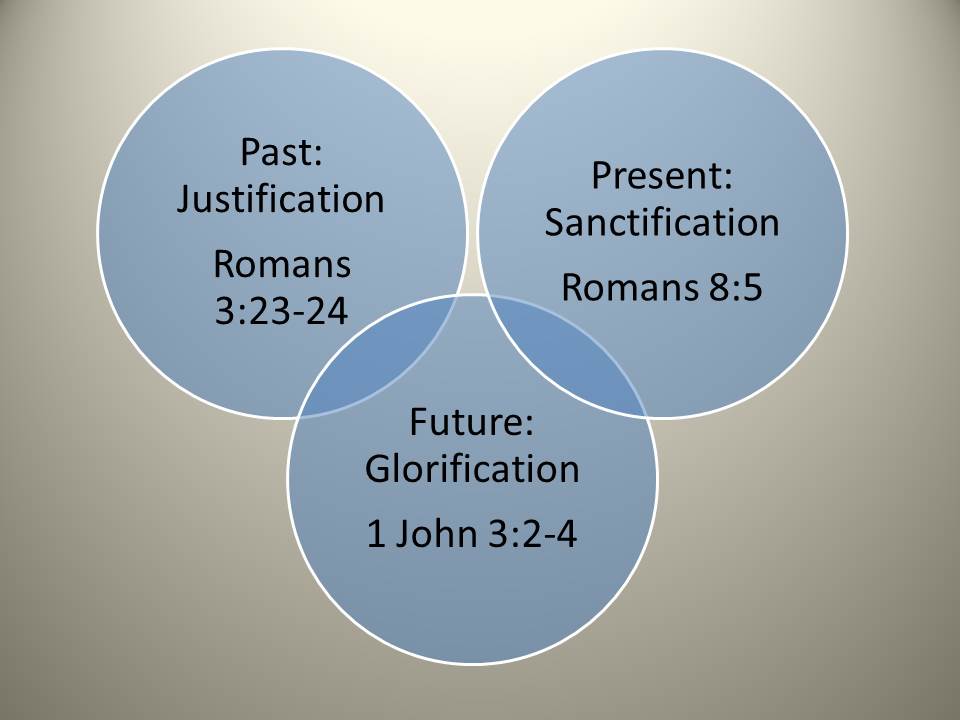
SalvationThe Christian life is indeed a journey, and our desired destination doesn’t always match the label reading “You are here.”  This is why we must understand that the Bible never defines salvation as a one-time event.  The language of “getting saved” is wholly absent from the pages of the New Testament.  Granted, I’m not suggesting that it’s less than that—such language has often been helpful when speaking to first-time believers.  But I am suggesting it’s more than that—and I believe scripture tells such a story.  Scripture tells us that salvation has both a past, present, and future component—all of which are helpful in dealing with lingering feelings of guilt.

We can actually see this in the eighty-fifth psalm.  Perhaps it’s fitting that this psalm has no specified author—it might just as well have been written by any one of us.  And ultimately, these words point us toward the salvation found in Jesus—graciously applied to all generations who seek Him.

JUSTIFICATION: “Restored, forgiven, covered”

First, salvation has a past component.

1 Lord, you were favorable to your land; you restored the fortunes of Jacob.

2 You forgave the iniquity of your people; you covered all their sin. Selah

3  You withdrew all your wrath; you turned from your hot anger.

The psalmist tells us that God was “favorable” to His people.  Look at the verbs he uses to unpack this: “restored, forgave, covered.”  There is great confidence in a God who covers over sin.

Christian theology calls this “justification,” a courtroom term that means being “declared righteous” before a judge.  The basis for this?  When Jesus died on the cross, He paid the just penalty for your sins—and my sins.  Elsewhere in Romans, Paul writes that “all have sinned and fall short of the glory of God, and are justified by his grace as a gift, through the redemption that is in Christ Jesus” (Romans 3:23-24).  And in exchange, we received His righteous reputation.  So when a holy and just God looks down at us, He no longer sees our sin, but Christ’s righteousness.

SANCTIFICATION: “Restore us again”

Second, salvation has a present component.  Listen to what the psalmist asks of God in the next collection of verses:

4  Restore us again, O God of our salvation, and put away your indignation toward us!

5  Will you be angry with us forever? Will you prolong your anger to all generations?

6  Will you not revive us again, that your people may rejoice in you?

7  Show us your steadfast love, O Lord, and grant us your salvation.

The psalmist asks that God “restore us again.”  Why?  Justification is a past event, yet as we move forward in the present we’ll experience the very sort of life Paul described above—doing what we hate, avoiding what we love.  Christian theology teaches that over time, through the Spirit’s leading, we become more like Jesus.  This is called “sanctification.”  The gospel says that I am accepted not by good works, but by Christ’s sacrifice.  If I am saved by grace, then surely I am also sanctified by grace.  How?  It’s simple: Christianity teaches that we are not loved because we are beautiful; we are beautiful because we are loved.  Because I already have God’s acceptance in Christ, I am set free to follow after Him in a lifelong pursuit of His goodness.  Will I succeed?  No—at least never entirely.  But like a young child chasing his earthly daddy, so too can we find joy in striving to be like our heavenly Father.

In Romans, Paul writes that “those who live according to the flesh set their minds on the things of the flesh, but those who live according to the Spirit set their minds on the things of the Spirit” (Romans 8:5).  The Christian life is about learning to walk in step with this Spirit.

GLORIFICATION: “righteousness and peace kiss each other”

Finally, there is a greater future for all of God’s people.  I love how the psalmist phrases it—that in God’s presence “righteousness and peace kiss each other.”  Israel looked forward to a time when God’s people would experience on earth the very blessings of heaven:

8  Let me hear what God the Lord will speak, for he will speak peace to his people, to his saints; but let them not turn back to folly.

9  Surely his salvation is near to those who fear him, that glory may dwell in our land.

10  Steadfast love and faithfulness meet; righteousness and peace kiss each other.

11  Faithfulness springs up from the ground, and righteousness looks down from the sky.

12  Yes,  the Lord will give what is good, and our land will yield its increase.

13  Righteousness will go before him and make his footsteps a way.


We see a glimpse of this in John’s gospel.  When calling His first disciples, Jesus says that “I tell all of you the solemn truth– you will see heaven opened and the angels of God ascending and descending on the Son of Man.” (John 1:51)  In his commentary on John, N.T. Wright says that it’s as if Jesus is saying, “follow me and you’ll see what it’s like when heaven and earth are open to each other.”  Heaven and earth intersect in the person of Jesus.  But heaven and earth will not become one until Christ’s future return:

Beloved, we are God’s children now, and what we will be has not yet appeared; but we know that when he appears we shall be like him, because we shall see him as he is. And everyone who thus hopes in him purifies himself as he is pure. (1 John 3:2-4)

What does this mean?  It means the struggle I experience today won’t be the struggle I experience for eternity.  Christian history is full of stories of men and women who struggled against sin in this life because they were confident that in the next life they would be “glorified”—free from all earthly suffering.  This is why eternity is so important; if this life is all we have, then the suggestion that we suppress our natural desires must seem unnatural—even cruel.  But if Christianity is true, then our present struggles will one day melt away in the presence of Jesus.

WHO’S REALLY MY SAVIOR?

Still, the guilt persists.  “I can’t forgive myself.”  But stop and examine the question.  Do we really need our own forgiveness?  When we struggle to forgive ourselves, it reveals that our truest savior is not God, but our own moral record.  Let it go.  Only when we begin to live in the light of the gospel and in step with the Spirit will we experience true and lasting freedom.  The reason the psalms become a vital part of our worship is because these things don’t happen to us over the course of a single Sunday, but a lifetime of Sundays.  But through God’s grace, this joyous song carries on into eternity.

What the church can learn from Kurt Cobain (Psalm 38)

Bono—the lead singer for the rock band U2—colorfully called David “the first blues musician.”  Music—or, more specifically, the lyrics it contains—reveals the depths and contours of the human soul like no other.  A famous philosopher once wrote that while “music is the furthest distance between two points, it is the closest distance to infinity.”

Kurt CobainI grew up in the era of grunge rock, of torn jeans, flannel shirts, and music that didn’t challenge convention as much as run it over with a truck.  In 1991, the rock band Nirvana stunned the music world with their sophomore album Nevermind.  The music was harsh, the production raw—but Kurt Cobain’s voice would shape my generation like few others would.  In many ways, Cobain’s lyrical legacy was unmatched.  While rock music of the 60s and 70s encapsulated a spirit of rebellion, rock music of the 90s turned its focus on personal feelings—both good and bad.  One analyst observed that hard rock was traditionally thought to be

“a very sort of macho genre. … But after Nevermind hit, suddenly it was cool to be in a hard rock band and to sing about your feelings—and to sing about your feelings in a complex way. Hard rock became inward-looking. You can see that influence in the nu metal bands like Korn or Slipknot. All of a sudden it was acceptable to be in a metal band and to sing about your neighbor molesting you or something. Hard rock really became cathartic as opposed to escapist.”(quoted by Tony Sclafani, “Why Nirvana’s ‘Nevermind’ Spoke to a Generation,” Today.com, September 22, 2011)

As you well know, Cobain’s inner demons were all too real.  A few years after Nevermind’s breakthrough success, he took his own life.  But his legacy would carry on into the present day.

What does this have to do with Christian worship?  Simply this: we live in a world whose inner demons have come unmasked.  You want to understand sin?  Understand inner anguish?  You have only to look as far as the radio dial, or the top 40 playlist.

So when we read the book of psalms we see something similar at work.  David is lamenting his sin, using the colorful language of poetry and song.  Watch what happens when we take one of his songs and place it side-by-side with a song by the band “Pop Evil:”

David: Psalm 38 Pop Evil: “Monster You Made”
1  O Lord, rebuke me not in your anger, nor discipline me in your wrath! 2  For your narrows have sunk into me, and your hand has come down on me. 3  There is no soundness in my flesh because of your indignation; there is no health in my bones because of my sin. 4  For my iniquities have gone over my head; like a heavy burden, they are too heavy for me.5  My wounds stink and fester because of my foolishness, 6  I am utterly bowed down and prostrate; all the day I go about mourning. 7  For my sides are filled with burning, and there is no soundness in my flesh. 8  I am feeble and crushed; I groan because of the tumult of my heart.


9  O Lord, all my longing is before you; my sighing is not hidden from you. 10  My heart throbs; my strength fails me, and the light of my eyes—it also has gone from me. 11  My friends and companions stand aloof from my plague, and my nearest kin stand far off.


12  Those who seek my life lay their snares; those who seek my hurt speak of ruin and meditate treachery all day long. 13  But I am like a deaf man; I do not hear, like a mute man who does not open his mouth. 14  I have become like a man who does not hear, and in whose mouth are no rebukes.


15  But for you, O Lord, do I wait; it is you, O Lord my God, who will answer. 16  For I said, “Only let them not rejoice over me, who boast against me when my foot slips!”


17  For I am ready to fall, and my pain is ever before me. 18  I confess my iniquity; I am sorry for my sin. 19  But my foes are vigorous, they are mighty, and many are those who hate me wrongfully. 20  Those who render me evil for good accuse me because I follow after good. 21  Do not forsake me, O Lord! O my God, be not far from me! 22  Make haste to help me, O Lord, my salvation!


Take a good look at me now
Do you still recognize me
Am I so different inside
This world is trying to change me
And I admit I don’t want to change with it
And I admit I can’t go on like this anymoreErase this monster I’ve become
Forgive me for all the damage done
It’s not over
Say it’s not over
I’m begging for mercy
I’m only the monster you made meI’m better alone now
See I’m torn from my mistakes
And I stop believing that I could ever make things change
How much can I take
When I know that it hurts you
How long can I wait
When I can’t go on like this anymore

Erase this monster I’ve become
Forgive me for all the damage done
It’s not over
Say it’s not over
I’m begging for mercy
I’m only the monster you made me

Because who I am
Isn’t who I used to be
And I’m not invincible
I’m not indestructible
I’m only human
Can’t you see
The beauty in me

Far away through the pain
I hear the angels calling
Far away through the pain
I see my demons falling


Far away through the pain
I hear the angels calling
Far away through the pain
I see my demons falling

Erase this
Erase this
Erase this monster you made me

True, the rock song lacks any specific object of hope—only a pleading for someone to “erase this monster.”  Yet ironically, in a world devoid of moral absolutes, the rock stars cry out against their own sinful consciences.

Yet sadly, as worship leader Michael Gungor observes, even though nearly 70% of the psalms are laments, less than 1% of the songs on the popular Christian worship database fit this pattern.  In other words, if you want to hear a song like David’s, you’re more likely to do so on the hard rock station than the worship station.  Worship leader Mike Cosper observes this discrepancy in his recent book, Rhythms of Grace:

“We are children of a much more sanitized era, you and I.  …The sentiment of most contemporary Christian worship is high on emotional language, heavy on the Spirit (and its accompanying imagery of flames, wind, and doves), but usually thin on (if not bereft of) the topic of bleeding birds and beasts.  We talk about the cross as a shorthand for the bloody sacrifice of Jesus, but even that is removed from the hands-on messiness of Israel’s worship.”  (Mike Cosper, Rhythms of Grace, p. 49)

I once knew of a worship leader who was fired from his job because he didn’t smile enough.  In today’s “sanitized era,” we’ve come to exchange sackcloth and ash for Colgate and hair gel.

But why would we find value in singing songs like David’s?  Who wants to come to church to sing about feeling “feeble and crushed?”  Well, more than you might think—at least if Kurt Cobain’s legacy is any indication.  We live in a hurting world.  I’m not trying to ennoble these rock stars, let alone affirm their hopelessness.  I’m suggesting that they express a sense of loneliness and hurt that can only be met through Jesus.  So I ask again, what value is there in the language of lament?  Because in the honesty of confession we find the certainty of consolation.  Musicians like Cobain did not find this consolation—but the psalms point us toward a God whose desire is to draw us nearer to Himself.  The church can—and I would suggest should—learn from this.  If we do not teach one another how to mourn—and mourn well—then who will?  The gospel promises hope to the fallen, grace to the barren, life to the lifeless.  But all of these demand an honest, unvarnished look at ourselves—for only then can we fully appreciate the contrasting beauty of the Savior.

“The Beating of that Hideous Heart” (Psalm 32)

heartEdgar Allen Poe’s “The Telltale Heart” is a classic story of paranoia, guilt, and a murder most foul.  The story is told from the narrator’s point of view, who defends his sanity all the while obsessing over the details of a murder.  Though the narrator claims to love the old man, he cannot tolerate the man’s “vulture eye” another day—and so he commits murder to rid himself of this menace.  He stashes the evidence beneath the floorboards, where he believes the matter has been put to rest.  So confident is he that when the police arrive to investigate, the narrator offers them chairs directly above the floorboards that conceal the old man’s body.

And that’s when he hears it.  The sound faint at first—like “a watch enveloped in cotton.”  But the sound persists, louder in his ears—surely the police hear it to? he wonders.   Finally he cries out:  “Villains! I admit the deed!—tear up the planks! here, here!—It is the beating of his hideous heart!”

MORAL EMOTIONS

Guilt belongs to a set of what psychologists call “moral emotions.”  Though Poe’s unnamed narrator is mad, we readily identify with his inner conflict and psychic pain.  Why?  Well, there’s no real consensus as to what purpose guilt serves—if any.  Sigmund Freud, the famous psychologist, believed that all human beings are trapped between a sense of love and loathing.  The human endeavor, then, is to learn to manage and mask this guilt—or, in some cases, to eliminate guilt entirely.  Though the specifics of Freud’s ideas haven’t stood the test of time, it’s hard to ignore his legacy.  There’s just one problem: we can never escape our guilt.  Guilt is far too universal.

In the latter half of the twentieth century, a psychologist named Richard Schweder suggested that humans experience “moral emotions” when we violate our standards of ethics.  If I violate the “ethics of community”—say, by cursing in a wedding toast—I feel a sense of embarrassment.  If I fail to achieve my personal goals—perhaps I miss a job promotion, or fail a test—then I feel disappointment at violating my own “ethic of autonomy.”  But if I feel a sense of guilt over some secret act, a sense of shame over my own thoughts and behavior, then I have violated what Schweder called the “ethics of divinity.”  Modern psychology only affirms what God’s word already tells us: that the “human heart is deceitful  above all things and desperately sick” (Jeremiah 17:9).

If you don’t have a church background, I can understand how you might feel a bit defensive.  Freud actually had a point when he observed that religion is the cause of our guilt as much as it is a solution.  “What I do in my bedroom is my business,” some might insist.  “What does it matter as long as I’m not hurting anyone?”  But if that’s true, if you really believe that, why is guilt so persistent and so pervasive?  It can’t be the negative effects of religion, or some lingering “Catholic guilt”—otherwise guilt would be a uniquely Western phenomenon.  No; guilt is a human phenomenon, and God’s Word tells us it is the symptom of a far greater disease.

It is the beating of our hideous heart.

DAVID’S REPENTANCE

This is why the so-called “penitential psalms” carry so much weight.  For centuries, confession of sin was considered a vital part of the worship experience.   Why?  Because repentance means more than reflecting on my guilt—it means turning toward the Source of my forgiveness.  So in Psalm 32 we read David speaking of what it means to be “blessed”—to be truly and joyously fulfilled:

1 Blessed is the one whose transgression is forgiven, whose sin is covered.

2  Blessed is the man against whom the Lordcounts no iniquity, and in whose spirit there is no deceit.

3  For when I kept silent, my bones wasted away through my groaning all day long.

4  For day and night your hand was heavy upon me; my strength was dried up as by the heat of summer.

Selah

Notice the Psalm is punctuated by the undefinable musical term Selah.  Each “stanza” of David’s blues song describes what repentance looks like.  David experiences guilt as a sense of inner anguish—he says that his “bones wasted away.”  But notice as well that in verse 4, David identifies God as the source of his guilt.  Why is this important?  Because it means that guilt doesn’t merely come from violating our own conscience or the shifting standards of our culture.  It comes from the very character of God.  Conform your life to God’s character, and you will experience blessing.  Violate God’s character, and you will experience guilt.

5  I acknowledged my sin to you, and I did not cover my iniquity; I said, “I will confess my transgressions to the Lord,” and you forgave the iniquity of my sin.

Selah

David’s solution is confession.  Contemporary psychology has emphasized a division between guilt and shame.  Guilt says: “I did a bad thing.”  Shame says: “I am a bad thing.”  Seeking to bolster self-esteem, psychology sought to focus on removing shame.  But this proved to be toxic.  Why?  Because if I am motivated by guilt, I can change my behavior.  If I am motivated by shame, instead of changing my behavior I seek to improve my mood.  Rather than look to God for forgiveness, I turn my focus to lesser comforts—career, relationships, pornography—to improve my self-worth.  The tragedy is that this only deepens the spiral.  Our modern remedies only further the illness.  We need God’s true forgiveness.

6  Therefore let everyone who is godly offer prayer to you at a time when you may be found; surely in the rush of great waters, they shall not reach him.

7  You are a hiding place for me; you preserve me from trouble; you surround me with shouts of deliverance.

Selah

Guilt can only be taken care of by God.  David, of course, didn’t have the benefit of our knowledge.  David’s righteousness was given on credit—but the bill would come due at Calvary.  When Jesus died on the cross, the forgiveness and blessing wasn’t just applied to the church that would come after Him—it was also granted to all God’s people who came before.

God therefore becomes the truest and best hiding place for those experiencing deep and profound guilt.  Our hearts are truly dirty, deceptive, hideous.  But the gospel promises that in time, we shall be granted a new heart, a clean heart—one that replaces the one we have now (Ezekiel 36:26).

What does life look like in the meantime?  It means living on mission, and sharing this same message of forgiveness:

8  I will instruct you and teach you in the way you should go; I will counsel you with my eye upon you.

9  Be not like a horse or a mule, without understanding, which must be curbed with bit and bridle,or it will not stay near you.

10  Many are the sorrows of the wicked, but steadfast love surrounds the one who trusts in the Lord.

11  Be glad in the Lord, and rejoice, O righteous, and shout for joy, all you upright in heart!

(Psalm 32:1-11)

Our lives are meant to gradually yet faithfully reflect the character of God.  When they do, we experience unspeakable joy.  When they don’t, we experience unspeakable grief.  God’s judgment weighs heavily on our minds—but justly so.  The good news of the gospel is that this judgment fell on Jesus, so that Jesus’ perfect record could be given to me.

In 2011, an elderly couple died an hour apart from each other.  The husband passed first—but family and medical staff were baffled that his heart monitor still registered a pulse.  It was because his wife lay beside him.  The rhythm of her heart was enough to be felt through her husband, as though love itself radiates like pure energy.  The same is true for you and for me.  My heart isn’t just hideous; it’s dead.  But when I stay close to Christ, the heartbeat of God flows through me, trading my guilt for his acceptance, death for life, and tears for joy.

Confession is good for the soul (Psalm 6)

Phone Booth starring Colin Farrell.

Tensions were high.  Sweat ran cold across the stern faces focused on the figure in the phone booth.  His name was Stu Shepherd—the character played by Collin Farrell in the 2002 film Phone Booth.

 As the target of a sophisticated terrorist plot, Shepherd is held hostage in a New York City phone booth—his unseen captor controlling him through the telephone.  Framed for the terrorist’s crimes, the booth is surrounded by police, reporters—and eventually Stu’s wife.  His unseen captor assures him that the only way out of his nightmare is to confess—to his wife, to the world—his affair, his selfishness, and his various indiscretions.  At the climax of the film, Stu Shepherd makes his confession:

“I have never done anything for anybody who couldn’t do something for me. I string along an eager kid with promises I’ll pay him money. I only keep him around because he looks up to me.…I lie in person and on the phone. I lie to my friends.…I am just a part of a big cycle of lies…I wear all this [fancy Italian clothing]because underneath I still feel like the Bronx. I think I need these clothes and this watch. My two-thousand-dollar watch is a fake and so am I. I’ve neglected the things I should have valued most.… I mean, I work so hard on this image, on Stu Shepherd…I have just been dressing up as something I’m not for so long, I’m so afraid no one will like what’s underneath.”

They say that confession is good for the soul.  If you were to write your own “Stu Shepherd” speech, what would you say?  Are there things that weigh on your conscience?  Perhaps like Stu, you live with the persistent fear that “no one will like what’s underneath.”  In one of his diaries, author Franz Kafka wrote: “The state in which we find ourselves today is sinful, quite independent of guilt.” Do you hear what he’s saying?   If you’re living in today’s world, you may be thinking: “No one has the right to judge me.  No one has the right to label what I do as a ‘sin.’”  Like Stu Shepherd, most of us spend our lives trying to either hide our “bad” qualities or emphasize our “good” qualities in order to manage the judgments of others.  Yet deep down, we live with a secret fear that if our souls were truly exposed, we would be judged, condemned, and rejected.

DAVID’S STU SHEPHERD SPEECH (PSALM 6)

O Lord, rebuke me not in your anger,nor discipline me in your wrath.
Be gracious to me, O Lord, for I am languishing; heal me, O Lord, for my bones are troubled.
My soul also is greatly troubled.    But you, O Lord—how long?

Turn, O Lord, deliver my life; save me for the sake of your steadfast love.
For in death there is no remembrance of you; in Sheol who will give you praise?

I am weary with my moaning; every night I flood my bed with tears; I drench my couch with my weeping.
My eye wastes away because of grief; it grows weak because of all my foes.

Depart from me, all you workers of evil, for the Lord has heard the sound of my weeping.
The Lord has heard my plea; the Lord accepts my prayer.
10 All my enemies shall be ashamed and greatly troubled; they shall turn back and be put to shame in a moment.

In his commentary on the Psalms, Derek Kidner writes that this “psalm gives words to those who scarcely have the heart to pray, and brings them within sight of victory.”  How?  David writes that “the Lord has heard the sound of my weeping” (v. 8).  David’s trust could lie in the character of God.  And so can ours.

See, we have to view the words of David in light of the work of Christ.  What David knew in part, we can experience in whole.  When Christ came, He finished the work of redemption that God had set in place since the day our ancestors were kicked out of paradise.  When we read Psalm 6, we can know that God delivers our lives because He offers His own.

BECOMING SIN

In his letter to the church in Corinth, Paul says that on the cross, Jesus “became sin…so that we might become His righteousness” (2 Corinthians 5:21).  We experience deliverance only because Christ endured condemnation.   And in so doing, we trade reputations.  Now it’s Christ who owns my “Stu Shepherd speech.”  It’s Christ who stands guilty for what I’ve done.  And me?  I now stand before God a free man, delivered from God’s just anger over my guilt.

That’s why Christianity is of such enormous and vital importance.  If Christianity isn’t true, then I have no hope for what to do with my guilt.  If Jesus Christ is just a man, then He can condemn my sin, but never purge me of it.  Religion alone can only magnify my guilt; only the cross can set me free from it.

Are you hurting?  Struggling?  Guilty?  Let David’s words become your own.  And only because of the finished work of Christ can you claim such words as your deliverance.

Counting the Days of our Lives (Psalm 90)

Counting the Days of our Lives (Psalm 90)

I believe my favorite of all Psalms on God’s Playlist is the 90th.  It is very unusual, as it is the only one written by Moses.  The subject and content seem to indicate it was from a period of his life when the children of Israel were wandering in the wilderness… spending 40 years with no purpose other than to see everyone over age 20 die off due to their unbelief.  Certainly this would mark a time when Moses had a special perspective on life and death.

PS 90:1 Lord, you have been our dwelling place throughout all generations.

PS 90:2 Before the mountains were born or you brought forth the earth and the world, from everlasting to everlasting you are God.

PS 90:3 You turn men back to dust, saying, “Return to dust, O sons of men.”

PS 90:4 For a thousand years in your sight are like a day that has just gone by, or like a watch in the night.

PS 90:5 You sweep men away in the sleep of death; they are like the new grass of the morning–

PS 90:6 though in the morning it springs up new, by evening it is dry and withered.

PS 90:7 We are consumed by your anger and terrified by your indignation.

PS 90:8 You have set our iniquities before you, our secret sins in the light of your presence.

PS 90:9 All our days pass away under your wrath; we finish our years with a moan.

PS 90:10 The length of our days is seventy years–or eighty, if we have the strength; yet their span is but trouble and sorrow, for they quickly pass, and we fly away.

PS 90:11 Who knows the power of your anger?  For your wrath is as great as the fear that is due you.

PS 90:12 Teach us to number our days aright, that we may gain a heart of wisdom.

What I find compelling about this Psalm is the way it speaks of the brevity of life and also puts numbers to the span of life.  He says that the average lifespan is 70 years, or 80 if you have extra strength… but even that is a mixed blessing.  We are as permanent as the grass that springs up with life, but withers quickly under the exposure of the sun’s heat.

Another interesting component of this Psalm is the way it makes its own application in verse 12 (I wish all Scriptures did that!).  Moses says we should number our days.  Since the average number of years in life is 70-80, we are able to figure out where we are in the big picture – presuming the gift of good health, etc.  If we are age 35-40, we are about half done already!

The goal is a heart of wisdom.  The Hebrew word here is one that speaks of a skill in living.  Skill in living, translated to our dispensation of the church, could rightly be said to define a fully devoted follower of Christ.  Wisdom in living for us involves being aware that life is short, and life is fleeting.  The days are forever passing that we may redeem in wisdom to live for the Lord.

It is easy in life to think (beginning as a Christian teenager) that there is time in college to get serious about living for God.  And then, in college, to think, “I’ll live for God when I get into my career.”  Before long, it gets postponed to “when I have a family.”  Next, it is “when the kids are growing up”… and then, “after I retire I’ll have the time.”  Then finally, in what has seemed like a mere passing of a couple of years, we are looking at soon passing into eternity.

My parents had an oft-quoted Christian saying posted on the wall of our dining room during my childhood years… “One life twill soon be past, only what’s done for Christ will last.”

It is good and healthy for us to daily consider how we are using the days of our lives.  It is wise to consider the priorities we establish.  We all have the same amount of time each day and each week.  We need to live in a conscious awareness of these parameters and make time to work for eternal benefit in service to God.

Col. 4:5 Be wise in the way you act toward outsiders; make the most of every opportunity. 6 Let your conversation be always full of grace, seasoned with salt, so that you may know how to answer everyone.

Hey God – I’ve Been Praying about This for a Long Time! (Psalm 88)

Any of us who have known the Lord for an extended time have had the experience of wondering why certain prayers that we have genuinely expressed perhaps even for years – prayers that would seem to be “no-brainers” for a loving and faithful heavenly father to answer – go on and on without any apparent divine acknowledgement.

It may be related to a physical ailment from which we’ve suffered for even decades. It could be about the heartbreak of a loved one who makes bad choices or is an addict. Perhaps it is related to life circumstances and the seeming inability to ever get ahead and not have to deal with worry and pending calamity.

If nothing else, it teaches us that this world is never going to satisfy and that we should have a hunger for a heavenly home and the redemption of all things – including our miserable weak bodies.

We should be reminded as well that God has bigger plans than providing for our creature comforts and sense of propriety about what He should do and when.

One of the most wonderfully instructive stories I have ever heard came from our supported missionary in Thailand – Dean Overholt. He spent his childhood and youth summers working hard on his grandfather’s farm. When he went to Penn State as a wrestler, he had to also figure out something to do academically – after all, it was a college! Not knowing what to study, he chose agriculture. After a while he met Christ, eventually at some later point going into missions work. There was a lot of catching up to do about growing in biblical knowledge and leadership, etc.

For many years Dean wondered why God did not use his life more efficiently – as those summers on the farm and the Penn State educational years were worth nothing to the work of missions in Asia. Why did God not get him saved sooner … and also pushed through that time of life quicker in order to have more time for ministry impact?

Well… then the famous tsunami hit in the South Pacific, including Thailand. Dean was thrust into the task of leading the entire effort to rebuild a village, plant a church, and get hundreds of people back on their feet. After that massive work was done and he looked back on all that had been accomplished and all who came to know Christ through it, he said, “Every skill I needed to do that ministry came from my grandfather’s farm and my agricultural education.”

God knew. God always knows. God knows your unanswered prayer, and if it is unanswered, there is a bigger reason than you can see … at least for now. But God wants you to keep praying and trusting Him. That is the essence of the famous parable in Luke 18:

18:1 Then Jesus told his disciples a parable to show them that they should always pray and not give up. 2 He said: “In a certain town there was a judge who neither feared God nor cared what people thought. 3 And there was a widow in that town who kept coming to him with the plea, ‘Grant me justice against my adversary.’

4 “For some time he refused. But finally he said to himself, ‘Even though I don’t fear God or care what people think, 5 yet because this widow keeps bothering me, I will see that she gets justice, so that she won’t eventually come and attack me!’”

6 And the Lord said, “Listen to what the unjust judge says. 7 And will not God bring about justice for his chosen ones, who cry out to him day and night? Will he keep putting them off? 8 I tell you, he will see that they get justice, and quickly.”

The application here is not that if you pester God long enough, he will eventually get so worn out that his arm will be twisted into giving you what you want. The lesson is that you should continue to pray and be persistent. And if an unjust judge can “come through” with a need, surely a loving Father is not going to ignore a request that is resultant in your ultimate detriment … keep praying.

Here is Psalm 88… written by a Temple musician. It expresses the idea that his unanswered prayer and pending demise will put him into a position where he is unable to praise God or be of service in any way. Another thought I have when reading this most depressing and sad of Psalms is that we are wonderfully blessed to have the knowledge of the victory of Christ over death and the certain resurrection. That was not something known at the time this was written …

Psalm 88

A song. A psalm of the Sons of Korah. For the director of music. According to mahalath leannoth. A maskil of Heman the Ezrahite.

1 Lord, you are the God who saves me; day and night I cry out to you.
2 May my prayer come before you; turn your ear to my cry.

3 I am overwhelmed with troubles and my life draws near to death.
4 I am counted among those who go down to the pit; I am like one without strength.
5 I am set apart with the dead, like the slain who lie in the grave, whom you remember no more, who are cut off from your care.

6 You have put me in the lowest pit, in the darkest depths.
7 Your wrath lies heavily on me; you have overwhelmed me with all your waves.
8 You have taken from me my closest friends and have made me repulsive to them. I am confined and cannot escape; my eyes are dim with grief.

I call to you, Lord, every day; I spread out my hands to you.
10 Do you show your wonders to the dead? Do their spirits rise up and praise you?
11 Is your love declared in the grave, your faithfulness in Destruction?
12 Are your wonders known in the place of darkness, or your righteous deeds in the land of oblivion?

13 But I cry to you for help, Lord; in the morning my prayer comes before you.
14 Why, Lord, do you reject me and hide your face from me?

15 From my youth I have suffered and been close to death; I have borne your terrors and am in despair.
16 Your wrath has swept over me; your terrors have destroyed me.
17 All day long they surround me like a flood; they have completely engulfed me.
18 You have taken from me friend and neighbor—darkness is my closest friend.

A Faithful God for the Old and Dispensable (Psalm 71)

Many of you have heard me say of myself, “How did such a young man as me get stuck inside this old body?”

I’ll be honest with you, there is not much I like about getting older. I hate not being able to run anymore, as that was such a big part of my life. Now, walking across a room pain free is a big victory. It comes to that.

Though we all intellectually know that it is going to happen to us, it still seems so difficult to believe it when it actually does. Old people were other people; they weren’t me.

In varied cultures and times of history, elderly people have been abused and neglected. Yet other cultures cherish and honor the aged. When travelling in the Turkic World of Uzbekistan, Kazakhstan, and Turkey, I was told by Americans living there that I would be especially welcomed among those within our travel group because I was the one person with white hair.

It does not honestly seem to me that the current American culture or church culture honors aging people as in the past. I went to seminary right after Bible College with my double bachelor degrees – yes, because God directed, but also because no church was going to hire a 23-year-old. It was a best use of time to spend the next four years working on the most academically-challenging theological education in the world. And even then, in my upper 20s, it was still difficult to get started since only older pastors were really honored. All of that has seemed to flip now 30+ years later.

One wonders where the country may go in terms of care and dignity for the elderly as the huge expense of the massive baby boom generation’s geriatric and medical care becomes a severe financial weight upon the country.

Today’s Psalm 71 was written by an unnamed aging man. His name might have been Randy ben David, but I can’t prove it.

The writer acknowledges that God has always been his refuge and that he again needs the Lord to deliver him from his enemies. God has been faithful to him from the very beginning. Now, for a variety of reasons, he is in peril of his enemies overtaking him – one of the reasons being that he is now an older man. The writer pleads for God’s help, and in the end he finishes with a strong sense of God’s preservation – for which he vows that he will be a public worshipper and teacher.

Psalm 71

1 In you, Lord, I have taken refuge; let me never be put to shame.
2 In your righteousness, rescue me and deliver me; turn your ear to me and save me.
3 Be my rock of refuge, to which I can always go; give the command to save me, for you are my rock and my fortress.
4 Deliver me, my God, from the hand of the wicked, from the grasp of those who are evil and cruel.

5 For you have been my hope, Sovereign Lord, my confidence since my youth.
6 From birth I have relied on you; you brought me forth from my mother’s womb. I will ever praise you.
7 I have become a sign to many; you are my strong refuge.
8 My mouth is filled with your praise, declaring your splendor all day long.

9 Do not cast me away when I am old; do not forsake me when my strength is gone.
10 For my enemies speak against me; those who wait to kill me conspire together.
11 They say, “God has forsaken him; pursue him and seize him, for no one will rescue him.”
12 Do not be far from me, my God; come quickly, God, to help me.
13 May my accusers perish in shame; may those who want to harm me be covered with scorn and disgrace.

14 As for me, I will always have hope; I will praise you more and more.

15 My mouth will tell of your righteous deeds, of your saving acts all day long—though I know not how to relate them all.
16 I will come and proclaim your mighty acts, Sovereign Lord; I will proclaim your righteous deeds, yours alone.
17 Since my youth, God, you have taught me, and to this day I declare your marvelous deeds.
18 Even when I am old and gray, do not forsake me, my God, till I declare your power to the next generation, your mighty acts to all who are to come.

19 Your righteousness, God, reaches to the heavens, you who have done great things. Who is like you, God?

20 Though you have made me see troubles, many and bitter, you will restore my life again; from the depths of the earth you will again bring me up.
21 You will increase my honor and comfort me once more.

22 I will praise you with the harp for your faithfulness, my God; I will sing praise to you with the lyre, Holy One of Israel.
23 My lips will shout for joy when I sing praise to you—I whom you have delivered.
24 My tongue will tell of your righteous acts all day long, for those who wanted to harm me have been put to shame and confusion.

I see two really big ideas coming out of this Psalm about how to deal well with aging and the burden of years of having seen troubles – “bitter and many!” We need to reclaim and to proclaim.

1.  Reclaim

As we look back upon a long life, especially if that life is filled with years of seeking to be a faithful disciple, we will know without any doubt that God has been good and true. There will be quite a pile of difficult times and painful memories. We will recall being very confused quite often and in those times uncertain where God was and what He was doing. But in retrospect, we will see a faithful hand of God and his works woven throughout the fabric and pathways of our lives. We need to remind ourselves of this when the pain gets bad and we wonder where we have made an impact in live.

2.   Proclaim

After years of living and experiencing day after day with the Lord, we have some wisdom about life that the next generation needs to hear. Yes, it is true that they do not understand how much they need these words, and yes, they errantly think they are way ahead of the game. Yet at the same time, older people need to realize that the vast majority of young adults in a church environment LOVE having older people who care about them and desire to make an active investment in their lives. In fact, there is no greater personal fulfillment to be found as an older person than to be a discipler and mentor to generations who are younger. It is as good for you to be able to share it as it is for them to receive it.

As many of you know, I have for quite a number of years been a battlefield guide at Antietam. I’ve taken groups on trips around that hallowed ground almost 500 times now. We get new guides joining our program. They are always very sharp, knowledgeable people about the Civil War. But they have no experience with the general public. They always know MORE than I do about the battle and War. But having taken people around that field so many times, I can tell you the questions that will be asked at certain points long before they are verbalized. And I could help a new associate by sharing that knowledge – if he is willing to listen.

So, wherever you are, be willing to listen and be willing to share.

Betrayal: The Worst Hurt of them All (Psalm 41)

Is there a bigger hurt in life than when someone with whom you have been close turns against you?  It is difficult to quantify emotion or pain, but I am at a loss to make much of any sort of list of anything that hurts much more than betrayal.

This happens especially to people in leadership. It is a way of life in politics, where a person is valuable so long as they have worth relative to the next election. In business, loyalty extends to the value for the bottom line profit. In athletic ventures, loyalty rises with the statistics that are good, and falls with stats that are poor.

But we expect family to be better; isn’t blood thicker than water? And the church family also gives us a deeper relationship status than anywhere else, right?

Not always.

David knew the hurt of betrayal. In multiple situations, those who had been his friends – even his own flesh and blood family – counted him as irretrievably down and out and gave up on him. Beyond that, they worked to contribute to his demise, sometimes using treachery and duplicitous deceit to hasten his destruction.

But God … yes, but God remained faithful and loyal. Though times looked very bad, God proved over and over to be his loyal preservation, saving him in this land through horrific circumstances and guaranteeing his eternal home.

Psalm 41

For the director of music. A psalm of David.

1 Blessed are those who have regard for the weak; the Lord delivers them in times of trouble.
2 The Lord protects and preserves them—they are counted among the blessed in the land—
    he does not gi+ve them over to the desire of their foes.
3 The Lord sustains them on their sickbed and restores them from their bed of illness.

4 I said, “Have mercy on me, Lord; heal me, for I have sinned against you.”
5 My enemies say of me in malice, “When will he die and his name perish?”
6 When one of them comes to see me, he speaks falsely, while his heart gathers slander;
    then he goes out and spreads it around.

7 All my enemies whisper together against me; they imagine the worst for me, saying,
8 “A vile disease has afflicted him; he will never get up from the place where he lies.”
9 Even my close friend, someone I trusted, one who shared my bread, has turned against me.

10 But may you have mercy on me, Lord; raise me up, that I may repay them.
11 I know that you are pleased with me, for my enemy does not triumph over me.
12 Because of my integrity you uphold me and set me in your presence forever.

13 Praise be to the Lord, the God of Israel, from everlasting to everlasting.
Amen and Amen.

God is loyal; Christ is the true friend. In sin we were unfaithful party, yet through grace we have been restored to relationship because of God’s covenant love. When all seems lost, when we feel betrayed, abandoned and alone, we have the loyal love of the one who called us to salvation and will sustain us through to ultimate glorification. Recall these wonderful words as well from Romans 8 …

28 And we know that in all things God works for the good of those who love him, who have been called according to his purpose. 29 For those God foreknew he also predestined to be conformed to the image of his Son, that he might be the firstborn among many brothers and sisters. 30 And those he predestined, he also called; those he called, he also justified; those he justified, he also glorified.

31 What, then, shall we say in response to these things? If God is for us, who can be against us? 32 He who did not spare his own Son, but gave him up for us all—how will he not also, along with him, graciously give us all things?

They Really ARE Out to Get Me! (Psalm 7)

“Just because you’re paranoid doesn’t mean they aren’t after you,” writes Joseph Heller in his classic 1961 novel “Catch-22.”

And David, the writer of this song, could be forgiven for being described as paranoid. Enemies were indeed out to get him. The superscription to the Psalm says that this related to a fellow named Cush – of the tribe of Benjamin – who was evidently leading the effort to harm David. This is certainly from the time of David’s life when Saul was out to capture him. Saul was from the tribe of Benjamin.

Have you ever lived through such a time – perhaps at your place of work – where there was someone who was intent on getting you and destroying you? It sadly happens all too often in a terribly sinful and fallen world. Right now, quickly, I can name two situations of folks I know who are facing this very real situation. Both are falsely accused in what is ridiculous fashion, yet fear abounds that a judge will not see the entire scenario accurately so as to render a just verdict.

With today’s devotional and reading, we begin with a new category of Psalms – the Lament. Up to this point over our three weeks, we have been reading and writing about the common category of the Praise Psalms.

Even our modern music contains a large percentage of songs that cry out from the soul about life’s sadness – of pain and relationships lost. Not all music is about love, romance, sunshine, happiness, parties and good times. We even have a genre of music called “the blues” and it has been said that King David was the first blues musician!

Actually, about 40% of the songs / Psalms in “God’s Playlist” of 150 tunes are Laments. And often, as in Psalm 7 today, the writer is pleading with God for justice to prevail when every appearance is that injustice is winning the day.

Psalm 7 

A shiggaion of David, which he sang to the Lord concerning Cush, a Benjamite.

Lord my God, I take refuge in you; save and deliver me from all who pursue me, or they will tear me apart like a lion and rip me to pieces with no one to rescue me.

David says he is pursued, though not guilty in any way. If he is guilty, he basically says to God to go ahead and let his enemy prevail over him, and let he himself die if he is not affirming the truth.

Lord my God, if I have done this and there is guilt on my hands—if I have repaid my ally with evil or without cause have robbed my foe—then let my enemy pursue and overtake me;  let him trample my life to the ground and make me sleep in the dust.

David prays for God to rise up from inaction, and as the righteous judge to vindicate his cause in just action against his enemies.

Arise, Lord, in your anger; rise up against the rage of my enemies. Awake, my God; decree justice. Let the assembled peoples gather around you, while you sit enthroned over them on high. Let the Lord judge the peoples. Vindicate me, Lord, according to my righteousness, according to my integrity, O Most High. Bring to an end the violence of the wicked and make the righteous secure—you, the righteous God who probes minds and hearts.

David feels he is in good hands if he can be sure he is in God’s hands. He knows God is just and that he displays that justice every day. He believes God is ready with weapons at hand to vindicate his cause.

10 My shield is God Most High, who saves the upright in heart. 11 God is a righteous judge, a God who displays his wrath every day. 12 If he does not relent, hewill sharpen his sword; he will bend and string his bow. 13 He has prepared his deadly weapons; he makes ready his flaming arrows.

David expresses his confidence that God’s system of justice will ultimately prevail with the Lord turning the circumstances upside-down … that “what goes around, will come around.” The picture is of a person digging a hole and preparing a pit to surprisingly capture prey … or an unsuspecting enemy. But before it can find success, the fool falls into his own pit and becomes the victim in a place prepared for others.

14 Whoever is pregnant with evil conceives trouble and gives birth to disillusionment.
15 Whoever digs a hole and scoops it out falls into the pit they have made.
16 The trouble they cause recoils on them; their violence comes down on their own heads.

17 I will give thanks to the Lord because of his righteousness; I will sing the praises of the name of the Lord Most High.

Sometimes injustice will prevail in a sinful world. But if such is to happen to one of us as God’s children, it is not because he is unaware. It would not be because he does not care or in unable to do something about it. God will be just in the end; justice will prevail. You can take that to the bank … even if it really is true that someone is out to get you!