
Gender in the tWorld (Genesis 2)

When God created the heavens and the earth, there was one—and only one—thing that he deemed to be “not good.”  “It is not good for man to be alone,” God says (Genesis 2:18).  From the very beginning, God’s design included the intention for a gendered community—one that reflected and exalted his very image.  As Mark Yarhouse puts it, our gendered selves point us toward a greater meaning found only in God:

“To be human is to experience a longing for completion. Did God create us with a longing for completion that forces us to look outside of ourselves so that the longing itself would be illustrative?  It may be that the longing for the other is related to our biological sex and gendered selves—because it is meant to represent a longing for God—was made possible in the creation of two sexes and is not in any way incidental to the creation.  The creation of two sexes provides, then, a living illustration of a point intended to direct us toward our creator.”[1]

In the tWorld, the world of tradition, we’ll find that man and woman were created in the image of a divine community, and in both the Trinity and humanity we find both equality and asymmetry.

IN THE IMAGE OF COMMUNITY

Genesis tells us that though God allowed the earth to bring forth every other living creature, the creation of humanity was deeply personal.

Then God said,  “Let us make man in our image, after our likeness. And let them have dominion over the fish of the sea and over the birds of the heavens and over the livestock and over all the earth and over every creeping thing that creeps on the earth.”

27  So God created man in his own image,

in the image of God he created him;

male and female he created them. (Genesis 1:26-27)

What does it mean to bear God’s “image?”  Though the term has been variously understood, the most direct meaning of the Hebrew word tselem or “image” is “representative rule.”[2]  Andreas Kostenberger writes that “just as God rules over a large domain—the whole universe—so humanity is given charge of the entire earth to rule it for God.”[3]

But who exactly is God?  Through the progress of God’s revelation, we learn that God eternally exists as a community of three persons: Father, Son, and Spirit.  So if humanity was made in the image of community, then it stands to reason that the need for community would be deeply woven into every facet of human existence.

This is why gendered humanity is so important.  Genesis tells us that God made us male (zakhar) and female (nekevah).  Men and women were designed to complement one another, in exactly the same way that members of the Trinity complement one another.

In his recent book on gender, Sam Andreades writes that men and women have both “equality and asymmetry.”[4]  We find much the same in the Trinity—where Father, Son, and Spirit are equally God, yet there exists an asymmetry in the way their roles are fulfilled.

So if men and women are created in the image of this community, we will find this same pattern of equality and asymmetry in the context of gendered relationships.

EQUALITY: IMAGO DEI

First—and perhaps most importantly—we must recognize that Christianity insists on the absolute equality of men and women.  Having both been created in the image of God, men and women share dignity and responsibility.  This would have been a shocking revelation to an ancient, patriarchal society.  In his analysis of this subject, Bruce Waltke outlines five specific ways that women share in the equality of men.[5]

  • Equality in creation—that is, sharing in the image of God (Genesis 1:26-28).
  • Equality in parenting—mothers have an equal authority over their children’s education (Proverbs 1:8; 31:26).
  • Equality in spiritual giftedness—In the Old Testament, women can become female prophets (e.g., Exodus 15:20-21; Isaiah 8:3), and in the New Testament women also receive God’s Spirit to share the gospel (Acts 1:8-14; 2:1-4).
  • Equality in prayer—women are able to pray directly to God without the need for a husband to mediate the process (Genesis 30:22-24).
  • Equality in worship—Women are able to celebrate God through singing, dancing (e.g. 1 Samuel 18:6) and can offer sacrifices along with men (Leviticus 12:6).

In fact, in the ancient world, in all the thousands of ancient texts, there is only one example of God calling a woman by name: God’s address of Hagar in Genesis 16:8.  Within Christianity, women are granted unique worth and significance.

ASYMMETRY: EZER KENEGDO

In Genesis 2, the story moves from the general to the specific.  Now we get a more detailed account of the creation of man and woman.  Adam had been created first, but now God realizes that something in his creation is “not good.”  “It is not good that the man should be alone;” God says.  “I will make him an ezer kenedgo for him” (Genesis 2:18).

An ezer kenegdo?  The word ezer most literally means “helper.”  To be honest, it’s hard to hear that because the word “helper” seems condescending—as if women are little more than Adam’s lab partner.  But when the word is used elsewhere, it is used to refer to God helping his people.  So being a “helper” can’t possibly mean that women are inferior.  The word kenegdo means “suitable,” or “fit.”  So God’s design for women is to fashion “a helper fit for him.”

Here, then , we find the “asymmetry” in design.  Yes; women equally share in the image of God, but they fulfill this role in ways that are unique to their gender.  This creates marked differences in the way gender roles and gender identity is expressed.  Therefore, in the tWorld, the world of tradition, we find a variety of ways to understand what is “masculine” and “feminine.”

But earlier we noted that while gender is not culturally constructed it is culturally expressed.  What factors influence masculinity and femininity in today’s world?  We might think of this as something of a spectrum: at one end we have the relatively fixed world of human biology, and at the other the ever-changing world of Western culture.[6]

Gender tWorld Spectrum

What we’re left with is a series of categories for understanding the factors that influence gender role:

Gender tWorld Int

  • Biologically determined: This includes all the biological factors associated with human reproduction—or, in the case of children, to be developing toward sexual maturity. Granted, we might (sensitively!) point out that there may be singles or couples who are unable to conceive, but even these seeming exceptions also serve to magnify the design present in biology.
  • Morally determined: This includes the morality associated with sexual maturity—including sexual morality and issues of modesty. But this also includes the way that husbands and wives are designed to interact in the context of marriage. Men are called to be leaders within the home (1 Corinthians 11:3; Ephesians 5:25), and women are called to “submit” to his authority (Ephesians 5:22-24).  Submission, we must emphasize, “is not an absolute surrender of her will.”  As a pair of theological writers define it, “submission refers to a wife’s divine calling to honor and affirm her husband’s leadership and help carry it through according to her gifts.”  Submission is a “disposition to yield to her husband’s guidance and her inclination to follow his leadership.” [7]

Let’s make no mistake: the roles expressed in the tWorld do not necessarily produce weak, demure women whose only role is to say “yes, dear.”  On the contrary: God’s design is that women would be seen as ferociously strong and challenge their men to be better leaders and better warriors for the gospel.
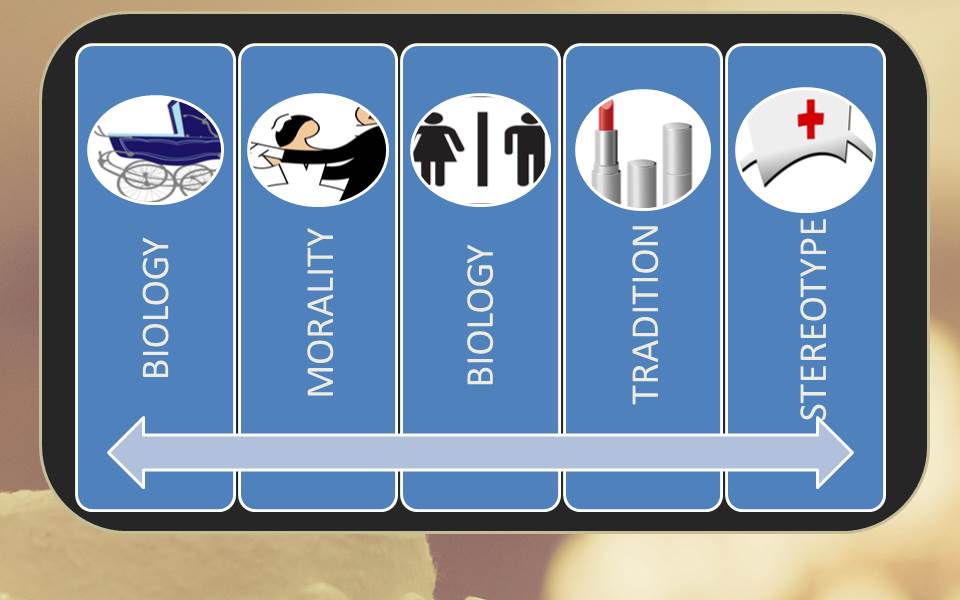
Gender tWorld Final

But there are several ways that masculinity and femininity have been shaped by cultural forces.  As we continue down the spectrum, we’ll see how we move farther from fixed absolutes into areas that, admittedly, are largely cultural.

  • Culturally determined based on biological differences: These are divisions we’ve constructed around our biological differences: men and women use separate restrooms and changing facilities. Because of our physical differences, men and women typically compete in different sports divisions.
  • Culturally determined based on social traditions: These are the standards that say that women wear dresses and makeup, or that men should pay for a date or open the door for a lady. They’re largely arbitrary, though not wholly meaningless.
  • Culturally determined based on harmful stereotypes: This is the prejudice that says that men can be doctors but women should be “just nurses.” Likewise, if a young man are sexually promiscuous, he is likely to be celebrated by his community, while a woman is shunned.  Such stereotypes demean both women and men, because they erode the image of God embedded in both.

The tWorld therefore contains both Biblical tradition as well as human tradition.  In some ways this is helpful, in others quite harmful.  But in either case, the tWorld reveals the ways in which gender fosters deeper relationships and—more significantly—reflects the glory of our Creator.


[1] Mark A. Yarhouse, Understanding Gender Dysphoria, p. 37.

[2] Hans-Walter Wolff, Anthropology of the Old Testament, p. 160.

[3] Andreas Kostenberger, God, Marriage, and Family: Rebuilding the Biblical Foundation, p. 24

[4] Sam A. Andreades, Engendered: God’s Gift of Gender Differences in Relationships.

[5] Bruce K. Waltke, Old Testament Theology, p. 239-41.

[6] George Alan Rekers, “Rearing Masculine Boys and Feminine Girls,” in Recovering Biblical Manhood and Womanhood: A Response to Evangelical Feminism, John Piper and Wayne Grudem, eds., p 307.

[7] John Piper and Wayne Grudem, “An Overview of Central Concerns: Questions and Answers,” in Recovering Biblical Manhood and Womanhood: A Response to Evangelical Feminism, John Piper and Wayne Grudem, eds., p. 61.

Why gender?

In the Spring of 2015, the Ad Council put together a video called “Love has no Labels.”  In the video, a giant X-ray screen is set up in the downtown area of a major city.  Behind the screen various couples are dancing and kissing—though the gathering crowd sees nothing more than skeletons.  Then comes the big reveal, when the crowds discover that the affectionate couple was a pair of women.  The video underscores this point, saying: “Love has no gender.”  The video went viral.  The point seemed inescapably clear.  As Slate’s J. Bryan Lowder puts it, “if we can get past our surface prejudices, love looks the same.”[1]

But is gender merely a matter of “surface prejudices?”  Sure, the contrast may not be as obvious, but a trained eye can spot the differences between a male and female skeleton—primarily (though not exclusively) in the bones of the hips and pelvis.  So the ad said more than it intended.  The ad’s message was that our differences are a matter of “surface prejudices.”  But the reality is that our differences go all the way to the bone.

SEX AND GENDER

First, let’s clarify our terms here.   In his work on gender dysphoria (a subject we’ll return to later on), Mark Yarhouse articulates a threefold distinction between sex and gender:[2]

  • Biological Sex: “As male or female (typically with reference to chromosomes, gonads, sex hormones, and internal reproductive anatomy and external genitalia).”
  • Gender : “The psychological, social, and cultural aspects of being male or female.”
  • Gender identity: “How you experience yourself (or think of yourself) as male or female, including how masculine or feminine a person feels.”
  • Gender role: “Adoption of cultural expectations for maleness or femaleness.”

So, for clarity, here’s what that might look like for a traditional understanding of sex and gender:[3]

Biological sex: Male Female
Gender identity: Man Woman
Gender role: Masculine Feminine

No one disputes the existence of obvious biological differences between men and women.  In their book Same Difference, Rosalind Barnett and Caryl Rivers suggest that gender goes deeper than mere biology.  “Of course there are differences between the sexes,” they write.   “But more important is the size of difference between men and women compared to those among women and men.”[4]  Any call to traditional gender norms “belies the energy we see around us, as our society embraces new freedoms and discovers new tolerance, rejecting old stereotypes. …More freedom…allows us to be more varied, complex, and unique than does a world shackled by the iron bars of a gender-difference culture.”[5]

MALE AND FEMALE

But the differences between men and women are hardly superficial.  It’s probably already obvious to point out that men have a higher basal metabolism and cardio capacity—that’s why men tend to have higher muscle mass and tougher bones and ligaments. [6]  But what might be less obvious is the way that men and women each have a radically different brain structure and thought process.  So much so that in recent years, some researchers have suggested that “brain sex [i.e., the sex of the brain] is paramount in determining human gender identity.”[7]  There’s an astounding body of data on this, but it might be more helpful to look at some of the more interesting ways it plays out in everyday life—many of which are detailed in the early chapters of Leonard Sax’s influential work, Why Gender Matters.

  • If you’re a father with a teenage daughter, have you ever had this conversation: “Stop yelling at me!” “I’m not yelling at you.”  We don’t even have to specify who’s the father and daughter in that exchange.  Why?  Well, women Women tend to have a more acute sense of touch, hearing, smell, and taste. [8]  So the father and daughter are experiencing the same sound in two different ways.”[9]  What seems normal to a forty-three-year-old sounds like yelling to a seventeen-year-old.
  • Ask a woman and man to give directions and you’ll get radically different sets of instructions. Sax tells us that according to the best research, “women typically navigate using landmarks that can be seen or heard or smelled.  Men are more likely to use absolute direction such as north and south or absolute distances such as miles or city blocks.”[10]  Why?  Because “young women use the cerebral cortex while young men use the hippocampus, a nucleus deep inside the brain that is not activated in women’s brains during navigational tasks.”[11]
  • In summer of this past year, Target announced that they would be introducing “gender-neutral” labels for some of their children’s sections—most notably the toy aisle.[12] This has been good news for parents of children who’d just as soon play tea party as construction worker.  But while gender-specific toys aren’t a rigid category, there are key differences in the preferences of young boys and girls that can’t be explained away by culture.  According to Sax, studies in both humans and monkeys have shown that girls tend to be concerned with things such as color and texture—and answering the question “What is it?”  Boys, on the other hand, tend to be more focused on action, speed—answering the question “Where is it now?”  “So we shouldn’t be surprised,” Sax says, “that young females…prefer dolls over trucks, while young males…prefer trucks over dolls.”[13] In other studies, these preferences appear as early as nine-months old—well before culture has had its chance to influence these choices.[14]

While it may be true that differences in gender may be culturally expressed, we can’t say that gender differences are culturally constructed.  If that were true, then every culture’s gender roles would look wildly different.  But, as Gregg Johnson points out in his article on gender differences, “of two hundred fifty cultures studied, males dominate in almost all….The fact that these universals transcend divergent animal groups and cultures suggests that there must be more than a cultural basis for these sex differences.”[15]

GENDER AND THE SOUL

Why gender?  Why such differences?  Perhaps our biological differences hint at something far deeper.  One spiritual writer puts it this way: “Our sexuality penetrates to the deepest metaphysical ground of our personality.”  That is, our identities as male and female go far deeper than we can ever hope to measure through biology or psychology.  “As a result,” he says, “the physical differences between the man and the woman are a parable of psychical and spiritual differences of a more ultimate nature.” [16]

Gender points beyond itself to a greater and more beautiful design.  Yet how can we affirm this design if gender roles are assumed to be human inventions?  How do we celebrate gender roles without bowing to gender stereotypes?  How do we ennoble our young men and women to see their differences as signs of strength, not weakness?


[1] J. Bryan Lowder, “Beyond the Visible Spectrum, Love Looks the Same,” http://www.slate.com/blogs/outward/2015/03/04/watch_this_brilliant_ad_council_x_ray_skeleton_video_about_love_video.html

[2] Mark A. Yarhouse, Understanding Gender Dysphoria: Navigating Transgender Issues in a Changing Culture, p. 17.

[3] Ibid., 18.

[4] Rosalind Barnett and Caryl Rivers, Same Difference: How Gender Myths are Hurting our Relationships, Our Children, and Our Jobs, p. 13.

[5] Ibid., 254.

[6] A. Glucksman, Sexual Dimorphism in Human and Mammalian Biology and Pathology (Academic Press, 1981), pp. 66-75.

[7] Gaya Aranoff and Jennifer Bell, “Endocrinology and Growth in Children and Adolescents,” in Marianne Legato, ed. Principles of Gender-Specific Medicine, p. 12.

[8] Durden-Smith and Desimone, Sex and the Brain, pp. 71-73.

[9] Leonard Sax, Why Gender Matters, p. 18.

[10] Sax, 25-6.

[11] Ibid., 26.

[12] A. Powlowski, “Target removing ‘gender-based’ signage after complaints from parents,” Today.com, August 10, 2015, http://www.today.com/parents/target-removing-gender-based-signage-after-complaints-t37711

[13] Sax, 22.

[14] Anne Campbell et al., “Infants’ Visual Preference for Sex-Congruent Babies, Children, Toys and Activities: A Longitudinal Study,” British Journal of Developmental Psychology, 18:479-98, 2000.

[15] Gregg Johnson, “The Biological Basis for Gender-Specific Behavior” in Recovering Biblical Manhood and Womanhood, Wayne Grudem and John Piper, eds., p.282.

[16] Emil Brunner, Das Gebot und die Ordungen, quoted in Paul Jewett, Man as Male and Female, p. 173.

Love in the rWorld (1 John 4)

The promise of the iWorld was personal fulfillment, but instead it only brought self-interest and absorption.  An addiction, in a way, to love—or at least to some selfish version of it.  Though he was speaking of American democracy, Alexis de Tocqueville famously said his greatest fear was that “amid all the constant trivial preoccupations of private life, ambition may lose both its force and its greatness, that human passions may grow gentler and at the same time baser.”[1]  Is this not precisely what’s become of love?  The danger of the iWorld is not that we love too much; the problem is that we love too little.  And what we often call “love” is indeed “baser,” a cruel imposter of what God originally intended.  The human heart cannot find satisfaction within itself, or within a culture constantly insisting we “look within.”  It is the “rWorld,” the world of relationship, that our hearts will find their truest home.

GOD’S DEFINITION OF LOVE

John was one of Jesus’ earliest and closest followers.  For John, Jesus was a teacher, a mentor, a friend.  But most of all, Jesus was God in the flesh—a theme that would become a repeated emphasis in John’s writings.  Because Jesus was fully God yet fully man, he alone could demonstrate what love truly was.  So when John’s culture became saturated by various rival forms of spirituality, he would lift up the person of Jesus as the model by which we measure all religious claims.

With love it was no different.  Love takes a prominent role in John’s letter to the ancient Church.  Most significantly, John understood that human love could not be understood outside the context of God’s love.

Beloved,  let us love one another, for love is from God, and whoever loves has been born of God and knows God. 8 Anyone who does not love does not know God, because God is love. 9 In this the love of God was made manifest among us, that God sent his only Son into the world, so that we might live through him. 10 In this is love, not that we have loved God but that he loved us and sent his Son to be the propitiation for our sins. 11 Beloved, if God so loved us, we also ought to love one another. 12 No one has ever seen God; if we love one another, God abides in us and his love is perfected in us. (1 John 4:7-12)

If Simon May points us toward understanding love as “rootedness,” then nowhere else can the human soul find root than in its source, in the very character of its Creator.  In his commentary on John’s letters, C.H. Dodd writes that everything God does is sourced in love.  “If he creates, he creates in love; if he rules, he rules in love; if he judges, he judges in love.” [2]  Therefore, to know God—through the work of Jesus—is to become transformed by love.

THE TRANSFORMED SELF

We shouldn’t ignore the fact that John embeds such rich theology in his passage on love.  In verse 10 John specifies that Jesus’ role was “to be the propitiation for our sins.”  Propitiation, at its simplest, means to satisfy God’s anger toward human selfishness and sin.  Through the cross, Jesus died the death that we deserve so that we can receive the approval we don’t deserve.  That’s love, John says.  The cross, the horrific symbol of suffering and death—that’s the way that God shows his love to the world.

The “rWorld” begins and ends in the character of God.  Have you never wondered why God ever chose to create human beings in the first place?  The answer, says C.S. Lewis, is love. 

“The doctrine that God was under no necessity to create is not a piece of dry scholastic speculation.  It is essential….God, who needs nothing, loves into existence wholly superfluous creatures in order that He may love and perfect them. He creates the universe, already foreseeing…the buzzing cloud of flies about the cross, the flayed back pressed against the uneven stake, the nails driven through the mesial nerves, the repeated incipient suffocation as the body droops, the repeated torture of back and arms as it is time after time, for breath’s sake, hitched up….Herein is love. This is the diagram of Love Himself, the inventor of all loves.”[3]

Can you see why this might be objectionable to an “iWorld?”  In a world ruled by self, I don’t want “propitiation.”  Such a word implies that I’m somehow unworthy “just the way I am.”  No; I don’t want mercy—I want affirmation.  I don’t want sacrifice—I want my significance to be recognized.

By now we’ve surely examined all the ways such self-interest leaves us empty and cold.  The iWorld was consumed with the discovered self.  The rWorld concerns itself with the transformed self.  The stark ugliness of the cross must therefore represent the crucifixion of the ego (cf. Galatians 2:20), as well as the promise that life does not consist of self-absorption.  While reflecting on this truth, a German writer once wrote that the cross “sets him free from his inhuman hubris to restore his true nature.  It makes the Homo incurvatus in se [man turned inward upon himself open to God and his neighbor, and gives Narcissus the power to love someone else.”[4]

We can’t help, then, to see that love is something of a paradox.  It anchors us, yet sets us free.  It makes the soul lighter yet more substantial.  It turns our focus outward toward others, yet multiplies our affections rather than spread them thin.

THE rWORLD AND HUMAN SEXUALITY

By now you’ve surely understood that our discussion of “love” has been somewhat introductory to the topics that follow.  Gender, sexuality, marriage, family—love is foundational to them all.  Though marriage and family is a gift given to all creation—and not just Christians—we believe with all sincerity of heart that without the love of God, we have no hope of truly understanding how human relationship could possibly work.  “We need God’s love, not just man’s,” writes Peter Kreeft, a Christian philosopher.

“Half our marriages are lies and betrayals…sacred vows sacrificed on the altar of the god of ‘I gotta be me.’  Family bonds break.  Nevertheless, even ‘when my mother and my father forsake me then the Lord will take care of me’ (Ps 27:10)…God cannot be pushed around.  God has no passions.  God is infinite activity.  His love is like the sun, like a billion burning suns.”[5]

Our aim is to turn the heat from these “burning suns” and magnify all that remains good and beautiful and true about human love.  For in the end we believe there to be an enduring design for all human relationships.  In their song “Awake my Soul,” the folk band Mumford and Sons tell us something true: “In these bodies we live; in these bodies we die.  Where you invest your love, you invest your life.”[6]  We believe that by investing our love in the way that God designed, our lives can be invested in something greater than our world’s every empty promise.


[1] Alexis de Tocqueville, Democracy in America. 

[2] Dodd, 110.

[3] C.S. Lewis, The Four Loves, 126-7

[4] Jürgen Moltmann, The Crucified God, p. 72-3

[5] Peter Kreeft, Back to Virtue, San Francisco, Ignatius Press, 1992. p. 77-8.

[6] Mumford and Sons, “Awake my Soul,” from Sigh No More, 2010.

Love in the iWorld (Part 2)(John 4)

When John Milton penned his poetic retelling of the creation story, he imagined that the temptation happened to Eve while Adam was off picking a wreath of flowers to give her.  When she returned to him—forbidden fruit in hand—he was devastated.  The flowers fell to the earth, and in anguish he questioned how it could have happened, that beauty would turn to tragedy, and “now to death devote?”[1]

TRADING ROOTEDNESS FOR HOMELESSNESS

Milton missed an important detail of the story—that Adam stood idly by while his bride entered into temptation, and then follow close behind.  But Milton understood something important: that this act of rebellion would bring a devotion to death.  And not just physical death, but the death of innocence and the purity of relationship.  In the words of singer Derek Webb, the couple “traded naked and unashamed for a better place to hide, for a righteous mask, a suit of fig leaves and lies.”[2]  The frantic coverings stitched together by our forebears may have clothed their bodies, but did little to clothe their souls.  With sickening swiftness, Eden sank to grief.  Shame entered like an unruly child.  When God appears in a rush of wind, the couple can only hide from his presence (Genesis 3:8).  And now we hear Adam speak for the second time in Scripture’s history.  The first time had been a song of love—“flesh of my flesh…bone of my bones.”  Now we hear words of blame.  “I heard the sound of you in the garden,” Adam tells his Maker, “and I was afraid, because I was naked, and I hid myself…The woman whom you gave to be with me, she gave me fruit of the tree, and I ate” (Genesis 3:10, 12).  The ultimate effect of the iWorld is estrangement.  Distance.  It is in the iWorld that man most fully devotes himself to the death of true intimacy, all because of a fading promise to “become like God.”

Few things in our own life offer this promise like the smart phone—or, by extension, all technology.  But like our ancestors in Eden, this promise of near-limitless power has only deepened the distance between us.  All too quickly we have sacrificed our intimacy on the altar of connectivity.

“Over the past three decades, technology has delivered to us a world in which we need not be out of contact for a fraction of a moment. …Yet within this world of instant and absolute communication, unbounded by limits of time or space, we suffer from unprecedented alienation. We have never been more detached from one another, or lonelier. In a world consumed by ever more novel modes of socializing, we have less and less actual society. We live in an accelerating contradiction: the more connected we become, the lonelier we are. We were promised a global village; instead we inhabit the drab cul-de-sacs and endless freeways of a vast suburb of information….According to a major study…roughly 20 percent of Americans—about 60 million people—are unhappy with their lives because of loneliness. Across the Western world, physicians and nurses have begun to speak openly of an epidemic of loneliness.” [3]

Earlier, we borrowed from Simon May who said that “love” had to do with a sense of being “rooted.”  But in the iWorld, there can be no such rootedness, no such grounding.  In the 1970’s, a group of social scientists said that the modern world’s emphasis on the individual has produced “a permanent identity crisis.”  “Modern man,” they say, “has suffered from a deepening condition of ‘homelessness.’”  For all our social progress, man’s experience “might be called a metaphysical loss of ‘home.’” [4]  In the iWorld, a world where the individual reigns supreme, we’ve traded “rootedness” for “homelessness,” an exchange that has dire consequences for modern living (and loving).

MIGHT AS WELL FACE IT (YOU’RE ADDICTED TO LOVE)

It’s cruelly ironic, in a way—that our haggard declarations of independence only deepen our obsession with love and romance.  It was the German writer Arthur Schopenhauer who once compared the human race to a group of porcupines in the cold.  We huddle together for warmth, only to be driven away again by each other’s quills.[5]  Similarly, we pursue things like love and romance with reckless abandon—only to pull back again once we realize the pain it causes and the sacrifices that love demands.

This is why sex becomes such a pale substitute for genuine love.  In John’s biography of Jesus, we meet a ragged woman who drags herself to a well in the middle of the noonday sun—no doubt to avoid the whispers of the other women of the village.  In a conversation with Jesus, we discover that she has “had five husbands,” not including the man she currently shares a bed with (John 4:18).  Jesus doesn’t say this to shame her, he says this as part of a larger conversation where he offers her “living water.”  He tells her:

“If you knew the gift of God, and who it is that is saying to you, ‘Give me a drink,’ you would have asked him, and he would have given you living water…. Everyone who drinks of this water will be thirsty again, 14 but whoever drinks of the water that I will give him will never be thirsty again.” (John 4:10, 13-14)

It’s as if Jesus is telling her: I want more for you.  More than another lover’s bed, more than another relationship, more than another fling.  In fact, it’s as if Jesus is saying that no lover can satisfy a heart unless God resides there first.

It’s an addiction, really—this whole notion of “being in love with being in love.”  It’s an idea that’s persisted since the so-called “romantic period” of the nineteenth century.  If we return to Simon May’s helpful analysis, he points out that in the recent past, we have lost a collective belief in God, and tried to replace him with human relationships:

“Human love, now even more than then, is widely tasked with achieving what once only divine love was thought capable of: to be our ultimate source of meaning and happiness, and of power over suffering and disappointment….To its immense cost, human love has usurped a role that only God’s love used to play.”[6]

Unfortunately, he says, man can never hope to “reach beyond the limits of human love.”  Interestingly, May’s insight aligns with that of C.S. Lewis, who treats romantic love with identical caution:

“Of all loves [Eros—or “romantic love”] is, at his height, most god-like; therefore most prone to demand our worship. Of himself he always tends to turn “being in love” into a sort of religion. Theologians have often feared in this love, a danger of idolatry. I think they meant by this that the lovers might idolize one another… The real danger seems to me not that the lovers will idolize each other but that they will idolize Eros himself.”[7]

When a writer from Yale and a classical Christian writer agree, we might do well to sit up and take notice.  Human love cannot solve our soul-level craving for connection and acceptance.  Only God’s love can do that, and we’ll find such love not in the iWorld, but in the rWorld, the world of relationship.


[1] John Milton, Paradise Lost, IX.901.

[2] Derek Webb, “I Want a Broken Heart,” from I See Things Upside Down.

[3] Stephen Marche, “Is Facebook Making Us Lonely?” The Atlantic, May 2012.

[4] P. 82

[5] Arthur Schopenhauer, Appendicies and Omissions, 2.XXXI.396.

[6] May, Love, p. 1-2.

[7] C.S. Lewis, The Four Loves, p. 110-111.

Love in the iWorld (Part 1)(Genesis 3)

Nothing breaks like a promise; its echoes carry through the years.  Human beings, as bearers of God’s image, were uniquely crafted for love and commitment.   So how did it all go so wrong?

Genesis 3 has been called the “pivot” of the whole Bible.[1]  It’s no exaggeration; the decisions made by this First Couple—the promises they would break to God and to each other—represent a malignancy that creeps over nearly every page of the Bible from this point forward.

Now the serpent was more crafty than any other beast of the field that the Lord God had made.  He said to the woman, “Did God actually say, ‘You shall not eat of any tree in the garden’?” And the woman said to the serpent, “We may eat of the fruit of the trees in the garden, but God said,  ‘You shall not eat of the fruit of the tree that is in the midst of the garden, neither shall you touch it, lest you die.’” But the serpent said to the woman, “You will not surely die. For God knows that when you eat of it your eyes will be opened, and you will be like God, knowing good and evil.” So when the woman saw that the tree was good for food, and that it was a delight to the eyes, and that the tree was to be desired to make one wise, she took of its fruit and ate, and she also gave some to her husband who was with her,  and he ate. Then the eyes of both were opened, and they knew that they were naked. And they sewed fig leaves together and made themselves loincloths. (Genesis 3:1-7)

Thus, the iWorld was born.  Where once the couple had eyes only for one another, now the woman “saw that the tree was good for food…a delight to the eyes, and that the tree was desired to make one wise.”  And before we let the man off the hook, we should point out that he stood idly by and watched the scene unfold rather than intervene and protect his wife.

What Christianity calls sin might really be seen as a form of misplaced love, a form of self-interest.  Martin Luther would later describe this as the homo incurvatus in se—the “incurvature of the soul.”[2]  Our hearts, once inclined toward God and to each other, became twisted inward, lovers only of self.  It’s as though we became convinced that we would be happy—really truly, deliriously happy—if only God had given us more than he already has.

Yet perhaps the greatest tragedy is that we’ve come to assume that this is the way it should be.  “There is no one big cosmic meaning for all,” writes international novelist Anaias Nin.  “There is only the meaning we give to our life, and individual meaning, an individual plot, like an individual novel, a book for each person.”  And why not?  After all, if we remove God from the equation, then there can be no absolute basis for right or wrong, for the design of the human story.  A student address during a Harvard commencement speech observed that one unifying value the graduates could share was one of “confusion”—because they had been repeatedly taught that no value system should be declared superior to another.  “The freedom of our day,” he concluded, “is the freedom to devote ourselves to any values we please, on the mere condition that we do not believe them to be true.”[3]

LOVE IN A TIME OF SELF-INTEREST

How does this impact our search for love?  Simple: we have come to view romantic love as a way of getting my needs met.  In their influential book Habits of the Heart, social researchers described this attitude this way: “If other people don’t meet your needs, you have to be willing to walk out, since in the end that may well be the only one way to protect your interests.”[4]

It seems too easy, then, to note that a world that prizes the individual would likewise promote easy access to marriage—and divorce.  Though the iWorld began as movements dating back before the Renaissance, we finally saw its full effects in the last century of American culture.  In her book Divorce Culture, Barbara Defoe Whitehead noted that in the context of marriage, “satisfaction…came to be based on subjective judgments about the content and quality of individual happiness … People began to judge the strength and ‘health’ of family bonds according to their capacity to promote individual fulfillment and personal growth.”[5]

INSUFFICIENCY OF SELF

In the Garden of Eden, man and woman were tempted with the lie that if they served their own interests, they could be satisfied.  And it’s the same lie that plays itself out in every facet of human society since then.  So are we?

I grew up in the age of the self-esteem movement.  In elementary school, we received specialized education on self-esteem; I even received a children’s book entitled Eight Keys to a Better Me.  Recent years, however, have produced research that seems to suggest that the self-esteem movement didn’t have the efficacy they envisioned. Writing for the New York Times, Erica Goode summarizes recent research that says that high self-esteem has negative impact on a person’s overall well-being:

“High self-esteem…was positively correlated with racist attitudes, drunken driving and other risky behaviors…[in studies] carried out on aggression, they found that it was narcissism, self-love that includes a conviction of one’s superiority…that led people to retaliate aggressively when their self-esteem was threatened…[College students] who were invested in appearing attractive…reported more aggressiveness, anger and hostility than others, more alcohol and drug use and more symptoms of eating disorders like anorexia and bulimia…They also became more depressed as the year wore on.”[6]

It’s what Bob Dylan once called the “disease of conceit.”[7]  And it’s what the Bible refers to as sin.  Focus on self, and the soul withers; relationships die.  Love can never be a means to some personal end—nor can we possibly give assent to the myth that “love is blindness.”  Far from it; love demands acuity, it demands that we look at our lover neither with rose-tinted glasses (to mask their faults) nor with a critical lens (to critique their flaws).  Instead, it demands that we look at one another with honesty and integrity, seeing one another for all that we are, and having the courage to see the image of God still alive beneath the surface of fig leaves and scars.  When we do that, we cease to see one another solely through the lens of our own expectations, and to come closer to seeing them as God sees them.


[1] W.H. Griffith Thomas, Genesis: A Devotional Commentary, p. 48.

[2] Luther’s Works, 25:291.

[3] Quoted in Robert Bellah et al., The Good Society, p. 44.

[4] Robert Bellah, Habits of the Heart.

[5] Barbara Defoe Whitehead, Divorce Culture

[6] Erica Goode, “Deflating Self-Esteem’s Role in Society’s Ills,” New York Times, October 1, 2002

[7] Bob Dylan, “Disease of Conceit,” from Oh Mercy, 1989.

Love in the tWorld

Contrary to the greeting card industry, the seat of human love is not the heart but the head.  More specifically, the brain.  There we find a teeming network of neurons that weave their way so mysteriously into that immaterial thing we might call the soul.  And while the soul itself cannot be measured—not by any craft of human agency—the brain itself represents one of the last true medical frontiers.

Helen Fisher is an anthropologist and researcher.  If you’re on the singles market—or you’ve opened your spam folder recently—you might be familiar with the name “chemistry.com.”  The site, partly founded by Fisher, boasts of its ability to match singles through a scientifically-based process.

Shrug your shoulders if you want, but Fisher’s done her homework.  In February of 2008, Fisher delivered a TED Talk entitled “The Brain in Love.”  The research she shares is staggering.  When in love, Fisher says, there’s a part of your brain that activates, “part of what we call the reptilian core of the brain, associated with wanting, with motivation, with focus and with craving. In fact, the same brain region where we found activity becomes active also when you feel the rush of cocaine.”  But it’s more than that, she says, because with cocaine—or any drug—you come down from your high.  Not with love, she says.  And this “obsession,” as she calls it, “can get worse when you’ve been rejected.”  After experiencing a breakup, “the reward system for wanting, for motivation, for craving, for focus—becomes more active when you can’t get what you want.” And finally—and perhaps least surprisingly—researchers “found activity in a brain region associated with deep attachment to another individual.”

“Love is in us,” she concludes.  “It’s deeply embedded in the brain.”[1]

LOVE AS ROOTEDNESS

What we learn from the brain only reinforces what we learn from culture: that love is universal, and part of who we are.  Earlier we were introduced to Simon May, a Yale professor whose groundbreaking work on the history of love weaves through literally centuries of philosophy and history.

Among the many great books he surveyed, May placed special significance on Plato’s Symposium, a work from ancient Greece.  The work itself contained the famous myth of Aristophanes.  In the myth, the gods created human beings that were perfect—only we had two of everything: two faces, two pairs of eyes, arms, etc.  So perfect was humanity that we chose to challenge the gods.  Rather than kill humanity (and risk losing loyal subjects!) the gods chose to chop every person in half.   According to the myth, this set every human being on a search, then, for his “missing half.”  In Plato’s view, man is a forlorn, lonely wanderer, cursed with the all-consuming desire for wholeness.

Though an ancient myth, May sees this same desire as operative in a variety of ways.

“This myth, like many myths, articulates deep human realities.  We still say that we have ‘found ourselves’ and feel ‘whole’ when we stumble across that unique person who can ‘complete’ us.  We still believe that there must be a ‘right’ person for each of us—the perfect ‘fit.’…For we have a sense of (re-)gaining something that belongs to our very nature, of restoring something primal…Over two thousand years later, we find Freud picturing the experience of the lovers’ union in remarkable similar terms.  He describes the desire to merge with our loved one—and the ‘oceanic feeling’ of lovers that the boundaries between them are melting away—as a regression to a primitive stage of development when the infant was united with its mother…”[2]

Here, now, we finally come to an understanding of what love truly is:

“Love, I will argue, is the rapture we feel for people and things that inspire in us the hope of an indestructible grounding for our life….This is the feeling that I call ‘ontological rootedness’…To feel rooted is to experience a relation to a ground beyond oneself, a ground that must seem insurmountably independent of us if it is to be a place in which we might anchor our being.”[3]

The phrase “ontological rootedness” doesn’t quite sound that great when written in a greeting card, but May seems to be onto something fundamental: that love is really about the search for home, the search for a horizon that is distinctly ours.

HOMESICK FOR EDEN

In a way, then, love is about being homesick for Eden.  It was there that God first fashioned man and woman for one another as bearers of the divine image (Genesis 1:26).  Is it any wonder that the very first words of human speech were actually a love poem written from man to wife?

“This at last is bone of my bones

and flesh of my flesh;

she shall be called Woman,

because she was taken out of Man.” (Genesis 2:23)

To bear God’s image, then, gives us the capacity to love.  In his careful study of the “image of God,” Anthony Hoekema concludes that the primary way that man reveals God’s image is in his capacity to love one another.[4]

The story—at least this first part of it—parts by describing the couple as “naked and unashamed” (Genesis 2:25).  Yet the funny thing is, they didn’t even know it.  If you remember the Genesis story, it’s only later, after they eat the forbidden fruit that “their eyes are opened and they knew that they were naked” (Genesis 3:7).   No; before so much as a mote of wickedness had stained their world, this first couple felt totally “at home,” totally “rooted” to one another, to the created world, and to the God who fashioned all of it.

No one had taught them that they had to hide.  They’d never known separation.  Or rejection.  Or mistrust.  No one had needed to tell them that they stood before one another stark raving naked.

And that’s beautiful.  Unclothed bodies, unclothed souls.  Our whole discussion has been about what love is like in the “tWorld,” that is, the world of tradition, the world marked by devotion and commitment to one another rather than to self.  And it is within the tWorld—and only in the tWorld—that love can truly flourish.  Why?  Because the moment I become concerned with self, my sense of “rootedness” disappears.  And that’s why love is such a crazy thing, because in the shadow of the Fall, the best we can hope to do is sift some scrap of “home” from the ashes of paradise.  But that’s what makes love simultaneously so possible and so difficult.  In his recent book on marriage, pastor and author Tim Keller says that love is about being “known” and being “loved.”  “To be loved but not known is comforting but superficial. To be known and not loved is our greatest fear. But to be fully known and truly loved is, well, a lot like being loved by God.”[5]

So in a very real sense, even as we seek to define love, we come to realize that love defines us.  The reason pop songs and poets have such enduring power is because, as Helen Fisher concluded from her research, “love is in all of us.”  But unlike Fisher, Christianity believes that love is not “embedded in the brain,” but imprinted on the soul.  It’s more than a feeling—even more than an action.  It’s part of us, part of ourselves and part of our world.  It demands that we nurture it, nourish and protect it.  For without love’s root, there can be no growth, and without love there can be no home.


[1] Helen Fisher, “The brain in love,” TED Talk, February 2008, https://www.ted.com/talks/helen_fisher_studies_the_brain_in_love?language=en

[2] Simon May,  Love: A History, p. 43.

[3] Ibid., pp. 1-10.

[4] Anthony A. Hoekema, Created in God’s Image.

[5] Timothy Keller, The Meaning of Marriage: Facing the Complexities of Commitment with the Wisdom of God, p. 95.

Why love?

“All you need is love.”  This, of course, was the conclusion of the Beatles.  And as we scan the radio dial, we find that love still has pride of place in contemporary music.  But with popularity comes plurality—if “all we need is love,” whose definition should we choose?

If we take our cues from Selena Gomez, love is about satisfying our lover’s expectations of us:

“gonna wear that dress you like, skin-tight, do my hair up real nice, and syncopate my skin to your heart beating…let me show you how proud I am to be yours, leave this dress a mess on the floor, and still look good for you.”[1]

Or, perhaps, we look to Ed Sheeran, who sings of a love whose value surpasses circumstance:

“Loving can hurt, Loving can hurt sometimes, but it’s the only thing that I know…When it gets hard, you know it can get hard sometimes, it is the only thing that makes us feel alive”[2]

Or maybe love is about freedom—about being who you are, like when Katy Perry promises to love “unconditionally:”

Acceptance is the key to be
To be truly free
Will you do the same for me?[3]

Indeed, if “all we need is love,” then we have a variety of options to choose from. It’s no wonder that “love” has become such a bankrupt word.  It’s a word that’s become cheapened with overuse.  You can love your spouse just as easily as you can say “I love tacos.”  With shuddering irony, “love” is the most-used words on a major porn site.[4]

Yet despite the shifting sands of American culture, love remains a dominant force.  But why love?  Why does love have this power, this significance?  We cannot make sense of sexuality, marriage, or family without first anchoring ourselves in an understanding of what love is.

UNIVERSAL LANGUAGE

Despite an estimated 7,000 spoken languages, love remains our native tongue.  The language of love unifies cultures even as it transcends them.  In every culture we find a priority placed on love, a concept whose definition spills over the brim into small rivers of related ideas.  The French, for example, use the phrase la douleur exquise, referring to “the enormous pain in your heart when you desire someone you cannot have.”  The Nordic language contains a word—forelesket—to describe “the euphoria you feel when you fall in love for the first time.”  Brazil even uses the Portuguese word cafune for the specific act of “slowly stringing your fingers through someone else’s hair.”[5]

In 2011 Yale Professor Simon May released a book called Love: A History, arguably one of the first modern attempts to write a history and philosophy of human love.  In his introduction, he points out that love is a unique experience—even when measured against other human experiences.  So, for example, if you take someone from a previous century and drop him into our current time period, he or she

“wouldn’t recognize our attitudes to morality, or freedom, or the position of women, or art, or race, or parenting, or homosexuality, or the Church, or travel.  He would be astonished to witness ordinary social relations—how the sexes interact, how children behave towards their parents, how black and white talk to each other, how gays touch—but he would quickly identify with what we think love is, or ought to be.”

The wheels of human progress grind ever on, yet “love seems frozen in time.”[6]  More than any other experience, love unites us and makes us emphatically human.  Modern society places limits on anger, on sadness, even on generosity.  Express any of these emotions “too much” and you may find yourself labeled as unbalanced.  People have anger problems, they struggle with lust, eating disorders and depression.  But love—ah, that’s something different, isn’t it?  When we place limits on our anger or sadness, we deem that a sign of emotional health.  But we don’t place such limits on love.  In fact, just the opposite: the more unrestrained our love, the deeper our devotion, the healthier we assume the lover to be.  We can’t dismiss this as merely an evolutionary adaptation or the product of social conditioning, for these might favor infatuation (or codependency) just as easily as genuine romance.  No; it’s almost as if love penetrates to a deeper level, as though the human soul bore the very fingerprints of a Lover beyond our immediate senses.

“…FIERCE AS THE GRAVE”

Christianity offers a unique perspective to the subject of love.  Paul tells the young pastor Timothy that “the goal of our instruction is love” (1 Timothy 1:5).  John’s biography of Jesus tells us that “God so loved the world that he gave his one and only Son” (John 3:16).  The statutes of the Hebrew Scriptures may be summarized as loving God and loving one’s neighbor (Luke 10:27).

But Christianity also offers a vision of human love that is wildly vivid and intensely erotic.  Among the collected love poems of King Solomon, we read lines such as these:

“Set me as a seal upon your heart,

as a seal upon your arm,

for love is strong as death,

jealousy is fierce as the grave.

Its flashes are flashes of fire,

the very flame of the Lord.

Many waters cannot quench love,

neither can floods drown it.

If a man offered for love

all the wealth of his house,

he would be utterly despised.”

(Song of Solomon 8:6-7)

This is the stuff our pop stars and romantic poems can only reach for and dream of.  For the further we dig in the further we realize the inadequacy of human language to describe this experience, and the way that we have reduced this tidal force to quaint romantic myths.

For, you see, no one ever falls in love.  Love isn’t something we “fall into.”  It elevates us, ennobles and enriches us.  It lifts our eyes beyond the frail horizon of self; it calls to us in ways that makes the heart swell and the bones ache.  Do we not yearn for it?  Do we not burn and pray and weep for a love as “strong as death,” as “fierce as the grave?”

Yet we are also painfully aware that love can never terminate on itself, nor can any human relationship bear its full weight.  No; we must look beyond love itself to the eternity to which it points.  It is only understanding love’s true Source that we will understand love’s truest value.  And so tomorrow we begin at the place where our hearts first felt at home.

We must begin at Eden.


[1] Selena Gomez, “Good for You”

[2] Ed Sheeran, “Photograph”

[3] Katy Perry, “Unconditionally”

[4] http://fightthenewdrug.org/oh-the-irony-this-is-the-most-used-word-in-porn-comments/

[5] These and others taken from Adrian Catron, “What is Love? A Philosophy of Life,” from The Huffington Post, December 5, 2014.  http://www.huffingtonpost.com/adrian-catron/what-is-love-a-philosophy_b_5697322.html

[6] Simon May, Love: A History, p. xiii.

Introduction: From the tWorld to the iWorld…

I knew what they were asking me.  Sure; they’d tried to cleverly disguise the question with another one, but I knew.

“How many kids do you have?”

The question came to me from a pastoral search committee.  I was applying for a job as an associate pastor, one whose job description had to do with a program oriented toward the intersection of faith and culture.  Yet this was one of the first questions I found myself facing. And I knew what I was really being asked: Are you married? 

Since I wanted the job, I gave a diplomatic answer, citing singleness as a God-given opportunity for ministry and service.

I was rejected within a day’s time.

The swiftness of their response (and others like it) came as a valuable lesson: what was on my resume would never be as valuable as what was on my left ring finger.  Marriage.  Children.  These were the unspoken “qualifications” I was deemed to lack.  And I suppose many in the church also feel that these are the standard by which we are judged—what it means to be happy or at least “normal.”

My point is simply this: while I can hardly compare my experience to those of others, I recognize that talking about God’s supposed “design” for love, marriage, and family presents a certain difficulty.  For some this standard shines as a beacon of hope; for others a harsh glare of judgment.  I understand that for many people, it’s hard to talk about God’s “design” when your experience doesn’t match the picture on the box.

But don’t you see?  We need marriage, we need families to form the social institutions we depend on—regardless of whether we’re married or single.  Yet in recent years these institutions have become more fluid, measured not by absolute standards but by personal perspective.  Recent court decisions regarding same-sex marriage only amplify this issue in the public square.  Christians have often been accused—sometimes rightly—of adopting a posture of condemnation rather than compassion.

At Tri-State Fellowship, it has never been our desire to target specific sins, as though sexual sin were somehow worse than all others.  No; this sermon series has less to do with exposing sin and everything to do with extolling virtue.  But first, we need to pause to examine just how virtue got lost in the sea of individualism.

NOT IN KANSAS ANYMORE

Throughout our series, we’ll be adopting an approach used by Dale S. Kuehne in his book Sex and the iWorld: Rethinking Relationships beyond an Age of Individualism.  Kuehne (whose name rhymes with “cane” or “lane”) gives us three different ways of understanding human culture:

  • tWorld: The “tWorld” is the world of tradition.  It’s the world of the Bible, but also cultures whose emphasis is on social obligation rather than personal satisfaction.
  • iWorld: The “iWorld” is the world of the individual. If the tWorld was asking: “how can we benefit?” the iWorld asks: “how can I benefit?”
  • rWorld: The “rWorld” is the world of relationship.  It’s not quite a return to tradition, but instead envisions a society that unifies around public virtues and not merely personal preferences.  And, for Kuehne as well as ourselves, these virtues can be found in the pages of Scripture.

It seems almost too obvious to say that we live in the “iWorld.”  The term itself is a reference to the various “iDevices” that have become part of our world: iPods, iPhones, iPads.  We have become a world of absolute individualism—and this has had a profound effect on our morals.

How so?  In the tWorld—the world of tradition—human societies could be organized around absolute standards.  For most, this meant the pages of the Bible.  But the iWorld has come to assume that things like “truth” and “morality” are the inventions of society.  They are “social constructs,” nothing more.  And if man invented them, then is he not free to reinvent them?

Thus, says Kuehne, the iWorld has reduced sexual ethics to three basic imperatives:

  1. One may not criticize someone else’s life choices or behavior.
  2. One may not behave in a manner that coerces or causes harm to others.
  3. One may not engage in a sexual relationship with someone without his or her consent.[1]

In such a world, virtue can impose herself only as a set of shackles.  Follow Jesus, and there’s a good chance you’ll be accused of bigotry and hate.  In the iWorld, Christianity represents a throwback to an era when women were consigned to the kitchen, and blacks to the back of the bus.  Why stand in the way of social progress?

AN INVITATION TO THE “rWORLD”

Our series aims to answer this very question.  Each week, we’ll examine how things like love, gender, and sex have been understood by the tWorld, how they’ve been distorted by the iWorld, and how they can be renewed in the rWorld.  It is in the rWorld, the world of relationship, that our hearts find their true home—starting with the most important relationship of all: a growing relationship with Jesus Christ.  None of us are perfect; all of us are broken.  It is only by being “in Christ” that we find hope and renewal.  Therefore, the gospel grants us both confidence (because we are secure in what Christ accomplished) and humility (because we know that salvation was achieved for us, not by us).  It is with both these attitudes that we approach this subject.

Why is love so important?  What is the purpose of family?  Now, more than ever, we need a robust theology of sexuality and marriage. We need a renewed understanding of human love; we need a reaffirmation of its enduring value for society.  We need a refined understanding of human relationships—one that avoids the extremes of treating sex either as a deity to be worshiped or a disease to be feared.

This series is an invitation to do just that.  And yes, even a young, single pastor has some things to share about God’s design for marriage.


[1] Dale S. Kuehne, Sex and the iWorld: Rethinking Relationships beyond an Age of Individualism., p. 71.

The Sovereign Hand of an Almighty God (Esther 10)(The Whole Bible)

And so we come to the end of the story and the book of Esther, and I hope you know more about it than you did at the beginning. I can say that I do. I have seen new perspectives I had not previously considered.

Even though this Bible book is not written from a religious viewpoint of prominently mentioning God at all, it is clearly assumed that he is behind all of the myriad circumstances and providential events. And that is a timeless truth of God’s sovereign hand in all of the ebb and flow of history, down to our very lives.

Of all the nations and peoples of the world, what other has endured through multiple attempts of being wiped off the face of the earth, other than the Jewish people and nation? A writer I read on this subject said that Israel has attended the funeral of every nation that has attempted to eliminate them.

God has a future for the nation of Israel, and I invite you to the upcoming 11:00 series that I will be doing on last times teachings of Scripture if you want to delve into this further.

The final three verses of the book of Esther speak of the greatness of the empire of the Medes and Persians, noting also the effective contributions of Mordecai to its greatness. The author says that this may be verified in the official records of the kingdom (though these are lost and unavailable, yet it demonstrates the author’s confidence in his accuracy). Mordecai was blessed because God was with him and he worked for the good of God’s people.

That is a timeless truth. God blesses and honors those who labor to serve his people, be they of antiquity, or the people of God in this age — the church of Jesus Christ. I love the verse in Hebrews 6:10 where it says that ”God is not unjust; he will not forget your work and the love you have shown him as you have helped his people and continue to help them.”

10:1 — King Xerxes imposed tribute throughout the empire, to its distant shores.2 And all his acts of power and might, together with a full account of the greatness of Mordecai, whom the king had promoted, are they not written in the book of the annals of the kings of Media and Persia? 3 Mordecai the Jew was second in rank to King Xerxes, preeminent among the Jews, and held in high esteem by his many fellow Jews, because he worked for the good of his people and spoke up for the welfare of all the Jews.

The Great Feast of Feasts (Revelation 19:4-9)

The following is totally true, even if it seems entirely unbelievable. In 1977, Diana and I got married on a budget of $1,000. We paid for everything related to the wedding and reception, as well as went on a 17-day honeymoon to Florida. It’s true!

The wedding was a simple affair (expense-wise), though there was significant spiritual investment in the content of the service. The reception was an ice cream social in the church fellowship hall, as Diana’s uncle owned a soft-serve ice cream business. And we camped about 10 of the evenings we were on our trip.

I’ve always had a bit of a critical spirit about wedding receptions that are somewhat massive and expensive affairs; but I have more recently come to reconsider my opinion. Celebrations I have seen of brides and grooms have oft been joyous outpourings of love and gratitude for the work of God in two lives — with the couple simply wanting to share it lavishly with their friends and families.

As we wrote yesterday about the common experiences of the Jewish people having God-ordained feasts, observances and celebrations, these were established to express gratitude and joy for the remembrance of God’s powerful works on behalf of the nation. One of these is this feast of Purim that we read about yesterday.

For all of us, our story as God’s pinnacle of creation is one that begins in a garden from which we were expelled because of sin, but ends with perfect reconciliation in heaven at a feast called “the marriage supper of the Lamb.” We read about it in Revelation 19 … so let’s look at it and then add some comments following the passage …

19:4 The twenty-four elders and the four living creatures fell down and worshiped God, who was seated on the throne. And they cried: “Amen, Hallelujah!”

5 Then a voice came from the throne, saying: “Praise our God, all you his servants, you who fear him, both great and small!”

6 Then I heard what sounded like a great multitude, like the roar of rushing waters and like loud peals of thunder, shouting: “Hallelujah! For our Lord God Almighty reigns. 7 Let us rejoice and be glad and give him glory! For the wedding of the Lamb has come, and his bride has made herself ready. 8 Fine linen, bright and clean, was given her to wear.”

(Fine linen stands for the righteous acts of God’s holy people.)

9 Then the angel said to me, “Write this: Blessed are those who are invited to the wedding supper of the Lamb!” And he added, “These are the true words of God.”

To be able to fully understand the significance of this, we need to recall the Jewish wedding context that undergirds this picture. Think of it as having three phases …

First is the betrothal period. Marriages were arranged by parents, and a dowry price was paid by the groom (or his parents).

Secondly, a year later the bridegroom would come for the bride accompanied by his friends. This was not a surprise — the bride would know he was coming and would be ready for him with her attendants. They would all then go to the groom’s house.

Finally, a marriage feast would follow which was a HUGE celebration that could go on and on, perhaps for days!

To interpret this, the arrangement for the marriage is the covenant love of the Father set upon us by His grace, along with our response in faith. The payment of the groom is, of course, the death of Christ. The coming of the bridegroom for the bride is the return of Christ to take away his bride, the church. And the event written in Revelation 19 is the feast in the groom’s home, in heaven … a big, big affair that is a blessing for those invited to attend.

What a beautiful picture! Purim was great. Celebrations are fun. But this is the ultimate feast, and in Christ you have your invitation to be a part of it.