Blessed Bigger to be a Bigger Blessing (I Corinthians 16)

One of the most intense job experiences of my life was working for UPS in Dallas, Texas the first two years I was in seminary. It was a nighttime shift from about 6:00-10:00, loading outbound trucks to other states. Though that was probably at the time of my peak health and fitness, I always said that the company only had part-time jobs for this task, because you would drop over before you got to eight hours of doing what we did.

The company started you out by loading trucks (in the heat!), teaching you how to do it just right. They constantly counted everything you did and tracked it in charts they would show you once in a while. When beginning, there was a certain number of boxes you should load in an hour (counting what you did in three minutes and multiplying by 20). As time went by, you were to get better, for which you were paid more.

Later, you might be moved to a “secondary sort” by picking boxes off a conveyor belt and funneling them to one of four or five trucks. If you did well with that, you got to work on the “primary sort” aisle, picking packages and sending them on one of seven belts that went to the pick-off guy, who sent them to the loaders on the trucks. It was a lot of memorizing zip codes, many of which I recall to this day.

With more responsibility came more accountability and expectations … and better pay as well. It was essentially the shipping world’s equivalent of a biblical principle stated by Jesus in Luke 12:48. In the context of teaching about diligent service and watchfulness, and using a parable about faithful stewardship when the master is away, Jesus said, “From everyone who has been given much, much will be demanded; and from the one who has been entrusted with much, much more will be asked.”

We should see our time, talents and treasures as resources given to us by the Lord — the ultimate Master — to be used as a stewardship. And in terms of our giving, the fourth principle that rises from our 1 Corinthians 16 passage is that giving is to be proportionate by prosperity.

From the text it says … each one of you should set aside a sum of money in keeping with your income, saving it up, so that when I come no collections will have to be made.

Paul never gives a number or a percentage that should guide giving. Tithing is an Old Testament concept that is difficult to apply in exact science to New Testament giving. We should strive to be generous, even happily so, recognizing how we are so blessed on the receiving end.

I have always promoted with people that tithing is a worthy goal to work toward early in life, family and career … to establish it early as a baseline financial discipline.  For those with greatest need, this is a difficult goal; for those with the greater blessings of resources, mere tithing could be the definition of falling quite short of being generous toward God as a faithful steward of what HE has prospered a person with.

But you all get the idea. As you are beginning in life and careers and so on, times may be tougher; but later when blessings are greater and multiplied, more can likely be done.

I have often said this: In my years of ministry experience, I am yet to find any person who has ever said that they regret what they gave to the Lord. Be generous; you simply can’t go wrong.

Everyone Has a Part to Play (1 Corinthians 16)

Some years ago at a Moody Pastors Conference seminar headed by a well-known mega-church pastor, he said to the group I was a part of, “You want to hear my best plan for assimilating new people and growing a church?”  And everyone leaned forward to hear this gem!  He said, “When we have a church potluck, I watch new people and what they bring and set on the table. Then I go around to my main people and say, ‘see that blue dish over there … make sure it goes home empty.’ Because when people contribute something of themselves to an event and see that something received, they then feel personal ownership and will keep coming.”

Flat tax or consumption tax advocates — who are against the idea of a graduated income tax that more heavily taxes wealthier people (by percentage), arguing for a tax system that involves everyone at every level — contend that it is best for “everyone to have some skin in the game.”  Though we may debate the details of these proposals, we can see the point that when everyone has a part is paying something, albeit small, there is a universal sense of ownership that comes with it.

I have been the “poor guy” in some wealthy settings. You all have often heard me talk about my experiences of living in Texas and my several years on the pastoral staff of a wealthy congregation. And even though our yearly offering to that church would not likely even amount to that given in a single week by many of the millionaires who attended, we faithfully did it, and we certainly felt a great sense of partnership and ownership with everything that church did, big and small. I still feel it and have an ongoing sense of affection for that congregation and the ministries we did together 35 years ago.

As we talk this week about our topic “Why Give?” we make the point that giving is something foreseen to be participated in pretty much by everyone (outside of dire circumstances of life, which do happen). From the text in 1 Corinthians 16, Paul said … On the first day of every week, each one of you should set aside a sum of money in keeping with your income…

Paul envisioned that everyone would play a part, not just that percentage that was either wealthy or more than sufficiently resourced.

Giving something, even a small amount, gives a person a sense of ownership and partnership, and we know this is true of any club or organization, not just a church.

But it has always been true in churches (as it is with clubs and other benevolences) as to the shocking percentage of members and attenders who don’t give anything or merely give the smallest amount, thus depending upon a fraction of the people to carry the bulk of the weight.

There is proportionate responsibility, and we’ll be getting to that tomorrow; but there is also the undeniable obligation for all to participate at some level.

Great sports teams have a roster of very different sorts of players. Along with the stars who hit all the home runs or score all the touchdowns, there are role players who do things like pinch run and steal a base once every five games, or who play a simple role like only being the long-snapper for the punter. But when the team wins the Super Bowl or the World Series, they get the same championship ring and the same playoffs share of the prize money. They each contributed what they could and they all had partnership and ownership.

Be a partner; be a player; be an owner, even if all you can do is a small amount. God will be faithful to supply your needs, as faithfully partnering in his service in the kingdom-building work of the church demonstrates your trust in him.

The Periodic and Persistent Giver (1 Corinthians 16)

We have all seen or heard illustrations of how saving even a small amount of money on a consistent basis pays off in a huge way over time. Yet so few people do this.

But the same thing is true of giving. It may not seem like much at the same time, but over a longer period it really does add up. And likewise with saving, too few people develop this as a discipline.

In the summers of 1987 and 1988 I took youth music teams to England and Scotland to do a variety of ministries involving singing and children’s VBS work. I met a missionary couple there (one-half of whom is originally from this area) and our family personally began to support them. The amount is not great – only being $25 a month. But now that I look back on it after 29 years of doing this, we have given to the work there close to $9,000.

A second principle about giving that rises from the text in 1 Corinthians 16 is that it be done periodically and persistently. Relative to the issue of giving toward the project of relief for the poor in the church at Jerusalem, Paul directs that this be received in an ongoing, weekly, persistent and disciplined process.

From the text in verses 1 and 2 of chapter 16 … On the first day of every week, each one of you should set aside a sum of money in keeping with your income, saving it up, so that when I come no collections will have to be made.

Obviously this is speaking about the gathering of the church on Sunday, the first day of the week. It was assumed that pretty much everyone was going to be there most every week. Imagine that! I know that looks very odd to many people today. Of course, folks then did not travel like they do today, and I doubt that they had junior gladiator travel team leagues for the kids to be a part of on Sundays.

People probably also received their wages in a more daily fashion; they likely did not have weekly, bi-weekly or monthly pay schedules. Nor were there checks and credit cards and the opportunity such as we have to do online giving or automated payments (which is how Diana and I have done our giving for quite a while, as this really keeps you regular and persistent).

The principle to take from this is to make the issue of giving to be a thoughtful, regular, planned and ongoing process of giving back to God (as his stewards) what is acknowledged to have first come from Him.

The second part of this: Paul did not want to see a situation where they would be scrambling around at the last minute to put together an offering. He knew it would not be the same thing nor nearly as effective.

The discipline of regular giving is a statement of our trust in God’s supply and our gratitude for all he has done for us. It connects us to his ongoing work in a regular fashion of being invested in all that is happening to build the Kingdom.

At one time, I owned stock in a particular company, and I would regularly check in on how that corporation was performing. After a time, I sold that position. And as I think about it now, I’ve never looked back again to see how it has done. I’m no longer invested, neither financially or by interest.

The Scriptures say that where our treasure is, our heart (our interest) will be also. And where our heart is, there too will be the expression of our treasure and investment. Persistent and regular giving keeps our heart and our interests focused upon the things that really matter, the things of eternity.

A Part of Something Purposeful (1 Corinthians 16)

Let’s start the week off with something totally depressing. After all, it’s Monday, the day after Sunday — the only day we’ve seen in a long time with its namesake, the sun making an appearance! And it’s going to rain again much of today. Just filled with good cheer here … so, here it is …

You love your family, but in four or five generations, nobody in going to remember who you are … this is, unless you do something really important or newsworthy, like become a serial killer or something like that. How do I know this? OK … name the names of your great-great-grandfathers.

So, you live, you do a few things, you die, a few folks cry for a couple of hours, and generational history dementia begins. (I told you this was going to be depressing.)

But here’s some good news: God does not forget you. He knew you before you were born. He chose you before you were born. Don’t argue with me on that last point, that’s what the words of the Scripture say. So if he has known you since before you knew yourself, he is going to know you after you are gone and nobody remains to remember you.

So while it is great to achieve a reasonably high level of success and reward in terms of the scorecard of material gains and assets, it is better to invest at least a decent portion of those resources in stuff that is going to be remembered eternally. We can help you out!

Our question for this series is “Why Church?”  The church is the bride of Christ. That’s pretty important, and the marriage begins our eternity future. And our question for this week is “Why Give?”  And we’ll give you five reasons that come out of a passage in 1 Corinthians 16:1-4 where Paul says this …

Now about the collection for the Lord’s people: Do what I told the Galatian churches to do.  On the first day of every week, each one of you should set aside a sum of money in keeping with your income, saving it up, so that when I come no collections will have to be made. Then, when I arrive, I will give letters of introduction to the men you approve and send them with your gift to Jerusalem. If it seems advisable for me to go also, they will accompany me.

The first reason or answer to the question “why give?” is that it is purposeful, it is for the Lord’s people. All that we give to the church, be it for benevolent purposes (as in this case) or for costs related to personnel, materials, projects or facilities to make it all happen … these are given with a purpose of growing the work of God’s people, the church. And it is work that has eternal consequence and reward, stuff that will not be forgotten.

In the context of this end of Paul’s first letter to the Corinthians, this “collection” related to providing funds for the relief of Christians in the very first of all the churches — the church in Jerusalem. Why was this church poorer than the others?

  • Jerusalem was a poor city to begin with, often a place flooded by people who came on feasts and pilgrimages.
  • As the center of Judaism, the early Christians there were particularly persecuted for their belief that the Messiah had come and been rejected by the Jews.
  • Many of those who were converted on the Day of Pentecost and thereafter had likely stayed there, sharing “all things in common” as it said in Acts, likely living with multiple families in a single home and scratching out a living.
  • There was a famine in that region that lasted for four years — we see this referenced in Acts 11.

Paul also had a purposeful passion beyond the mere human needs to be addressed by these gifts. He wanted to see the body of Christ become One, bringing together the disparate background of Jews and Gentiles into one new and amazing family unity, unlike anything else. And he realizes this is a great opportunity to do just that. Not only might he help relieve the needs of the Jerusalem church, but in an overwhelming act of love, this money from many Gentiles would go a long way to solidify union in the family of faith.

These early Christians, on both the giving and receiving ends, would realize that they were a part of something so much bigger and greater than anything else. It is the stuff of eternity.

And this remains true in our generation. The dollar that provides a building with a youth program and a youth worker with resources … who meets a visiting student who enjoys the event and comes back, trusting in Christ as savior … who gets discipled over time and ends up on a mission field in another part of the world where a new church is begun there … this is the work of the church. And we can be a part of it and rejoice throughout all of eternity for what was accomplished in the mundane of the here and now.

A place at the table: Who is worthy of communion?

Fact: I’ve only once eaten at the “kids’” table on Thanksgiving.

I was also a freshman in college.

There’s always something weird about being seated where you feel you don’t belong.  I rarely eat in restaurants alone, but being single occasionally it becomes necessary.  A few years ago I was traveling alone and ended up eating dinner in a relatively nice restaurant.  They proceeded to usher me to the center table.  As in, the table in the middle of the restaurant. As in, the table where passersby could gawk at the peculiar single man eating alone with no one there to tell him that he has food stuck to his face and then wonder if the food stuck to his face was even from the same meal because, hey, maybe he ate lunch alone too and hasn’t been near a mirror.

That sort of table.

A few years ago everyone was talking about the movie The Blind Side, the true story of how Michael Oher came under the care of Leigh Anne Tuohy—played by Sandra Bullock.  I remember being struck at how many scenes took place around a table: the dinner table, the same table while studying, every scene seeming to underscore Oher’s new position not just on the football field, but as a member of the Tuohy family.

That’s what communion does for us.  This is a meal reminding us that we are welcome at the king’s table.  Paul discusses the importance of this meal with the church in the city of Corinth.  Though the meal’s primary purpose is to re-tell the story of salvation, the meal also serves to unite us and remind us who we are and who we are meant to be.

COMMUNION UNITES THE CHURCH

First, Paul emphasizes the unifying element of the Lord’s Table:

16 The cup of blessing that we bless, is it not a participation in the blood of Christ? The bread that we break, is it not a participation in the body of Christ? 17 Because there is one bread, we who are many are one body, for we all partake of the one bread. (1 Corinthians 10:16-17)

Sharing this common meal together reminds us of our place in a larger community of believers.  I’m told of other people taking communion alone, as part of their devotional life.  There’s nothing wrong with this, of course, but the greater blessing is to be a part of the larger church community.  This is why—for the earliest churches—communion was the primary focus of their gatherings.  More than the sermon or music or anything else, the communion table serves as the climax of the service.  We should probably see it as ironic, then, that the one thing Jesus commanded his followers to do is the one thing we’re guilty of treating as optional.  The communion table is meant to be a regular part of our body life.  It unites us to Jesus by uniting us to his body, the Church.

COMMUNION HELPS US TELL GOD’S STORY FROM NOW TO THE SECOND COMING

Second, Paul sees the practice of communion as enduring from the time of Jesus’ death until the time of Jesus’ return.  He even quotes Jesus, saying:

23 For I received from the Lord what I also delivered to you, that the Lord Jesus on the night when he was betrayed took bread, 24 and when he had given thanks, he broke it, and said, “This is my body which is for you. Do this in remembrance of me.”  25 In the same way also he took the cup, after supper, saying, “This cup is the new covenant in my blood. Do this, as often as you drink it, in remembrance of me.” 26 For as often as you eat this bread and drink the cup, you proclaim the Lord’s death until he comes. (1 Corinthians 11:23-26)

Because communion is a means of re-telling the story of the gospel, every time we take this meal together we remind ourselves that yes, we once were deserving of God’s justice, but Christ took our place and now we share a place at the Father’s table.  And one day we will enjoy this table fellowship not merely symbolically, but in some great “marriage supper of the Lamb” (Revelation 19:6).

If you’ve ever been in a wedding, then you know that the night before the wedding party typically gathers to review what’s going to be happening in the official ceremony.  And usually, the party joins together to enjoy a “rehearsal dinner.”  This usually isn’t as special as the meal at the actual wedding, but it’s usually a memorable time full of anticipation.

In one very real sense, the communion table is the rehearsal dinner for the church—a way of rehearsing what our new life will look like when Jesus returns to establish perfect justice in his restored creation.

WHO IS WORTHY?

But Paul now takes a slightly darker turn in his letter:

27 Whoever, therefore, eats the bread or drinks the cup of the Lord in an unworthy manner will be guilty concerning the body and blood of the Lord. 28 Let a person examine himself, then, and so eat of the bread and drink of the cup. 29 For anyone who eats and drinks without discerning the body eats and drinks judgment on himself. 30 That is why many of you are weak and ill, and some have died.  31 But if we judged ourselves truly, we would not be judged. 32 But when we are judged by the Lord, we are disciplined so that we may not be condemned along with the world. (1 Corinthians 11:27-32)

Apparently, Paul was dealing with folks who were treating the communion meal as their personal dinner table if not some sort of party.  But it seems to be broader than that.  He cautions against those who take communion in an “unworthy manner,” and even suggests dire consequences for those who fail to heed this warning.

What does it mean to be “unworthy?”  It seems to refer to those who seem totally out of step with the sacrificial death of Jesus.  And I think it really comes down to taking our sin too lightly.  We can do that in two different ways:

  • The first way is to simply ignore our sin. We approach the table without genuinely having repented, brushing aside the darkness of our hearts as inconsequential or simply a “mistake.”  For some, this might even mean ignoring the social dimension of sin.  Jesus commands us to “leave our gift at the altar” and go and be reconciled to one another before entering worship (Matthew 5:24).  To ignore these things or treat them as optional is to take the bread and cup in an unworthy manner.
  • The second way is far more subtle. When I was younger, the “unworthy manner” verse was always trotted out as a prod to get us to really   The motive was good, but it provoked an unhealthy perspective toward sin.  It meant that before you went to the table, you sat there and catalogued all the bad things you did, and you better be really sorry you did that stuff and then you can go to the table.  Right?  The whole thing smacks of an attitude that says that I make myself worthy of the Lord’s Table.  And that’s utter nonsense, but when we think of repentance only as a feeling of being really, really sorry, we have approached the table in an unworthy manner.

So…what’s the alternative?  The opposite of taking communion in an “unworthy manner” is not—repeat, not—that we are ever worthy of coming to the table.  No; we come to the table because Jesus is worthy and we sit at the King’s table only by the grace of his invitation.

This means that this table is for you.  No matter who you are, Jesus invites you to His Father’s table.  No matter if you’re a sinner or saint, this table is for you.  It’s for those who struggle with ongoing sin.  It’s for those who struggle with their own sense of pride.  It’s at this table that Jesus invites us to repent of both our self-indulgence as well as our self-righteousness.  This table is about casting aside our devotion to sin and self and falling face-first on the mercy of God alone.

We need that.  We started this week by suggesting that rituals help define who we are, where we’ve been, and where we’re going.

There’s a good chance that you look back at your past accomplishments and beam with pride.  You see yourself as put together and accomplished and your future is bright.  This table reminds you—perhaps painfully so—that your identity will not be found in your achievements, but only in the achievement of Jesus.  The table—like the gospel message itself—challenges our sense of superiority and bends our twisted hearts back open to love God and neighbor.

There’s a good chance that you look back at your past experiences and cringe with shame.  For some it’s the wrongs you have done, for others it’s the wrongs committed against you.  You see yourself as broken and worthless, and your future seems dim if you think of it at all.  This table reminds you that your identity will not be found in failure but only in the Savior who took your place on the cross, to pay for your sin as well as to experience the effects of sin, namely pain and humiliation and death.  This table—like the gospel message itself—challenges our sense of inferiority and lifts our gaze from our past to God’s glorious future.

This table is for all of us who place their trust in the accomplishments of Jesus.  It prompts reverence, yes, but also joy.  And it reminds us all that in Jesus, we all find a place at the table.

Candles in the cake: Communion and the story of God

I have two different short stories for you.  They differ only by the length of a single sentence.  Don’t blink, or you’ll miss them.  Ready?  Here’s the first one:

Last night I went to my friend’s house.  They served cake.

Easy enough?  Here’s the second:

Last night I went to my friend’s house.  They served cake.  There were candles in the cake.

Chances are, you read the first story without your mind supplying a tremendous amount of detail.  You might have imagined a dinner party or something as simple as coffee and dessert (or tea, for those of us sophisticated enough to avoid coffee).

But the second story was probably quite different.  The inclusion of “candles in the cake” changed the whole story.  Now you’re picturing balloons, streamers, colorfully-wrapped presents. If you’re a parent, you might also be picturing pointy hats, noisemakers, and a stream of bratty kids that you’re thankful aren’t yours.

The stories above illustrate the simple yet fundamental relationships between symbols and rituals.  The “candles in the cake” are a symbol that instantly connects us to a larger cultural narrative: a birthday party.  And so our minds instantly fill in the gaps.  We can even visualize the types of rituals that accompany the symbols: singing to the guest of honor, watching him or her blow out the candles, and so on.

We’re talking now about communion.  It’s something of a “dinner party,” I guess—or at least Jesus began it as one.  But what kind of dinner party?  When Jesus inaugurated the ritual of the Lord’s Table, it was at one of the most famous of Jewish celebrations known as Passover:

Then came the day of Unleavened Bread, on which the Passover lamb had to be sacrificed. So Jesus sent Peter and John, saying, “Go and prepare the Passover for us, that we may eat it.” (Luke 22:7-8)

Here’s what we need to understand: “unleavened bread” meant as much to them as “candles in the cake mean to us.”  By that I mean that those words evoke the images of a whole series of symbols and rituals deeply embedded in Jewish culture.  It’s likely that even Luke’s non-Jewish readers would have understood at least the basics of Passover.

So when we talk about Communion, we need to make sure we recognize this ritual as embedded in a much larger story.

THE FIRST EXODUS

Even if you’ve never been to church, you might know the story of the exodus from the old Charlton Heston film. On the night that Israel would be released from captivity, each family was to mark their doorways with the blood of a goat or lamb.  The idea, of course, was that God would “pass over” that house in his plague against Egypt’s firstborn.  The meal the family shared that evening would be Passover meal.jpgrepeated in the years after as a reminder of what the Lord had done for his people.  Passover therefore became “a memorial day,” and the nation of Israel was commanded to “keep it as a feast to the Lord…as a statute forever” (Exodus 12:14).

The point, of course, was that every element of the Passover meal was meant to testify to what they had endured and the price paid for their freedom.  We can name a few:

  • Lamb: to represent the blood shed at their release
  • Unleavened bread: containing no yeast, because their deliverance would happen so quickly they had no time to wait for the bread to rise.
  • Bitter herbs: the flavor meant to remind them of the bitterness of their former slavery.
  • Eating while reclining: because in that time, this was the posture of freed peoples.

So while this is certainly removed from the traditions of our modern birthday parties, we can see how Jesus’ last meal with his disciples was saturated in symbolic meaning and historic tradition.

THE NEW EXODUS

But Communion, as we said, is part of our act of “playing make-believe.”  New Testament scholar Scot McKnight suggests that Jesus’ last meal was “a Passover-like meal the night before the Passover meal.”

14 And when the hour came, he reclined at table, and the apostles with him. 15 And he said to them, “I have earnestly desired to eat this Passover with you before I suffer. 16 For I tell you I will not eat it until it is fulfilled in the kingdom of God.”  17 And he took a cup, and when he had given thanks he said, “Take this, and divide it among yourselves.18 For I tell you that from now on I will not drink of the fruit of the vine until the kingdom of God comes.”  19 And he took bread, and when he had given thanks, he broke it and gave it to them, saying, “This is my body, which is given for you. Do this in remembrance of me.” 20 And likewise the cup after they had eaten, saying, “This cup that is poured out for you is the new covenant in my blood. (Luke 22:14-20)

McKnight writes that Jesus is indeed re-telling the story of the exodus here with his disciples:

“During the meal, Jesus interprets the bread…and wine as his body and his blood….Jesus is asking his followers to participate in his death.  But rather than dying with them on the cross, he asks that they merely ingest bread and wine to identify themselves in the story of Jesus and so learn to participate in his death by faith.”[1]

Jesus is therefore announcing a new exodus, a new release not from the captivity of a tyrannical power, but from the enslaving powers of sin, Satan, and death.

Communion meal.jpgWe are commanded, quite plainly, to celebrate this meal together, as a sort of re-telling of this great story.  Communion is therefore analogous to Passover, only this time we are heading steadily for the time when all of human history is consummated at Christ’s return, and Christ’s followers celebrate the “wedding supper of the Lamb” (Revelation 19:6).

This ritual therefore tells us something about who we are and where we’ve been as well as where we’re going:

Passover Communion
Who we are God’s chosen nation God’s adopted sons
Where we’ve been Egyptian slavery In the bondage of sin
Where we’re going God’s promised land Resurrected into God’s restored creation

So we gather as a church to remember what’s behind us, as well as to celebrate the glorious future ahead of us.

The bread reminds us that Jesus was broken that we might be made whole.  The cup (grape juice, in our case, just to avoid issues with alcohol) reminds us that when God’s holiness rightly demanded our blood, God offers his own.

The Communion meal is therefore not something we take casually, but something we take joyously as we recognize our own place in God’s story.


[1] Scot McKnight, A Community Called Atonement, p. 84.

Who gets baptized?

“You’ve come a long way, baby.”  These were the first words from the mouth of Dr. Jeffery Bingham as he began our second semester of Church history while I was a student in seminary.  We have, as he repeatedly emphasized, come a long way from the time of Jesus and the time of the early church.  And in the two thousand years between the world of the New Testament and our own, many traditions have come and gone and diverged into many different branches.

Given that our series is called Why Church?, it may be helpful to think through the ways in which our practices are embedded in a larger historical framework.  More specifically, we might find ourselves wondering why so many churches practice so many different forms of baptism.  After all, if I was so confident yesterday that baptism is a symbol for believers, why do some churches baptize babies?

Let’s do our best to give a brief survey of how baptism has been handled in church tradition:Baptism history

  • Baptism washes away original sin. We shouldn’t neglect the fact that many adults were baptized in the early church.  But soon enough the church started baptizing babies.  Why?  Augustine, in roughly 400 AD, put forth an understanding that baptism was the means by which the “stain” of our original sin was removed.  This interpretation stuck around for a very long time, and baptism (among several other practices) became known as a “sacrament” by which God’s divine grace was experienced.  In 1517, the Church became split into what we now know as Protestant and Roman Catholic theology, a reformation that began with Martin Luther.  Though many of us associate Luther with salvation by faith alone, Luther would agree with the Church’s position that baptism washes away the stain of original sin.  The difference, however, was that Luther said that baptism only counted if and only if the child later grew up to express a faith of his own.
  • Baptism provides entrance into the believing, covenant community. One of Luther’s contemporaries, Ulrich Zwingli, pushed beyond these beliefs.  Zwingli thought that perhaps baptism should be seen as analogous to circumcision in the Old Testament.  It wasn’t really about washing away sin, but more about being initiated into the believing community.  Reformed theology would later weave this into their confessional documents.  There is, in the reformed view, a covenant of works and a covenant of grace.  In the Old Testament, the entrance into the covenant of grace was through circumcision.  So, too, do believers today enter into the covenant of grace through baptism.  Support may be found in 1 Corinthians 10:2 which speaks of being “baptized into Moses.”  But when we examine this verse alongside the practices described in the book of Acts, it’s hard to see this practice supported by the earliest New Testament believers.  I admit that I have a lot of respect for this view, and there are many that I count as friends who hold to this view.  But as I was reading the explanation from Richard Pratt from Reformed Seminary in Orlando, I was struck by just how heavily he leaned on documents such as the Westminster Confession rather than the pages of Scripture.  Don’t misunderstand, I respect Dr. Pratt immensely, but here is a case where I don’t know that Church tradition supersedes what I see as a clear practice in Scripture.
  • Baptism confers salvation. Some emphasize the teachings of the New Testament that call for a life of radical obedience to the teachings of Christ.  “Faith without works is dead,” James tells us (James 2:20).  So, some say, baptism is necessary for salvation, because what good is faith without direct obedience?  Positively, we have to admire the attempt to re-unify salvation with the practice of baptism.  But negatively, we might object that this teaches a salvation based on performance rather than grace alone—the kind of “gospel” that Paul railed against in his letter to the Galatians in the strongest terms possible.
  • Baptism identifies you with Christ and his Church. This, of course, is the view that I’ve been arguing for.  In yesterday’s post, we looked through a handful of passages that illustrated that in the world of the New Testament, baptism was uniformly practiced (1) as an outward symbol of salvation, (2) only for believers, and (3) normally practiced by immersion.

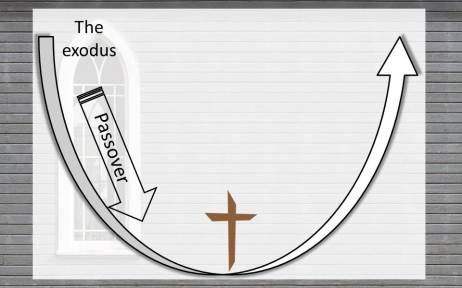
But notice something about our diagram.  The baptism of children is motivated by looking backward toward the past (symbolized by the backward arrow).  To baptize a baby is to perform a ritual based on either the faith of the family or the tradition of the Church.  To baptize an adult, however, is to look at the way the believer seeks to “play make-believe”—that is, to express what their faith looks like as they begin their journey with Christ.

BAPTISM: DEFINED

We might therefore define baptism as an outward sign of personal faith.  This seems to be the basic meaning Paul speaks of in Romans 6:

Do you not know that all of us who have been baptized into Christ Jesus were baptized into his death? We were buried therefore with him by baptism into death, in order that, just as Christ was raised from the dead by the glory of the Father, we too might walk in newness of life. For if we have been united with him in a death like his, we shall certainly be united with him in a resurrection like his.  (Romans 6:3-5)

Granted, burial practices weren’t the same in Paul’s day as they are in ours, so we probably shouldn’t stress the external symbolism too heavily.  But the early church would very likely have understood the general idea of descent and ascent—burial and resurrection—that symbolizes the way that we die to ourselves and are raised to new life in Christ.

Baptism therefore symbolizes our own response to the gospel message:

  • Baptism symbolizes our own repentance and choice to commit to following Jesus
  • Baptism identifies us with Christ
  • Baptism identifies us with Christ’s Church

UNDERSTANDING THE SYMBOL

The “classic” illustration of this is, of course, the wedding ring.  If you wear a wedding ring, what does that mean to you?  If you are married, does taking off your wedding ring alter your relationship with your husband or wife? (actually, if you do this on a business trip, it very well might…)  Likewise, if you give your wedding ring to someone else, does it mean you’re now married to them?

The illustration is clear enough: a wedding ring is a powerful and important symbol of a new relationship and a new way of life.  But, in the end, it is only a symbol.

Our obedience to Christ’s clear command to be baptized should therefore not be construed as a requirement of salvation.  But we must likewise not neglect the history and significance to this symbolic exchange.

WHO SHOULD BE BAPTIZED?

Part of the reason I wanted to offer a cursory survey of the historical views of baptism is because I suspect that some of you have already been baptized in other Church traditions.  Does this mean you should be baptized again?

Here’s what I would tell you.  If you were baptized as an infant, then you have been (or rather, your family had been) perfectly obedient to your Church tradition.  But I cannot agree with your Church tradition.  If you are unpersuaded by our presentation of believer’s baptism, then I obviously can’t ask for a re-baptism.  But if you are newly convinced that baptism is for believers, then by all means, we would welcome you to express your faith through public baptism.


The history and development of baptism

Where did baptism come from?  Who was the first to practice it?  The answer to this question is a bit elusive.  It’s likely that many ancient religions practiced something like baptism, though it wouldn’t be until the days of the early church that we see the word “baptism” emerge as a uniquely Christian practice.  So what are its origins?  How did it develop?

BAPTISM IN THE OLD TESTAMENT

While other ancient cultures had their own ceremonial rites, Israel’s worship was unique in every way.  You might already remember that Israel’s religion was expressed in a series of laws governing the categories of “clean” and “unclean,” symbolically reflecting the purity of God’s character.  Something of this might be in view when Ezekiel describes the formation of God’s relationship with Israel:

8 “When I passed by you again and saw you, behold, you were at the age for love, and I spread the corner of my garment over you and covered your nakedness; I made my vow to you and entered into a covenant with you, declares the Lord God, and you became mine. 9 Then I bathed you with water and washed off your blood from you and anointed you with oil. (Ezekiel 16:8-9)

Some point to various sorts of “precursors” to baptism in the Old Testament—even the apostle Peter would draw some loose connection between baptism and Noah’s flood.  In another setting, Elisha instructs a leper to wash himself by dipping his body into the Jordan river seven times—purifying him of this disease (2 Kings 5:1-14).  So we might find some “hints” of what baptism might look like in the future.

But the clearest examples of regular purification rituals comes from the system of Levite priests.  The book of Leviticus even specifies purification routines centered around the great “Day of Atonement:”

He shall put on the holy linen coat and shall have the linen undergarment on his body, and he shall tie the linen sash around his waist, and wear the linen turban; these are the holy garments. He shall bathe his body in water and then put them on. (Leviticus 16:4)

23 “Then Aaron shall come into the tent of meeting and shall take off the linen garments that he put on when he went into the Holy Place and shall leave them there. 24 And he shall bathe his body in water in a holy place and put on his garments and come out and offer his burnt offering and the burnt offering of the people and make atonement for himself and for the people. (Leviticus 16:23-24)

Priests were often “sequestered” for a week prior to this event in order to minimize the risk of any sort of contamination.

JOHN THE BAPTIST

Jesus was famously baptized by his cousin, John the Baptist:

13 Then Jesus came from Galilee to the Jordan to John, to be baptized by him. 14 John would have prevented him, saying, “I need to be baptized by you, and do you come to me?” 15 But Jesus answered him, “Let it be so now, for thus it is fitting for us to fulfill all righteousness.” Then he consented. 16 And when Jesus was baptized, immediately he went up from the water, and behold, the heavens were opened to him, and he saw the Spirit of God descending like a dove and coming to rest on him;17 and behold, a voice from heaven said, “This is my beloved Son, with whom I am well pleased.” (Matthew 3:13-17)

What’s going on here?  John the Baptist was a born a preacher’s kid, but it’s speculated that when his father passed away John would end up spending his time with a group of desert people called the “Essenes.”  These folks were the hippies of the ancient world, dwelling in caves in the wilderness as a form of separation from the Roman establishment.  Yet when John returns from the wilderness, he doesn’t seem to have adopted their practices as much as reinvented them.  So John is introducing a new form of baptism, which in some way involves a new form of repentance.  Given John’s role as the “forerunner” for Jesus, it’s as if his baptism is a way of saying, “Come and be baptized as we enter into the age of the Messiah.”  So it seems as if John’s baptism had a lot more to do with identification with Jesus’ initial movement.  And we should notice that John would say that his baptism was very different from the actual ministry of Jesus, saying:

11 “I baptize you with water for repentance, but he who is coming after me is mightier than I, whose sandals I am not worthy to carry. He will baptize you with the Holy Spirit and fire. (Matthew 3:11)

John seems to have envisioned Jesus as having a unique ministry in the future, and it’s this ministry that helps us clarify baptism today.

IN THE AGE OF THE CHURCH

After the resurrection, Jesus gathered his closest followers to issue the “marching orders” of the Church.  The purpose of all God’s people is worship, but the Church is now commanded to gather others together that we might all worship God in spirit and in truth.  So when Jesus tells his followers to share the good news, he includes instructions to perform baptisms:

19 Go therefore and make disciples of all nations, baptizing them in the name of the Father and of the Son and of the Holy Spirit, 20 teaching them to observe all that I have commanded you. And behold, I am with you always, to the end of the age.” (Matthew 28:19-20)

Baptism is not optional.  This practice is commanded by Jesus himself.  In the pages of the book of Acts, we find Jesus’ followers obeying this command.  We can draw three conclusions based on their practice:

  • Baptism symbolizes salvation

Whenever we see baptism performed, we see it performed as a symbol of a declaration of faith.  To be clear, baptism is never described apart from a personal, faith commitment.  Salvation therefore doesn’t come from baptism, but baptism is a sign of obedience.  But what we also see in the New Testament is that baptism immediately followed conversion.  For example, in Acts 2 Peter’s sermon brought thousands to Christ:

41 So those who received his word were baptized, and there were added that day about three thousand souls. (Acts 2:41)

Some English translations say “those who believed.”  Baptism comes only after a faith commitment.  Likewise, in Philip’s ministry:

12 But when they believed Philip as he preached good news about the kingdom of God and the name of Jesus Christ, they were baptized, both men and women.  (Acts 8:12)

Again, baptism comes only after a faith commitment.  And in the most famous of Philip’s stories, he shares the good news with a spiritual outsider.  A high-ranking eunuch is riding a chariot and reading a portion of the Bible.  Now, in those days people would often read out loud, so Philip—having been guided by the Lord—overheard him.  After a brief conversation, it became clear that the eunuch was spiritually curious, but didn’t understand that the scriptures he was reading were about Jesus:

35 Then Philip opened his mouth, and beginning with this Scripture he told him the good news about Jesus. 36 And as they were going along the road they came to some water, and the eunuch said, “See, here is water! What prevents me from being baptized?”  38 And he commanded the chariot to stop, and they both went down into the water, Philip and the eunuch, and he baptized him.  (Acts 8:35-36, 38)

Once more, it’s hard to imagine this scene as anything other than a public profession of personal faith.  And apparently the early church agreed, because some later manuscripts would include the addition: “And Philip said, “If you believe with all your heart, you may.” And he answered and said, “I believe that Jesus Christ is the Son of God” (included in some Bibles as Acts 8:37).  Granted, this verses is an addition, and not original to the Bible, but it shows that many in the early church did agree that baptism was merely an outward symbol.

  • Baptism is therefore reserved for believers

This conclusion follows from the previous principle.  If baptism symbolizes salvation, then of course the only ones being baptized would be believers.

But this wouldn’t necessarily only be adult believers.  While we can find no explicit reference to a child being baptized, we do find the Bible describing baptism applied to whole households:

30 Then he brought them out and said, “Sirs, what must I do to be saved?” 31 And they said, “Believe in the Lord Jesus, and you will be saved, you and your household.” 32 And they spoke the word of the Lord to him and to all who were in his house. 33 And he took them the same hour of the night and washed their wounds; and he was baptized at once, he and all his family. 34 Then he brought them up into his house and set food before them. And he rejoiced along with his entire household that he had believed in God. (Acts 16:30-34)

Admittedly this seems confusing to us since we see faith as something so deeply personal.  What should probably see here is that the entire household placed their faith in Jesus, and the whole household was baptized as a way of expressing that.  This, I think, helps us make sense of this passage in light of the others.  What I don’t think we should see, however, is evidence suggesting infant baptism.  So while children may believe in the gospel, baptism might not be for the very young.  The normative expression in the New Testament seems to be the baptism of believers.

  • Baptism is usually performed by immersion

Even the Greek verb baptizo means “to immerse” or “to submerge” or even “to drown.”  In the New Testament baptism was performed by being placed under the water.  It wasn’t until later when the early church put together a collection of documents known as the Didache, or the “Teaching(s).”  This resource clarified that if water was scarce, it was acceptable to pour water on the convert’s head and this would be sufficient for baptism.  Again, baptism usually came so quickly after conversion that they just wouldn’t wait until they found a body of water.

I know many conservative folks who would object to this, since baptism is meant to be immersion.  I don’t know that I’d join them in their objection.  If baptism is a symbol, then I’d say that while immersion would be the ideal, if someone came up on Sunday morning and wanted to be baptized right there on the spot, that a Styrofoam cup full of water would be insufficient to make that happen.  It sounds silly, but the public declaration is what matters more than the ritual itself.

But this also highlights the deeper meaning behind baptism, which we will return to tomorrow.  For now, I’d simply challenge those of you who claim to follow Christ yet haven’t been baptized to think about what it is you’re waiting for.  This isn’t a salvation issue, but it is a matter of obedience.  If you want to sign up for baptism, contact myself or one of us on the Church staff, and we’d love to be a part of that declaration of faith.

Why ritual: Learning to play make-believe

So I’ve noticed something recently.  More than in the past, weddings have become occasions for the bride and groom to inject their own distinct personalities into the wedding ceremony—and I mean that in the very best way possible.  Couples will often put extra thought and care into making the ceremony mirror the uniqueness of their relationship, even while retaining the more “traditional” elements we’re all used to seeing.

In fact, of the handful of weddings that I’ve performed in the past five years or so, nearly every couple included some additional “ritual” in the midst of the proceedings.  So while they’ve exchanged rings and said their vows, they’ve also done something else, something creative, as a way of illustrating what their marriage will be like in the future.  So, for instance, some couples do a “cord of three strands,” in which they braid three cords together to symbolize the way that husband, wife, and Jesus are now being woven into a unified, God-honoring relationship.  As another example, a couple poured two vials of colored sand together into a common vase—illustrating the way that two halves have now combined to form a whole.

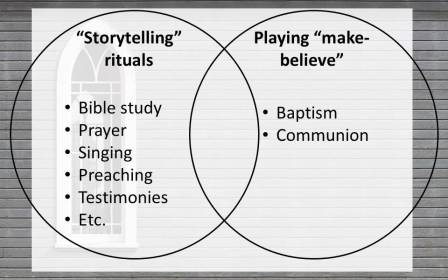
Weddings are already laden with symbols and rituals.  Believe it or not, there’s actually a whole field of study devoted to symbols (it’s called “semiotics” if you want to sound smart at parties).  Experts in this field tell us that there are two broad categories of symbols: summarizing symbols and elaborating symbols—though for clarity it might be helpful for us to think about these things a different way.  There are some symbols and rituals that tell a story.  At a wedding, the exchange of rings is a storytelling ritual, because the ring testifies to the story of marriage.  But what about the “cord of three strands” or the sand art?  These are symbols that help us “play make believe.”  When a couple weaves together those cords, they’re playing make believe—the ritual serving to help them understand what marriage will look like in the future.

And that’s beautiful.

CLASH OF SYMBOLS

Christianity is full of symbols and rituals.  If that sounds like a weird way to describe your faith, just visit another church some Sunday.  You may very well find that this other congregation is used to a slightly different set of rituals and a different set of symbols.  I can remember a story a friend told me of a Church that every Sunday would turn around, face the rear of the sanctuary, and then recite one of the Church’s creeds (a “creed” is an official statement of faith).  Why face backwards? he wondered, but when he asked no one seemed to know.  He would later learn that when the church had first started, they placed the text of the creed on the wall at the rear of the sanctuary; the congregation would turn and face rear so they could read the words.  When enough people had it memorized, they took the words down.  But people kept standing up and facing backwards, and soon the ritual stuck.  And that’s…well, that’s kinda weird, honestly.

Rituals are something of a subset of worship.  Emile Durkheim—the father of what we know as “sociology”—famously defined religion as “the effervescence of the collective.”  It’s a fun phrase, really; it refers to the behavior that happens when people gather in groups.  So if you’re at a baseball game, and the crowd next to you starts “the wave,” you better keep it going, right?  Or think of the music they play to get the crowd to yell out “Charge!”  These are all rituals—we might even do them without even thinking.

Why RitualThe Church practices a variety of rituals like this—and, maybe we even do these without thinking (!).  Some of our rituals are storytelling rituals—they’re like the rings at a wedding ceremony.  We gather, we sing, we read Scripture together, we pray.  These are vital to the life of the body of Christ, and vital to our own personal walk with Jesus.

But there are other rituals that help the Church “play make believe.”  There are two rituals in particular that the Church regularly practices:

  • Baptism

First, baptism is woven into Jesus’ final commands to his followers after his resurrection:

19 Go therefore and make disciples of all nations, baptizing them in the name of the Father and of the Son and of the Holy Spirit, 20 teaching them to observe all that I have commanded you. And behold, I am with you always, to the end of the age.” (Matthew 28:19-20)

Baptism is something the Church is meant to practice.

  • Communion

Second, on the night before his death, Jesus commanded his followers to celebrate the Lord’s Table or Communion:

19 And he took bread, and when he had given thanks, he broke it and gave it to them, saying, “This is my body, which is given for you. Do this in remembrance of me.”  (Luke 22:19)

As we’ll see in the days ahead, both of these practices are ways that the Church “plays make-believe.”  I don’t use that phrase casually or flippantly—as we observed earlier, “playing” and the imagination is where a great deal of learning and growth takes place.  I’m actually borrowing the idea from a spiritual writer who targets the Lord’s Table in particular as a place of make-believe:

“You make believe that the one who breaks the bread and blesses the wine is not the plump parson who smells of Williams’ Aqua Velva but Jesus of Nazareth.  You make believe that the tasteless wafer and cheap port are his flesh and blood.  You make believe that by swallowing them you are swallowing his life into your life and that there is nothing in earth or heaven more important for you to do than this.”[1]

We might likewise think of baptism as making believe that we, too, are dying and being raised with Christ (cf. Romans 6:3-4).

WHY RITUAL?

Rituals—all rituals, from the sports stadium to the shopping mall—tell us something of who we are, where we’ve been, where we’re going.  Rituals are part of our identity as a church just as much as the “cord of three strands” is part of an identity as a couple.

Rituals are what help us enter into God’s story, a way of seeing our lives intersect with his.  It’s not for nothing that the Lord’s Table is little more than a shared meal, a chance to regularly remember and re-enact Christ’s sacrifice.

Baptism and communion therefore represent the core features of what makes a Christian Church.  A Church can be more than these two rituals, of course, but a Church that does not perform them cannot be said to be a Church in the New Testament sense.

In the days ahead, let’s spend some time unpacking these two practices, and come to a better understanding of what they mean for us.

[1] Frederich Buechner, Wishful Thinking: A Seeker’s ABC, p. 63.